Cinarizine "oz"
Ukraine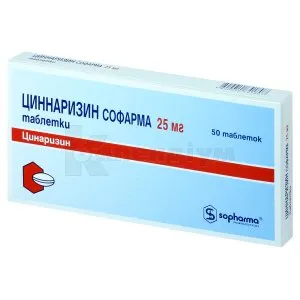
Table of Contents
INSTRUCTIONS for medical use of the medicinal product CINNARIZINE "OZ" (CINNARIZINE "OZ")
Composition:
Active substance: cinnarizine;
1 tablet contains 25 mg of cinnarizine;
Excipients: lactose monohydrate, corn starch, povidone, colloidal anhydrous silicon dioxide, magnesium stearate.
Pharmaceutical form. Tablets.
Main physicochemical properties: white or almost white tablets.
Pharmacotherapeutic group. Agents used in vestibular disorders. ATC code N07CA02.
Pharmacological Properties.
Pharmacodynamics.
Cinnarizine inhibits the contraction of vascular smooth muscle cells by blocking calcium channels. In addition to direct calcium antagonism, cinnarizine reduces the contractile effect of vasoactive substances such as norepinephrine and serotonin by blocking receptor-operated calcium channels. The blockade of calcium influx into cells is tissue-selective and leads to a reduction in vasoconstriction without affecting arterial blood pressure and heart rate.
Cinnarizine may additionally improve impaired microcirculation by increasing erythrocyte membrane elasticity and reducing blood viscosity. With its use, cellular resistance to hypoxia is increased.
Cinnarizine suppresses stimulation of the vestibular system, thereby inhibiting nystagmus and other vegetative disturbances. Cinnarizine can prevent or alleviate acute attacks of vertigo.
Pharmacokinetics.
Absorption. Maximum plasma concentrations of cinnarizine are reached within 1–3 hours after oral administration.
Distribution. Plasma protein binding is 91%.
Metabolism. Cinnarizine is metabolized mainly via CYP2D6.
Elimination. The elimination half-life of cinnarizine from plasma ranges from 4 to 24 hours. One-third of these metabolites is excreted by the kidneys, and two-thirds through the intestine.
Clinical Characteristics.
Indications.
Cerebrovascular disorders:
- symptomatic treatment of cerebrovascular disorders, including dizziness, tinnitus, vascular headache, irritability, memory loss, and inability to concentrate;
- migraine prophylaxis.
Peripheral circulation disorders:
- symptomatic treatment of peripheral vascular disorders, including Raynaud's disease, acrocyanosis, intermittent claudication, trophic disorders, trophic and varicose ulcers, paresthesia, nocturnal leg cramps, cold extremities.
Balance disorders:
- symptomatic treatment of labyrinthine disorders, including dizziness, tinnitus, nystagmus, nausea, and vomiting.
Motion sickness:
- prevention of motion sickness.
Contraindications.
Hypersensitivity to the active substance or to any of the excipients of the medicinal product.
Interaction with other medicinal products and other forms of interaction.
Alcohol / central nervous system (CNS) depressants / tricyclic antidepressants: concomitant use may enhance the sedative effect of these agents or of cinnarizine.
Diagnostic procedures: due to its antihistaminic effect, cinnarizine may mask positive skin reactivity responses during skin testing; therefore, its use should be discontinued 4 days prior to the test.
Special precautions for use.
As with other antihistamines, cinnarizine may cause irritation in the epigastric region; taking the drug after food intake may help reduce gastric mucosal irritation.
Cinnarizine should be prescribed to patients with Parkinson's disease only if the benefits of treatment outweigh the potential risk of worsening the course of the disease.
Since cinnarizine may cause drowsiness, especially at the beginning of treatment, concomitant use of alcohol, CNS depressants, or tricyclic antidepressants should be avoided.
Cinnarizine should not be used in patients with porphyria.
Cinnarizine should be used with caution in patients with hepatic and/or renal insufficiency.
The medicinal product contains lactose. If the patient has known intolerance to certain sugars, medical advice should be sought before taking this medicinal product.
Use during pregnancy or breastfeeding.
Although animal studies have not revealed teratogenic effects of cinnarizine, the drug is not recommended for use during pregnancy.
There is no information available on the ability of cinnarizine to pass into breast milk. Therefore, cinnarizine treatment should be avoided in women who are breastfeeding.
Ability to affect reaction speed when driving or operating machinery.
Since the use of the drug, particularly at the beginning of treatment, may cause drowsiness, patients should refrain from driving or operating machinery during treatment.
Method of Administration and Dosage
Cerebral Circulatory Disorders
Adults and children aged 12 years and older: 1 tablet 3 times daily.
Peripheral Circulatory Disorders
Adults and children aged 12 years and older: 2–3 tablets 3 times daily. The recommended maximum dose should not exceed 225 mg (9 tablets) per day. Since the effect in vertigo is dose-dependent, dosage should be gradually increased.
Balance Disorders
Adults and children aged 12 years and older: 1 tablet 3 times daily.
Motion Sickness
- Adults and children aged 12 years and older: 1 tablet half an hour before travel; the dose may be repeated every 6 hours;
- Children aged 5–12 years: half the adult dose may be recommended.
Method of Administration
For oral use. It is advisable to take cinnarizine after meals.
Children. The medicinal product should not be used in children under 5 years of age.
Overdose.
Symptoms: in isolated cases of acute overdose (90 to 2250 mg), the following manifestations have been observed: altered consciousness ranging from drowsiness to stupor and coma, vomiting, extrapyramidal symptoms, and arterial hypotension. Seizures have been observed in a small number of children. In most cases, the clinical outcome was not severe, but fatal cases have been reported following overdose, particularly when used concomitantly with other medicinal products, including cinnarizine.
Treatment: there is no specific antidote. Gastric lavage should be performed within the first hour after ingestion. Activated charcoal may be administered if indicated.
Adverse Reactions
Somnolence and gastrointestinal disturbances may occur. These symptoms are usually temporary and resolve with gradual attainment of the optimal dose. Rarely, symptoms such as headache, dry mouth, weight gain, sweating, or allergic reactions may develop. In very rare cases, Wilson's disease and lupus-like symptoms have been reported.
A single case of obstructive jaundice has been described in the medical literature. In elderly patients undergoing long-term treatment, cases of exacerbation or emergence of extrapyramidal symptoms have been observed, sometimes in combination with depressive states. In such cases, the use of this agent should be discontinued.
The adverse reactions listed below were observed during clinical trials and in the post-marketing period with cinnarizine use.
Frequency is defined as follows: very common (≥ 1/10); common (≥ 1/100 to < 1/10); uncommon (≥ 1/1000 to < 1/100); rare (≥ 1/10,000 to < 1/1000); very rare (< 1/10,000); frequency not known (cannot be estimated from available data).
Nervous system disorders:
Common: somnolence;
Uncommon: hypersomnia, lethargy;
Frequency not known: extrapyramidal disorders, dyskinesia, parkinsonism, tremor.
Gastrointestinal disorders:
Common: nausea, dyspepsia;
Uncommon: stomach discomfort, vomiting, upper abdominal pain.
Hepatobiliary disorders:
Frequency not known: cholestatic jaundice.
Skin and subcutaneous tissue disorders:
Uncommon: hyperhidrosis, lichenoid keratosis, including erythematous lichen planus;
Frequency not known: subacute cutaneous lupus erythematosus.
Musculoskeletal and connective tissue disorders:
Frequency not known: muscle rigidity.
General disorders:
Uncommon: fatigue.
Laboratory findings:
Common: weight gain.
Additionally, cases of hypersensitivity reactions, headache, and dry mouth have been reported.
Shelf life. 4 years.
Storage conditions. Store in a light-protected place at a temperature not exceeding 25 °C.
Keep out of reach of children.
Packaging. Tablets, 50 pieces in a blister; 50 pieces, 10×5 in blisters in a carton.
Prescription category. Prescription only.
Manufacturer.
Limited Liability Company "Experimental Plant 'GNCLS'".
Limited Liability Company "FARMEKS GROUP".
LIMITED LIABILITY COMPANY "CORPORATION 'ZDOROV'YA".
Manufacturer's address and place of business.
Ukraine, 61057, Kharkiv region, Kharkiv, Vorobiova St., 8.
(Limited Liability Company "Experimental Plant 'GNCLS'")
Ukraine, 08301, Kyiv region, Boryspil, Shevchenka St., 100.
(Limited Liability Company "FARMEKS GROUP")
Ukraine, 61013, Kharkiv region, Kharkiv, Shevchenka St., 22.
(LIMITED LIABILITY COMPANY "CORPORATION 'ZDOROV'YA")