Cefinak®
Ukraine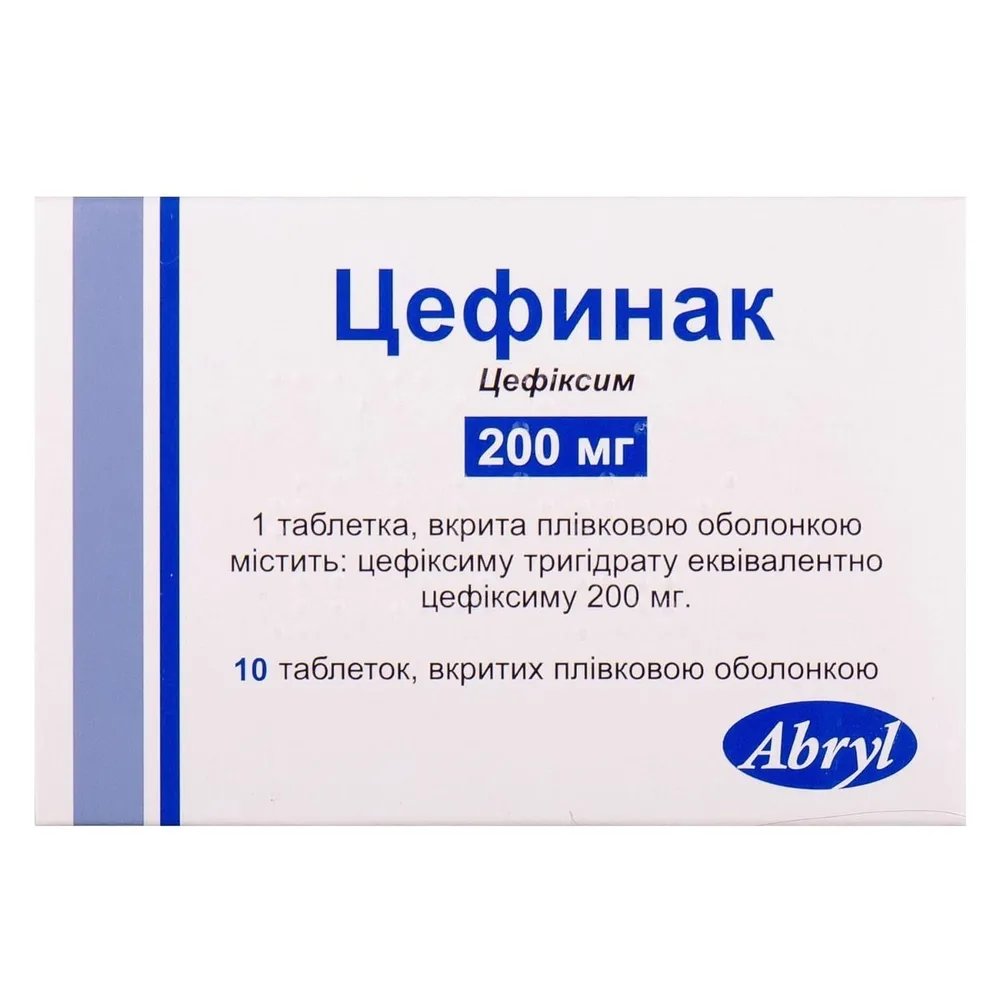
Table of Contents
INSTRUCTIONS FOR MEDICAL USE OF THE MEDICINAL PRODUCT CEFINAK® (CEFINAK®)
Composition:
Active substance: cefixime;
One film-coated tablet contains cefixime trihydrate equivalent to cefixime 200 mg or 400 mg;
Excipients: microcrystalline cellulose (PH 102), calcium hydrogen phosphate dihydrate, pregelatinized starch, magnesium stearate; film coating Opadry White 03G58632: hypromellose, titanium dioxide (E 171), polyethylene glycol 3350, triacetin.
Pharmaceutical form. Film-coated tablets.
Main physicochemical properties:
200 mg tablets: round, biconvex, film-coated tablets of white to almost white color, with imprint “A 11” on one side and smooth on the other;
400 mg tablets: elongated, film-coated tablets of white to almost white color, with a break line on both sides, imprint “A” and “10” on one side and smooth on the other.
Pharmacotherapeutic group.
Antibacterials for systemic use. Other β-lactam antibiotics. Third-generation cephalosporins. ATC code J01D D08.
Pharmacological Properties
Pharmacodynamics
Cefixime is an oral third-generation cephalosporin antibiotic. In vitro, it demonstrates potent bactericidal activity against a broad spectrum of gram-positive and gram-negative microorganisms.
It is clinically effective in the treatment of infections caused by the most common pathogenic microorganisms, including Streptococcus pneumoniae, Streptococcus pyogenes, Escherichia coli, Proteus mirabilis, Klebsiella species, Haemophilus influenzae (both beta-lactamase-positive and -negative strains), Moraxella (Branhamella) catarrhalis (both beta-lactamase-positive and -negative strains), and Enterobacter species. It exhibits high stability in the presence of beta-lactamases.
Most strains of enterococci (Streptococcus faecalis, group D Streptococci) and Staphylococci (including coagulase-positive, coagulase-negative, and methicillin-resistant strains) are resistant to cefixime. In addition, most strains of Pseudomonas, Bacteroides fragilis, Listeria monocytogenes, and Clostridia are also resistant to cefixime.
Pharmacokinetics
Absolute bioavailability after oral administration of cefixime ranges from 22% to 54%. Since the presence of food does not significantly affect absorption, cefixime can be administered regardless of food intake.
According to in vitro studies, serum or urine concentrations of 1 µg/mL or higher are considered adequate for most common pathogens against which cefixime is active. The peak serum concentration after administration of recommended doses in adults or children ranges from 1.5 to 3 µg/mL. With repeated dosing, there is minimal or practically no accumulation of cefixime.
The pharmacokinetics of cefixime were compared in healthy elderly patients (aged >64 years) and young volunteers (aged 11–35 years) after administration of 400 mg of cefixime once daily for 5 days. Mean values of maximum concentration (Cmax) and area under the plasma concentration-time curve (AUC) were slightly higher in elderly patients. However, elderly patients can be administered the same dosage as adults.
Cefixime is excreted predominantly unchanged in urine. The primary mechanism is glomerular filtration. Metabolites of cefixime have not been identified in human serum or urine.
Protein binding is well characterized in human and animal serum. Cefixime is almost entirely bound to the albumin fraction, with a mean free fraction of approximately 30%. Binding of cefixime to proteins depends only on serum concentration at very high concentrations not achieved with clinical dosing.
Transfer of 14C-labeled cefixime from lactating rats to their offspring via breast milk was quantitatively low (approximately 1.5% of the maternal cefixime content transferred to offspring). There are no data on the excretion of cefixime into human breast milk. Placental transfer of radiolabeled cefixime was minimal in pregnant rats receiving the drug.
Clinical characteristics.
Indications.
Infectious and inflammatory diseases caused by microorganisms sensitive to the drug:
- infections of the upper respiratory tract (including acute otitis media, sinusitis, pharyngitis, tonsillitis of bacterial etiology), when resistance of the causative agent to other commonly used antibiotics is known or suspected, or when there is a risk of their ineffective use;
- infections of the lower respiratory tract (including bronchitis);
- urinary tract infections (including cystitis, cystourethritis, uncomplicated pyelonephritis).
Contraindications.
Hypersensitivity to cefixime or to any other components of the drug, other cephalosporins, or penicillins (see section "Special precautions"). Porphyria.
Interaction with other medicinal products and other forms of interaction.
Anticoagulants
As with other cephalosporins, prolonged prothrombin time has been reported in some patients; therefore, caution should be exercised in patients receiving anticoagulant therapy.
Cefixime should be used with caution in patients receiving anticoagulants such as coumarins, e.g. warfarin potassium. Since cefixime may potentiate the effect of anticoagulants, prolongation of prothrombin time with or without clinical signs of bleeding may occur.
Other types of interactions
During treatment with cefixime, false-positive glucose in urine tests may occur when using copper sulfate tablets, Benedict's or Fehling's solutions. For determination of glucose in urine, a glucose oxidase test is recommended.
Cephalosporin antibiotics may cause false-positive results in the direct Coombs test. Therefore, it should be borne in mind that a positive Coombs test result may be due to the use of this medicinal product.
Special precautions for use.
Encephalopathy
Beta-lactams, including cefixime, may increase the risk of encephalopathy (which may include convulsions, confusion, altered consciousness, and motor disturbances) in patients, particularly in cases of overdose and renal impairment.
Severe skin reactions
Severe cutaneous adverse reactions such as toxic epidermal necrolysis, Stevens-Johnson syndrome, drug rash with eosinophilia and systemic symptoms (DRESS syndrome), and acute generalized exanthematous pustulosis (AGEP) have been reported in some patients receiving cefixime. Patients should be informed about the signs and symptoms of serious skin manifestations and should be closely monitored. Treatment should be discontinued at the first appearance of skin rash, mucosal lesions, or any other signs of skin hypersensitivity.
The drug should be administered with caution to patients with hypersensitivity to other drugs.
Hypersensitivity to penicillins
As with other cephalosporins, cefixime should be used with caution in patients with a history of penicillin hypersensitivity, as there is some evidence of partial cross-allergenicity between penicillins and cephalosporins.
Severe reactions (including anaphylaxis) have been observed with both classes of drugs. If an allergic reaction occurs, the drug should be discontinued immediately and appropriate therapy initiated.
Hemolytic anemia
Cases of hemolytic anemia, including severe cases with fatal outcomes, have been reported following the use of cephalosporins. Hemolytic anemia has also been reported after re-administration of cephalosporins, including cefixime.
Acute renal failure
As with other cephalosporins, cefixime may lead to acute renal failure, with tubulointerstitial nephritis being the main underlying pathological condition. If acute renal failure occurs, cefixime should be discontinued and appropriate therapy and/or interventions initiated.
Renal impairment
Cefixime should be used with caution in patients with significant renal function impairment (see section "Dosage and administration").
Pediatric use
The safety of cefixime in premature infants or neonates has not been established (see section "Special precautions for use").
Antibiotic-associated colitis
Prolonged use of antibacterial agents may disrupt the normal intestinal flora, potentially leading to overgrowth of Clostridium difficile. Studies indicate that the toxin produced by Clostridium difficile is the primary cause of antibiotic-associated diarrhea. Pseudomembranous colitis has been associated with the use of broad-spectrum antibiotics (including macrolides, semisynthetic penicillins, lincosamides, and cephalosporins); therefore, this diagnosis should be considered in patients who develop diarrhea during or after antibiotic therapy.
Symptoms of pseudomembranous colitis may occur during or after discontinuation of antibiotic treatment.
Treatment of pseudomembranous colitis should include sigmoidoscopy, appropriate bacteriological testing, and administration of fluids, electrolytes, and protein solutions. If colitis symptoms do not improve after discontinuation of the drug, oral vancomycin should be administered, as it is the antibiotic of choice for pseudomembranous colitis caused by C. difficile. Other causes of colitis should be ruled out.
Use during pregnancy or breastfeeding.
Reproductive function studies in animals administered doses nearly 400 times higher than the human dose showed no effect on fertility or fetal abnormalities attributable to cefixime. In animal studies at doses up to 4 times the human dose, there was no evidence of teratogenic effects; however, a high incidence of abortions and maternal mortality was observed, which is an expected consequence of the known sensitivity of animals to antibiotic-induced alterations in intestinal flora.
There are no data on the use of cefixime during pregnancy. Cefixime crosses the placenta.
The drug should not be used during pregnancy or breastfeeding except when clearly needed and prescribed by a physician.
Ability to affect reaction speed when driving or operating machinery.
If adverse reactions such as encephalopathy (which may include seizures, confusion, altered consciousness, and motor disturbances) occur, patients should avoid driving or operating machinery.
Administration and Dosage
Food intake does not affect cefixime absorption. The usual duration of treatment is 7 days; if necessary, up to 14 days. For treatment of uncomplicated cystitis, the treatment course is 3 days.
Adults. The recommended dose for adults is 200–400 mg per day, depending on the severity of infection, administered as a single dose or divided into two separate doses.
Elderly patients. Administer the drug at the recommended adult dose. Renal function should be monitored and dosage adjusted in cases of severe renal impairment.
Children with body weight over 50 kg or aged 10 years and older. Treatment should be conducted according to the recommended adult dose (200–400 mg per day depending on the severity of infection).
The safety and efficacy of cefixime have not been established in children under 6 months of age.
Dosing in renal impairment. Cefixime can be used in patients with impaired renal function. For patients with creatinine clearance of 20 mL/min or higher, the standard dose and dosing regimen should be used. For patients with creatinine clearance below 20 mL/min, the dose should not exceed 200 mg once daily. This also applies to patients undergoing continuous ambulatory peritoneal dialysis or hemodialysis.
Children.
For children under 10 years of age, it is recommended to use the drug in another pharmaceutical form.
Overdose.
There is a risk of developing encephalopathy when using beta-lactam antibiotics, including cefixime, especially in cases of overdose or impaired renal function. Study data have shown that at doses up to 2 g per day, cefixime has a safety profile similar to that of recommended therapeutic doses.
Dialysis contributes only minimally to cefixime elimination from the body. There is no specific antidote. General supportive therapy is recommended.
Adverse Reactions
Adverse reactions caused by cefixime are generally mild and occur infrequently.
Blood and lymphatic system disorders: Eosinophilia, hyper-eosinophilia, agranulocytosis, leukopenia, neutropenia, granulocytopenia, hemolytic anemia, thrombocytopenia, thrombocytosis.
Gastrointestinal disorders: Abdominal pain, diarrhea*, dyspepsia, nausea, vomiting, flatulence.
Hepatic disorders: Jaundice.
Infections and infestations: Pseudomembranous colitis, vaginitis.
Laboratory findings: Increased levels of transaminases (AST, ALT), bilirubin, urea, and creatinine in blood serum.
Nervous system disorders: Headache, dizziness. Seizures have been reported with the use of cephalosporins, including cefixime (frequency unknown).
Beta-lactams, including cefixime, may increase the risk of encephalopathy (which may include seizures, confusion, altered consciousness, and movement disorders) in patients, particularly in cases of overdose and renal impairment (frequency unknown)**.
Respiratory system disorders: Dyspnea.
Renal and urinary system disorders: Acute renal failure, including tubulointerstitial nephritis (see section "Special precautions for use").
Immune system disorders: Anaphylactic reactions, angioneurotic edema, serum sickness-like reactions.
Skin and subcutaneous tissue disorders: Drug rash with eosinophilia and systemic symptoms (DRESS syndrome), erythema multiforme, Stevens-Johnson syndrome, toxic epidermal necrolysis, urticaria, skin rashes, pruritus, acute generalized exanthematous pustulosis (AGEP) (see section "Special precautions for use").
General disorders: Fever, arthralgia, facial swelling, genital pruritus.
*Diarrhea is usually associated with higher doses of the drug. Cases of diarrhea (from moderate to severe) have been reported, for which discontinuation of therapy may be warranted. If severe diarrhea occurs, cefixime should be discontinued.
**Cannot be estimated from available data.
Reporting suspected adverse reactions after drug authorization is of great importance. It allows continuous monitoring of the benefit-risk balance of the medicinal product. Healthcare and pharmaceutical professionals, as well as patients or their legal representatives, should report all suspected adverse reactions and lack of efficacy via the Automated Pharmacovigilance Information System at: https://aisf.dec.gov.ua.
Shelf life. 3 years.
Storage conditions.
Store at temperatures not exceeding 30°C in the original packaging.
Keep out of reach of children.
Packaging.
10 tablets in a blister; 1 blister in a cardboard box.
Prescription category. Prescription only.
Manufacturer.
Nectar Lifesciences Limited - Unit VI.
Manufacturer's address and location of its business operations.
Village Bhatolikalan, near Jharmajri, E.P.I.P., P.O. Barotiwala, Tehsil Baddi, District Solan, Himachal Pradesh, 174103, India.