Tropicamide-pharmak
Ukraine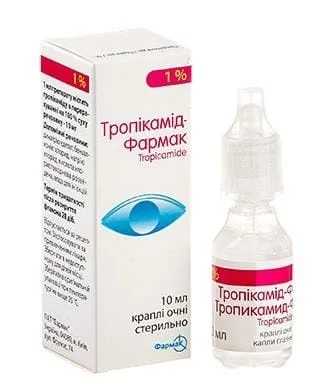
Table of Contents
INSTRUCTIONS for medical use of the medicinal product Tropicamid-FARMAK (Tropicamide-FARMAK)
Composition:
Active substance: tropicamide;
Eye drops 1 %: 1 ml of the preparation contains 10 mg of tropicamide calculated as 100 % dry substance;
Eye drops 0.5 %: 1 ml of the preparation contains 5 mg of tropicamide calculated as 100 % dry substance;
Excipients: disodium edetate, benzalkonium chloride, sodium chloride, diluted hydrochloric acid, water for injections.
Pharmaceutical form. Eye drops.
Main physicochemical properties: clear, colorless liquid.
Pharmacotherapeutic group. Agents used in ophthalmology. Anticholinergic agents. ATC code S01F A06.
Pharmacological properties.
Pharmacodynamics.
An anticholinergic agent that blocks M-cholinoreceptors of the iris sphincter and ciliary muscle, causing mydriasis. Tropicamide acts similarly to atropine, but the cycloplegic and mydriatic effects occur more rapidly and are short-lived.
A 0.5% solution can be used to achieve mydriasis with minimal cycloplegia. Administration of a 1% solution also causes paralysis of accommodation.
Preclinical studies on pharmacological safety, repeat-dose toxicity, genotoxicity, carcinogenic potential, and reproductive toxicity revealed no risk to humans. Toxic effects were observed only at doses exceeding the maximum dose for humans, and their occurrence is unlikely during clinical use.
Pharmacokinetics.
Maximum effect occurs approximately 20 minutes after ocular instillation. Pupil size returns to normal within 6 hours.
After instillation into the eye, slight systemic absorption may occur, primarily via the nasolacrimal ducts.
Clinical characteristics.
Indications.
For achieving mydriasis and cycloplegia during ophthalmic examinations.
Contraindications.
- Hypersensitivity to the active substance or to any of the excipients.
- Closed-angle glaucoma or suspicion of closed-angle glaucoma.
Interaction with other medicinal products and other forms of interaction.
Interaction studies of Tropicamide-Pharmak with other medicinal products have not been conducted.
The effect of tropicamide may be enhanced when used concomitantly with other medicinal products having M-cholinolytic properties, such as amantadine, certain antihistamines, antipsychotics – phenothiazine derivatives, and tricyclic antidepressants.
Special precautions for use.
- For ophthalmic use only. Tropicamide-Pharmak is intended solely for local ocular application and must not be administered parenterally or orally.
- After instillation, it is recommended to apply digital pressure to the lacrimal sac area or gently close the eyelids. This may reduce systemic absorption of the drug during ophthalmic use and consequently decrease the risk of systemic adverse reactions.
- Tropicamide-Pharmak may cause an increase in intraocular pressure.
- The possibility of undiagnosed glaucoma should be considered in certain patients, such as elderly patients. Intraocular pressure and the depth of the anterior chamber angle should be assessed before initiating treatment.
- Psychotic reactions and behavioral disturbances induced by Tropicamide-Pharmak may occur in patients with increased sensitivity to anticholinergic agents (e.g., belladonna alkaloids).
- Tropicamide-Pharmak contains benzalkonium chloride, which may cause eye irritation and may also discolor soft contact lenses. Contact with soft contact lenses should be avoided.
Patients should be advised to remove contact lenses before instilling Tropicamide-Pharmak and to wait at least 15 minutes before reinserting contact lenses.
- Anticholinergic agents should generally be used with caution in patients with chronic prostatic hyperplasia. However, if the drug is used only once, as in the case of an occasional examination, the likelihood of complications is very low.
- Close monitoring is required in patients with arterial hypertension, hyperthyroidism, diabetes mellitus, or cardiovascular disorders after local application of tropicamide.
- Some patients may experience increased sensitivity to light when pupils are dilated; therefore, eyes should be protected from excessive light exposure.
- Use with caution in cases of ocular inflammation or conjunctival hyperemia, as these conditions significantly increase the rate of systemic absorption through the conjunctiva.
Use during pregnancy or breastfeeding.
Reproductive function
There is insufficient information regarding the effect of the drug on reproductive function in men or women, as well as possible teratogenic effects or other adverse effects on the fetus.
Pregnancy
The amount of data on the use of tropicamide in pregnant women is limited. The use of tropicamide during pregnancy is not recommended.
Breastfeeding
It is unknown whether tropicamide or its metabolites pass into breast milk.
The risk of the drug passing into the infant’s body via breast milk cannot be excluded. The use of the medicinal product during breastfeeding is possible only if, in the opinion of the physician, the expected benefit to the mother outweighs the potential risk to the infant.
Ability to affect reaction speed when driving or operating machinery.
The drug may cause drowsiness, blurred vision, and light sensitivity. Patients should be warned not to drive or engage in other potentially hazardous activities until vision clears. Tropicamide-Pharmak significantly impairs the ability to drive vehicles or operate machinery.
Method of Administration and Dosage
Before starting the procedure, hands should be thoroughly washed with soap. Ensure that the bottle and dropper are intact. Opening the bottle is performed by puncturing the top part of the neck through twisting the cap until it stops. During the procedure, do not touch the eye mucosa or other body parts with the dropper tip of the bottle, as this may lead to contamination of the medication. Soft contact lenses must be removed before using Tropicamide-Pharmak. They may be reinserted no sooner than 15 minutes after instillation of the medication.
The patient should tilt their head backward and gently pull down the lower eyelid with the index finger to form a pouch. With the other hand, hold the bottle with the dropper pointing downward as close to the eye as possible, without touching the mucous membrane. Looking upward, gently squeeze the bottle walls so that one drop falls into the pouch formed by the lower eyelid. Then release the lower eyelid and close the eye. For 2–3 minutes, keep the head slightly tilted downward, as if looking at the floor. Try not to blink or keep the eyes closed. Gently press with a finger at the location of the tear duct to reduce drug reabsorption. Remove excess liquid from the face with a tissue. Do not wipe or rinse the dropper tip of the bottle. Do not touch the rim of the bottle. After each use, close the bottle tightly. Wash hands to remove any residual medication.
Do not use the medication more than 28 days after the first opening of the bottle. Before use, check the expiration date of the medication.
As reported, tropicamide use for cycloplegia in children may be insufficient, possibly requiring a more potent cycloplegic agent such as atropine. Do not use concentrations greater than 0.5% in infants.
For examination of the lens and determination of refraction: instill 1–2 drops of the 1% solution twice, with a 5-minute interval. If prolongation of the mydriatic effect is needed, an additional drop may be instilled 20–30 minutes later.
Fundoscopy: instill 1–2 drops of the 0.5% solution 15–20 minutes before the examination.
When using multiple ophthalmic medications, administer them at 5-minute intervals. Ophthalmic ointments should be applied last.
Children. Do not use the 1% solution of tropicamide in infants.
Tropicamide may cause disorders of the central nervous system, which can be dangerous for children, especially infants.
Excessive use in children may cause symptoms of systemic intoxication. The medication should be used with extreme caution in infants, young children, premature infants, children with Down syndrome, spastic paralysis, or cerebral disorders.
Patients should be warned that this medication must not be ingested by children and should be advised to wash their own hands and the child’s hands after administration.
Overdose.
In case of local overdose, remove the excess medication from the eye by rinsing it with warm running water.
Systemic intoxication may occur after local administration, especially in children. Symptoms of systemic intoxication include facial flushing and dry skin (rashes may occur in children), blurred vision, rapid and irregular pulse, fever, abdominal distension in infants, seizures, psychiatric disturbances (hallucinations), and loss of neuromuscular coordination. In such cases, symptomatic and supportive treatment should be administered. It is necessary to keep the skin surface of infants and young children moist.
In case of accidental ingestion, induce vomiting or perform gastric lavage.
Side effects
The adverse reactions listed below have been identified as being associated with the use of tropicamide as a topical ophthalmic agent. Adverse reactions are classified by frequency as follows: very common (≥ 1/10), common (≥ 1/100 to < 1/10), uncommon (≥ 1/1,000 to < 1/100), rare (≥ 1/10,000 to < 1/1,000), very rare (< 1/10,000), or frequency not known (cannot be estimated from the available data). Within each frequency category, adverse effects are listed in order of decreasing severity. Data on adverse effects were obtained from clinical trials and spontaneous reports during the post-marketing period.
| System organ classes |
Adverse reactions according to MedDRA (version 12.1) |
| Cardiac disorders |
Rare: bradycardia, tachycardia, arrhythmia. |
| Psychiatric disorders |
Rare: psychotic disorders, hallucinations, abnormal behaviour, disorientation. |
| Nervous system disorders |
Uncommon: headache. Rare: coordination disorder. Frequency unknown: dizziness. |
| Eye disorders |
Common: photophobia, eye pain, blurred vision, eye discomfort, accommodation disorder. Uncommon: increased intraocular pressure, eye irritation, ocular hyperemia. Rare: conjunctivitis, eye swelling, punctate keratitis. Frequency unknown: eye pruritus. |
| Vascular disorders |
Rare: flushing, pallor, syncope, arterial hypotension. |
| Respiratory, thoracic and mediastinal disorders |
Rare: nasal dryness. |
| Gastrointestinal disorders |
Rare: vomiting, nausea, constipation, dry mouth. |
| Skin and subcutaneous tissue disorders |
Rare: rash, dry skin. |
| Renal and urinary disorders |
Rare: dysuria, urinary retention. |
| General disorders |
Frequency unknown: prolonged effect of the drug. |
Description of some adverse reactions.
Cycloplegic agents may increase intraocular pressure and may provoke angle-closure glaucoma in patients predisposed to this condition.
The drug may cause hypersensitivity reactions in some patients.
This medicinal product may cause disorders of the central nervous system, which may be dangerous in children. The drug should be used with particular caution in children and in patients sensitive to belladonna alkaloids due to the increased risk of systemic toxicity. Skin rash may occur in children, and abdominal distension may occur in infants. Psychotic reactions, behavioral disorders, and cardiopulmonary collapse have been reported in children receiving medicinal products of this class.
Other toxic effects of anticholinergic medicinal agents include dryness of mucous membranes, reduced secretion of sweat glands, decreased gastrointestinal motility, and reduced bronchial and lacrimal secretions.
Shelf life.
3 years.
Shelf life after opening the container – 28 days.
Do not use the drug after the expiry date stated on the packaging.
Storage conditions.
Store in the original packaging at a temperature not exceeding 25 °C. Keep out of reach of children.
Packaging. 5 ml or 10 ml in a bottle. 1 bottle per pack.
Prescription status. Prescription only.
Manufacturer: JSC "Farmak".
Address of manufacturer and location of business activities.
74, Kyrylivska Street, Kyiv, 04080, Ukraine.