Troxevanol
Ukraine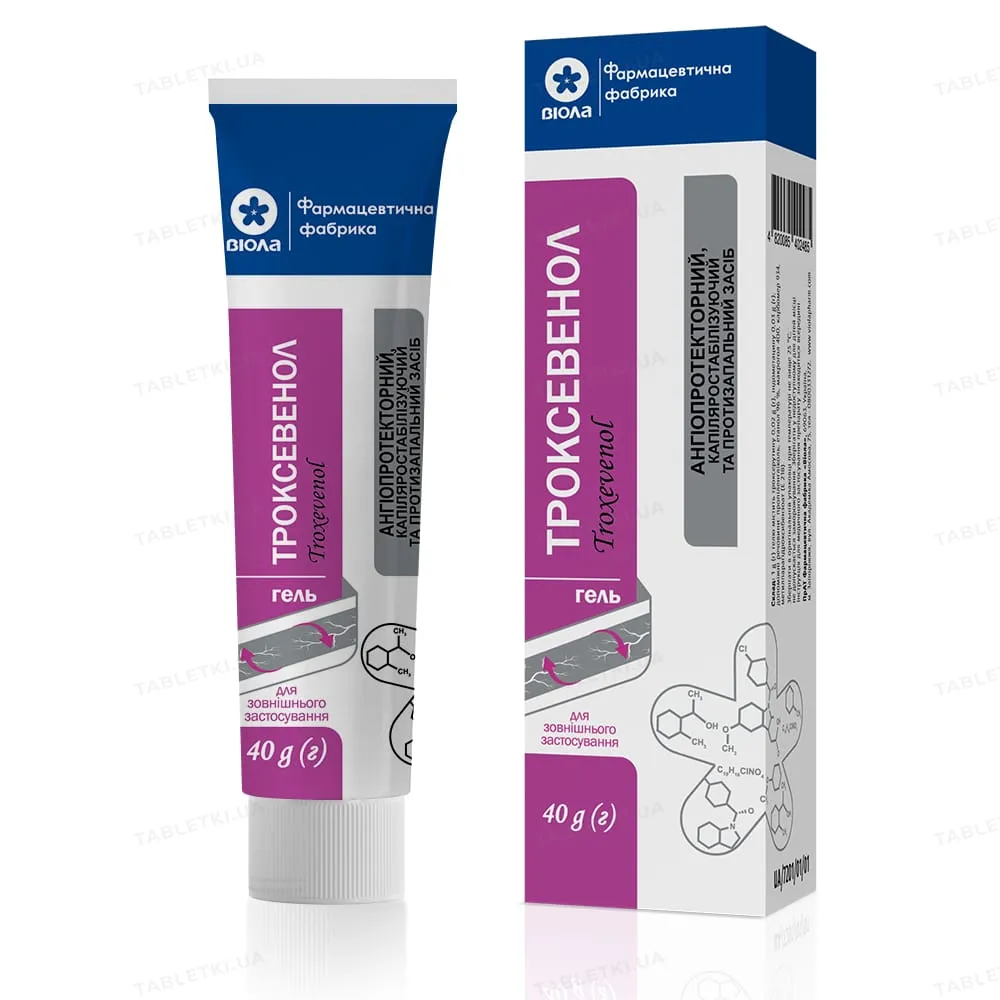
Table of Contents
I N S T R U C T I O N for medical use of the medicinal product TROXEVENOL (Troxevenol)
Composition:
Active substances: troxerutin, indometacin;
1 g of gel contains 20 mg (0.02 g) of troxerutin and 30 mg (0.03 g) of indometacin;
Excipients: propylene glycol, 96% ethanol, macrogol 400, carbomer 934, methylparahydroxybenzoate (E 218).
Medicinal form. Gel.
Main physicochemical properties: homogeneous, yellow-colored, transparent or slightly opalescent gel.
Pharmacotherapeutic group.
Capillary stabilizing agents. Troxerutin, combinations. ATC code C05CA54.
Pharmacological properties.
Pharmacodynamics.
Troxevanol is a combined topical preparation. Indomethacin exerts a pronounced anti-inflammatory, analgesic, and anti-edematous effect due to reversible inhibition of prostaglandin synthesis by blocking the cyclooxygenase (COX) enzyme, and also inhibits platelet aggregation. When applied topically, it reduces pain and swelling and shortens the duration of functional rehabilitation in musculoskeletal injuries. Indomethacin demonstrates stronger anti-inflammatory activity compared to salicylates and phenylbutazone.
Troxerutin belongs to the group of bioflavonoids and is a mixture of hydroxyethyl derivatives of rutoside, with trihydroxyethylrutoside being predominant. It exhibits angioprotective activity, reduces capillary permeability, and exerts a venotonic effect. It counteracts the vasodilatory effects of histamine, bradykinin, and acetylcholine, and demonstrates anti-aggregatory and anti-inflammatory actions on perivenous tissues, while increasing capillary resistance. It reduces tissue edema and improves tissue trophism in pathological conditions associated with venous insufficiency.
Pharmacokinetics.
The gel base of the preparation ensures complete solubility of the active ingredients and their penetration into inflamed tissues and synovial fluid. Indomethacin is more than 90% bound to plasma proteins and undergoes hepatic biotransformation via O-demethylation and N-deacetylation, forming inactive metabolites. Indomethacin is excreted in urine (60%), bile, and feces (30%). It penetrates into breast milk.
The majority of absorbed tri-, di-, and polyhydroxyethylrutosides are excreted via bile, with a significantly smaller portion eliminated in urine. Tetrahydroxyethylrutoside is excreted predominantly in urine.
Clinical characteristics.
Indications.
Symptomatic treatment of venous insufficiency, varicose veins, superficial thrombophlebitis, phlebitis, post-phlebitis conditions; in complex therapy of hemorrhoids; rheumatic disorders of soft tissues – tenosynovitis, bursitis, fibrositis, periarthritis; edema following surgical procedures; contusions, dislocations, sprains.
Contraindications.
Hypersensitivity to any component of the drug or to nonsteroidal anti-inflammatory agents. The drug is contraindicated in patients with bronchial asthma.
Interaction with other medicinal products and other forms of interactions.
The drug should not be used concurrently with other nonsteroidal anti-inflammatory drugs (potentiation of effect) and corticosteroids (risk of ulcerogenic action).
Special precautions for use.
The gel is intended for external use only.
Troxevazol should be applied only to intact skin. Avoid contact of the gel with mucous membranes, open wound surfaces, and eyes.
If treatment duration exceeds 10 days, leukocyte count and platelet count should be monitored.
Do not exceed the recommended dose.
As with other medicinal products containing nonsteroidal anti-inflammatory agents, this product should be used with particular caution in patients with allergic disorders or reactions, impaired liver or kidney function, when applied over large skin areas, and in patients with peptic ulcer disease.
Use during pregnancy or breast-feeding.
There is no clinical experience confirming the safety of using this medicinal product during pregnancy. Therefore, it should be prescribed only if the expected therapeutic benefit for the mother outweighs the potential risk to the fetus. Since indomethacin penetrates into breast milk, the use of this product is not recommended during breastfeeding.
Ability to influence reaction rate while driving or operating machinery.
No effect.
Method of administration and dosage.
For external use only. Apply a 4-5 cm strip of gel as a thin layer to affected areas and gently rub in 3–4 times daily. The total daily dose should not exceed 20 cm of gel. Treatment duration should not exceed 10 days.
Children.
The use of the drug is not recommended in children under 14 years of age due to lack of sufficient clinical experience.
Overdose.
With topical application, overdose has not been reported. However, during prolonged treatment (more than 10 days), monitoring is required to detect possible systemic effects—such as hepatotoxicity, severe headache, hemorrhages—and laboratory blood tests (monitoring of leukocyte count and platelet levels). In case of accidental ingestion, symptoms may include burning sensation in the oral cavity, salivation, nausea, and vomiting. In such cases, gastric and oral lavage is indicated, along with symptomatic treatment if necessary. If the gel comes into contact with eyes, mucous membranes, or open wounds, local irritation may occur—such as lacrimation, hyperemia, burning, and pain. Rinse the affected area thoroughly with a large amount of distilled water or 0.9% sodium chloride solution until symptoms have completely disappeared or significantly diminished.
Adverse reactions.
Local reactions: possible symptoms of skin hypersensitivity – contact dermatitis, itching, redness, rash, sensation of warmth and burning at the application site.
Systemic reactions: very rarely, with prolonged use over large areas of the body, adverse effects may occur:
Gastrointestinal effects – nausea, vomiting, stomach pain, increased levels of liver enzymes;
Immune system effects – hypersensitivity symptoms (anaphylaxis, asthma attack, angioneurotic edema).
The product contains propylene glycol, which may cause skin irritation, and methylparaben, which may cause allergic reactions.
If any adverse reactions occur, discontinue use of the product and consult a physician immediately.
Shelf life. 2 years.
Storage conditions.
Store in the original packaging at a temperature not exceeding 25 °C; do not freeze. Keep out of reach of children.
Packaging.
40 g in tubes. 1 tube per carton or without carton.
Availability category. Over-the-counter.
Manufacturer: JSC Pharmaceutical Factory "Viola".
Manufacturer's address and place of business.
69063, Ukraine, Zaporizhzhia, Amosova St., 75.
Marketing authorization holder: JSC Pharmaceutical Factory "Viola".
Address of the marketing authorization holder.
69063, Ukraine, Zaporizhzhia, Amosova St., 75.