Thiogamma® 600 hr
Ukraine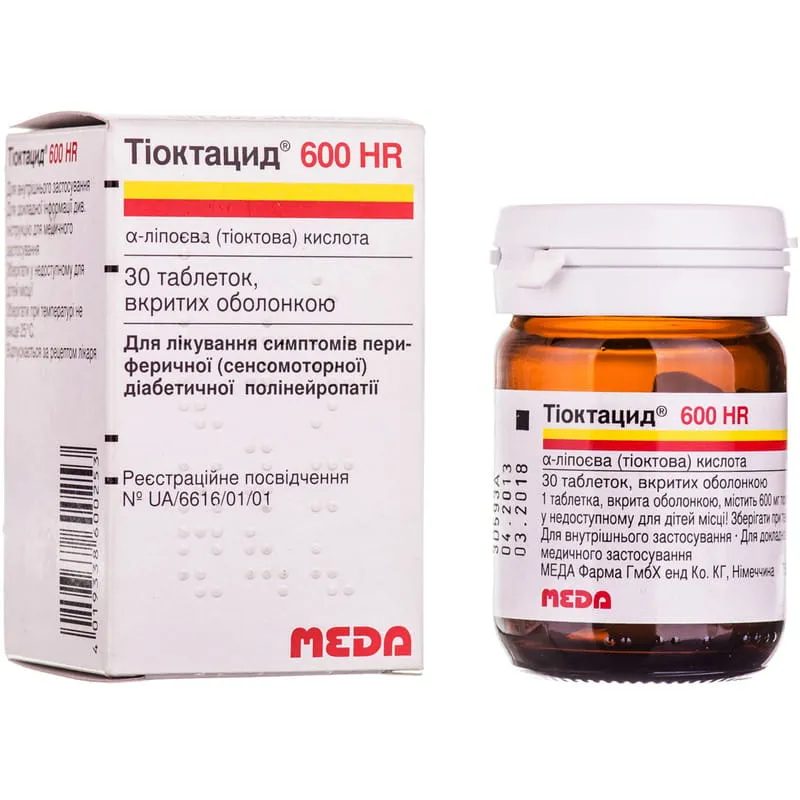
Table of Contents
INSTRUCTIONS FOR MEDICAL USE OF THE MEDICINAL PRODUCT THIOCTACID® 600 HR (THIOCTACID® 600 HR)
Composition:
Active substance: thioctic acid (thioctic (α-lipoic) acid);
One film-coated tablet contains 600 mg of thioctic (α-lipoic) acid;
Excipients: low-substituted hydroxypropylcellulose, hydroxypropylcellulose, magnesium stearate, hypromellose, polyethylene glycol 6000, titanium dioxide (E 171), talc, quinoline yellow (E 104), indigocarmine (E 132).
Pharmaceutical form. Film-coated tablets.
Main physicochemical properties: yellow-greenish, dull lustrous, elongated biconvex film-coated tablets.
Pharmacotherapeutic group. Agents affecting the digestive system and metabolic processes. Thioctic acid.
ATC code A16AX01.
Pharmacological properties.
Pharmacodynamics.
α-lipoic acid acts as a coenzyme in the oxidative decarboxylation of α-keto acids.
Hyperglycemia caused by diabetes mellitus leads to the accumulation of glucose on matrix proteins of blood vessels and the formation of so-called "advanced glycation end-products" (AGEs). This process results in reduced endoneurial blood flow and endoneurial hypoxia/ischemia, associated with increased production of reactive oxygen species (ROS), leading to damage of peripheral nerves.
Animal studies have shown that α-lipoic acid affects biochemical processes induced by streptozotocin-induced diabetes, resulting in improved endoneurial blood flow and increased levels of the physiological antioxidant glutathione. As an antioxidant, it also reduces the amount of reactive oxygen species in diabetic-affected nerves.
The effects observed in experimental studies indicate that peripheral nerve function can be improved by α-lipoic acid. This is relevant to sensory disturbances in diabetic polyneuropathy, which may manifest as paresthesia, including burning sensations, pain, numbness, and "pins and needles."
Pharmacokinetics.
After oral administration, Thioctacid® 600 HR (rapid release) provides rapid absorption of α-lipoic acid. Due to a significant first-pass effect, the absolute bioavailability of α-lipoic acid (measured as the parent substance) following administration of Thioctacid® 600 HR tablets is approximately 20% compared to intravenous administration. Due to rapid tissue distribution, the elimination half-life of α-lipoic acid is approximately 25 minutes. Similar to the oral solution, which is considered the reference formulation with maximum absorption, Thioctacid® 600 HR tablets exhibit an absorption profile characterized by a rapid influx of the active substance, accompanied by reduced inter-individual variability. The relative bioavailability of Thioctacid® 600 HR (compared to the oral solution) is > 60%. A maximum plasma concentration of 4 μg/mL was observed approximately 0.5 hours after oral intake of 600 mg α-lipoic acid. Animal experiments (rats, dogs) using radiolabeled compounds demonstrated that the drug is eliminated predominantly via the kidneys (80–90%), mainly in the form of metabolites. In humans, only a minor fraction of the unchanged substance is excreted in urine. Biotransformation occurs primarily through oxidative shortening of side chains (β-oxidation) and/or S-methylation of the corresponding thiols.
Clinical characteristics.
Indications. Treatment of symptoms of peripheral (sensorimotor) diabetic polyneuropathy.
Contraindications. Hypersensitivity to thioctic acid or to any of the excipients of the medicinal product.
Interaction with other medicinal products and other forms of interactions. The efficacy of cisplatin is reduced when administered concomitantly with thioctic acid.
Thioctic acid is a metal chelator; therefore, it should not be administered together with metal-containing compounds (e.g., iron or magnesium preparations, or with dairy products due to their calcium content). If the daily dose is administered 30 minutes before breakfast, iron- or magnesium-containing preparations should be taken at lunch or in the evening. Alpha-lipoic acid forms poorly soluble complexes with sugar molecules (e.g., with lavulose solution).
When using Thiocitacid® 600 HR in patients with diabetes mellitus, a potentiation of the blood glucose-lowering effect of insulin and oral antidiabetic agents may occur. Therefore, especially during the initial stage of treatment, careful monitoring of blood glucose levels is recommended. In some cases, to avoid symptoms of hypoglycemia, a reduction in the dose of insulin or oral antidiabetic agents may be necessary.
Caution
Regular alcohol consumption is a significant risk factor for the development and progression of the clinical picture of neuropathy and may thus negatively affect the treatment process with Thiocitacid® 600 HR. Therefore, patients with diabetic polyneuropathy are generally advised, whenever possible, to abstain from alcohol consumption. Restrictions on alcohol intake also apply to the intervals between treatment courses.
Special precautions.
An unusual odor of urine may occur during the use of the drug, which has no clinical significance.
At the beginning of treatment for polyneuropathy, transient intensification of paresthesia with sensations of "crawling ants" may occur due to regenerative processes.
Use during pregnancy or breastfeeding. The use of thioctic acid during pregnancy is not recommended due to the lack of appropriate clinical data.
There are no data on the penetration of thioctic acid into breast milk; therefore, its use during breastfeeding is not recommended.
Ability to influence reaction rate when driving or operating machinery. Caution is necessary during treatment (due to possible adverse reactions such as dizziness and visual disturbances) when driving vehicles or engaging in other potentially hazardous activities requiring increased attention and speed of psychomotor reactions.
Method of administration and dosage.
Adults are prescribed 1 tablet of Thioctacid® 600 HR (equivalent to 600 mg of α-lipoic acid) once daily. The tablet should be taken approximately half an hour before the first meal.
The medication should be taken on an empty stomach, without chewing, and with sufficient amount of water. Taking the medication during meals may reduce the absorption of α-lipoic acid; therefore, it is recommended to take the entire daily dose about half an hour before breakfast.
The duration of treatment is determined individually by the physician.
Children. Since there is no data available regarding the safety and efficacy of this medication in children, it is not recommended for use in this age group.
Overdose.
In cases of overdose, nausea, vomiting, and headache may occur. Following accidental ingestion or suicide attempts involving oral administration of thioctic acid in doses ranging from 10 g to 40 g in combination with alcohol, severe intoxication has been observed, in some cases resulting in death. In the initial stage, the clinical picture of intoxication may present as psychomotor agitation or impaired consciousness. Subsequently, generalized seizures and lactic acidosis may develop. Additionally, with high-dose thioctic acid intoxication, hypoglycemia, shock, acute necrosis of skeletal muscles, hemolysis, disseminated intravascular coagulation syndrome, bone marrow suppression, and multiorgan failure have been reported.
Treatment. In suspected cases of severe intoxication, immediate hospitalization is recommended, along with measures according to general principles for managing accidental poisoning (e.g., inducing vomiting, gastric lavage, administration of activated charcoal). Treatment of life-threatening complications such as generalized seizures and lactic acidosis should be carried out in accordance with modern intensive care principles; such treatment should be symptomatic. To date, the benefit of hemodialysis, hemoperfusion, or filtration methods with forced elimination of thioctic acid has not been confirmed.
Adverse Reactions
Gastrointestinal disorders: Common – nausea; in individual cases – gastrointestinal disorders including vomiting, abdominal pain and gastro-intestinal pain, diarrhea.
Allergic reactions: in individual cases – allergic reactions, including skin rash, urticaria (urticarial rash), itching and eczema.
Central nervous system disorders: Common – dizziness; very rare – alteration or disturbance of taste sensations.
Metabolic disorders: in individual cases – decreased blood glucose levels. Reports have been received of symptoms indicative of hypoglycemic states (dizziness, increased sweating, headache, and visual disturbances).
Other: dyspnea (difficulty breathing).
Shelf life. 5 years.
Storage conditions. Store at a temperature not exceeding 25 °C. Keep out of reach of children.
Packaging. 30 or 100 film-coated tablets in a bottle; 1 bottle in a cardboard box.
Prescription status. Prescription only.
Manufacturer.
MEDA Pharma GmbH & Co. KG.
Alternative manufacturer
Rottapharm Ltd.
Address of manufacturer and location of business operations.
Benzstrasse 1, 61352 Bad Homburg, Germany.
Address of alternative manufacturer
Damastown Industrial Park, Mulhuddart, Dublin 15, Ireland.