Tafnat
Ukraine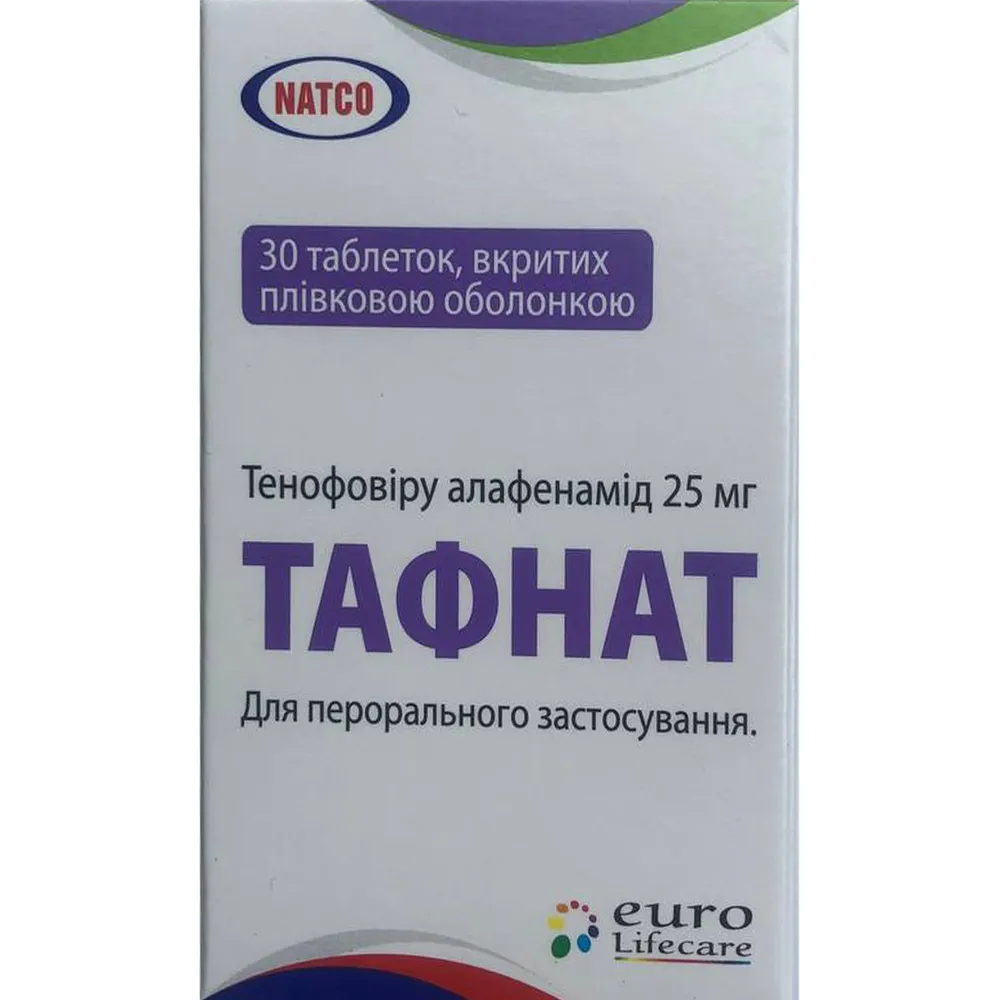
Table of Contents
INSTRUCTIONS FOR MEDICAL USE OF THE MEDICINAL PRODUCT TAFNAT (TAFNAT)
Composition:
Active substance: tenofovir alafenamide;
One film-coated tablet contains tenofovir alafenamide fumarate equivalent to 25 mg of tenofovir alafenamide;
Excipients: lactose monohydrate; microcrystalline cellulose; sodium croscarmellose; magnesium stearate;
film coating Opadry II Blue (85F505153): polyvinyl alcohol, titanium dioxide (E 171), polyethylene glycol, talc, brilliant blue FCF dye, aluminum lake (E 133).
Pharmaceutical form. Film-coated tablets.
Main physicochemical characteristics: oval, film-coated, blue tablets with "TA" engraved on one side and "25" on the other.
Pharmacotherapeutic group.
Antiviral agents for systemic use, nucleoside and nucleotide reverse transcriptase inhibitors. ATC code J05AF13.
Pharmacological properties.
Pharmacodynamics.
Mechanism of action. Tenofovir alafenamide is a phosphonamidate prodrug of tenofovir (a 2'-deoxyadenosine monophosphate analogue). Tenofovir alafenamide enters primary hepatocytes via passive diffusion and is transported by hepatic uptake transporters—organic anion transporting polypeptides (OATP1B1 and OATP1B3). Within primary hepatocytes, tenofovir alafenamide is primarily hydrolyzed by carboxylesterase-1 to form tenofovir. Intracellular tenofovir is subsequently phosphorylated to the pharmacologically active metabolite, tenofovir diphosphate. Tenofovir diphosphate inhibits hepatitis B virus (HBV) replication by incorporation into viral DNA via HBV reverse transcriptase, resulting in DNA chain termination.
Tenofovir has specific activity against HBV and human immunodeficiency virus (HIV-1 and HIV-2).
Tenofovir diphosphate is a weak inhibitor of mammalian DNA polymerases, including mitochondrial DNA polymerase γ. Based on data from several studies, including mitochondrial DNA studies, mitochondrial toxicity of the drug has not been demonstrated in vitro.
Antiviral activity. The antiviral activity of tenofovir alafenamide was evaluated in hepatocellular carcinoma (HepG2) cells using a panel of clinical HBV strains, genotypes A–H. The EC50 (50% effective concentration) values for tenofovir alafenamide ranged from 34.7 to 134.4 nM, with an overall mean EC50 of 86.6 nM. The CC50 (50% cytotoxic concentration) in HepG2 cells was >44,400 nM.
Resistance. In a combined analysis of patients receiving tenofovir alafenamide, genetic sequencing analysis was performed on paired samples (baseline and on-treatment HBV isolates) from patients who experienced virologic breakthrough (two consecutive visits with HBV DNA ≥69 IU/mL after a prior level <69 IU/mL or an increase in HBV DNA of ≥1.0 log10 compared to the lowest level) by Week 48 of treatment, or who had HBV DNA ≥69 IU/mL at early discontinuation at Week 24 or later. Analysis of 20 paired samples revealed no amino acid substitutions associated with resistance to tenofovir alafenamide.
Cross-resistance. Antiviral activity of tenofovir alafenamide was assessed against a panel of strains containing nucleoside/nucleotide reverse transcriptase inhibitor mutations in HepG2 cells. HBV strains expressing rtV173L, rtL180M, and rtM204V/I substitutions, associated with resistance to lamivudine, remained sensitive to tenofovir alafenamide (<2-fold change in EC50 value). HBV strains expressing rtL180M, rtM204V, and rtT184G, rtS202G, or rtM250V substitutions, associated with resistance to entecavir, retained sensitivity to tenofovir alafenamide. HBV strains expressing individual rtA181T, rtA181V, or rtN236T substitutions, associated with resistance to adefovir, remained sensitive to tenofovir alafenamide; however, the HBV strain expressing both rtA181V and rtN236T showed reduced sensitivity to tenofovir alafenamide (3.7-fold change in EC50 value). The clinical significance of these substitutions is unknown.
Pharmacokinetics.
Absorption. After oral administration of tenofovir alafenamide on an empty stomach to adult patients with chronic hepatitis B (CHB), maximum plasma concentration (Cmax) of tenofovir alafenamide was observed approximately 0.48 hours after dosing. Based on population pharmacokinetic analysis of Phase 3 studies in CHB patients, mean values of the area under the plasma concentration-time curve over 24 hours (AUC0–24) at steady state for tenofovir alafenamide and tenofovir were 0.22 and 0.32 μg•h/mL, respectively. The steady-state concentration (Css) for tenofovir alafenamide and tenofovir was 0.18 and 0.02 μg•h/mL, respectively. Compared to fasting conditions, administration of a single dose of tenofovir alafenamide with a high-fat meal increased exposure to tenofovir alafenamide by 65%.
Distribution. Binding of tenofovir alafenamide to plasma proteins is approximately 80%. Binding of tenofovir to human plasma proteins is less than 0.7% and is independent of concentration within the range of 0.01 to 25 μg/mL.
Metabolism. Metabolism is the primary route of elimination of tenofovir alafenamide in humans, accounting for >80% of the administered dose. In vitro studies have shown that tenofovir alafenamide is metabolized to tenofovir (the major metabolite) by carboxylesterase-1 in hepatocytes and by cathepsin A in peripheral blood mononuclear cells and macrophages. In vivo, tenofovir alafenamide is intracellularly hydrolyzed to tenofovir (the major metabolite), which is then phosphorylated to tenofovir diphosphate (the active metabolite).
In vitro, tenofovir alafenamide is not metabolized by cytochrome P450 (CYP) enzymes CYP1A2, CYP2C8, CYP2C9, CYP2C19, or CYP2D6. CYP3A4 has minimal impact on the metabolism of tenofovir alafenamide.
Elimination. Renal excretion of unchanged tenofovir alafenamide is a minor elimination pathway, accounting for less than 1% of the administered dose. Tenofovir alafenamide is primarily eliminated following its conversion to tenofovir during metabolism. Mean half-life (T1/2) values of tenofovir alafenamide and tenofovir in plasma are 0.51 and 32.37 hours, respectively. Tenofovir is eliminated by the kidneys through two mechanisms—glomerular filtration and active tubular secretion.
Linearity/Non-linearity. Pharmacokinetic parameters of tenofovir alafenamide were dose-dependent over the range of 8 to 125 mg.
Pharmacokinetics in special patient populations
Age, sex, and race. No clinically significant differences in pharmacokinetics based on age or race were observed. Differences in pharmacokinetics based on sex were not considered clinically significant.
Patients with hepatic impairment. In patients with severe hepatic impairment, total plasma concentrations of tenofovir alafenamide and tenofovir are lower than in patients with normal hepatic function. After correction for protein binding, unbound (free) plasma concentrations of tenofovir alafenamide in severe hepatic impairment are similar to those in normal hepatic function.
Patients with renal impairment. In studies of tenofovir alafenamide, no clinically significant differences in the pharmacokinetics of tenofovir alafenamide or tenofovir were observed between healthy volunteers and patients with severe renal impairment (estimated creatinine clearance [CrCl] >15 but <30 mL/min).
Pediatric patients. Pharmacokinetics of tenofovir alafenamide and tenofovir were evaluated in previously untreated, HIV-1-infected adolescents receiving tenofovir alafenamide (10 mg) coadministered with elvitegravir, cobicistat, and emtricitabine as a fixed-dose combination tablet (cobicistat + tenofovir alafenamide + elvitegravir + emtricitabine). No clinically significant differences in the pharmacokinetics of tenofovir alafenamide or tenofovir were observed between adolescents and adults infected with HIV-1.
Clinical characteristics.
Indications.
Treatment of chronic hepatitis B in adults and adolescents (aged 12 years and older with body weight at least 35 kg).
Contraindications.
Hypersensitivity to the active substance or to any of the excipients of the medicinal product.
Interaction with other medicinal products and other forms of interactions.
Interaction studies have been conducted only in adults.
Tafnat should not be coadministered with medicinal products containing tenofovir disoproxil fumarate, tenofovir alafenamide, or adefovir dipivoxil.
Medicinal products that may have a negative effect on tenofovir alafenamide
Transport of tenofovir alafenamide is mediated by P-glycoprotein (P-gp) and BCRP. Medicinal products that are P-gp inducers (e.g., rifampicin, rifabutin, carbamazepine, phenobarbital, or St. John’s wort (Hypericum perforatum)) are expected to reduce plasma concentrations of tenofovir alafenamide, which may lead to loss of therapeutic effect of Tafnat. Concomitant use of such medicinal products with Tafnat is not recommended.
Concomitant administration of Tafnat with medicinal products that inhibit P-gp and BCRP may increase plasma concentrations of tenofovir alafenamide. Coadministration of Tafnat with strong P-gp inhibitors is not recommended.
Tenofovir alafenamide is a substrate of OATP1B1 and OATP1B3 in vitro. Activity of OATP1B1 and/or OATP1B3 may negatively affect the distribution of tenofovir alafenamide in the body.
Effect of tenofovir alafenamide on other medicinal products
Tenofovir alafenamide is not an inhibitor of CYP1A2, CYP2B6, CYP2C8, CYP2C9, CYP2C19, or CYP2D6 in vitro. It is neither an inhibitor nor an inducer of CYP3A in vivo.
Tenofovir alafenamide is not an inhibitor of UGT1A1 in vitro. It is unknown whether tenofovir alafenamide is an inhibitor of other UGT enzymes.
Information on interactions between Tafnat and potential concomitant medicinal products is presented in Table 1 (increases are indicated as “↑”, decreases as “↓”, no change as “↔”; twice daily as “2 times/day”; single dose as “SD”; once daily as “1 time/day”; intravenous as “IV”). The described drug interactions are based on studies conducted with tenofovir alafenamide or are expected with the use of Tafnat.
Table 1
Interaction of the medicinal product Tafnat with other medicinal products
| Medicinal product (therapeutic group) |
Effect on drug levels a,b Mean change ratio (90% confidence interval) AUC, Cmax, Cmin |
Recommendations for co-administration with Tafnat |
| ANTICONVULSANTS |
||
| Carbamazepine (300 mg orally, 2 times daily) |
Tenofovir alafenamide |
Concomitant use is not recommended |
| Oxcarbazepine |
Interaction not studied. |
Concomitant use is not recommended |
| Phenytoin |
Interaction not studied. |
Concomitant use is not recommended |
| Midazolam d (2.5 mg orally, OD) once daily) |
Midazolam |
No dose adjustment of midazolam (when administered orally or intravenously) is required |
| Midazolam d (1 mg IV, OD) once daily) |
Midazolam |
|
| ANTIDEPRESSANTS |
||
| Sertraline (50 mg orally, OD) once daily) |
Tenofovir alafenamide |
No dose adjustment of Tafnat or sertraline is required |
| Sertraline (50 mg orally, OD) once daily) |
Sertraline |
|
| ANTIFUNGAL AGENTS |
||
| Itraconazole |
Interaction not studied. |
Concomitant use is not recommended |
| ANTIMYCOBACTERIAL AGENTS |
||
| Rifampicin |
Interaction not studied. |
Concomitant use is not recommended |
| Rifabutin |
Interaction not studied. |
Concomitant use is not recommended |
| ANTIVIRAL AGENTS FOR TREATMENT OF HEPATITIS C VIRUS (HCV) INFECTION |
||
| Sofosbuvir (400 mg orally, once daily) |
Interaction not studied. |
No dose adjustment of Tafnat or sofosbuvir is required |
| Ledipasvir/sofosbuvir (90/400 mg orally, once daily) once daily) |
Ledipasvir |
No dose adjustment of Tafnat or ledipasvir/sofosbuvir is required |
| Sofosbuvir/velpatasvir (400/100 mg orally, once daily) |
Interaction not studied. |
No dose adjustment of Tafnat or sofosbuvir/velpatasvir is required |
| Sofosbuvir/velpatasvir/voxilaprevir (400 mg/100 mg/100 mg + 100 mg internally, once daily) Tenofovir alafenamide f (25 mg orally, once daily) |
Sofosbuvir ↔ Cmax 0.95 (0.86; 1.05) ↔ AUC 1.01 (0.97; 1.06) GS-331007g ↔ Cmax 1.02 (0.98; 1.06) ↔ AUC 1.04 (1.01; 1.06) Velpatasvir ↔ Cmax 1.05 (0.96; 1.16) ↔ AUC 1.01 (0.94; 1.07) ↔ Cmin 1.01 (0.95; 1.09) Voxilaprevir ↔ Cmax 0.96 (0.84; 1.11) ↔ AUC 0.94 (0.84; 1.05) ↔ Cmin 1.02 (0.92; 1.12) Tenofovir alafenamide ↑ Cmax 1.32 (1.17; 1.48) ↑ AUC 1.52 (1.43; 1.61) |
No dose adjustment of Tafnat or sofosbuvir/velpatasvir/voxilaprevir is required |
| ANTI-HIV ANTIRETROVIRAL AGENTS — PROTEASE INHIBITORS |
||
| Atazanavir/cobicistat (300/150 mg orally, once daily) |
Tenofovir alafenamide |
Concomitant use is not recommended |
| Atazanavir/ritonavir (300/100 mg orally, once daily) |
Tenofovir alafenamide |
Concomitant use is not recommended |
| Darunavir/cobicistat (800/150 mg orally, once daily) |
Tenofovir alafenamide |
Concomitant use is not recommended |
| Darunavir/ritonavir (800/100 mg orally, once daily) |
Tenofovir alafenamide |
Concomitant use is not recommended |
| Lopinavir/ritonavir (800/200 mg orally, once daily) |
Tenofovir alafenamide |
Concomitant use is not recommended |
| Tipranavir/ritonavir |
Interaction not studied. |
Concomitant use is not recommended |
| ANTI-HIV ANTIRETROVIRAL AGENTS — INTEGRASE INHIBITORS |
||
| Dolutegravir (50 mg orally, once daily) |
Tenofovir alafenamide |
No dose adjustment of Tafnat or dolutegravir is required |
| Raltegravir |
Interaction not studied. |
No dose adjustment of Tafnat or raltegravir is required |
| ANTI-HIV ANTIRETROVIRAL AGENTS — NNRTIs |
||
| Efavirenz (600 mg orally, once daily) |
Tenofovir alafenamide |
No dose adjustment of Tafnat or efavirenz is required |
| Nevirapine |
Interaction not studied. |
No dose adjustment of Tafnat or nevirapine is required |
| Rilpivirine (25 mg orally, once daily) |
Tenofovir alafenamide |
No dose adjustment of Tafnat or rilpivirine is required |
| ANTI-HIV ANTIRETROVIRAL AGENTS — CCR5 ANTAGONISTS |
||
| Maraviroc |
Interaction not studied. |
No dose adjustment of Tafnat or maraviroc is required |
| PLANT-BASED SUPPLEMENTS |
||
| St. John's wort (Hypericum perforatum) |
Interaction not studied. |
Concomitant use is not recommended |
| HORMONAL CONTRACEPTIVES |
||
| Norgestimate (0.18/0.215/0.25 mg orally, once daily) |
Norelgestromin |
No dose adjustment of Tafnat or norgestimate/ethinylestradiol is required |
a All interaction studies were conducted in healthy volunteers.
b All no-effect boundaries are 70–143%.
c Study using a fixed-dose combination tablet containing emtricitabine/tenofovir alafenamide.
d Sensitive CYP3A4 substrate.
e Study using a fixed-dose combination tablet containing elvitegravir/cobicistat/emtricitabine/tenofovir alafenamide.
f Study using a fixed-dose combination tablet containing emtricitabine/rilpivirine/tenofovir alafenamide.
g Primary circulating nucleoside metabolite of sofosbuvir.
h Study using tenofovir alafenamide 40 mg and emtricitabine 200 mg.
i The study was conducted with an additional dose of voxilaprevir 100 mg to achieve voxilaprevir exposures expected in patients infected with hepatitis C virus.
Special precautions for use.
Transmission of HBV. Patients should be advised that the medication Tafnat does not prevent the risk of transmission of HBV to others via sexual contact or blood. Appropriate preventive measures should continue to be observed.
Patients with decompensated liver disease
There are no data on the safety and efficacy of Tafnat in HBV-infected patients with decompensated liver disease and a Child-Pugh score >9 points (Class C). These patients may be at increased risk of developing serious hepatic or renal adverse reactions. Therefore, closer monitoring of liver and renal function is required in this patient population (see section "Pharmacokinetics").
Hepatitis flare
Flare during treatment. Spontaneous flares of chronic hepatitis B (CHB) occur relatively frequently and are characterized by a transient increase in serum alanine aminotransferase (ALT) activity. After initiation of antiviral therapy, serum ALT levels may increase in some patients. In patients with compensated liver insufficiency, increased serum ALT activity is usually not associated with elevated serum bilirubin levels or hepatic decompensation. However, in patients with cirrhosis, a hepatitis flare may increase the risk of hepatic decompensation; therefore, careful monitoring during treatment is required.
Flare after discontinuation of treatment. Cases of hepatitis flare have been reported in patients who discontinued hepatitis B treatment, usually associated with increased HBV DNA levels in plasma. In most such cases, patients do not require treatment; however, severe flares may occur after discontinuation of hepatitis B therapy, potentially leading to fatal outcomes. Therefore, continued clinical and laboratory monitoring for at least 6 months after stopping hepatitis B treatment is necessary; liver function parameters should be monitored periodically. If necessary, hepatitis B treatment should be reinstated.
Discontinuation of treatment is not recommended in patients with progressive liver disease or cirrhosis, as hepatitis flare after stopping treatment may lead to hepatic failure. In patients with decompensated liver disease, hepatitis flare is particularly dangerous and may in some cases result in death.
Renal function impairment
Patients with CrCl <30 mL/min. Recommendations for once-daily use of Tafnat in patients with CrCl ≥15 mL/min but <30 mL/min, and in patients with CrCl <15 mL/min on hemodialysis, are based on very limited pharmacokinetic data, as well as modeling and simulation. Safety data for Tafnat use in HBV-infected patients with CrCl <30 mL/min are lacking.
Tafnat is not recommended for patients with CrCl <15 mL/min who are not on hemodialysis (see section "Dosage and administration").
Nephrotoxicity. Post-marketing reports have described cases of renal dysfunction, including acute renal failure and proximal renal tubulopathy, during treatment with medications containing tenofovir alafenamide. The potential for nephrotoxicity due to prolonged low-dose exposure to tenofovir resulting from tenofovir alafenamide dosing cannot be excluded.
Renal function should be assessed in all patients prior to or at the initiation of Tafnat therapy and monitored during treatment as clinically indicated. In patients who develop clinically significant renal function decline or signs of proximal renal tubulopathy, discontinuation of Tafnat should be considered.
Patients coinfected with HBV and hepatitis C or D virus
There are no data on the safety and efficacy of Tafnat in patients coinfected with HBV and hepatitis C or D virus. For treatment of hepatitis C, recommendations for combination therapy should be followed (see section "Interaction with other medicinal products and other forms of interaction").
HBV/HIV coinfection
Prior to initiating therapy with Tafnat, all HBV-infected patients with unknown HIV-1 status should be recommended to undergo HIV antibody testing. For patients with HBV/HIV coinfection, Tafnat should be prescribed in combination with other antiretroviral agents that provide appropriate HIV treatment (see section "Interaction with other medicinal products and other forms of interaction").
Concomitant use with other medicinal products
Tafnat should not be coadministered with medicinal products containing tenofovir alafenamide, tenofovir disoproxil fumarate, or adefovir dipivoxil.
Concomitant use of Tafnat with certain anticonvulsants (e.g., carbamazepine, oxcarbazepine, phenobarbital, and phenytoin), antimycobacterial agents (e.g., rifampicin, rifabutin, and rifapentine), or St. John’s wort, which are P-gp inducers and may reduce plasma concentrations of tenofovir alafenamide, is not recommended.
Concomitant use of Tafnat with strong P-gp inhibitors (e.g., itraconazole and ketoconazole) may increase plasma concentrations of tenofovir alafenamide. Concomitant use is not recommended.
Lactose intolerance
Tenofovir alafenamide tablets contain lactose monohydrate and therefore should not be used in patients with rare hereditary conditions such as galactose intolerance, Lapp lactase deficiency, or glucose-galactose malabsorption.
Use during pregnancy or breastfeeding.
Pregnancy. Data on the use of tenofovir alafenamide in pregnant women are limited (fewer than 300 pregnancy cases) or absent. However, extensive data from pregnant women who received tenofovir disoproxil fumarate (over 1000 observations) indicate no evidence of developmental abnormalities or embryonal/neonatal toxicity associated with tenofovir disoproxil fumarate.
Animal studies have not shown any direct or indirect adverse effects related to reproductive toxicity.
Therefore, if necessary, the use of Tafnat during pregnancy may be considered.
Breastfeeding period. There is no information on whether tenofovir alafenamide is excreted in human breast milk. However, animal studies have shown that tenofovir is excreted in milk. Information on the effects of tenofovir on neonates/infants is insufficient. Risk to the infant cannot be ruled out; therefore, Tafnat is not recommended during breastfeeding.
Fertility. There are no data on the effect of Tafnat on human fertility. Animal studies have not shown any adverse effects of tenofovir alafenamide on fertility.
Ability to drive or operate machinery.
Tafnat has no or negligible influence on the ability to drive or operate machinery. Patients should be warned about the possible occurrence of dizziness during treatment with Tafnat.
Method of Administration and Dosage.
The drug is administered orally.
Treatment should be initiated and supervised by a physician experienced in the management of chronic hepatitis B.
Adults and adolescents (aged 12 years and older with body weight ≥35 kg): 1 tablet once daily with food.
Discontinuation of treatment
Consideration regarding discontinuation of treatment may be as follows (see "Special Warnings"):
- In patients with detectable hepatitis B e antigen (HBeAg-positive) without liver cirrhosis, treatment should be continued for at least 6–12 months after confirmed HBe seroconversion (loss of HBeAg and HBV DNA, with appearance of anti-HBe antibodies), or until HBs seroconversion, or until loss of treatment response (see "Special Warnings"). After treatment discontinuation, patients should be monitored regularly for detection of virological relapse;
- In HBeAg-negative patients without liver cirrhosis, treatment should be continued at least until HBs seroconversion or until signs of treatment failure occur. With long-term treatment exceeding 2 years, patients should be monitored regularly to confirm that the treatment regimen remains optimal for the individual patient.
Missed dose. If a dose is missed and less than 18 hours have passed since the usual dosing time, the patient should take the missed dose of Tafnat as soon as possible, then continue with the regular dosing schedule. If more than 18 hours have passed since the usual dosing time, the patient should not take the missed dose and simply resume the regular dosing schedule.
If vomiting occurs within 1 hour after taking Tafnat, the patient should take another tablet. If vomiting occurs more than 1 hour after taking Tafnat, an additional tablet is not required.
Special patient groups
Elderly patients. Dose adjustment of Tafnat is not required for patients aged 65 years and older (see section "Pharmacokinetics").
Renal impairment. Dose adjustment of Tafnat is not required for adults or adolescents (aged 12 years and older with body weight ≥35 kg) with calculated CrCl ≥15 mL/min, or for patients with CrCl <15 mL/min undergoing hemodialysis (see section "Pharmacokinetics").
On days when hemodialysis is performed, Tafnat should be taken after completion of the hemodialysis session.
There are currently no dosage recommendations for Tafnat in patients with CrCl <15 mL/min who are not on hemodialysis (see "Special Warnings").
Hepatic impairment. Dose adjustment of Tafnat is not required in patients with hepatic impairment (see sections "Pharmacokinetics" and "Special Warnings").
Children.
The safety and efficacy of Tafnat in children under 12 years of age or with body weight less than 35 kg have not been established. Data are lacking.
Overdose.
In case of overdose, the patient should be monitored for signs of toxicity (see section "Adverse Reactions").
Treatment: general supportive measures, including monitoring of vital functions and observation of the patient's clinical status.
Tenofovir is efficiently removed by hemodialysis with an extraction coefficient of approximately 54%. It is unknown whether tenofovir is removed by peritoneal dialysis.
Adverse reactions
The assessment of adverse reactions is based on pooled safety data from two Phase 3 trials in which 866 hepatitis B virus (HBV)-infected patients received tenofovir alafenamide 25 mg once daily up to Week 72 (with a median exposure duration of 88 weeks).
The most commonly observed adverse reactions during treatment were: headache (12%), nausea (6%), and fatigue (6%).
The following adverse reactions have been reported with tenofovir alafenamide use in patients with chronic hepatitis B (CHB) (see Table 2), listed by system organ class and frequency. Frequency of adverse reactions is defined as follows: very common (≥1/10); common (≥1/100 to <1/10); uncommon (≥1/1000 to <1/100); rare (≥1/10,000 to <1/1000); very rare (<1/10,000).
Table 2
Adverse reactions associated with the use of tenofovir alafenamide
| System organ class |
|
| Frequency |
Adverse reaction |
| Gastrointestinal disorders |
|
| Common |
Diarrhea, vomiting, nausea, abdominal pain, bloating, flatulence |
| General disorders and administration site conditions |
|
| Common |
Weakness |
| Nervous system disorders |
|
| Very common |
Headache |
| Common |
Dizziness |
| Skin and subcutaneous tissue disorders |
|
| Common |
Rash, pruritus |
| Uncommon |
Angioneurotic edema*, urticaria* |
| Hepatobiliary disorders |
|
| Common |
Elevated ALT activity |
| Musculoskeletal and connective tissue disorders |
|
| Common |
Arthralgia |
| General disorders |
|
| Common |
Malaise |
*Adverse reaction identified during post-marketing surveillance of products containing tenofovir alafenamide.
Reporting suspected adverse reactions
It is important to report suspected adverse reactions after the medicinal product is authorized. This allows continued monitoring of the benefit-risk balance of the medicinal product. Healthcare professionals should report any suspected adverse reactions via the national reporting system.
Shelf life.
3 years.
Storage conditions.
Store in the original packaging at a temperature not exceeding 30 °C.
Keep out of reach and sight of children.
Packaging.
30 film-coated tablets in a high-density polyethylene (HDPE) bottle with a polypropylene cap equipped with child-resistant closure. 1 bottle in a cardboard box.
Prescription status.
Prescription only.
Manufacturer.
Natco Pharma Limited.
Manufacturer's address and place of business.
Pharma Division, Kothur, Rangareddy, Telangana 509228, India.