Plantago syrup
Ukraine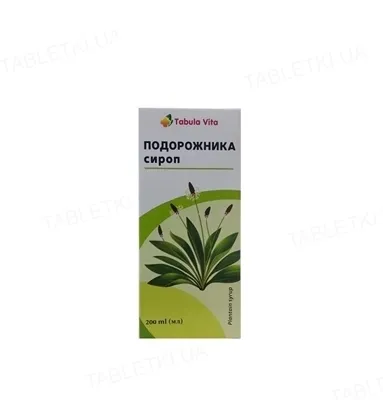
Table of Contents
INSTRUCTION FOR MEDICAL USE OF THE MEDICINAL PRODUCT PLANTAGO SYRUP
Composition:
Active ingredients: Plantago lanceolata leaf extract, marshmallow flower extract, ascorbic acid;
5 ml (6.6 g) of syrup contains:
Plantago lanceolata leaf extract (Plantaginis lanceolatae folia) (1:5) (extraction solvent – water) – 1.25 g,
marshmallow flower extract (Malvae sylvestris flos) (1:5) (extraction solvent – water) – 1.25 g,
ascorbic acid – 0.065 g;
Excipients: methylparaben (E 218), propylparaben (E 216), ethanol 96%, confectionery sugar.
The syrup contains 0.45% ethanol.
Pharmaceutical form. Syrup.
Main physicochemical properties: syrup-like liquid of dark raspberry or reddish-brown color with a characteristic odor and taste. Sediment may occur during storage.
Pharmacotherapeutic group. Medicinal products used in cough and common cold. Plantago preparations. ATC code R05C A17.
Pharmacological properties.
Pharmacodynamics. A combination drug with expectorant, mucolytic, antibacterial, and immunostimulant properties, containing aqueous extracts of lanceolate plantain and mallow, as well as ascorbic acid. The active ingredients of plantain leaves include mucilage, iridoid glycosides (aucubin), saponins, flavonoids, polysaccharides, and organic acids. Saponins and other active components of plantain extract stimulate bronchial gland secretion, thereby increasing sputum volume and reducing its viscosity. Mucilage forms a protective layer, reducing irritation of the upper respiratory tract mucosa, enhancing the mucolytic effect, decreasing stimulation of cough receptors, and acting as a barrier against infection. Plantain extract, due to its content of iridoid glycosides, flavonoids, and organic acids, also exerts immunostimulant, anti-inflammatory, analgesic, anti-hypoxic, antibacterial, and antiviral effects.
Mallow extract, thanks to its content of mucilage, flavonoids, phenolic acids, anthocyanosides, anthocyanidins, and tannins, forms a protective film on the mucous membranes of the respiratory tract, reduces inflammation and irritation, eases breathing, and alleviates non-productive cough.
Ascorbic acid acts as an antioxidant, participates in collagen synthesis, strengthens vascular walls, enhances non-specific immunity, and reduces general body intoxication. It is widely used in the treatment and prevention of respiratory diseases.
Pharmacokinetics. Not studied.
Clinical characteristics.
Indications.
Persistent non-productive cough of various etiologies, including infectious respiratory diseases in adults and children, cough caused by tobacco smoke and other irritants.
Contraindications.
Hypersensitivity to the active substances or to any inactive component of this medicinal product. Nephrolithiasis. Gastroesophageal reflux disease, including reflux esophagitis, hyperacidic gastritis, gastric and duodenal ulcer. Severe kidney diseases.
Interaction with other medicinal products and other forms of interaction.
Plantago lanceolata leaf extract and Malva sylvestris flower extract.
Unknown.
Ascorbic acid.
Concomitant use with antacids containing aluminum may increase urinary excretion of aluminum. This combination is not recommended, especially in patients with a history of kidney disease.
Ascorbic acid increases iron absorption.
Concomitant administration with deferoxamine promotes iron excretion. Use of high doses of ascorbic acid in patients receiving deferoxamine may cause heart diseases (such as cardiomyopathy and congestive heart failure). In case of such combination, the daily dose of ascorbic acid should not exceed 200 mg, and careful monitoring of cardiac function is recommended. Ascorbic acid should not be used in patients with heart failure who are undergoing treatment with deferoxamine. Ascorbic acid should not be administered during the first month of deferoxamine treatment.
High-dose ascorbic acid (1 g) intake inhibits the disulfiram-alcohol reaction in patients with alcoholism undergoing treatment with disulfiram.
Ascorbic acid reduces amphetamine absorption due to its effect on gastric pH.
Ascorbic acid increases total clearance of ethanol.
High doses of ascorbic acid impair renal excretion of mexiletine due to changes in urine pH. Careful monitoring of patients is required when mexiletine is used concomitantly with high doses of ascorbic acid.
High doses of ascorbic acid may affect urine pH and increase the risk of crystalluria during sulfonamide therapy.
Special precautions for use.
The product contains sugar and therefore is not recommended for patients with diabetes mellitus.
If dyspnea, fever, or purulent sputum occur, consult a physician.
Do not exceed the recommended doses.
High doses of ascorbic acid increase oxalate excretion in urine, thus increasing the risk of developing oxalate urinary stones. The risk is extremely low in healthy patients, especially when ascorbic acid is used at doses below 1 g per day. In patients with urolithiasis or hyperoxaluria, the daily dose of ascorbic acid should not exceed 1 g, taking into account dietary intake and dietary supplements.
When using high doses of ascorbic acid, kidney function should be monitored. The product should be used with caution in patients with a history of kidney disease, considering the vitamin C content in food and dietary supplements.
Use with caution in patients with glucose-6-phosphate dehydrogenase deficiency.
High-dose vitamin C should not be administered to patients with increased blood coagulability, thrombophlebitis, or predisposition to thrombosis.
Since ascorbic acid enhances iron absorption, its use in high doses may be hazardous in patients with hemochromatosis, thalassemia, polycythemia, leukemia, or sideroblastic anemia. Patients with high body iron stores should receive the product in minimal doses.
Ascorbic acid may interfere with laboratory test results, such as glucose, bilirubin, transaminase activity, and lactate dehydrogenase activity.
Use during pregnancy or breastfeeding.
Due to insufficient reliable data on the use of the product during pregnancy or breastfeeding, its use during these periods is not recommended.
Ability to affect reaction rate when driving or operating machinery.
There are no data on the effect of "Plantago syrup" on the ability to drive or operate machinery.
Dosage and Administration
The medication can be taken regardless of food intake.
Children aged 2 to 7 years: 5 mL (1 teaspoonful) of syrup three times daily.
Children aged 7 to 14 years: 1–2 teaspoonfuls of syrup three times daily.
Adults and children aged 14 years and older: 2 teaspoonfuls of syrup 3–5 times daily.
The syrup should be taken with a large amount of warm fluid.
The treatment course lasts 5–7 days.
Children.
Do not use in children under 2 years of age.
Overdose.
There have been no reports of overdose cases.
Ascorbic acid is well tolerated. It is a water-soluble vitamin, and excess amounts are excreted in urine. Overdose may lead to changes in renal excretion of ascorbic acid and uric acid during urine acidification, increasing the risk of oxalate stone formation. High doses of ascorbic acid may cause epigastric pain, heartburn, vomiting, nausea, or diarrhea, which resolve after discontinuation of the medication. Treatment is symptomatic.
Significant exceeding of recommended doses (vitamin C dose exceeding 1 g per day) may lead to renal failure, sleep disturbances, sensation of warmth, fatigue, disturbances in zinc and copper metabolism, increased excitability, erythrocytopenia, and neutrophilic leukocytosis.
Prolonged use of high-dose ascorbic acid may suppress the function of the pancreatic islet apparatus; therefore, its functional capacity should be monitored. When administering high doses of ascorbic acid, blood pressure should be monitored due to its stimulatory effect on corticosteroid hormone production.
Treatment is symptomatic.
Side effects.
Immune system side effects: hypersensitivity reactions (itching, urticaria, eczema), angioneurotic edema, anaphylactic shock.
Methylparaben (E 218) may cause allergic reactions (possibly delayed).
Nervous system side effects: headache.
Renal and urinary system side effects.
When ascorbic acid is used in doses exceeding 1 g per day – oxaluria, kidney stone formation, renal tubular damage.
Blood system side effects.
Administration of ascorbic acid in doses exceeding 1 g per day in patients with glucose-6-phosphate dehydrogenase deficiency may cause hemolysis of erythrocytes (hemolytic anemia).
If severe adverse reactions occur, treatment should be discontinued.
Shelf life. 2 years.
The shelf life of the medication after opening the bottle – 28 days.
Storage conditions.
Store in the original packaging at a temperature not exceeding 25 °C.
Keep out of reach of children.
Packaging.
130 g in bottles or jars, placed in a carton with a measuring spoon.
Availability. Over-the-counter.
Manufacturer/Applicant.
LLC "Ternopharm".
Manufacturer's address and location of business activity.
LLC "Ternopharm".
4 Fabrychna St., Ternopil, 46010, Ukraine.