Sidocard
Ukraine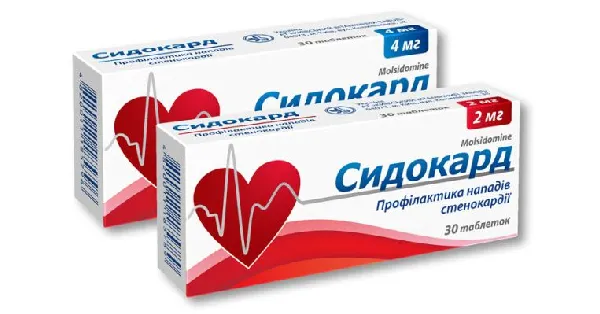
Table of Contents
INSTRUCTIONS FOR MEDICAL USE OF THE MEDICINAL PRODUCT SIDOCARD (SIDOCARD)
Composition:
Active substance: molsidomine;
1 tablet contains 2 mg or 4 mg of molsidomine;
Excipients: lactose monohydrate; mannitol (E 421); wheat starch; microcrystalline cellulose; hypromellose (hydroxypropylmethylcellulose); colloidal anhydrous silicon dioxide; magnesium stearate; peppermint oil; Yellow FCF (E 110).
Pharmaceutical form. Tablets.
Main physicochemical properties: round, flat-faced tablets with bevelled edges, a score line on one side, light pink in colour, with a peppermint odour.
Pharmacotherapeutic group. Vasodilators used in the treatment of heart diseases. Molsidomine. ATC code C01D X12.
Pharmacological Properties
Pharmacodynamics
Molsidomine exhibits venodilating, antiaggregant, analgesic, and prolonged antianginal effects. Its venodilating activity is due to the release of nitric oxide (NO) following a series of metabolic transformations. NO stimulates soluble guanylate cyclase; therefore, molsidomine is considered a donor of NO. Accumulation of cyclic guanosine monophosphate (cGMP) leads to relaxation of vascular smooth muscle cells (primarily in veins). Reduction of preload, even without affecting myocardial contractility, helps restore the impaired balance between oxygen demand and supply in patients with coronary insufficiency. Molsidomine dilates large epicardial coronary arteries affected by atherosclerosis but still capable of dilation, thereby improving peripheral circulation.
It increases tolerance to physical exertion and reduces manifestations of angiospasm. Molsidomine inhibits the early phase of platelet aggregation and reduces the synthesis and release of serotonin, thromboxane, and other proaggregatory substances.
It reduces myocardial preload in patients with chronic heart failure, decreases pulmonary artery pressure, reduces left ventricular filling and myocardial wall tension, and increases cardiac stroke volume. The effect begins within 20 minutes after administration, reaches maximum within 0.5–1 hour, and persists for up to 6 hours. Unlike nitrate therapy, tolerance development with reduced efficacy during prolonged molsidomine treatment is generally not observed.
Pharmacokinetics
After oral administration, molsidomine is almost completely absorbed from the gastrointestinal tract. Bioavailability is 60–70%. Maximum concentration (4.4 µg/mL) is achieved within 1 hour. Oral intake after food delays absorption but does not reduce it (maximum plasma concentration is reached 30–60 minutes later compared to administration on an empty stomach). The minimal effective plasma concentration of molsidomine is 3–5 ng/mL. It practically does not bind to plasma proteins. In the liver, it is metabolized to form the pharmacologically active compound SIN-1 (3-morpholinosydnonimine), which in turn forms the highly unstable substance SIN-1a (N-morpholino-N-aminosinonitrile), releasing NO and forming the pharmacologically inactive compound SIN-1c. Other metabolites are also formed during metabolism. Molsidomine is excreted by the kidneys (90%, as metabolites) and through the intestine (9%). The elimination half-life ranges from 1 to 3.5 hours. It does not accumulate (including in patients with renal insufficiency).
In severe hepatic insufficiency (increase in bromsulphthalein test from 20% to 50%), delayed elimination and increased plasma concentration of molsidomine have been observed.
Clinical characteristics.
Indications.
Ischemic heart disease: prevention of attacks of stable and unstable angina pectoris (especially in elderly patients and in individuals with intolerance to nitrates).
As part of combination therapy for chronic heart failure.
Contraindications.
Hypersensitivity to the active substance or to any of the excipients; glaucoma (especially angle-closure glaucoma); acute angina attack; acute myocardial infarction; acute circulatory failure including shock (including cardiogenic shock); vascular collapse; pronounced arterial hypotension (systolic blood pressure less than 100 mm Hg); concomitant use of phosphodiesterase type 5 (PDE5) inhibitors (sildenafil, vardenafil, tadalafil) — due to high risk of developing arterial hypotension; toxic pulmonary edema; reduced central venous pressure; concomitant administration of nitric oxide donors in any form and stimulators of soluble guanylate cyclase (e.g., riociguat) — due to risk of hypotension.
Interaction with other medicinal products and other types of interactions.
When used concomitantly with peripheral vasodilators, calcium channel blockers (CCBs), antihypertensive agents, and ethanol, the antihypertensive effect of the medicinal product is enhanced.
Sidocard may be used concomitantly with other antianginal drugs (e.g., added to dual or triple therapy with nitrates, CCBs, and β-blockers).
Alcohol consumption should be avoided during treatment with Sidocard.
When used concomitantly with acetylsalicylic acid, its antiplatelet activity is enhanced.
There is a high risk of developing arterial hypotension when used concomitantly with PDE5 inhibitors such as sildenafil, vardenafil, and tadalafil. Concomitant use of Sidocard with PDE5 inhibitors is contraindicated.
Ergot alkaloids. A pharmacodynamic interaction between nitric oxide donors and ergot alkaloids is possible, which may result in antagonistic effects of the drugs. Concomitant use of nitric oxide donors and ergot alkaloids should be avoided.
Concomitant administration of molsidomine and stimulators of soluble guanylate cyclase (e.g., riociguat), which act as nitric oxide receptor agonists, is contraindicated, as this combination increases the risk of hypotension.
Special precautions for use.
Do not use for the treatment of acute angina attacks!
Molsidomine usually does not cause significant reduction in arterial blood pressure; however, caution should be exercised when administering it to patients with arterial hypotension or at increased risk of arterial hypotension, elderly patients with reduced circulating blood volume, and patients receiving other vasodilators. Careful monitoring is required, and dosage should be adjusted according to the patient's condition.
When using the medicinal product Sidocard, it should be borne in mind that resting arterial pressure (AP), particularly systolic AP, may decrease. In such cases, initially high blood pressure responds more significantly than normotensive or hypotensive pressure.
Use with caution in patients with hypertrophic obstructive cardiomyopathy, constrictive (restrictive) pericarditis, cardiac tamponade, reduced ventricular pressure, aortic stenosis or mitral stenosis, acute myocardial infarction, and impaired left ventricular function (left ventricular insufficiency).
Since 90–95% of molsidomine metabolites are excreted by the kidneys, dosage reduction or increased intervals between doses may be necessary, depending on the individual patient's response to the drug. Patients with hepatic or renal insufficiency should receive lower doses, gradually increasing them until the desired therapeutic effect is achieved. In cases of marked hepatic dysfunction (increase in bromsulphthalein test by 20–50%), plasma concentration of molsidomine increases and elimination half-life is prolonged, necessitating dose adjustment.
Particular attention is required when using the medicinal product Sidocard in patients after hemorrhagic stroke, those with cerebral circulation disorders and elevated intracranial pressure, patients who recently suffered myocardial infarction, patients with glaucoma, and those prone to hypotensive reactions or with existing arterial hypotension. The medicinal product Sidocard should be administered only under strict medical supervision with continuous hemodynamic monitoring.
During prolonged nitrate therapy, molsidomine is recommended to be included in the treatment regimen to prevent the development of nitrate tolerance.
Elderly patients with hepatic or renal functional impairment should be prescribed lower doses of the drug.
This medicinal product contains lactose and therefore should not be administered to patients with rare hereditary forms of galactose intolerance, lactase deficiency, or glucose-galactose malabsorption syndrome.
Wheat starch, an ingredient of the medicinal product, may contain gluten, but only in insignificant amounts; thus, the drug is considered safe for patients with celiac disease.
Due to the presence of the colorant "Yellow FCF" (E 110) in the formulation, allergic reactions are possible.
Use during pregnancy or breastfeeding.
The use of the medicinal product during pregnancy is contraindicated.
The medicinal product should not be used during breastfeeding. If treatment is necessary, breastfeeding should be discontinued.
Ability to influence reaction speed when driving or operating machinery.
Considering the drug's adverse reactions (dizziness) and possible negative impact on attention concentration, the medicinal product should be prescribed with caution to individuals who drive vehicles or operate machinery, only after careful assessment of potential risks.
Dosage and Administration.
Administer the medicinal product orally during or after meals, swallowing with an adequate amount of liquid.
For prophylaxis of angina attacks, prescribe 1–2 mg (½–1 tablet) 4–6 times daily on the first and second days of therapy; thereafter, the dose may be increased if necessary to 2–4 mg 2–3 times daily.
The dosage regimen is individual and depends on the type and stage of the disease, as well as the severity of clinical symptoms. The usual daily dose is 2–4 mg, divided into 2 equal doses. Occasionally, the dose may be increased to 6–8 mg, which should be divided into 3–4 doses.
Maximum daily dose — 12 mg.
Duration of treatment depends on the course of the disease and is determined by the physician.
Children. The use of the medicinal product in children is contraindicated.
Overdose.
Symptoms: bradycardia, weakness, drowsiness, severe headache, dizziness, arterial hypotension, tachycardia accompanied by nausea and vomiting; in severe cases — collapse.
Treatment: measures aimed at rapid elimination of the drug from the body (gastric lavage, forced diuresis) and symptomatic therapy should be implemented.
There are no data on the effectiveness of dialysis in overdose.
Adverse reactions.
Nervous system side effects: headache (usually mild, disappears during continued treatment), dizziness, increased fatigue, slowed psychomotor and motor reaction speed (in most cases at the beginning of treatment), weakness.
Gastrointestinal side effects: nausea, loss of appetite, diarrhea, vomiting.
Cardiovascular system side effects: thrombocytopenia, circulatory insufficiency, pronounced decrease in arterial pressure, orthostatic hypotension, rarely progressing to collapse or shock, tachycardia, facial skin redness. In such cases, dose reduction or discontinuation of the drug may be required.
Immune system side effects: hypersensitivity reactions, including allergic reactions, itching, rashes, bronchospasm, asthma, anaphylactic shock.
Skin and subcutaneous tissue side effects: urticaria.
Shelf life. 3 years.
Storage conditions.
Store in the original packaging at a temperature not exceeding 25 °C.
Keep out of reach of children.
Packaging. 10 tablets per blister pack; 3 blisters per carton.
Prescription status. Prescription only.
Manufacturer. JSC "KYIV VITAMIN PLANT".
Manufacturer's address and location of business activity.
38 Kopilivska Street, Kyiv, 04073, Ukraine.
Web-site: www.vitamin.com.ua