Streptocide
Ukraine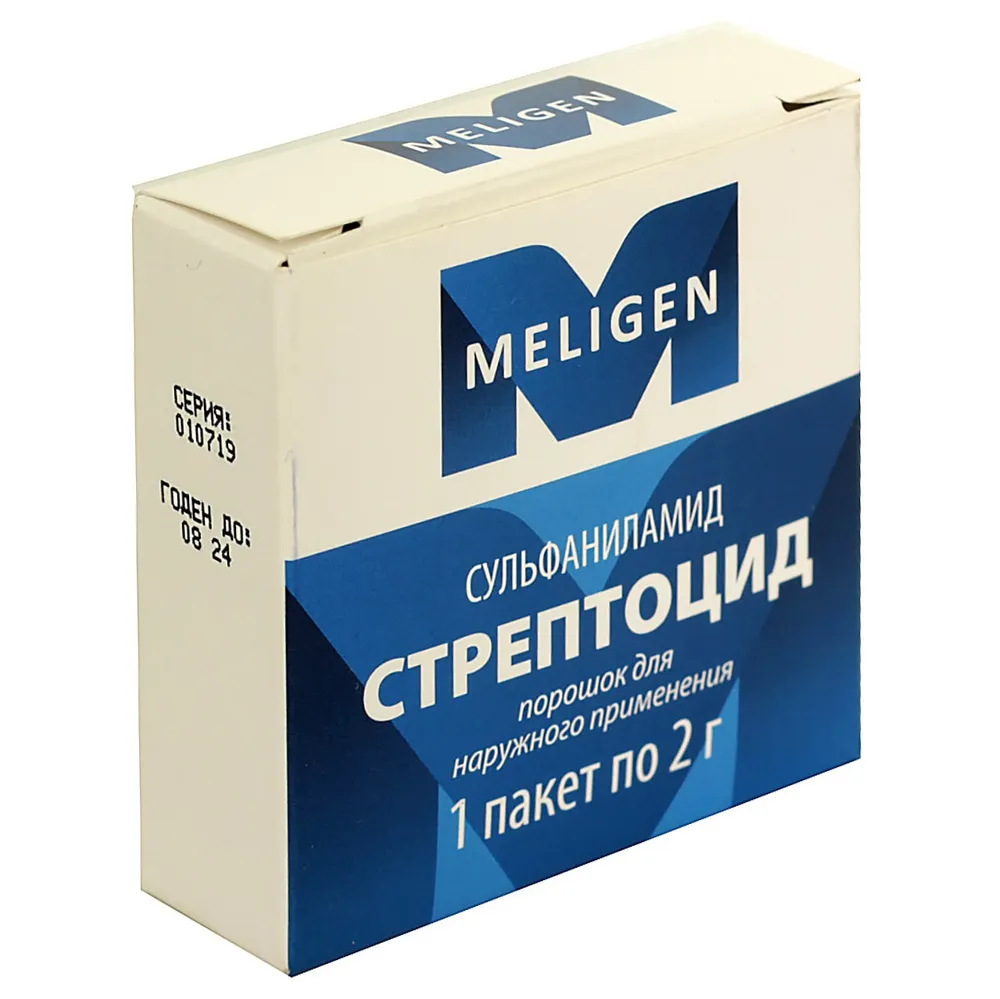
Table of Contents
INSTRUCTIONS FOR MEDICAL USE OF THE MEDICINAL PRODUCT STREPTOCID (STREPTOCID)
Composition:
Active substance: sulfanilamide;
1 sachet contains 2 g or 5 g of sulfanilamide;
1 polymer bottle contains 15 g of sulfanilamide.
Pharmaceutical form. Topical powder.
Main physico-chemical properties: white or yellowish-white powder.
Pharmacotherapeutic group.
Chemotherapeutic agents for topical use. Sulfonamides.
ATC code D06B A05.
Pharmacological properties.
Pharmacodynamics.
Streptocide exerts an antimicrobial bacteriostatic effect. It is active against gram-positive and gram-negative cocci, Escherichia coli, Shigella spp., Vibrio cholerae, Clostridium perfringens, Bacillus anthracis, Corynebacterium diphtheriae, Yersinia pestis, Chlamydia spp., Actinomyces israelii, Toxoplasma gondii. Streptocide disrupts the assimilation process of microbial cells' growth factors—folic acid, dihydrofolic acid, and other compounds containing para-aminobenzoic acid (PABA). Due to the similarity in chemical structure between PABA and sulfanilamide, the latter acts as a competitive antagonist of the acid, incorporates into the metabolism of microorganisms, and disrupts it.
Pharmacokinetics.
Not studied.
Clinical characteristics.
Indications.
Infected superficial wounds of various etiologies and burns (I and II degrees), pyodermas, impetigo, and superficial infectious-inflammatory skin conditions.
Contraindications.
Hypersensitivity to sulfanilamide or to any other sulfonamide agents; renal failure; acute porphyria; blood disorders; acute hepatitis; congenital glucose-6-phosphate dehydrogenase deficiency; pregnancy and breastfeeding.
Interaction with other medicinal products and other forms of interaction.
Preparations containing para-aminobenzoic acid (PABA) esters (e.g., procaine, anestezin, dicaine) inactivate the antibacterial activity of sulfonamides.
Concomitant use with other agents causing bone marrow suppression is not recommended.
During Streptocide application, it is undesirable to take the following medicinal products: digoxin, hydrochloric acid, caffeine, mesaton, phenobarbital, epinephrine hydrochloride.
Instructions for use
If an allergic reaction occurs at the site of powder application, discontinue use of the medicinal product. Premature discontinuation of treatment may lead to the development of sulfonamide-resistant microorganisms.
Avoid contact of the product with the eyes.
When using the product in patients with extensive skin lesions, consider the possibility of absorption of the active ingredient. Consult a physician before use.
Use during pregnancy or breastfeeding
The use of the medicinal product is contraindicated.
Ability to affect reaction speed when driving or operating machinery
Has no effect.
Method of Administration and Dosage.
Adults are usually administered Streptocide powder once every 1–2 days.
The powder should be sprinkled over the affected area; the amount of medication depends on the size of the lesion. If necessary, after applying the medication to the affected skin area, a gauze dressing may be applied. The maximum single dose for adults is 5 g; the maximum daily dose for adults is 15 g. Frequency and duration of administration depend on the severity of the disease, the therapeutic effect achieved, and are determined individually by the physician.
Children. Can be used in children aged 3 years and older, as prescribed by a physician, following careful assessment of the benefit/risk ratio.
Overdose.
In case of overdose, adverse drug reactions may intensify.
Treatment: discontinuation of the drug, symptomatic therapy. In case of accidental ingestion — gastric lavage.
Adverse reactions.
Allergic reactions are possible, including dermatitis and urticaria; if these occur, the drug must be discontinued immediately.
Reporting suspected adverse reactions
Reporting suspected adverse reactions after drug registration is highly important. It enables ongoing monitoring of the benefit-risk balance of the medicinal product. Healthcare and pharmaceutical professionals, as well as patients or their legal representatives, should report all cases of suspected adverse reactions and lack of efficacy via the Automated Pharmacovigilance Information System at the following link: https://aisf.dec.gov.ua.
Shelf life. 3 years.
Storage conditions.
Store in the original packaging at a temperature not exceeding 25 °C.
Keep out of reach of children.
Packaging.
2 g or 5 g of powder in sachets, 20 sachets per cardboard box.
15 g of powder in a polymer bottle, 1 polymer bottle per cardboard box.
Supply category. Over-the-counter.
Manufacturer.
LLC "Istok-Plus".
Manufacturer's address and location of business activity.
4 Makarenka Street, Zaporizhzhia, Ukraine, 69032.