Strepsils® original
Ukraine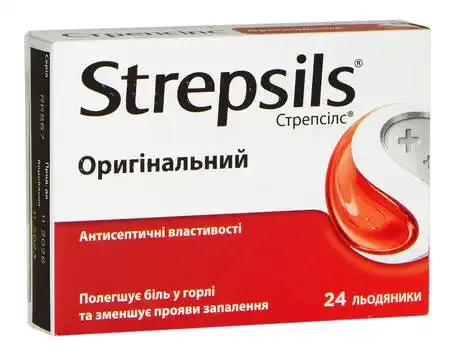
Table of Contents
INSTRUCTIONS FOR MEDICAL USE OF THE MEDICINAL PRODUCT STREPSILS® ORIGINAL (STREPSILS® ORIGINAL)
Composition:
Active substances:
2,4-dichlorobenzyl alcohol, amylmetacresol;
1 lozenge contains: 2,4-dichlorobenzyl alcohol 1.2 mg; amylmetacresol 0.6 mg;
Excipients:
star anise oil, peppermint oil, levomenthol, tartaric acid, Ponceau 4R (E 124), carmoisine (E 122), sucrose solution, glucose solution.
Pharmaceutical form.
Lozenges.
Main physicochemical properties:
Round red lozenges with the letter "S" embossed on both sides.
Pharmacotherapeutic group.
Preparations used in throat disorders. Antiseptics. Dichlorobenzyl alcohol. ATC code R02A A03.
Pharmacological properties.
Pharmacodynamics.
The product has antiseptic properties. It is active against a broad spectrum of Gram-positive and Gram-negative microorganisms and exerts antifungal effects. The efficacy of the product is due to the presence of two broad-spectrum antibacterial components that help relieve throat pain and reduce inflammatory symptoms. Amylmetacresol disrupts the protein structure of bacteria, providing bactericidal action. 2,4-Dichlorobenzyl alcohol exerts bacteriostatic action by dehydrating the bacterial cell.
Strepsils® Original contains star anise oil and peppermint oil, which help relieve throat pain.
Pharmacokinetics.
Due to negligible absorption, the product is considered a locally acting agent. Because of this, pharmacokinetic parameters have not been determined.
Clinical characteristics.
Indications.
Symptomatic treatment of infectious and inflammatory diseases of the oral cavity and throat.
Contraindications. Hypersensitivity to any component of the drug.
Interaction with other medicinal products and other types of interactions.
Interaction studies have not been conducted.
Special precautions for use.
Do not exceed the stated maximum dose.
If symptoms persist for more than 3 days, consult a physician for further adjustment of the treatment regimen.
This medicinal product should not be used in patients with rare hereditary problems of fructose intolerance, glucose-galactose malabsorption or sucrase-isomaltase deficiency. Diabetic patients should be aware that one lozenge contains approximately 2.6 g of sugar.
Use during pregnancy or breastfeeding.
Pregnancy.
The safety of using this medicinal product during pregnancy or breastfeeding has not been fully established; however, risk occurrence during these periods is not expected. Nevertheless, as with all medicinal products, caution should be exercised during pregnancy or breastfeeding.
Breastfeeding.
It is unknown whether 2,4-dichlorobenzyl alcohol, amylmetacresol, or their metabolites pass into breast milk. Risk to newborns/infants cannot be ruled out.
Data on effects on fertility are lacking.
Ability to affect reaction speed when driving or operating machinery.
The effect on the ability to drive or operate machinery is absent or negligible.
Dosage and Administration.
For oromucosal use.
Use the lowest effective dose necessary to relieve symptoms for the shortest possible duration.
Recommended for adults and children aged 6 years and older: one lozenge every 2–3 hours. The lozenge must be slowly dissolved in the mouth until completely dissolved. Do not use more than 12 lozenges within 24 hours. If symptoms do not improve or worsen within 3 days, consult a physician.
Dosage adjustment is not required for elderly patients.
Children.
Due to the pharmaceutical form, the medicinal product is contraindicated in children under 6 years of age.
Overdose.
In the unlikely event of overdose, serious adverse effects are not expected. Some gastrointestinal discomfort may occur. Treatment is symptomatic.
Side effects.
The following side effects have been observed with short-term use of
2,4-dichlorobenzyl alcohol and amylmetacresol at over-the-counter doses. Other side effects may occur during treatment of chronic conditions or with prolonged use.
Side effects are classified by system organ class and frequency. Frequency is defined as follows: very common: ≥1/10; common: ≥1/100 and <1/10; uncommon: ≥1/1000 and <1/100; rare: ≥1/10000 and <1/1000; very rare: <1/10000; not known (cannot be estimated from available data). Within each frequency group, side effects are listed in decreasing order of severity.
Immune system disorders.
Uncommon: hypersensitivity reactions, including rash, urticaria, and angioneurotic edema, which may involve swelling of the face, neck, throat, or tongue and may affect breathing.
Respiratory, thoracic and mediastinal disorders.
Uncommon: pharyngeal edema (throat swelling).
Gastrointestinal disorders.
Uncommon: oral discomfort (oral burning sensation), throat irritation (throat burning), oral paraesthesia (tingling in the mouth), oral swelling. Rare: glossodynia (painful tongue). Very rare: dyspepsia, nausea, stomatitis. Not known: abdominal pain.
Skin and subcutaneous tissue disorders.
Not known: skin rash, pruritus, erythema.
Shelf life.
3 years.
Storage conditions.
Store at a temperature not exceeding 25 °C. Keep out of the reach of children.
Packaging.
12 lozenges in a blister; 2 blisters in a cardboard box.
Marketing authorization category.
Over-the-counter.
Manufacturer.
Reckitt Benckiser Healthcare International Limited
Manufacturer's address.
Nottingham Site, Thane Road, Nottingham, NG90 2DB, United Kingdom.