Steatel
Ukraine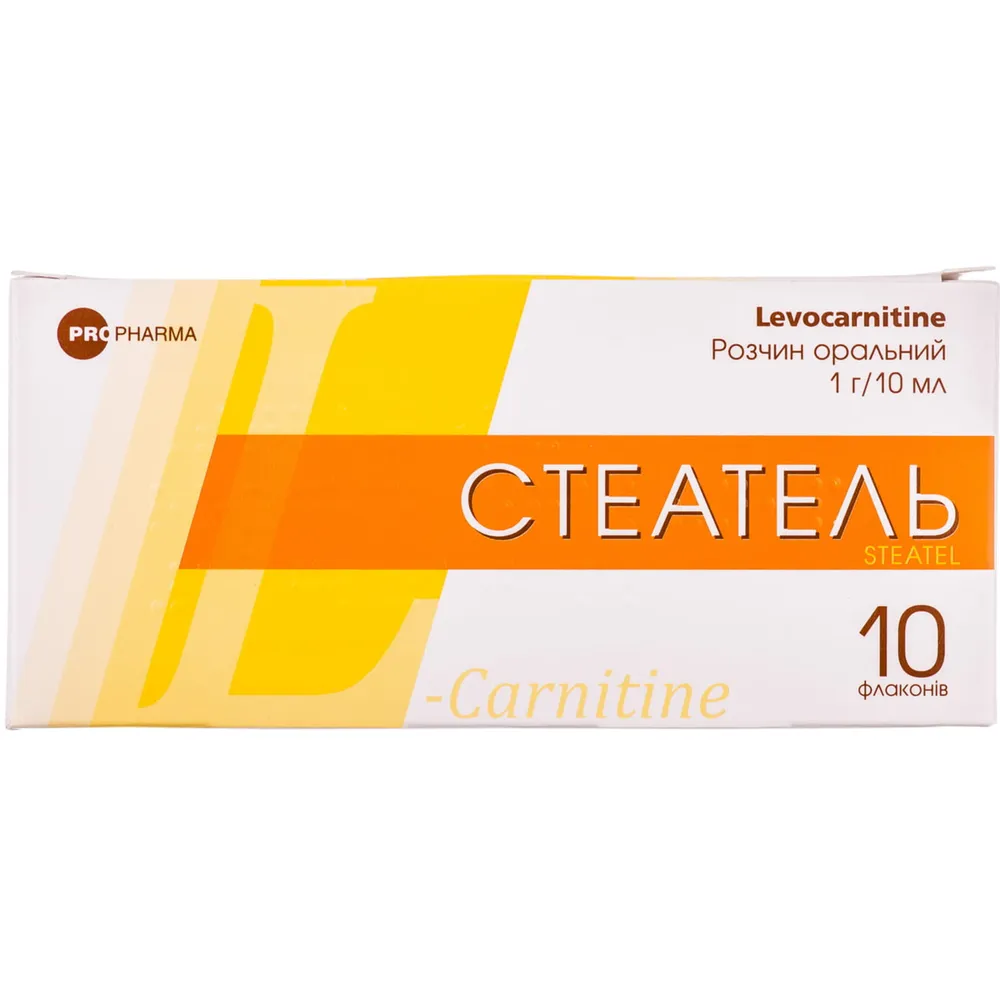
Table of Contents
INSTRUCTIONS FOR MEDICAL USE OF THE MEDICINAL PRODUCT STEATEL (STEATEL)
Composition:
Active substance: levocarnitine;
1 ml of solution contains 100 mg of levocarnitine;
Excipients: malic acid, methylparaben (E 218), propylparaben (E 216), sodium saccharin, orange flavor, purified water.
Pharmaceutical form. Oral solution.
Main physicochemical properties: clear liquid, colorless to slightly yellowish.
Pharmacotherapeutic group. Amino acids and their derivatives. ATC code A16AA01.
Pharmacological Properties
Pharmacodynamics
Levocarnitine is a natural substance essential for energy metabolism. Levocarnitine facilitates the entry of long-chain fatty acids into the mitochondria of cells, thereby providing a substrate for oxidation and energy production. Fatty acids are used as an energy substrate in all tissues except the brain. Primary systemic carnitine deficiency is characterized by low concentrations of levocarnitine in blood plasma, erythrocytes, and/or tissues. It is not fully established which symptoms are caused specifically by carnitine deficiency and which by organic acidemia; however, carnitine is expected to alleviate symptoms of both conditions. Carnitine enhances the elimination of excess organic and fatty acids in patients with impaired fatty acid metabolism and/or specific organic acidopathies that cause accumulation of acyl-CoA in the body.
Secondary deficiency occurs due to dietary carnitine deficiency, incomplete endogenous synthesis, or exceptionally high endogenous demands for carnitine, including in critically ill, weakened, and postoperative patients. A significant reduction in myocardial carnitine levels has been observed in patients with dilated cardiomyopathy and ischemic heart disease. Total myocardial carnitine levels have been shown to decrease to 42% in heart failure. Carnitine deficiency has been proven to impair myocardial contractility and cause cardiac arrhythmias.
The development of hepatic steatosis is associated with carnitine deficiency leading to mitochondrial dysfunction. Levocarnitine promotes improved energy metabolism and reduces fatty infiltration of the liver.
Carnitine deficiency may result from congenital metabolic disorders. Carnitine can reduce metabolic disturbances in patients with congenital conditions causing accumulation of toxic organic acids. This effect has been demonstrated in the following conditions: glutaric aciduria type II, methylmalonic aciduria, propionic acidemia, and medium-chain acyl-CoA dehydrogenase deficiency. 7,8-auto-intoxication in these patients results from the accumulation of acyl-CoA compounds, which disrupt intermediary metabolism. Subsequent hydrolysis of acyl-CoA compounds into free acids leads to acidosis, which may be life-threatening. Levocarnitine neutralizes acyl-CoA compounds by forming acylcarnitine, which is rapidly excreted from the body. Carnitine is effective in alcohol- or drug-induced intoxication, as well as intoxication caused by xenobiotics.
Carnitine deficiency is diagnosed biochemically by very low plasma free carnitine concentration—less than 20 µmol/L one week after drug administration—and may be associated with simultaneously low tissue and/or urinary concentrations. Additionally, this condition may be linked to a plasma acylcarnitine/levocarnitine ratio exceeding 0.4 or abnormally high concentrations of acylcarnitine in urine. In preterm infants and newborns, secondary deficiency is defined as plasma levocarnitine concentration below the age-specific reference range. Carnitine has demonstrated efficacy in peripheral neuropathy, including diabetic and alcoholic neuropathy, as well as in patients with obesity and atherogenic dyslipidemia. Levocarnitine increases cellular sensitivity to insulin.
Levocarnitine did not bind to plasma proteins or albumin at any concentrations tested in animals and humans.
Pharmacokinetics
Between 58% and 65% of levocarnitine is excreted in urine and feces within 5–11 days. Maximum plasma concentration of carnitine was observed 2.0–4.5 hours after administration. The main identified metabolites were trimethylamine-N-oxide, predominantly in urine (8%–49% of the administered dose), and [3H]-γ-butyrobetaine, predominantly in feces (0.44%–45% of the administered dose). Renal excretion of unchanged levocarnitine accounts for 4%–8% of the administered dose. Fecal excretion of unchanged levocarnitine is less than 1% of the administered dose.
Clinical characteristics.
Indications.
Primary (congenital) carnitine deficiency;
secondary carnitine deficiency;
cardiomyopathy.
Contraindications.
Hypersensitivity to the components of the drug.
Special safety precautions.
Administration of levocarnitine to patients with diabetes mellitus who are receiving insulin or oral hypoglycemic therapy may cause hypoglycemia. For such patients, plasma glucose levels should be monitored continuously to adjust the hypoglycemic treatment regimen. Long-term oral administration of high doses of levocarnitine to patients with severe renal function impairment or end-stage renal disease (ESRD) is not recommended, as it may lead to accumulation in blood of potentially toxic metabolites, trimethylamine (TMA) and trimethylamine-N-oxide (TMAO), due to insufficient renal excretion. Such accumulation leads to increased TMA in urine.
The recommended doses of the drug should not be exceeded. If adverse effects occur, the drug should be discontinued.
Interaction with other medicinal products and other forms of interaction.
Concomitant use of glucocorticoids leads to accumulation of levocarnitine in body tissues (except liver). Other anabolic agents enhance the effect of the drug.
Usage Notes.
Use during pregnancy or breastfeeding.
Teratogenic or embryotoxic effects of the drug have not been reported. However, due to the lack of adequate controlled clinical studies, the drug should be used during pregnancy only if the expected benefit for the mother outweighs the potential risk to the fetus.
If Steatil use is necessary, breastfeeding should be discontinued for the duration of treatment.
Ability to influence reaction rate when driving or operating machinery.
Has no effect.
Dosage and Administration.
The dosage and duration of treatment are determined individually by a physician, depending on age and the specific nosological form of the disease. Steateal should be taken orally, 30 minutes before meals. For dosing the medication, use the provided dosing syringe or measuring cup.
For adults, the initial dose is 1 g (10 ml) per day, gradually increasing the dose depending on the patient's condition and tolerability. The usual dosage for adults is 1–3 g (10–30 ml) per day, divided into 1–3 doses. The maximum daily dose for adults is 6 g (60 ml).
The average treatment course for adults and children lasts 1–3 months. If necessary, the treatment course may be repeated. In cases of primary and secondary carnitine deficiency, the medication should be taken continuously or until the underlying cause is resolved.
Children. The medication may be administered to children (full-term and preterm newborns) starting from the first day of life.
For children, Steateal should be initiated at a dose of 50 mg/kg per day. Usual doses for children range from 50–100 mg/kg per day (see table).
Table
| Age |
Single dose |
Number of doses per day |
| Newborns |
100 mg (1 ml) |
2-3 |
| Children under 1 year |
100-200 mg (1-2 ml) |
2-3 |
| Children 1-3 years |
200-400 mg (2-4 ml) |
3 |
| Children 4-6 years |
400-600 mg (4-6 ml) |
3 |
| Children 7-11 years |
500-800 mg (5-8 ml) |
3 |
| Children from 12 years |
800-1000 mg (8-10 ml) |
3 |
The maximum daily dose for children is 3 g (30 ml).
Overdose.
There have been no reports of toxicity of levocarnitine in case of overdose. Large doses of the drug may cause diarrhea.
In case of overdose, symptomatic treatment should be administered.
Side effects.
With prolonged oral administration of L-carnitine, various mild gastrointestinal disturbances have been reported: reversible nausea and vomiting, flatulence, diarrhea. Cases of mild myasthenia have been described only when L-carnitine was administered to patients with uremia.
Sensitivity to the drug should be carefully monitored during the first week of treatment and after each dose increase.
Seizure episodes have been reported in patients both with and without pre-existing seizure activity who received levocarnitine orally or intravenously.
Shelf life.
3 years.
Storage conditions.
Store at a temperature not exceeding 25 °C, in a protected from light place. Keep out of reach of children.
Packaging.
10 ml in a vial, 10 vials in a cardboard box.
Prescription status.
Over-the-counter (non-prescription).
Manufacturer.
HELP S.A.
HELP S.A.
Manufacturer's address and place of business.
Pedini Ioanninon, Ioannina 45500, Greece.