Son-night
Ukraine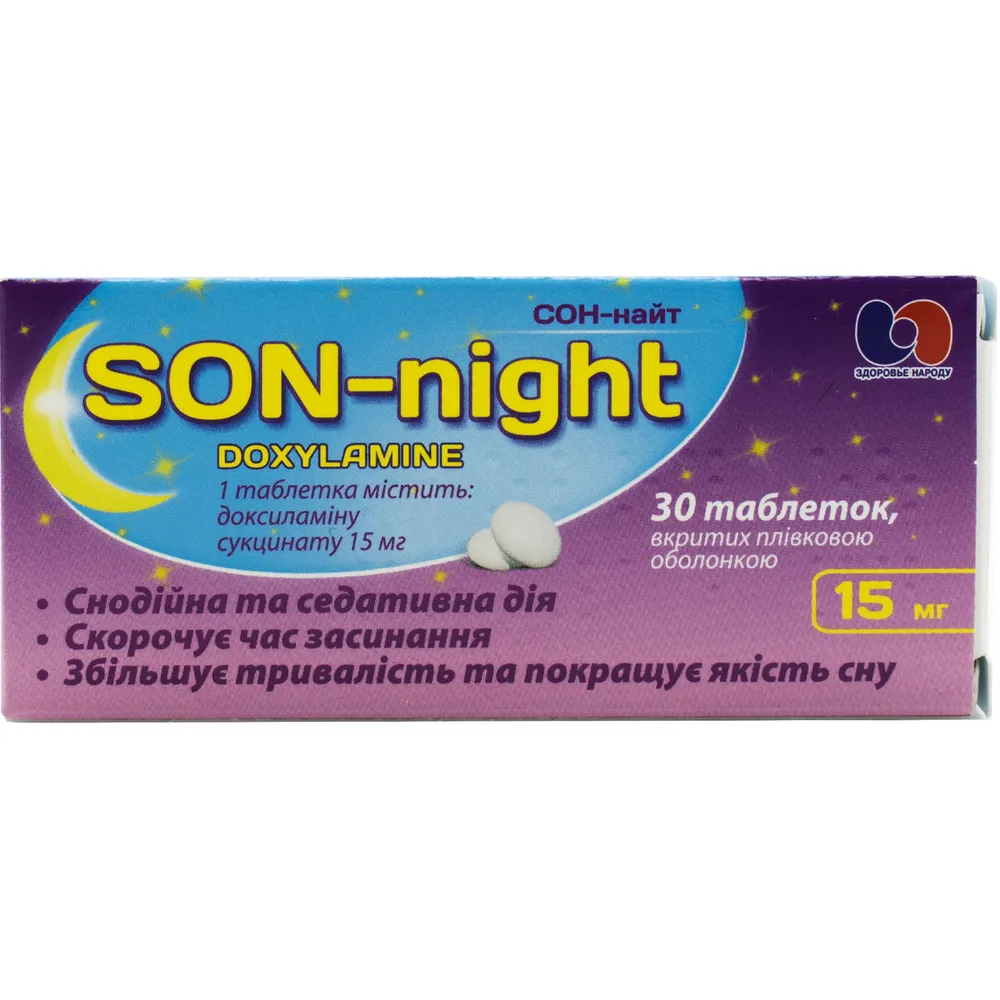
Table of Contents
INSTRUCTION FOR MEDICAL USE OF THE MEDICINAL PRODUCT SLEEP-NIGHT
Composition:
Active substance: doxylamine;
1 tablet contains 15 mg of doxylamine succinate;
Excipients: sodium hydrocarbonate, citric acid, polyethylene glycol 6000, sodium benzoate (E 211), anhydrous sodium sulfate, sodium hydrogen phosphate.
Pharmaceutical form. Effervescent tablets.
Main physico-chemical properties: white, round-shaped tablets with a flat surface, bevelled edges, and a score line on one side. Effervescence (gas bubbles) is observed when dissolving in water. Chipping is permissible.
Pharmacotherapeutic group.
Antihistamines for systemic use. ATC code R06A A09.
Hypnotics and sedatives. ATC code N05C M.
Pharmacological Properties.
Pharmacodynamics.
Doxylamine succinate is an H1-histamine receptor antagonist of the ethanolamine class, which has sedative and atropine-like effects. It has been demonstrated to reduce the time required to fall asleep, as well as improve sleep duration and quality.
Pharmacokinetics.
Maximum plasma concentration (Cmax) is reached on average within 1 hour (Tmax) after administration of doxylamine succinate.
The average elimination half-life from plasma (T½) is approximately 10 hours.
Doxylamine succinate is partially metabolized in the liver via demethylation and N-acetylation. The various metabolites formed during degradation are not quantitatively significant, as 60% of the administered dose is excreted in urine in the unchanged form of doxylamine.
Clinical characteristics.
Indications. Periodic and transient insomnia in adults.
Contraindications. Hypersensitivity to doxylamine succinate or to other antihistamines. History of closed-angle glaucoma in the patient or family history. Urethroprostatic disorders with risk of urinary retention.
Interaction with other medicinal products and other forms of interaction. Alcohol enhances the sedative effect of most H1-antihistamines. Consumption of alcoholic beverages and medicinal products containing ethanol should be avoided.
The following combinations with the drug should be taken into account:
- with atropine and atropine-like medicinal products (tricyclic antidepressants, anticholinergic antiparkinsonian agents, atropine-like spasmolytics, disopyramide, phenothiazine neuroleptics) may lead to adverse effects such as urinary retention, constipation, dry mouth;
- with other central nervous system depressants (morphine derivatives: analgesics; antitussives and substitution therapy agents, neuroleptics; barbiturates, benzodiazepines; anxiolytics other than benzodiazepines; sedative antidepressants: amitriptyline, doxepin, mianserin, mirtazapine, trimipramine; sedative H1-antihistamines; centrally acting antihypertensives; others: baclofen, pizotifen, thalidomide), due to enhanced central nervous system depression.
Special precautions for use
Insomnia may have various causes that do not necessarily require drug treatment; therefore, consultation with a physician is recommended before starting the use of this medicinal product.
Like all hypnotics or sedatives, doxylamine succinate may exacerbate sleep apnea syndrome (increasing the number and duration of breathing pauses).
H1-antihistamines should be used with caution in elderly patients due to the risk of dizziness, which may increase the risk of falls (e.g., when getting up at night), potentially leading to serious consequences in this patient group.
To prevent daytime drowsiness, it should be remembered that the duration of sleep after taking the medication should be at least 7 hours.
This medicinal product contains 21 mmol (or 484 mg)/dose (1 tablet) of sodium. Caution is advised when administering to patients on a sodium-restricted diet.
Use during pregnancy or breastfeeding. Based on available data, doxylamine may be used during pregnancy after consultation with a physician. If this medicinal product is used in late pregnancy, the atropine-like and sedative properties of this molecule should be taken into account when monitoring the newborn.
It is unknown whether doxylamine passes into breast milk; therefore, the use of this medicinal product during breastfeeding is not recommended.
Ability to affect reaction speed while driving or operating machinery. The risk of daytime drowsiness should be considered, particularly in individuals who drive or operate machinery, as it may occur during treatment with this medicinal product.
Dosage and Administration.
For oral use. Take 15–30 minutes before bedtime.
The recommended dose is 7.5–15 mg per day (½–1 tablet per day). If necessary, the dose may be increased to 30 mg per day (2 tablets per day). Dissolve the tablet in ½ glass of water before administration.
In elderly patients and patients with renal or hepatic impairment, a reduced dose is recommended.
The duration of treatment is 2–5 days.
If insomnia persists for more than 5 days, consult a physician regarding the appropriateness of continuing the medication.
Children. The drug must not be used in children under 18 years of age.
Overdose. The initial signs of acute poisoning include drowsiness and anticholinergic effects: excitation, dilated pupils, accommodation paralysis, dry mouth, facial and neck flushing, hyperthermia, and sinus tachycardia. Delirium, hallucinations, and athetoid movements are more commonly observed in children; these may sometimes precede seizures—rare complications of massive poisoning. Even in the absence of seizures, acute doxylamine poisoning may occasionally cause rhabdomyolysis, which can lead to acute renal failure. This muscular disorder is relatively common and requires systematic screening by measuring creatine phosphokinase activity.
Treatment is symptomatic. In early stages of poisoning, activated charcoal is recommended (50 g for adults, 1 g/kg for children).
Side effects.
Anticholinergic effects are rarely developed: constipation, dry mouth, accommodation disturbances, tachycardia.
Daytime drowsiness: if this effect develops, the dose should be reduced.
Allergic reactions are possible, including skin rashes, itching.
Shelf life. 2 years.
Storage conditions. Store in the original packaging at a temperature not exceeding 25 °C.
Keep out of reach of children.
Packaging. Effervescent tablets 15 mg; No. 10 (2 x 5), No. 20 (2 x 10) in a strip in a box.
Availability classification.
No. 10 - over-the-counter;
No. 20 - prescription only.
Manufacturer. LIMITED LIABILITY COMPANY "CORPORATION "ZDOROVIYA".
Manufacturer's address and location of business activity. 22, Shevchenko Street, Kharkiv, Kharkiv region, 61013, Ukraine.