Gastric collection
Ukraine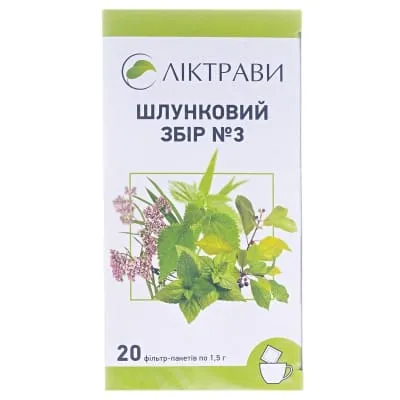
Table of Contents
INSTRUCTION FOR MEDICAL USE OF THE MEDICINAL PRODUCT GASTRIC HERBAL MIXTURE
Composition:
Active substances: contains a mixture of powdered herbal raw materials: chamomile flowers (Matricariae flos) – 1 part, yarrow herb (Millefolii herba) – 1 part, marigold flowers (Calendulae flos) – 1 part, St. John's wort herb (Hyperici herba) – 1 part, peppermint leaves (Menthae piperitae folium) – 1 part.
Pharmaceutical form. Herbal mixture.
Main physicochemical characteristics: mixture of particles and fragments of various shapes, yellow-green in color, with white and yellow-brown inclusions. Weak, aromatic odor.
Pharmacotherapeutic group.
Agents affecting the digestive system and metabolic processes. ATC code A16A X.
Pharmacological properties.
Pharmacodynamics.
The herbal mixture contains anthraglycosides, free anthranols, triterpene glycosides, resinous substances, essential oil, terpenoids, flavonoids, tannins, glycosides, carotenoids, organic acids, micro- and macroelements, and free isovaleric acid. This complex of biologically active compounds causes chemical stimulation of receptors in the gastric and intestinal mucosa, resulting in a regulatory effect of the herbal mixture on the functions—including motility—of these sections of the gastrointestinal tract. Aqueous extracts of the mixture exert mild laxative, spasmolytic, sedative, anti-inflammatory, and choleretic effects.
The complex of substances contained in chamomile flowers (chamazulene, bitter glycosides, flavonoid compounds) exerts anti-inflammatory, spasmolytic, and choleretic effects.
Biologically active substances present in peppermint leaves exert spasmolytic, analgesic, and choleretic effects.
Calendula flowers contain carotenoids (carotene, lycopene, violaxanthin, citroxanthin, rubixanthin, flavoxanthin), flavonoids (narsetin, ramnetin, isorhamnetin-3-triglucoside, isoquercitrin), essential oil, saponins, the bitter compound calendin, resinous and tannin substances, mucilage, inulin, organic acids (malic, salicylic, pentadecylic), phytosterol, enzymes, vitamin C, and alkaloids. This complex of biologically active substances exerts anti-inflammatory, wound-healing, bactericidal, spasmolytic, and choleretic effects and accelerates tissue regeneration. Calendula preparations administered internally promote regeneration of gastric and intestinal mucosa, accelerate healing of ulcers and erosions, exert a sedative and mild hypotensive effect, and support normalization of cardiac function.
Yarrow herb contains essential oil composed of proazulene, α- and β-pinene, camphor, borneol, thujone, cineole, caryophyllene, as well as flavonoids (luteolin-7-glucoside, rutin), sesquiterpenes (matricin, millefolide, balkhanolide), tannins and bitter substances, achillein, vitamin K, and organic acids (acetic, formic, isovaleric). This complex of biologically active substances exerts hemostatic, anti-inflammatory, bactericidal, and anti-allergic effects; stimulates taste receptors and enhances gastric secretory activity; dilates bile ducts and increases bile secretion; and promotes diuresis.
St. John's wort herb contains tannins, flavonoids (hyperoside, rutin, quercitrin, myricetin, leucoanthocyanins), saponins, pigments (hypericin, pseudohypericin, hyperin, frangulaemodinanthranol), essential oil, resinous substances, carotene, and ascorbic acid. This complex of biologically active substances exerts astringent, anti-inflammatory, and mild antimicrobial effects, promotes tissue regeneration, moderately influences bile secretion, and stimulates gastric secretion.
Clinical characteristics.
Indications.
Functional dyspepsia, flatulence; as part of complex treatment of gastric and duodenal ulcers.
Contraindications.
Hypersensitivity to the components of the drug. Bronchial asthma. Pregnancy and breastfeeding. Pediatric age.
Interaction with other medicinal products and other forms of interaction.
Not established.
Special precautions.
If your condition worsens, consult a doctor.
The tincture should be shaken before use.
Use during pregnancy or breastfeeding.
The safety and clinical efficacy of the medicinal product during pregnancy or breastfeeding have not been studied; therefore, Gastric Collection should not be administered during these periods.
Ability to influence reaction rate while driving or operating machinery.
No effect.
Dosage and Administration.
Place 2 filter packets in a glass or enameled container, pour 200 ml (1 glass) of boiling water, cover and let steep for 15 minutes.
Place 10 g (2 tablespoons) of the herbal mixture into an enameled container, add 500 ml of hot boiled water, cover with a lid, and steep in a water bath for 15 minutes. Allow to cool at room temperature for 45 minutes, then strain, squeezing the residue, and add the squeezed liquid to the strained infusion. Adjust the total volume of the infusion to 500 ml with boiled water.
Adults should take 1 glass of the warm infusion twice daily, 20–30 minutes before meals.
The duration of treatment is determined individually by the physician, depending on the nature, severity, and course of the disease, stability of the achieved therapeutic effect, and the patient's tolerance to the drug, and usually lasts 2–4 weeks.
Children.
The safety and efficacy of the drug in children have not been established; therefore, Gastric Herbal Mixture should not be administered to this age group.
Overdose.
There have been no reports of overdose with this medicinal product.
Adverse reactions.
Allergic reactions and photosensitization are possible.
If any unusual reactions occur, consult a physician.
Shelf life.
2 years.
Storage conditions.
Store in the original packaging at a temperature not exceeding 25°C.
Keep out of reach of children.
Packaging.
1.5 g in filter bags, 25 units per pack; 50 g in packets; 50 g in film packets in packs.
Prescription category.
Over-the-counter.
Manufacturer.
JSC "Lubnipharm".
Manufacturer's location and address of business activity.
16, Barvinkova St., Lubny, Poltava region, 37500, Ukraine.
INSTRUCTIONS
for medical use of medicinal product
GASTRIC HERBAL TEA
Composition:
Active ingredients: contains a mixture of powdered herbal raw materials: chamomile flowers (Matricariae flos) – 1 part, yarrow herb (Millefolii herba) – 1 part, calendula flowers (Calendulae flos) – 1 part, St. John's wort herb (Hyperici herba) – 1 part, peppermint leaves (Menthae piperitae folium) – 1 part.
Pharmaceutical form. Herbal tea.
Main physicochemical properties: mixture of particles and fragments of different shapes, yellow-green in color with white and yellow-brown inclusions. Odor is weak, aromatic.
Pharmacotherapeutic group.
Agents affecting the digestive system and metabolic processes.
ATC code: A16AX.
Pharmacological properties.
Pharmacodynamics.
The components of the herbal tea contain anthraglycosides, free anthranols, triterpene glycosides, resinous substances, essential oil, terpenoids, flavonoids, tannins, glycosides, carotenoids, organic acids, micro- and macroelements, and free isovaleric acid. This complex of biologically active compounds causes chemical irritation of gastric and intestinal mucosal receptors, thereby determining the regulatory effect of the herbal tea on functions, including motility, of the specified parts of the gastrointestinal tract. Aqueous extracts of the herbal tea exert mild laxative, spasmolytic, sedative, anti-inflammatory, and choleretic effects.
The complex of substances contained in chamomile flowers (chamazulene, bitter glycoside, flavonoid compounds) exerts anti-inflammatory, spasmolytic, and choleretic effects.
Biologically active substances present in peppermint leaves exert spasmolytic, analgesic, and choleretic effects.
Calendula flowers contain carotenoids (carotene, lycopene, violaxanthin, citraxanthin, rubixanthin, flavochrome), flavonoids (narciissin, rhamnetin, isorhamnetin-3-triglucoside, isoquercitrin), essential oil, saponins, bitter substance calendin, resinous and tannin substances, mucilage, inulin, organic acids (malic, salicylic, pentadecylic), phytosterin, enzymes, vitamin C, and alkaloids. This complex of biologically active substances exerts anti-inflammatory, wound-healing, bactericidal, spasmolytic, and choleretic effects, accelerates tissue regeneration processes. Preparations from calendula flowers taken internally promote regeneration of gastric and intestinal mucosa, accelerate healing of ulcers and erosions, exert sedative and mild hypotensive effects, and contribute to normalization of cardiac function.
Yarrow herb contains essential oil, which includes proazulene, α- and β-pinenes, camphor, borneol, thujone, cineole, caryophyllene, as well as flavonoids (luteolin-7-glucoside, rutin), sesquiterpenes (matricin, millefolide, balchanolide), tannins and bitter substances, achillein, vitamin K, and organic acids (acetic, formic, isovaleric). This complex of biologically active substances exerts hemostatic, anti-inflammatory, bactericidal, and anti-allergic effects, irritates taste receptors and enhances gastric secretory activity, dilates bile ducts and increases bile excretion, enhances diuresis.
St. John's wort herb contains tannins, flavonoids (hyperoside, rutin, quercitrin, myricetin, leucoanthocyanins), saponins, pigments (hypericin, pseudohypericin, hyperin, frangulaemodin anthranol), essential oil, resinous substances, carotene, and ascorbic acid. This complex of biologically active substances exerts astringent, anti-inflammatory, and some antimicrobial effects, promotes tissue regeneration, moderately affects bile excretion, and stimulates gastric secretion.
Clinical characteristics.
Indications.
Functional dyspepsia, meteorism; as part of complex treatment of gastric and duodenal ulcers.
Contraindications.
Hypersensitivity to the components of the preparation. Bronchial asthma. Pregnancy and lactation. Pediatric age.
Interaction with other medicinal products and other types of interactions.
Not established.
Special precautions.
If the condition worsens, consult a physician.
The infusion is recommended to be shaken before use.
Use during pregnancy or breastfeeding.
Safety and clinical efficacy of the preparation during pregnancy or breastfeeding have not been studied; therefore, Gastric Herbal Tea should not be administered during these periods.
Ability to affect reaction rate when operating vehicles or machinery.
Does not affect.
Administration and dosage.
Place 2 filter bags into a glass or enameled container, pour 200 ml (1 glass) of boiling water, cover and let steep for 15 minutes.
Place 10 g (2 tablespoons) of the herbal tea into an enameled container, add 500 ml of hot boiled water, cover with a lid, and let steep in a boiling water bath for 15 minutes. Cool at room temperature for 45 minutes, strain, squeeze residue into the strained infusion. Adjust the volume of the infusion to 500 ml with boiled water.
Adults take 1 glassful twice daily, warm, 20–30 minutes before meals.
The duration of treatment is determined individually by a physician depending on the nature, severity, and course of the disease, stability of the achieved therapeutic effect, and tolerability of the preparation, and usually lasts 2–4 weeks.
Children.
Safety and efficacy of the preparation in children have not been established; therefore, Gastric Herbal Tea should not be administered to this age group.
Overdose.
No cases of overdose have been reported.
Adverse reactions.
Allergic reactions and photosensitization are possible.
In case of any unusual reactions, consult a physician.
Shelf life.
2 years.
Storage conditions.
Store in the original packaging at a temperature not exceeding 25°C.
Keep out of reach of children.
Packaging.
1.5 g in filter bags, 25 units per pack; 50 g in packets; 50 g in film packets in packs.
Prescription category.
Over-the-counter.
Manufacturer.
JSC "Lubnipharm".
Manufacturer's location and address of business activity.
16, Barvinkova St., Lubny, Poltava region, 37500, Ukraine.