Setegis
Ukraine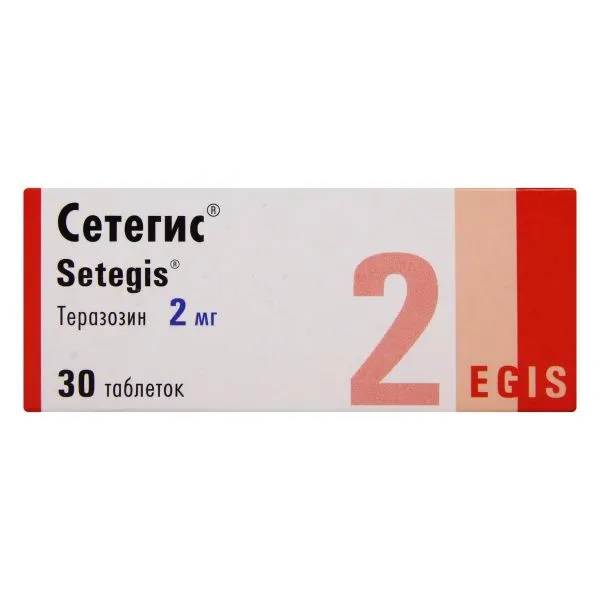
Table of Contents
INSTRUCTIONS FOR MEDICAL USE OF THE MEDICINAL PRODUCT SЕТЕГIS® (SETEGIS®)
Composition:
Active substance: 1 tablet contains 1 mg or 2 mg or 5 mg or 10 mg of terazosin (as 1.187 mg or 2.374 mg or 5.935 mg or 11.87 mg of terazosin hydrochloride dihydrate, respectively);
Excipients: lactose monohydrate, pregelatinized starch, povidone, magnesium stearate, talc;
Tablets 2 mg contain quinoline yellow (E 104);
Tablets 5 mg or 10 mg: yellow sunset FCF (E 110).
Pharmaceutical form. Tablets.
Main physico-chemical properties:
Tablets 1 mg – round, flat, white tablets with a bevel, smooth on one side and engraved with a stylized letter E and the number 451 on the other side, odorless;
Tablets 2 mg – round, flat, yellow tablets with a bevel, smooth on one side and engraved with a stylized letter E and the number 452 on the other side, odorless;
Tablets 5 mg – round, flat, light-orange tablets with a bevel, smooth on one side and engraved with a stylized letter E and the number 453 on the other side, odorless;
Tablets 10 mg – round, flat, orange tablets with a bevel, smooth on one side and engraved with a stylized letter E and the number 454 on the other side, odorless.
Pharmacotherapeutic group. Drugs used in benign prostatic hyperplasia. Alpha-adrenoreceptor antagonists. Terazosin.
ATC code G04C A03.
Pharmacological properties.
Pharmacodynamics.
Terazosin selectively blocks peripheral postsynaptic α1-adrenoceptors. Blockade of these receptors causes arterial vasodilation, reduction of total peripheral resistance, arterial pressure, and cardiac afterload. The tone of venous vessels is also reduced, leading to decreased venous return and cardiac preload. Long-term treatment with terazosin is usually not accompanied by reflex tachycardia; terazosin has minimal effects on cardiac output, renal perfusion, and glomerular filtration rate. The drug promotes normalization of lipid metabolism: it reduces levels of total cholesterol, triglycerides, LDL, and VLDL, while increasing HDL levels. With regular use, regression of left ventricular hypertrophy is observed.
By blocking postsynaptic α1-adrenoceptors in smooth muscles of the bladder outlet, proximal urethra, and prostate, terazosin reduces resistance to urine flow and normalizes micturition in patients with benign prostatic hyperplasia. The drug does not affect prostate size.
Pharmacokinetics.
Terazosin is rapidly and almost completely absorbed in the gastrointestinal tract, regardless of food intake. This indicates very low first-pass hepatic metabolism. The bioavailability of terazosin is nearly 90%. Terazosin is highly bound (90–94%) to plasma proteins. It is metabolized in the liver; one of the four known metabolites is pharmacologically active. The elimination half-life is approximately 12 hours and remains practically unchanged even in renal impairment. Maximum plasma concentration is reached within 1 hour, and maximum effect occurs 2–3 hours after oral administration. The duration of action is 24 hours. Approximately 40% of the administered dose is excreted in urine and 60% in feces.
Clinical characteristics.
Indications.
Symptomatic treatment of urinary retention due to benign prostatic hyperplasia.
Arterial hypertension (as monotherapy or in combination with other antihypertensive agents).
Contraindications.
- Hypersensitivity to the active substance or to any of the excipients.
- Known hypersensitivity to other structurally similar α-adrenoceptor antagonists.
- Patients with a history of syncope during urination.
- Arterial hypotension.
- Pediatric age (due to lack of sufficient clinical data).
Interaction with other medicinal products and other forms of interactions.
In clinical studies in patients with benign prostatic hyperplasia who received terazosin concomitantly with ACE inhibitors, beta-blockers, calcium ion antagonists, or diuretics, the incidence of dizziness or other treatment-related adverse effects was higher than in patients who received terazosin alone.
Caution should be exercised when administering terazosin concomitantly with other antihypertensive agents to avoid the development of pronounced hypotensive effects. It is recommended to reduce the dose of terazosin when diuretics or other antihypertensive drugs are added to the treatment regimen, and the additional agent should be initiated at the lowest possible doses. When terazosin is added to existing therapy, its initial dose should not exceed 1 mg.
No signs of interaction have been observed when terazosin was used concomitantly with analgesics, nonsteroidal anti-inflammatory drugs (NSAIDs), theophylline, cardiac glycosides, anxiolytics, antianginal agents, hypoglycemic agents, antiarrhythmics, sedatives, antibacterial agents, hormones, steroids, or antigout agents.
Cases of arterial hypotension have been reported with concomitant use of terazosin and phosphodiesterase-5 inhibitors (PDE-5). Combined use of terazosin with sildenafil or vardenafil is possible only in patients who are stable on terazosin therapy. Furthermore, vardenafil should not be taken within 6 hours after taking terazosin, and sildenafil should not be taken within 4 hours after taking terazosin.
The hypotensive effect of the drug may be enhanced by ethanol.
Special precautions for use.
Currently, there is insufficient experience with the use of terazosin in children.
Terazosin, like other α-adrenergic receptor antagonists, is not recommended for patients with a history of syncope associated with involuntary urination.
Terazosin should be prescribed with caution to patients aged 65 years and older who are prone to orthostatic hypotension, as well as in patients with ischemic heart disease and other severe cardiac disorders, cerebrovascular disease, hypertensive retinopathy grade III–IV, insulin-dependent diabetes mellitus, or hepatic or renal impairment.
Dose adjustment is not required for patients with renal impairment or elderly patients.
Before initiating treatment for benign prostatic hyperplasia, malignant prostate neoplasm should be excluded.
The drug should be used cautiously in patients with pheochromocytoma and in those requiring surgical intervention.
During the first days of treatment and after the first dose, a "first-dose effect" may occur—namely, a sudden drop in blood pressure, particularly orthostatic hypotension (accompanied by dizziness, impaired coordination, or loss of consciousness). The risk of postural hypotension may be increased in patients with reduced fluid volume or those on a low-salt diet. Similar symptoms may also develop when treatment is resumed after an interruption of several days. In such cases, treatment should be restarted at the initial dose (1 mg). The frequency of syncope episodes is approximately 1%.
In addition to the "first-dose effect," loss of consciousness may also result from too rapid an increase in dosage or the addition of diuretics or other antihypertensive agents to the treatment regimen. Loss of consciousness is primarily associated with pronounced orthostatic hypotension, which is sometimes accompanied by tachycardia (120–160 beats/min). The most pronounced orthostatic effect occurs immediately after drug intake, and the risk of syncope is highest 30–90 minutes after administration.
Dizziness, impaired coordination, or loss of consciousness may occur when changing from a sitting or lying position to a standing position, during prolonged standing, during excessive physical exertion, in hot weather, or when alcohol is consumed concurrently. If a patient experiences syncope, they should be placed in a horizontal position with legs elevated; symptomatic therapy should be administered if necessary.
When diuretics or other antihypertensive agents are added to terazosin therapy, it is recommended to reduce the dose of terazosin. To avoid excessive reduction in blood pressure, additional therapy should be initiated at low doses and under close medical supervision. Caution should also be exercised when adding terazosin to diuretic therapy or other antihypertensive agents. In such cases, the initial dose of terazosin should also be 1 mg.
Elderly patients may exhibit increased sensitivity to the hypotensive effects of terazosin. When prescribing the drug to patients with benign prostatic hyperplasia, blood pressure should be monitored regularly. This should be taken into account when selecting and increasing the dose, as well as when adding other antihypertensive agents.
The efficacy of terazosin in the treatment of benign prostatic hyperplasia should be evaluated after 4–6 weeks of maintenance therapy.
In some patients who were taking tamsulosin during cataract surgery or prior to the procedure, intraoperative floppy iris syndrome (IFIS) was observed during surgery. Isolated cases of this adverse effect have also been reported with other α1-adrenergic blockers; therefore, the possibility of this effect occurring with other drugs in this class cannot be excluded. Since IFIS may increase the frequency of procedural complications during surgery, ophthalmic surgeons should be informed in advance whether the patient is currently taking or has previously taken an α1-adrenergic blocker. Preoperative discontinuation of α1-blocker therapy may be preferable to continuing long-term treatment.
Caution should be exercised when terazosin is used concomitantly with thiazide diuretics or other antihypertensive agents. If combination therapy is necessary, the dose of terazosin should be reduced.
Concomitant use of phosphodiesterase-5 (PDE-5) inhibitors, including sildenafil, tadalafil, and vardenafil, with terazosin may lead to a pronounced decrease in blood pressure in some patients. To minimize the risk of orthostatic hypotension, it is essential to achieve stable blood pressure control with terazosin therapy before initiating PDE-5 inhibitor treatment.
Since Setegis® tablets contain lactose, the drug should not be used in patients with hereditary galactose intolerance, lactase deficiency, or glucose/galactose malabsorption.
Patients should be informed that, upon the first signs of orthostatic hypotension (fainting, dizziness, weakness), they should sit or lie down and remain in that position until symptoms improve. They should also be advised about the increased risk of pronounced hypotension when consuming alcohol, prolonged standing, physical exertion, or exposure to high ambient temperatures.
Terazosin tablets of 5 mg or 10 mg contain the colorant Sunset Yellow FCF (E 110), which may cause allergic reactions.
Use during pregnancy or breastfeeding.
The drug is contraindicated during pregnancy or breastfeeding.
Ability to affect reaction speed when driving or operating machinery.
After taking the initial dose of terazosin, when the dose is increased, or when resuming treatment after interruption, dizziness, impaired coordination, or loss of consciousness may occur. Therefore, patients should avoid driving or operating hazardous machinery for 12 hours after the initial dose, after dose escalation, or after resuming treatment following a break.
Dosage and Administration
The tablets should be taken regardless of food intake, without chewing, once daily. The duration of treatment is determined individually by a physician.
Benign prostatic hyperplasia.
The initial dose is 1 mg. The maintenance dose is 5–10 mg once daily. The maximum daily dose is 20 mg. Therapeutic effect is usually observed within 2 weeks after initiation of treatment. To achieve a sustained effect, the treatment course with the maintenance dose should last 4 weeks.
Arterial hypertension.
An individual dose adjustment is recommended for each patient.
The initial dose is 1 mg, which should be administered at night. The maintenance daily dose should be gradually increased to 2 mg, 5 mg, or 10 mg once daily, doubling the dose at weekly intervals until the desired blood pressure level is achieved. The maximum daily dose is 20 mg.
Children.
The safety and efficacy of the drug in children have not been established; therefore, it is contraindicated in this patient population.
Overdose.
Symptoms: orthostatic collapse, arterial hypotension, tachycardia, circulatory shock, electrolyte imbalance, and severe renal failure.
Treatment: symptomatic therapy. The patient should be placed in a supine position with legs elevated. If necessary, anti-shock therapy with fluid administration and vasoconstrictor agents should be initiated. Restoration of fluid and electrolyte balance is required. Since terazosin is highly protein-bound, it cannot be removed from the body by dialysis.
Adverse Reactions
During treatment with terazosin, an adverse effect of unknown origin and unknown frequency may occur: hypersensitivity reactions or angioneurotic edema.
Sedegis®, like other alpha-adrenergic antagonists, may cause syncope. Episodes of syncope may occur within 30–90 minutes after the initial dose of the drug.
In clinical trials for arterial hypertension, the incidence of syncope episodes was approximately 1%. In most cases, this was considered due to excessive postural hypotensive effect, although sometimes syncope may be preceded by tachycardia with heart rate ranging from 120 to 160 beats per minute. If a patient becomes unconscious, they should be placed in a lying position. Dizziness, mild headache, or fainting may occur when rising quickly from a lying or sitting position. Patients should be warned about these conditions and advised to lie down if such symptoms occur, remaining in this position for several minutes before standing again to prevent recurrence of symptoms. These adverse reactions do not require discontinuation and in most cases do not recur after the initial treatment period or with dose titration. To avoid hypotension, terazosin therapy should be initiated at a dose of 1 mg taken at bedtime.
Cardiovascular system: headache and dizziness of vascular origin, arterial hypotension, flushing, palpitations, tachycardia—especially in patients taking vasodilators, worsening of ischemic heart disease manifestations such as angina, arrhythmia (causal relationship with terazosin use not established), myocardial infarction, skin redness accompanied by sensation of warmth. Orthostatic hypotension, vasodilation, peripheral edema, palpitations, postural hypotension, atrial fibrillation, ventricular fibrillation.
Blood and lymphatic system: thrombocytopenia, decreased hemoglobin, leukocyte count, hematocrit, total protein, and albumin levels, indicating possible hemodilution; very rarely, increased tendency to bleeding during or after surgical procedures has been observed.
Nervous system: fainting, dizziness, somnolence, headache, paresthesia, hypotonia.
Eye disorders: blurred vision, amblyopia. During cataract surgery in patients treated with α1-blockers, intraoperative floppy iris syndrome (IFIS) has been observed. Visual disturbances and conjunctivitis (causal relationship with terazosin use not established).
Ear and labyrinth disorders: vertigo, tinnitus (causal relationship with terazosin use not established).
Respiratory system: nasal congestion (frequency unknown); rhinitis, dyspnea, sinusitis.
Bronchitis, epistaxis, influenza-like symptoms, pharyngitis, increased coughing (causal relationship with terazosin use not established).
Gastrointestinal disorders: nausea.
Abdominal pain, constipation, diarrhea, dry mouth, dyspepsia, flatulence, vomiting (causal relationship with terazosin use not established).
Urinary system: increased urinary frequency, urinary tract infections, urinary incontinence in postmenopausal women (causal relationship with terazosin use not established).
Skin and subcutaneous tissue disorders: pruritus, rash, increased sweating (causal relationship with terazosin use not established).
Musculoskeletal and connective tissue disorders: back pain, limb pain.
Neck and shoulder pain, arthralgia, arthritis, joint pain, myalgia (causal relationship with terazosin use not established).
Endocrine disorders: gout (causal relationship with terazosin use not established).
General disorders: increased fatigue, asthenia, edema, weight gain.
Chest pain, facial swelling, malaise (causal relationship with terazosin use not established).
Immune system disorders: anaphylactoid reactions, allergic reactions including skin rash, urticaria, possibly severe bronchospasm and Quincke's edema.
Reproductive system disorders: impotence, priapism.
Psychiatric disorders: decreased libido, depression, nervousness.
Anxiety, insomnia (causal relationship with terazosin use not established).
Additional adverse events reported in clinical studies or during post-marketing experience, but not clearly linked to terazosin use, include: facial edema, fever, abdominal, neck, and shoulder pain, vasodilation, arrhythmia, dry mouth, dyspepsia, flatulence, gout, arthralgia, arthritis, joint disorders, myalgia, restlessness, insomnia, bronchitis, influenza-like symptoms, pharyngitis, rhinitis, cold symptoms, increased cough, sweating, visual disturbances, conjunctivitis, tinnitus, increased urinary frequency (increased diuresis).
Treatment with terazosin for 24 months had no significant effect on prostate-specific antigen (PSA) levels.
Post-marketing experience: thrombocytopenia, hypertension, and priapism have been reported. Atrial fibrillation has been reported, although causal relationship has not been established. Anaphylaxis has been observed rarely.
According to post-marketing surveillance data, in some patients taking α1-adrenergic blockers, including tamsulosin, intraoperative floppy iris syndrome (IFIS) has been observed during or prior to cataract surgery (see section "Special Warnings and Precautions for Use").
Laboratory investigations: laboratory findings suggest possible hemodilution (e.g., slight decreases in hematocrit, hemoglobin, leukocytes, total protein, and albumin were observed in controlled clinical trials).
Shelf life: 3 years.
Storage conditions:
Store at temperatures not exceeding 30°C, in a place inaccessible to children.
Packaging:
10 tablets in a blister; 3 blisters in a cardboard box.
Prescription status: Prescription only.
Manufacturer:
EGIS Pharmaceuticals Ltd., Hungary.
Manufacturer's address and place of business:
1165 Budapest, Bekenyfelti Street 118–120, Hungary.