Ritossе plantago
Ukraine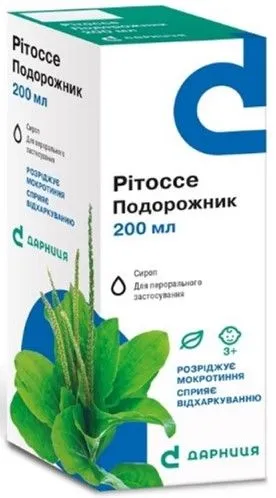
Table of Contents
INSTRUCTION FOR MEDICAL USE OF THE MEDICINAL PRODUCT RITOSSE Plantain
Composition:
Active substance: plantaginis lanceolatae folii extractum fluidum;
100 g of syrup contain plantain lanceolata leaf liquid extract (DER 1 : 1) [extraction solvent – ethanol 25% (v/v)] 8.00 g;
Excipients: sucrose, blackcurrant flavor (concentrate), potassium sorbate, citric acid monohydrate, purified water.
Pharmaceutical form. Syrup.
Main physicochemical characteristics: red transparent liquid (when diluted 1:1) with a characteristic odor. Sediment may form during the storage period.
Pharmacotherapeutic group. Preparations used in cough and colds. Expectorants. ATC code R05C A.
Pharmacological properties.
Pharmacodynamics.
Ritossé Plantain is a traditional herbal medicinal product intended for use according to the indications.
The main active ingredients of Plantago lanceolata are mucilages, iridoid glycosides (aucubin, catalpol), phenolic carboxylic acids (chlorogenic acid) and their glycosides (verbascoside), saponins, flavonoids, and tannins. Due to these constituents, Plantago lanceolata possesses anti-inflammatory, secretolytic, and antibacterial properties. It liquefies phlegm and promotes expectoration.
Pharmacokinetics.
Pharmacokinetic studies have not been conducted.
Clinical characteristics.
Indications.
Use as part of complex therapy for dry cough associated with infectious and inflammatory diseases of the upper respiratory tract.
Contraindications.
Hypersensitivity to any component of the medicinal product.
Interaction with other medicinal products and other forms of interaction.
No interactions between plantain syrup and other medicinal products or food have been observed to date.
Do not use simultaneously with antitussive medicinal products, as this may interfere with the expulsion of liquefied mucus.
Special precautions for use
Do not exceed the recommended doses.
If dyspnea, fever, or purulent sputum occurs during administration of the medicinal product, consult a physician.
Use with caution in children, patients at high risk of impaired liver function, and patients with a history of epileptic seizures.
Excipients.
The medicinal product contains 1.8% ethanol.
A 5 ml dose contains up to 0.11 g of ethanol, equivalent to approximately 1.2 ml of wine and 2.8 ml of beer.
A 10 ml dose contains up to 0.22 g of ethanol, equivalent to approximately 2.3 ml of wine and 5.6 ml of beer.
When single doses exceeding 5 or 10 ml are used, the patient receives more than 100 mg of ethanol. Harmful for patients suffering from alcoholism.
A 5 ml dose contains approximately 3.5 g of sucrose, equivalent to 0.29 bread units; therefore, use with caution in patients with diabetes mellitus.
This medicinal product contains sucrose and should not be administered to patients with glucose-6-phosphate dehydrogenase deficiency, rare hereditary fructose or galactose intolerance, glucose-galactose malabsorption syndrome, or sucrase-isomaltase deficiency.
This medicinal product contains 200 mg of potassium per dose. Use with caution in patients with impaired renal function or those on a potassium-controlled diet.
This medicinal product contains citric acid; therefore, use with caution in patients suffering from hyperacidic gastritis, peptic ulcer disease with increased acidity, or reflux esophagitis.
Use during pregnancy or breastfeeding.
Due to lack of clinical data, this medicinal product should not be used during pregnancy or breastfeeding.
Ability to affect reaction speed when driving or operating machinery.
There are no data on the effect of the medicinal product on the ability to drive or operate machinery when used at recommended doses.
The medicinal product contains 1.8% ethanol. Adults receiving a single dose of 10 ml ingest up to 0.22 g of ethanol, equivalent to approximately 2.3 ml of wine and 5.6 ml of beer.
After an overdose of the medicinal product, ethanol may be detected by breath alcohol testing devices.
Dosage and Administration.
Children aged 3 to 4 years:
- 5 ml of syrup, 3 times a day.
Children aged 5 to 11 years:
- 10 ml of syrup, 3 times a day.
Children aged 12 years and older, adults, and elderly patients (aged 65 years and older):
- 10 ml of syrup, 3–4 times a day.
The duration of treatment should be determined individually by a physician. If symptoms persist for more than 7 days, medical advice should be sought.
Patients should avoid eating or drinking immediately after taking the medication, as food and beverages may accelerate the removal of the drug from the mucous membranes of the oral cavity and throat.
The syrup should be shaken well before use.
During treatment with the syrup, it is recommended to drink plenty of warm fluids.
Children.
Not recommended for children under 3 years of age.
Overdose.
In case of liver function disorders, alcoholism, epilepsy, brain injury, or psychiatric disorders, adverse effects may occur in overdose due to the harmful effects of ethanol.
Treatment is symptomatic.
Side effects.
Gastrointestinal disorders: heartburn, diarrhea.
Skin and subcutaneous tissue disorders: erythema, rash, pruritus, eczema, skin edema, urticaria.
Immune system disorders: hypersensitivity reactions, including angioneurotic edema and anaphylactic shock.
If any adverse reactions occur, discontinue use of the medicinal product immediately and consult a physician without delay.
Shelf life. 3 years.
Shelf life after opening the bottle – 3 months.
Storage conditions.
Store in the original packaging at a temperature not exceeding 25 °C.
Keep out of reach of children.
Packaging.
200 ml in a bottle; 1 bottle with a measuring cup in a carton.
Availability. Over-the-counter (without prescription).
Manufacturer: Fitofarm Klenka S.A.
Manufacturer's address and place of business.
1 Klenka Street, 63-040 Nowe Miasto nad Wartą, Poland