Riabal
Ukraine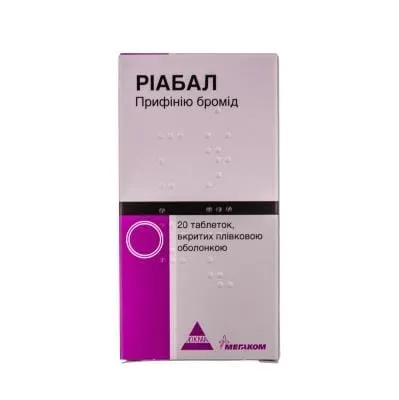
Table of Contents
INSTRUCTIONS FOR MEDICAL USE OF THE MEDICINAL PRODUCT RYABAL (RIABAL®)
Composition:
Active substance: prifinium bromide;
1 tablet contains 30 mg of prifinium bromide;
Excipients: lactose monohydrate, potato starch, povidone K-30, colloidal anhydrous silicon dioxide, magnesium stearate, sodium croscarmellose, erythrosine (E 127);
Coating: Instacoat Aqua II (IA-II-30107).
Pharmaceutical form. Film-coated tablets.
Main physico-chemical properties: round, biconvex tablets with a film coating, pink in color.
Pharmacotherapeutic group.
Agents used in functional gastrointestinal disorders. Synthetic anticholinergic agents, quaternary ammonium compounds.
ATC code A03AB18.
Pharmacological properties.
Pharmacodynamics.
Reabal selectively blocks peripheral M-cholinergic receptors in the mucous membranes of the gastrointestinal tract, biliary and urinary tracts, and uterus. Reabal does not penetrate the blood-brain barrier.
By selectively blocking M-cholinergic receptors, Reabal renders them insensitive to acetylcholine produced at the terminals of postganglionic parasympathetic nerves. As a result, the tone of smooth muscles in the esophagus, intestines, gallbladder, bile ducts, urinary tract, and uterus is reduced, along with decreased secretion of hydrochloric acid and pepsin, and reduced exocrine activity of the pancreas. With prolonged use, Reabal has no adverse effects on liver function, kidneys, or hematopoietic tissue.
Pharmacokinetics.
The drug is poorly absorbed from the gastrointestinal tract. The half-life is 2.18 hours. Serum clearance and renal clearance are 12.5 and 5.8 ml/min/kg, respectively. It is excreted in feces and urine.
Clinical characteristics.
Indications.
Pain associated with spasms and increased gastrointestinal tract peristalsis: in gastritis, gastric and duodenal ulcer, enteritis, colitis, after gastrectomy, and in irritable bowel syndrome.
Pain associated with spasms and dyskinesia of the biliary ducts: in cholecystitis, cholelithiasis.
Pain in pancreatitis.
Pain due to urinary tract spasms: in the presence of urinary tract calculi, bladder tenesmus, cystitis, pyelitis.
Pharmacological preparation prior to gastroscopy and gastrointestinal X-ray imaging.
Dysmenorrhea.
Contraindications.
Rebal is contraindicated in patients with the following conditions:
- Glaucoma: symptoms may be exacerbated due to increased intraocular pressure;
- Urinary disorders caused by prostate hyperplasia: urinary disorders may worsen, as the drug promotes detrusor muscle relaxation and bladder sphincter muscle contraction;
- Severe heart diseases: symptoms may be exacerbated due to increased heart rate;
- Paralytic intestinal obstruction: symptoms may worsen due to decreased gastrointestinal tract peristalsis;
- Hypersensitivity to any component of the drug.
Interaction with other medicinal products and other types of interactions.
Pirenzepine bromide should be used with caution when administered concomitantly with the following medicinal products (see table).
| Medicinal products |
Signs, symptoms and treatment |
Mechanism and risk factors |
| Tricyclic antidepressants (imipramine; amitriptyline) Phenothiazines (chlorpromazine) Antihistamines (diphenylhydramine) |
Due to anticholinergic effects, adverse reactions may occur (visual accommodation disturbances, dry mouth, urinary retention). |
Since prifinium bromide and these drugs exert anticholinergic effects, their actions may be additionally potentiated. |
| MAO inhibitors |
Due to anticholin游戏副本 The anticholinergic effect of the drug may be potentiated when used concomitantly with antihistamines, tricyclic antidepressants, phenothiazine derivative neuroleptics, and disopyramide. It enhances the effect of narcotic analgesics, antidepressants, antipsychotic drugs, neuroleptics, antiparkinsonian agents, and M-cholinoblocking agents. Special precautions for useAdministration of drugs with anticholinergic effects may lead to increased intraocular pressure. The drug should be used with caution in patients with the following conditions: cardiovascular disorders – atrial fibrillation, tachycardia, chronic heart failure, mitral stenosis, arterial hypertension, acute bleeding, in which an increase in heart rate may be undesirable; in patients with thyrotoxicosis, elevated body temperature, reflux esophagitis, hiatal hernia with reflux esophagitis, achalasia and pyloric stenosis, intestinal atony in elderly or debilitated patients, paralytic intestinal obstruction, hepatic or renal insufficiency; chronic lung diseases, especially in young children and debilitated patients; myasthenia gravis, autonomic neuropathy, gestosis; brain injury in children, Down's syndrome, central paralysis in children. In patients with prostatic hyperplasia, anticholinergic agents may reduce the maximum pressure in the urinary bladder, increase the maximum bladder volume, and sometimes exacerbate dysuria. Pyrifenium bromide should be used with caution in patients with hyperthyroidism, as they usually have tachycardia or accelerated heart rate, which may be intensified by the drug. Ribal should be used with caution in patients with congestive heart failure, as heart rate may increase and symptoms may worsen. The medicinal product should be used with caution in patients with ulcerative colitis, as toxic megacolon may develop. Pyrifenium bromide should be used with caution in patients exposed to high ambient temperatures, as secretory systems such as sweat glands and body thermoregulation are suppressed, which may lead to hyperthermia. Due to the anticholinergic effect of the drug, pyrifenium bromide should be used with caution in elderly patients, as symptoms such as impaired visual accommodation, dry mouth, or urinary retention may occur (see section "Adverse reactions"). Ribal contains lactose. Therefore, if a patient has known intolerance to certain sugars, medical advice should be sought before taking this medicinal product. Use during pregnancy or breastfeeding Pregnancy: The safety of pyrifenium bromide in pregnant women has not been studied. The use of the drug during pregnancy or breastfeeding is possible only when the expected benefit to the woman outweighs the potential risk to the fetus/infant. Ability to affect reaction speed when driving or operating machinery Ribal may cause visual accommodation disturbances. Patients should be warned about this, especially when engaging in potentially hazardous activities requiring alertness, such as driving vehicles or operating machinery. Dosage and Administration.Reabal tablets are administered orally. Children aged 6 to 12 years: 15–30 mg 2–3 times daily. Children aged 12 years and older, and adults: 30–60 mg 3 times daily. For acute, severe pain, adults may be administered 90 mg per dose. If administration of pheniramine bromide at a dose of 15 mg is required, the drug should be administered at the corresponding dosage or in syrup form. Children. The drug is administered to children from 6 years of age. For children under 6 years of age, the drug should be administered in syrup form. Overdose. Symptoms: hallucinations and curare-like effect (respiratory depression) are possible when the average therapeutic dose is exceeded by 100 times. Treatment: gastric lavage, administration of a mild saline solution to induce diarrhea. Intramuscularly, intravenously, or subcutaneously administer 1–2 mg of physostigmine salicylate to counteract the effects of anticholinergic agents on the central and peripheral nervous systems. If necessary, perform artificial ventilation of the lungs. Side effects.In individuals with increased sensitivity, allergic reactions may rarely occur. Dry mouth, blurred vision, and visual accommodation disturbances are rare and disappear when the dose is reduced or after discontinuation of the drug. In isolated cases, the following adverse reactions may occur: Immune system: allergic reactions, including skin rash, itching, hyperemia, urticaria, angioedema, skin redness. Gastrointestinal tract: nausea, vomiting, constipation, dry mouth. Urinary system: urinary retention. Eyes: accommodation disorders, blurred vision. Nervous system: headache, dizziness, weakness, tremor. Cardiovascular system: flushing, tachycardia, increased blood pressure, palpitations. Shelf life. 5 years. Storage conditions. Store in the original packaging at a temperature not exceeding 25 °C. Keep out of reach of children. Packaging. 10 tablets per blister; 2 blisters per cardboard box. Availability category. Over-the-counter (without prescription). Manufacturer. Za Arob Pharmaceutical Manufacturing Co. Ltd. Manufacturer's address and location of business operations. P.O. Box 42, Al-Bukhairyah – Salt - Jordan. Marketing Authorization Holder. Hikma Pharmaceuticals Co. Ltd. Address of the Marketing Authorization Holder. P.O. Box 182400, Amman 11118, Jordan. |