Restasis®
Ukraine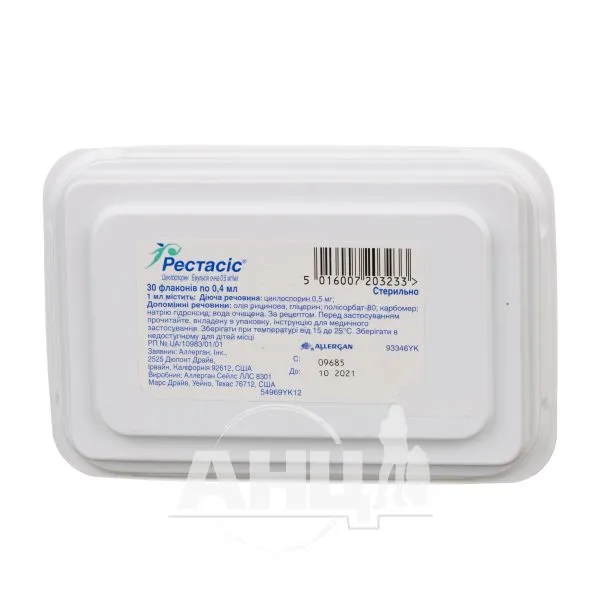
Table of Contents
INSTRUCTIONS FOR MEDICAL USE OF THE MEDICINAL PRODUCT RESTASIS® (RESTASIS®)
Composition:
Active substance: cyclosporine;
1 ml of emulsion contains 0.5 mg of cyclosporine;
Excipients: castor oil, glycerin, polysorbate 80, carbomer, sodium hydroxide, purified water.
Pharmaceutical form. Ophthalmic emulsion.
Main physicochemical properties. Semitransparent or cloudy, homogeneous white emulsion.
Pharmacotherapeutic group. Other ophthalmological agents. ATC code S01X A18.
Pharmacological Properties
Pharmacodynamics
Cyclosporine is an immunosuppressive agent when administered systemically. In patients with presumed suppressed tear production suffering from dry keratoconjunctivitis, cyclosporine emulsion is considered to act partially as an immunomodulator. The exact mechanism of action has not been established.
Pharmacokinetics
Cyclosporine blood concentrations were determined using a quantitative HPLC-MSD method (high-performance liquid chromatography and mass detector spectrophotometry). In adults, cyclosporine concentrations in all collected samples following topical administration of Restasis® at a concentration of 0.5 mg/mL twice daily for up to 12 months were below the detectable level of 0.1 ng/mL. No accumulation of cyclosporine in blood was observed during treatment with Restasis® ophthalmic emulsion.
Clinical characteristics.
Indications.
Increase in tear production in patients with expected reduced tear production due to inflammatory eye disease associated with dry keratoconjunctivitis (dry eye syndrome).
Contraindications.
Presence of acute ocular infection. Known or suspected hypersensitivity to cyclosporine or to any of the excipients.
Interaction with other medicinal products and other forms of interaction.
Interaction studies of cyclosporine in this pharmaceutical form with other medicinal products have not been conducted. However, when using the ophthalmic emulsion, interactions characteristic of cyclosporine during systemic administration cannot be excluded.
Can be used in combination with products containing artificial tears (see section "Dosage and administration").
Special precautions for use.
The use of the drug in patients with a history of herpesvirus keratitis has not been studied.
The use of Restasis® in patients with hepatic or renal impairment has not been studied.
No differences in efficacy and safety of the drug have been established between elderly patients (65 years of age and older) and younger adult patients.
The emulsion contained in a single-dose vial should be used immediately after opening the vial. The medication should be instilled into both eyes. Any remaining medication in the vial must be discarded immediately after use, in accordance with local requirements.
To avoid microbial contamination of the eyes, do not touch the eye with the tip of the vial. The vial tip should not touch the eyes or any surface to prevent contamination of the vial contents.
Restasis® should not be used while wearing contact lenses. If the patient wears contact lenses, they must be removed prior to instillation of the emulsion. Contact lenses may be reinserted 15 minutes after administration of Restasis®.
Use during pregnancy or breastfeeding.
Adequate and well-controlled studies of Restasis® in pregnant women have not been conducted.
Lactation. It is known that cyclosporine is excreted into breast milk following systemic administration; excretion into breast milk after topical ophthalmic use has not been studied.
Restasis® should be used with caution in breastfeeding women. The decision should consider the benefits of breastfeeding for infant development and health, the mother's clinical need for Restasis® therapy, and any potential adverse effects on the infant during breastfeeding following cyclosporine administration.
Ability to affect reaction rate when driving or operating machinery.
Transient blurred vision may occur immediately after administration of the drug. Therefore, patients should wait until vision clears before driving or operating machinery. Dizziness should also be considered as a potential adverse effect.
Dosage and Administration.
Recommended dose: 1 drop of Restasis® ophthalmic emulsion instilled into each eye twice daily, approximately 12 hours apart.
Before use, shake the bottle several times to obtain a uniform, white, opaque emulsion. Restasis® may be used in combination with artificial tear products, provided there is a 15-minute interval between administration of the products.
Children.
The efficacy and safety of Restasis® in pediatric patients have not been established; therefore, use in this patient population is not recommended.
Overdose.
Cases of overdose with Restasis® have not been reported. Overdose is unlikely following topical ophthalmic administration of the emulsion. Due to the low systemic concentration of cyclosporine in blood plasma after topical use, systemic intoxication is not expected.
Treatment is symptomatic and supportive.
Adverse reactions.
Pooled data from the phase III clinical trials indicate that adverse reactions occurred in approximately 29% of patients during the first year of treatment. Most of these reactions were ocular in nature, mild in severity, and none were serious. The most frequently reported adverse reactions were burning sensation, reported in approximately 17% of patients during the first year, with a reduction in incidence to 5% in the second year. The frequencies of adverse reactions are listed below.
Very common (≥1/10); common (≥1/100 to <1/10); uncommon (≥1/1,000 to <1/100); rare (≥1/10,000 to <1/1,000); very rare (<1/10,000).
| From the nervous system |
|
| Common |
Headache. |
| Uncommon |
Dizziness. |
| From the eye organs |
|
| Very common |
Burning sensation in eyes. |
| Common |
Eye irritation, foreign body sensation in the eye, conjunctival hyperemia, pain, sharp pain, eye discharge, photophobia, itching, visual disturbance (blurred vision), dry eye. |
| Uncommon |
Ulcerative keratitis, eyelid edema, eyelid erythema, increased lacrimation. |
| From the gastrointestinal tract |
|
| Uncommon |
Nausea. |
| From the skin and its derivatives |
|
| Uncommon |
Rash. |
Post-marketing data.
The following additional information on adverse reactions has been reported during the post-marketing use of the drug: eye swelling, hypersensitivity, severe angioedema, facial swelling, tongue swelling, laryngeal swelling, dyspnea, superficial eye irritation (upon touching the eye with the edge of the vial during administration), burning sensation, itching, urticaria, allergic reactions.
Since post-marketing reports of adverse reactions are submitted voluntarily from a population of uncertain size, it is not always possible to reliably estimate their frequency.
Shelf life. 2 years.
Do not use after the expiry date stated on the packaging.
Storage conditions.
Store at 15–25 °C.
Store unused vials in the original packaging.
Keep out of reach and sight of children.
Packaging.
0.4 mL of preservative-free drug in a sterile, single-dose vial made of low-density polyethylene with a capacity of 0.9 mL. 30 vials per package made of polypropylene, sealed with an aluminum foil membrane and closed with a polystyrene cap.
Prescription status.
Prescription only.
Manufacturer.
Allergan Sales LLC.
Manufacturer's address.
8301 Mars Drive, Waco, Texas 76712-6578, USA.