Proposol-n
Ukraine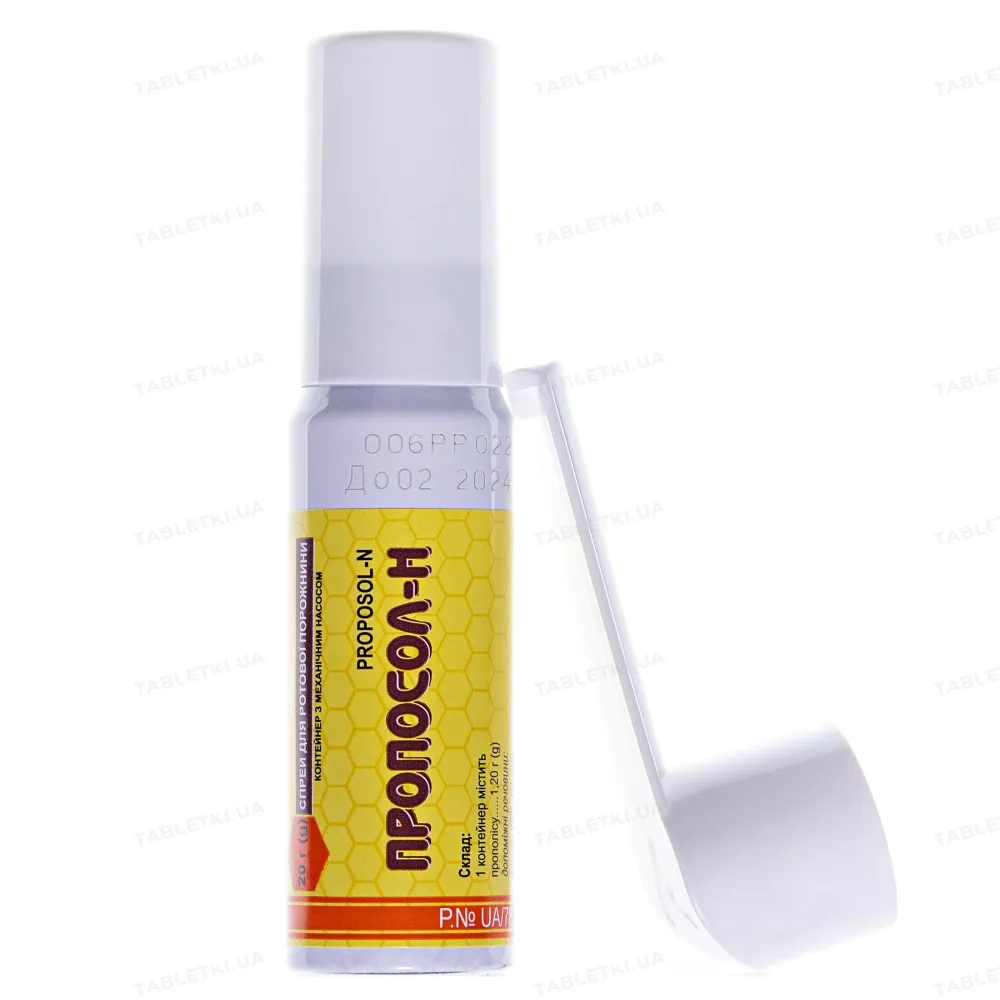
Table of Contents
INSTRUCTIONS FOR MEDICAL USE OF THE MEDICINAL PRODUCT PROPOSOL-N (PROPOSOL-N)
Composition:
Active substance: propolis;
1 container contains 1.2 g or 3.6 g of propolis;
Excipients: ethanol 96%, glycerol.
Pharmaceutical form. Oral spray.
Main physicochemical properties: brown or ranging from yellowish-brown to reddish-brown liquid with a characteristic odor.
Pharmacotherapeutic group.
Agents for use in dentistry. ATC code A01AB11.
Pharmacological Properties.
Pharmacodynamics. The active ingredient, propolis, contains a complex of biologically active natural compounds (flavonoids, amino acids, resins, organic acids, essential oils, vitamins, microelements). Propolis has pronounced antimicrobial, anti-inflammatory, reparative, and antioxidant properties, providing the therapeutic effect of Proposol-N in catarrhal, aphthous, and ulcerative stomatitis, catarrhal gingivitis, glossitis, and periodontitis. In addition, glycerin and ethyl alcohol are included in the spray formulation, which also exert therapeutic effects—softening and antiseptic. The combination of these pharmacological properties ensures comprehensive pathogenetic therapy of inflammatory diseases of the oral mucosa, without exerting local irritant or general toxic effects.
Pharmacokinetics. Proposol-N is absorbed by the oral mucosa within 2–4 minutes and produces a local resorptive therapeutic effect.
Clinical characteristics.
Indications.
Local treatment of inflammatory diseases of the oral mucosa: aphthous, catarrhal, and ulcerative stomatitis; tonsillitis, catarrhal gingivitis, glossitis.
Contraindications.
Hypersensitivity to the components of the drug/beekeeping products, eczema (acute forms), bleeding from affected areas of the mucosa.
Interaction with other medicinal products and other types of interactions.
It is not recommended to use simultaneously with other antiseptic agents or beekeeping products.
Special precautions for use.
Before using the medication, it is recommended to rinse the oral cavity with warm boiled water. Since the medication contains ethanol, it should be administered with caution to patients with liver diseases. After spraying the medication into the oral cavity, food intake should be avoided for 15–30 minutes.
Avoid contact of the medication with eyes, as it contains ethanol.
Use during pregnancy or breastfeeding.
During pregnancy, the medication should be used only if the benefit to the mother outweighs the potential risk to the fetus. If use of the medication is necessary during lactation, breastfeeding should be discontinued.
Ability to influence reaction rate while driving or operating machinery.
The medication contains 80% of 96% ethanol. When the spray pump is pressed for 1–2 seconds, up to 0.8 g of 96% ethanol is delivered into the oral cavity together with the medication, which is not expected to negatively affect reaction speed while driving or operating machinery.
Method of Administration and Dosage
The medication is intended for use in adults and children aged 12 years and older for irrigation of affected areas in the oral cavity. At the beginning of treatment, the medication should be administered 2–3 times daily; once inflammation has subsided, reduce to 1–2 applications daily until full recovery. The treatment course lasts 3–7 days.
Instructions for Using the Aerosol Can
- Remove the protective cap from the canister and, after ensuring the spray nozzle is clean, attach it onto the valve stem.
- Holding the canister vertically with the spray nozzle pointing upward, press the spray head several times until the first drops of liquid appear.
- Insert the free end of the spray nozzle into the oral cavity, direct it toward the affected area, and press the spray head 1–2 times to evenly distribute the medication over the affected area of the oral cavity.
- After spraying, avoid eating or drinking until the burning sensation in the mouth has subsided.
- After completing the irrigation, cover the canister with the protective cap.
Care of the Spray Nozzle. To prevent clogging, rinse the spray nozzle under a stream of warm water, shake off excess water, and dry it in a warm place, avoiding exposure to high temperatures.
Children. The medication is not recommended for children under 12 years of age.
Overdose.
Symptoms: allergic reactions, severe burning, and dryness in the oral cavity.
Treatment: in case of pronounced symptoms, rinse the oral cavity with warm boiled water; in the presence of allergic reactions, administer antihistamine medications.
Side effects.
Allergic reactions (including allergic dermatitis, hyperemia, skin itching, rash, laryngospasm, shortness of breath, angioedema), nausea, local effects (sensation of mild burning of the tongue, dry mouth).
Shelf life. 2 years.
Do not use after the expiry date stated on the packaging.
Storage conditions.
Store at a temperature not exceeding 25 °C. Keep out of reach of children. Protect from direct sunlight. Do not spray near fire.
Packaging.
20 g or 60 g in a container with a mechanical pump; 1 container with a spray nozzle and protective cap in a cardboard box.
Availability. Over-the-counter.
Manufacturer: LLC "Micropharm".
Manufacturer's address and place of business.
20 Shevchenka Street, Kharkiv, 61013, Ukraine.