Povidin
Ukraine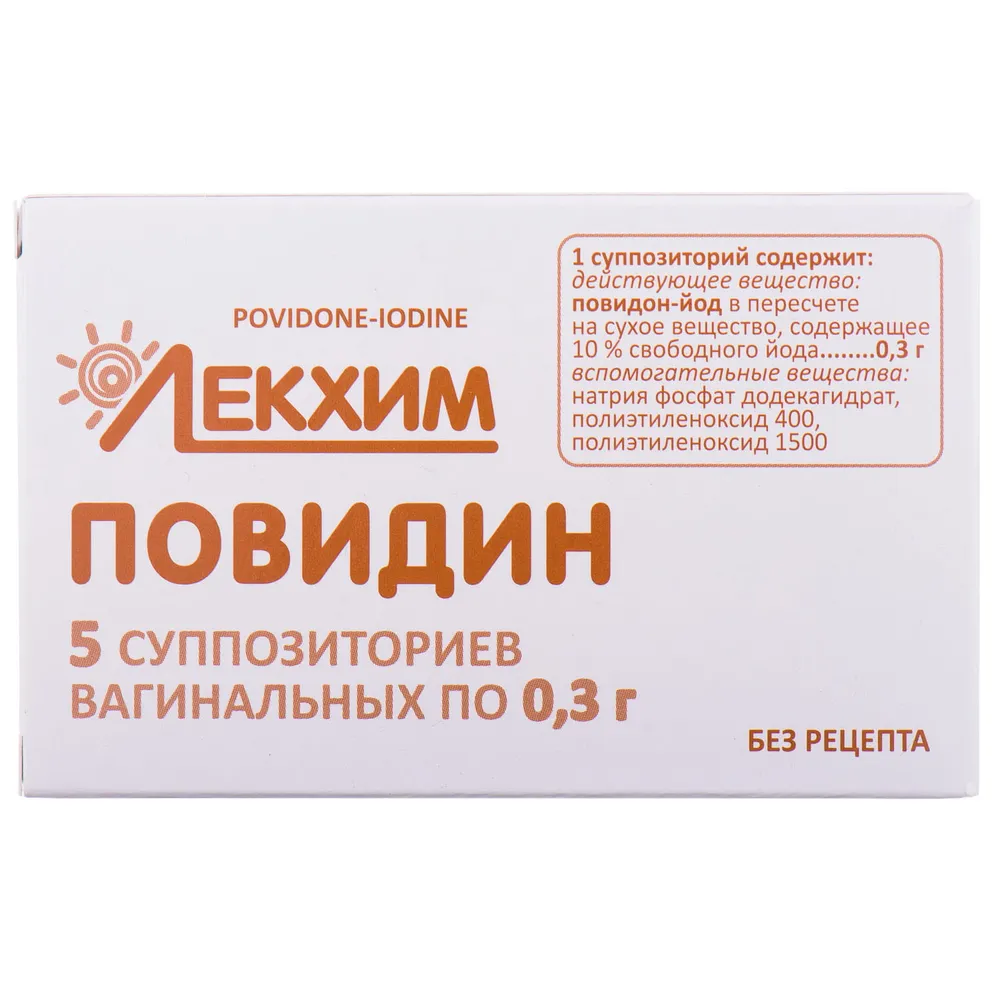
Table of Contents
INSTRUCTION FOR MEDICAL USE OF THE MEDICINAL PRODUCT POVIDIN (Povidin)
Composition:
Active substance: povidone-iodine;
1 suppository contains povidone-iodine equivalent to dry substance containing 10% free iodine – 300 mg (0.3 g);
Excipients: sodium phosphate dodecahydrate, polyethylene glycol 400, polyethylene glycol 1500.
Pharmaceutical form. Vaginal suppositories.
Main physicochemical properties: brown to dark brown suppositories, bullet-shaped, with a characteristic odor.
Pharmacotherapeutic group. Antimicrobial and antiseptic agents used in gynecology. ATC code GO1A X11.
Pharmacological properties.
Pharmacodynamics.
Suppositories exert an antiseptic (bactericidal, fungicidal, virucidal) effect, including against microflora with polyresistance to chemotherapeutic agents. They exert an anti-inflammatory effect due to the hyperosmolar properties of the hydrophilic base. Povidone-iodine is a water-soluble complex of iodine with a synthetic non-toxic polymer, polyvinylpyrrolidone. Upon contact with skin or mucous membranes, ionized iodine is released from the complex, exhibiting pronounced antiseptic activity due to its high oxidative capacity. Therefore, povidone-iodine has potent bactericidal, fungicidal, sporicidal, and selective antiviral effects, and is active against protozoa.
Pharmacokinetics.
With local application, absorption of iodine from the mucous membrane is negligible.
Clinical characteristics.
Indications.
Treatment of acute and chronic vaginitis and colpitis caused by mixed infections, trichomonal colpitis, and fungal vaginal infections.
Contraindications.
Individual hypersensitivity to iodine; dermatitis herpetiformis Duhring; thyroid adenoma; hyperthyroidism; renal failure. Not recommended for use in children, or in women during pregnancy or breastfeeding. Period before and after radioactive iodine therapy.
Interaction with other medicinal products and other forms of interaction.
The product must not be used simultaneously with radioactive iodine, disinfectants containing chlorhexidine, silver sulfadiazine, mercury, or alkali, due to possible partial inactivation.
Concomitant use of the product with lithium may cause a synergistic hypothyroid effect.
Special precautions.
In cases of subclinical hyperthyroidism and other thyroid gland disorders, especially in elderly patients, the drug should be used under constant medical supervision. Its activity decreases in an acidic environment. During treatment, it is recommended to use sanitary pads to avoid soiling of clothing.
Prolonged or extensive use of povidone-iodine should be avoided in patients receiving lithium therapy, those with hepatic insufficiency, or thyroid gland disorders. The use of povidone-iodine may reduce iodine uptake by the thyroid gland, which can affect the results of certain diagnostic tests (thyroid scintigraphy, protein-bound iodine determination, diagnostic procedures involving radioactive iodine). A break of at least 1–4 weeks from povidone-iodine use is required prior to performing such procedures.
The oxidizing effect of povidone-iodine may cause corrosion of metals, whereas plastics and synthetic materials are generally resistant to povidone-iodine. In individual cases, discoloration may occur, which is usually reversible.
Povidone-iodine can be easily removed from textiles and other materials with warm water and soap. Stubborn stains should be treated with an ammonia solution or sodium thiosulfate.
Use during pregnancy or breastfeeding.
The drug should not be administered to women during pregnancy or breastfeeding.
Ability to affect reaction speed when driving or operating machinery.
No data available.
Method of Administration and Dosage
Administer vaginally, one suppository per day, at bedtime, for 14 days. Before insertion, the suppository should be moistened with water. If necessary, depending on the infection, the suppositories may be used twice daily and throughout the entire menstrual cycle, including during menstruation.
Children. The drug is contraindicated for use in children.
Overdose.
Exaggeration of adverse reactions, allergic reactions. It is recommended to reduce the frequency of administration or discontinue the drug completely.
Symptoms of acute iodine intoxication include: metallic taste in the mouth, increased salivation, heartburn, pain in the mouth or throat; eye irritation and swelling; skin reactions; gastrointestinal disturbances; kidney dysfunction, anuria; circulatory insufficiency; laryngeal edema with secondary asphyxia, pulmonary edema, metabolic acidosis, hypernatremia, metabolic disturbances.
Treatment: supportive and symptomatic therapy with monitoring of electrolyte balance, kidney function, and thyroid gland function.
In cases of intoxication caused by oral intake of the drug, immediate administration of food products containing starch or protein (e.g., starch solution in water or milk) is indicated. Gastric lavage with a 5% solution of sodium thiosulfate or, if necessary, intravenous administration of 10 mL of 10% sodium thiosulfate solution at three-hour intervals.
In cases of overdose, toxic concentrations of iodine in blood serum can be effectively reduced by peritoneal dialysis or hemodialysis.
If signs of iodine-induced hyperthyroidism occur, appropriate treatment is recommended.
Adverse reactions.
Unpleasant sensations in the groin area and itching, which are rare and transient in nature, are possible.
Painful sensitivity and skin hypersensitivity reactions such as skin rash, urticaria, pruritus, and hyperemia may occur. In individual cases, generalized hypersensitivity reactions may develop, including decreased blood pressure and/or suffocation, angioneurotic edema, anaphylactic shock (anaphylactic reactions).
If signs of local intolerance reactions (irritation and sensitivity) occur, the use of the drug should be discontinued.
Cases of hypothyroidism and hyperthyroidism have been reported. Extensive and prolonged topical use of povidone-iodine may occasionally cause neutropenia.
The drug may have a spermicidal effect and should not be used when conception is desired.
Shelf life.
2 years.
Storage conditions. Store in the original packaging at a temperature not exceeding 25 °C.
Keep out of reach of children.
Packaging. 5 suppositories in a blister, 1 or 2 blisters per carton.
7 suppositories in a blister, 2 blisters per carton.
Prescription status. Over-the-counter.
Manufacturer: Private Joint-Stock Company "Lekhim-Kharkiv".
Manufacturer's address and place of business.
36 Severina Pototskoho Street, Kharkiv, Kharkiv Oblast, Ukraine, 61115.