Pecef
Ukraine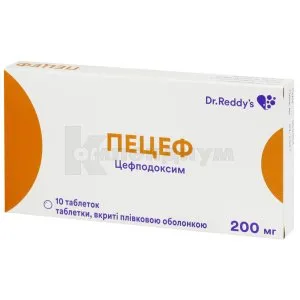
Table of Contents
INSTRUCTIONS FOR MEDICAL USE OF THE MEDICINAL PRODUCT PECEF (PECEF)
Composition:
Active substance: cefpodoxime;
1 film-coated tablet contains cefpodoxime proxetil equivalent to cefpodoxime 100 mg or 200 mg;
Excipients: calcium carboxymethylcellulose; maize starch; crospovidone (type B); lactose monohydrate; sodium lauryl sulfate; hydroxypropylcellulose; magnesium stearate; Opadry White 03H58900 (hypromellose, titanium dioxide (E 171), propylene glycol).
Pharmaceutical form. Film-coated tablets.
Main physicochemical properties:
film-coated tablets, 100 mg: round, biconvex, film-coated tablets, white to almost white in color, with well-defined edges, marked with the imprint «C1» on one side and smooth on the other;
film-coated tablets, 200 mg: round, biconvex, film-coated tablets, white to almost white in color, with well-defined edges, marked with the imprint «C7» on one side and smooth on the other.
Pharmacotherapeutic group. Antibacterial agents for systemic use. Other beta-lactam antibiotics. Third-generation cephalosporins. ATC code J01D D13.
Pharmacological properties.
Pharmacodynamics.
Cefpodoxime proxetil is a beta-lactam antibiotic belonging to the third-generation oral cephalosporins and is an inactive prodrug form of cefpodoxime. After oral administration, it is absorbed in the intestine, where it is rapidly hydrolyzed by nonspecific esterases into cefpodoxime, which is then systemically absorbed.
The mechanism of action of cefpodoxime is based on inhibition of bacterial cell wall synthesis. Cefpodoxime is resistant to the action of most beta-lactamases.
Cefpodoxime has been shown to exhibit in vitro bactericidal activity against numerous gram-positive and gram-negative bacteria.
It is highly active against gram-positive microorganisms:
- Streptococcus pneumoniae
- Group A streptococci (S. pyogenes), group B (S. agalactiae), groups C, F, and G
- Other streptococci (S. mitis, S. sanguis, and S. salivarius)
- Corynebacterium diphtheriae
It is highly active against gram-negative microorganisms:
- Haemophilus influenzae (strains producing and not producing beta-lactamases)
- Haemophilus para-influenzae (strains producing and not producing beta-lactamases)
- Branhamella catarrhalis (strains producing and not producing beta-lactamases)
- Neisseria meningitidis
- Neisseria gonorrhoeae
- Escherichia coli
- Klebsiella spp. (K. pneumoniae; K. oxytoca)
- Proteus mirabilis
It shows moderate activity against methicillin-sensitive staphylococci strains, both producing and not producing penicillinases (S. aureus and S. epidermidis).
As with other cephalosporins, the following microorganisms are resistant to cefpodoxime: enterococci, methicillin-resistant staphylococci (S. aureus and S. epidermidis), Staphylococcus saprophyticus, Pseudomonas aeruginosa and Pseudomonas spp., Clostridium difficile, Bacteroides fragilis, and related species.
As with other antibiotics, susceptibility should whenever possible be confirmed by in vitro testing.
Pharmacokinetics.
Absorption.
The absorption of cefpodoxime proxetil administered orally on an empty stomach in tablet form equivalent to 100 mg of cefpodoxime is 40–50%. Absorption increases with food intake; therefore, the drug should be taken with meals.
Cefpodoxime proxetil is absorbed in the intestine and hydrolyzed to its active metabolite, cefpodoxime.
Distribution.
Plasma concentration.
After a single oral dose of 100 mg, the maximum plasma concentration (Cmax) of cefpodoxime is 1–1.2 mg/L. After a single 200 mg dose, the maximum plasma concentration is 2.2–2.5 mg/L. In both cases (100 or 200 mg), Cmax is reached (Tmax) within 2–3 hours.
Residual concentrations 12 hours after administration of 100 mg and 200 mg are 0.08 mg/L and 0.18 mg/L, respectively.
After repeated administration of 100–200 mg twice daily for 14.5 days, the pharmacokinetic parameters of cefpodoxime in plasma do not change, indicating no accumulation of the active substance.
The volume of distribution of cefpodoxime is 30–35 L in young healthy volunteers (0.43 L/kg).
Plasma protein binding.
The plasma protein binding of cefpodoxime is 40%, primarily to albumin. This binding is not saturable.
Tissue and fluid penetration.
Cefpodoxime penetrates well into lung parenchyma, bronchial mucosa, pleural fluid, tonsils, and interstitial fluid.
4–7 hours after a single 100 mg dose, the concentration in tonsils is 0.24–0.1 µg/g (20–25% of plasma concentration).
After a single 200 mg dose of cefpodoxime, the concentration in interstitial fluid is 1.5–2.0 mg/L (80% of plasma concentration).
3–12 hours after a single 200 mg dose of cefpodoxime, the concentration in lung tissue is 0.6–0.2 µg/g; in pleural fluid it is 0.6–0.8 mg/L.
In bronchial mucosa, 1–4 hours after a 200 mg dose, the concentration of cefpodoxime is approximately 1 µg/g (40–45% of plasma concentration).
Measured concentrations exceed the minimum inhibitory concentration for susceptible organisms.
Biotransformation and elimination.
Following absorption, the main metabolite is cefpodoxime, formed by hydrolysis of cefpodoxime proxetil.
Cefpodoxime undergoes minimal metabolism.
After absorption of cefpodoxime proxetil, 80% of the released cefpodoxime is excreted unchanged in urine.
The elimination half-life of cefpodoxime averages 2.4 hours.
Patients in risk groups.
Pharmacokinetic parameters of cefpodoxime are only slightly altered in elderly patients with normal renal function.
However, the slight increase in maximum serum concentration and elimination half-life does not require dose reduction in these patients, except in individuals with a creatinine clearance of less than 40 mL/min.
In renal impairment, when creatinine clearance is less than 40 mL/min, the prolonged elimination half-life from plasma and increased plasma maximum concentration require a 50% dose reduction and administration once daily.
In hepatic impairment, the minor kinetic changes observed do not require specific dose adjustments.
Clinical characteristics.
Indications.
Treatment in adults of infections caused by microorganisms sensitive to the drug, such as:
- tonsillitis;
- acute sinusitis;
- acute bronchitis;
- exacerbations of chronic bronchitis;
- bacterial pneumonias.
Contraindications.
Hypersensitivity to cefpodoxime or other cephalosporin group drugs, or to any of the excipients.
Immediate and/or severe hypersensitivity reactions (anaphylaxis) to penicillin or other beta-lactam antibiotics in medical history.
Rare hereditary intolerance to galactose, Lapp lactase deficiency, or glucose-galactose malabsorption syndrome.
Interaction with other medicinal products and other forms of interaction.
Studies have shown that the bioavailability of the drug decreases by approximately 30% when cefpodoxime is administered with agents that neutralize gastric pH or inhibit acid secretion. Therefore, drugs such as mineral-type antacids and H2-blockers (e.g., ranitidine), which may increase gastric juice pH, should be taken 2–3 hours after administration of cefpodoxime.
H2-histamine antagonists and antacids reduce the bioavailability of cefpodoxime.
Increased gastric pH: anti-H2 agents (ranitidine) and antacids (aluminum hydroxide, sodium bicarbonate) lead to reduced biological efficacy.
Decreased gastric pH (pentagastrin) increases biological efficacy. Clinical implications remain unclear.
Concomitant administration with probenecid reduces excretion of cephalosporins. Cephalosporins may potentially enhance the anticoagulant effect of coumarins and reduce the contraceptive effect of estrogens.
Regular monitoring of the international normalized ratio (INR) is recommended during and shortly after concomitant use of cefpodoxime with oral anticoagulants. False-positive glucose in urine tests may occur when using Benedict's or Fehling's solution or copper sulfate test tablets, but not with enzymatic reactions in the presence of glucose oxidase.
Numerous cases of enhanced effect of oral anticoagulants have been reported in patients receiving antibiotics. A clearly evident infectious or inflammatory process, age, and the patient’s general condition appear to be risk factors for such an effect.
Regardless of food intake, the biological efficacy of cefpodoxime is increased when the drug is taken with food.
Special precautions for use.
Before initiating therapy, it is necessary to check the patient's history for severe hypersensitivity reactions to cefpodoxime, other cephalosporins, or any other type of beta-lactam antibiotics. The drug should be prescribed with caution to patients with a history of mild hypersensitivity reactions.
As with other beta-lactam antibiotics, serious and sometimes fatal hypersensitivity reactions have been reported. In the event of severe hypersensitivity reactions, cefpodoxime therapy should be discontinued immediately, and appropriate emergency measures should be initiated.
In cases of severe renal impairment, dose adjustment may be required depending on creatinine clearance.
Cefpodoxime should always be prescribed with caution to patients with a history of gastrointestinal disorders, particularly colitis.
Cases of antibiotic-associated colitis, including pseudomembranous colitis, have been reported with nearly all antibiotics, including cefpodoxime; the severity of these conditions may range from mild to life-threatening. This should be considered if diarrhea develops during or after cefpodoxime therapy. Discontinuation of cefpodoxime and initiation of specific therapy directed against Clostridium difficile should be considered. Antiperistaltic agents should not be prescribed.
As with other beta-lactam antibiotics, neutropenia and, less frequently, agranulocytosis may occur, especially during prolonged treatment. If therapy lasts longer than 10 days, monitoring of hematological parameters is recommended; treatment should be discontinued if neutropenia is detected.
Cephalosporins may be adsorbed onto erythrocyte membranes and react with drug-directed antibodies, potentially leading to a positive Coombs test and, very rarely, to hemolytic anemia. Cross-reactivity with penicillin may occur if such a reaction develops.
Renal function impairment has been observed during treatment with cephalosporin antibiotics, particularly when used concomitantly with potentially nephrotoxic agents such as aminoglycosides and/or diuretics. In such cases, monitoring of renal function is recommended.
As with other broad-spectrum antibiotics, prolonged use of cefpodoxime proxetil may lead to overgrowth of resistant microorganisms, which may necessitate discontinuation of therapy.
The drug should be discontinued in case of any signs of allergy.
Administration of cephalosporins requires prior evaluation; cross-reactivity with cephalosporins is observed in 5–10% of patients with penicillin allergy.
Cephalosporins should be administered with extreme caution to patients with penicillin sensitivity: strict medical supervision is required from the first dose.
Cephalosporins are absolutely contraindicated in patients with a history of immediate-type allergy to cephalosporins. In case of suspected such allergy, the first dose must be administered under direct medical supervision to manage possible anaphylactic reactions.
Hypersensitivity reactions (anaphylaxis) associated with these two types of beta-lactams may be severe and sometimes fatal.
Diarrhea may be a symptom of pseudomembranous colitis, which is diagnosed by colonoscopy. Such rare cases of pseudomembranous colitis associated with cephalosporin use require immediate discontinuation of therapy and initiation of appropriate specific antibiotic treatment (e.g., vancomycin). In such cases, consumption of products promoting fecal stasis should be completely avoided.
This medicinal product contains lactose and is therefore contraindicated in patients with hereditary galactosemia, glucose-galactose malabsorption syndrome, or lactase deficiency.
Bacteriostatic antibiotics (chloramphenicol, erythromycin, sulfonamides, tetracyclines) reduce the efficacy of cefpodoxime.
Use during pregnancy or breastfeeding.
Clinical data on the effect of cefpodoxime proxetil during pregnancy are lacking. Despite insufficient clinical and animal study data, cefpodoxime use during pregnancy may be considered if the expected benefit justifies the potential risk. The drug should be prescribed to pregnant women only if clearly needed and with caution.
Animal studies indicate no direct or indirect adverse effects of the drug on pregnancy, embryonic/fetal development, parturition, or postnatal development.
Cefpodoxime is excreted in human breast milk; therefore, breastfeeding should be discontinued during treatment.
Ability to affect driving and operating machinery.
During cefpodoxime therapy, cases of dizziness have been reported, which may impair the ability to drive or operate machinery.
Dosage and Administration
The drug should be taken orally twice daily with a 12-hour interval, during meals.
Acute bacterial sinusitis: 2 tablets of 200 mg per day: 1 tablet (200 mg) in the morning and 1 tablet (200 mg) in the evening. For acute maxillary sinusitis, effective treatment duration is 5 days.
Tonsillitis: 100 mg twice daily.
Acute bronchitis: 200 mg twice daily.
Exacerbation of chronic bronchitis: 200 mg twice daily.
Bacterial pneumonia: 200 mg twice daily.
Elderly patients.
Dose adjustment in elderly patients with normal renal function is not required.
Renal impairment.
Dose adjustment of cefpodoxime is not necessary if creatinine clearance exceeds 40 mL/min. If creatinine clearance is below 40 mL/min, the daily dose should be halved and administered once daily.
Renal insufficiency.
Dose adjustment in patients with renal insufficiency is not required when creatinine clearance is greater than 40 mL/min/1.73 m². If creatinine clearance is below this value, the dose should be adjusted accordingly (see table below).
| Creatinine clearance (mL/min) |
Recommended dose |
| 39–10 |
Single unified dose1 administered once every 24 hours (i.e. half the usual adult dose) |
| <10 |
Single unified dose1 administered once every 48 hours (i.e. quarter of the usual adult dose) |
| Patients undergoing hemodialysis |
Administer the unified dose1 after each dialysis session |
1The usual dose is 100 mg or 200 mg depending on the type of infection. The duration of treatment depends on the severity of the disease and is determined individually.
Hepatic impairment.
Dose adjustment is not required.
Children.
Currently, there is no information regarding the use of the drug in children.
Overdose.
In case of cefpodoxime overdose, supportive and symptomatic therapy is indicated.
In case of overdose, particularly in patients with renal insufficiency, reversible encephalopathy may develop. Specific antidote is unknown.
Adverse Reactions
Mainly gastrointestinal disorders were observed: diarrhea, nausea, vomiting, abdominal pain. General disorders: asthenia, fatigue, malaise.
There have also been reports of several rare cases of the following adverse reactions:
- Gastrointestinal system: As with other broad-spectrum antibiotics, rare cases of enterocolitis with hemorrhagic diarrhea and rare cases of pseudomembranous colitis, flatulence, acute pancreatitis have been reported.
- Hepatobiliary system: Mild, transient increases in transaminases, aspartate aminotransferase (AST), alanine aminotransferase (ALT), and alkaline phosphatase, increased bilirubin, acute hepatitis.
- Skin: Allergic reactions: skin rashes, pruritus, urticaria, Quincke's edema, anaphylactic shock, various rashes, localized bullous rashes, polymorphic erythema, Stevens–Johnson syndrome and Lyell's syndrome, erythema.
- Nervous system: Headaches, dizziness, paresthesia.
- Kidneys and urinary system: Mild increases in blood urea and creatininemia, acute renal failure.
- Blood system: Thrombocytosis, thrombocytopenia, leukopenia and hyper-eosinophilia, agranulocytosis, hemolytic anemia, eosinophilia, lymphocytosis, neutropenia, leukocytosis.
- Auditory and vestibular organs: Tinnitus.
Reporting suspected adverse reactions
Reporting of suspected adverse reactions after medicinal product authorization is of great importance. It allows continuous monitoring of the benefit-risk balance of the medicinal product. Healthcare and pharmaceutical professionals, as well as patients or their legal representatives, should report all cases of suspected adverse reactions and lack of efficacy via the automated pharmacovigilance information system at the following link: https://aisf.dec.gov.ua.
Shelf life. 3 years.
Storage conditions. Store below 25 °C. Keep out of reach of children.
Packaging. 10 tablets in a blister pack. 1 blister pack in a cardboard box.
Prescription category. Prescription only.
Manufacturer. Sai Parenterals Limited, India.
Manufacturer's address and location of operations.
Plot No. 45A & B, Anrith Industrial Park, IDA Bollaram, Sangareddy District, Telangana, Bollaram (Village), Jinnaram (Mandal), Sangareddy (Dist.), Telangana, India.