Pentasa
Ukraine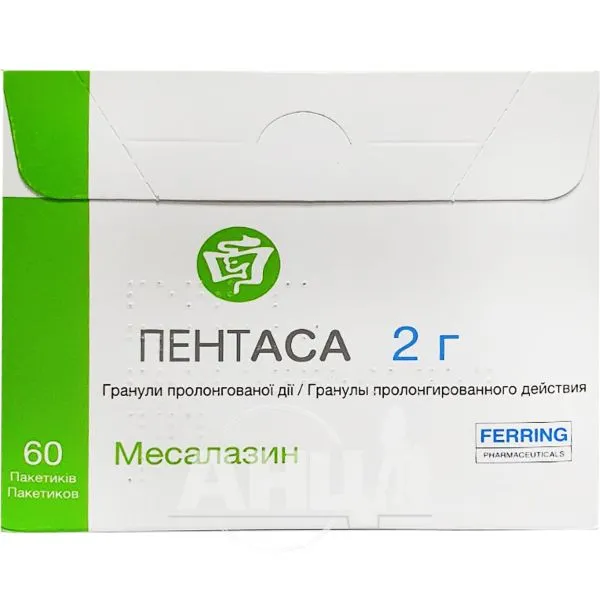
Table of Contents
INSTRUCTIONS FOR MEDICAL USE OF THE MEDICINAL PRODUCT PENTASA (PENTASA)
Composition:
Active substance: mesalazine;
1 sachet contains mesalazine 1 g or 2 g;
Excipients: povidone, ethylcellulose.
Pharmaceutical form. Prolonged-release granules.
Main physico-chemical properties: cylindrical granules ranging from white-grey to light white-brown in color.
Pharmacotherapeutic group. Anti-inflammatory agents used in intestinal disorders. Aminosalicylic acid and related substances. Mesalazine.
ATC code A07EC02.
Pharmacological properties.
Pharmacodynamics.
Mesalazine is the active component of sulfasalazine, which is used for the treatment of ulcerative colitis, Crohn's disease, and proctitis.
Mesalazine likely exerts a local anti-inflammatory effect on the pathologically altered segments of the intestinal wall.
In patients with chronic inflammatory bowel diseases, increased leukocyte migration, abnormal cytokine production, elevated production of arachidonic acid metabolites (particularly leukotriene B4), and increased concentrations of free radicals in inflamed intestinal tissues are observed.
Mesalazine reduces inflammation by inhibiting leukocyte chemotaxis, decreasing cytokine and leukotriene production, and neutralizing free radicals. At present, it is unknown which of these effects plays a role in the clinical efficacy of mesalazine and thus is the most important.
Pharmacokinetics.
Pentasa sachet consists of microgranules. The microgranules gradually release mesalazine at a rate dependent on the pH in the small and large intestine (faster release at higher pH).
One hour after oral administration, microgranules are found in the duodenum regardless of food intake. The mean transit time through the small intestine in healthy volunteers is 3–4 hours.
Absorption. Urine analysis data from healthy volunteers have shown that approximately 30% of the dose is absorbed after oral administration. Maximum plasma concentration of mesalazine is reached within 1–6 hours after administration. When mesalazine is administered once daily (1 × 4 g/day) or twice daily (2 × 2 g/day), the exposure (AUC) over 24 hours is comparable, indicating continuous release of mesalazine from the formulation throughout the treatment period. Steady state is achieved after 5 days of treatment with oral administration.
Table 1
| Mesalazine dosage |
Single dose |
Steady state |
||
| Cmax (ng/mL) |
AUC0-24 (ng*h/mL) |
Cmax (ng/mL) |
AUC0-24 (ng*h/mL) |
|
| 2 g twice daily |
5103.51 |
36,456 |
6803.70 |
57,519 |
| 4 g once daily |
8561.36 |
35,657 |
9742.51 |
50,742 |
| Molecular weight of mesalazine is 153.13 g/mol; of acetyl-mesalazine is 195.17 g/mol. |
||||
The passage and release of mesalazine in the intestine after oral administration are independent of food intake, whereas systemic exposure may be increased.
Distribution. Mesalazine and acetyl-mesalazine do not cross the blood-brain barrier. Plasma protein binding of mesalazine is approximately 50%, and that of acetyl-mesalazine is approximately 80%.
Metabolism. Mesalazine is acetylated to acetyl-mesalazine primarily in the intestinal mucosa, but also in the liver. Partial acetylation is mediated by colonic bacteria. Acetylation of mesalazine is probably not related to the patient's acetylator phenotype.
After oral administration, the plasma ratio of acetyl-mesalazine to mesalazine ranges from 3.5 to 1.3 following doses of 500 mg three times daily and 2 g three times daily, respectively, reflecting dose-dependent saturated acetylation.
Elimination. Due to the continuous release of mesalazine from the granules of Pentasa throughout the gastrointestinal tract, it is not possible to determine the elimination half-life after oral administration. The plasma elimination half-life after intravenous or orally administered non-coated mesalazine is approximately 40 minutes and approximately 70 minutes for acetyl-mesalazine.
Special patient groups
Pathophysiological changes such as diarrhea and increased intestinal acidity observed during active inflammatory bowel disease have limited impact on the amount of mesalazine reaching the colonic mucosa after oral administration.
In patients with hepatic or renal impairment, the risk of renal toxicity may be increased due to elevated systemic concentrations of mesalazine resulting from reduced elimination.
Clinical characteristics.
Indications.
Ulcerative colitis.
Crohn's disease.
Contraindications.
Hypersensitivity to mesalazine, to any of the excipients or to salicylates; severe hepatic and/or renal impairment.
Interaction with other medicinal products and other forms of interaction.
During combined treatment with Pentasa and azathioprine, 6-mercaptopurine, or thioguanine, a higher incidence of myelosuppressive effects has been observed in some studies, suggesting a possible interaction, although the mechanism of interaction has not been fully established. Regular monitoring of white blood cell counts is recommended, and the dosage regimen of thiopurines should be adjusted accordingly.
Evidence that mesalazine may reduce the anticoagulant effect of warfarin is weak.
Special precautions for use
Pentasa should be prescribed with caution to patients who have hypersensitivity to sulfasalazine (risk of allergic reactions to acetylsalicylic acid derivatives).
In case of acute intolerance reactions such as abdominal cramps, acute abdominal pain, fever, uncontrollable headache, or skin rash, treatment must be discontinued immediately.
Severe skin adverse reactions
Severe skin adverse reactions (SSARs) have been reported, including drug reaction with eosinophilia and systemic symptoms (DRESS syndrome), Stevens-Johnson syndrome (SJS), and toxic epidermal necrolysis (TEN), associated with mesalazine treatment.
At the first signs or symptoms of severe skin reactions, such as skin rash, mucosal lesions, or other hypersensitivity symptoms, mesalazine treatment must be discontinued immediately.
The drug should be used with caution in patients with gastric or duodenal lesions.
Mesalazine should be used cautiously in patients with impaired liver function. Liver function parameters (ALT or AST) should be monitored before and during treatment at the physician’s discretion.
This medicinal product is not recommended for patients with impaired renal function. Renal function should be monitored regularly, including measurement of serum creatinine levels (especially during the initial phase of treatment). Before and during treatment, urine status should be tested (using test strips) at the physician’s discretion. Renal dysfunction during treatment may be caused by the nephrotoxic effect of mesalazine.
Laboratory tests are recommended before starting treatment, after 2 weeks, and subsequently 2–3 times at 4-week intervals. If test results remain within normal limits, periodic testing may be performed every three months. In case of new symptoms, these tests should be performed immediately.
Cases of nephrolithiasis have been reported with mesalazine use, including stones composed of 100% mesalazine. Adequate fluid intake is recommended during treatment.
Concomitant use of known nephrotoxic agents, such as nonsteroidal anti-inflammatory drugs (NSAIDs) and azathioprine, may increase the risk of renal adverse reactions. This may necessitate more frequent monitoring of renal function.
Patients with respiratory disorders, particularly asthma, should be under medical supervision throughout the treatment period.
Mesalazine-induced hypersensitivity reactions affecting the heart (myocarditis and pericarditis) are rare. Serious blood dyscrasias have been reported rarely. Before and during treatment, the physician may, at their discretion, recommend blood tests. The concomitant use of mesalazine with azathioprine, 6-mercaptopurine, or thioguanine increases the risk of blood dyscrasias (see section “Interaction with other medicinal products and other forms of interaction”). If such adverse reactions occur or are suspected, treatment should be discontinued.
Mesalazine may cause a red-brown discoloration of urine upon contact with sodium hypochlorite-based bleach (e.g., in toilets cleaned with sodium hypochlorite-containing bleaches).
Use during pregnancy or breastfeeding
Pregnancy
Adequate and well-controlled studies of Pentasa in pregnant women have not been conducted. Limited published data on the use of mesalazine in pregnant women have not shown an increased risk of congenital malformations. Mesalazine is known to cross the placental barrier, but fetal concentrations are lower than maternal concentrations. Reproductive toxicity has not been observed in animal studies.
Pentasa is not recommended during pregnancy except when clearly needed.
Breastfeeding
Mesalazine is excreted in low concentrations in breast milk. Acetyl-mesalazine is excreted in breast milk at higher concentrations.
Spontaneous cases of acute diarrhea in breastfed infants have been reported.
Pentasa may be used during breastfeeding only if, in the physician’s opinion, the potential benefit to the mother outweighs the potential risk to the infant.
Fertility
Animal studies with mesalazine have not shown any effect on fertility.
Ability to affect reaction speed when driving or operating machinery
There are no data on the effect of Pentasa on the ability to drive or operate machinery. However, such an effect is unlikely.
Method of administration and dosage.
Dosage should be adjusted according to the severity of the disease.
| Adults. Individual dosing. Table 2 |
||
| Condition |
Ulcerative colitis |
Crohn's disease |
| Exacerbation phase |
Up to 4 g of mesalazine once daily or in divided doses according to physician's recommendations or patient's choice. |
2−4 g of mesalazine daily in divided doses. Depending on the course of the disease, the dose may be gradually reduced to 2 g daily. |
| Maintenance therapy |
Recommended dose is 2 g of mesalazine once daily. |
|
| Children (≥ 6 years). Individual dosing. There are only limited documented data on the effectiveness of the drug in children aged 6–18 years. Table 3 |
|
| Exacerbation phase |
Initial dose – 30−50 mg/kg/day in several divided doses. Maximum dose – 75 mg/kg/day in several divided doses. Total daily dose – no more than 4 g/day (maximum dose for adults). |
| Maintenance therapy |
Initial dose – 15–30 mg/kg/day in several divided doses. Total daily dose – no more than 2 g/day (recommended dose for adults). |
It is recommended that children with a body weight of up to 40 kg receive half the adult dose, while children with a body weight above 40 kg should receive the standard adult dose.
Method of administration
Pentasa should be taken with water or yoghurt. Do not chew.
If a dose of Pentasa is missed, the missed dose should be taken at any time before the next scheduled dose.
If adverse effects occur (see section "Side effects"), their severity may be reduced by taking the medication at a different time or by dividing the required dose into several administrations throughout the day.
The medication may be taken during or shortly after meals if the patient experiences gastric discomfort.
Children.
Pentasa is contraindicated in children under 6 years of age.
Overdose.
Clinical experience with overdose is limited (e.g., suicide attempts involving large doses of mesalazine) and does not indicate the presence of renal or hepatic toxicity. There is no specific antidote; treatment should be symptomatic and supportive.
Adverse reactions.
The adverse reactions most commonly observed in clinical trials were: diarrhea, nausea, stomach pain, headache, vomiting, and skin rash. Hypersensitivity reactions sometimes occurred. Serious skin adverse reactions (SSARs) have been reported with mesalazine treatment, including drug-induced eosinophilia with systemic symptoms (DRESS syndrome), Stevens-Johnson syndrome (SJS), and toxic epidermal necrolysis (TEN) (see section "Special precautions").
The frequency of adverse effects reported during clinical trials and post-marketing surveillance was defined as follows: common (≥ 1/100, < 1/10), rare (≥ 1/10,000, < 1/1,000), very rare (< 1/10,000), frequency not known (cannot be estimated based on available data).
Blood and lymphatic system disorders: very rare – blood disorders such as eosinophilia (as part of an allergic reaction), anemia, aplastic anemia, neutropenia, leukopenia (including granulocytopenia), thrombocytopenia, agranulocytosis, pancytopenia.
Immune system disorders: very rare – hypersensitivity reactions* (including allergic exanthema, anaphylactic reaction), drug fever*.
Nervous system disorders: common – headache*; rare – dizziness; very rare – peripheral neuropathy.
Cardiac disorders: rare – myocarditis and pericarditis.
Respiratory, thoracic and mediastinal disorders: very rare – allergic alveolitis, allergic and fibrotic lung changes (including dyspnea, cough, bronchospasm, pulmonary eosinophilia, interstitial lung disease, pulmonary infiltration, pneumonitis, pneumopericarditis).
Gastrointestinal disorders: common – diarrhea, abdominal pain*, nausea, vomiting, flatulence; rare – increased amylase levels, acute pancreatitis; very rare – pancolitis.
Hepatobiliary disorders: very rare – increased liver enzymes*, cholestatic parameters and bilirubin, hepatotoxicity (including hepatitis, cholestatic hepatitis, cirrhosis, liver failure).
Skin and subcutaneous tissue disorders: common – skin rash* (including urticaria, erythematous rash); rare – photosensitivity#; very rare – alopecia, drug reaction with eosinophilia and systemic symptoms (DRESS syndrome), erythema multiforme; frequency not known – Stevens-Johnson syndrome, toxic epidermal necrolysis (TEN), drug-induced eosinophilia with systemic symptoms (DRESS syndrome).
Musculoskeletal and connective tissue disorders: very rare – myalgia, arthralgia.
Renal and urinary disorders: very rare – renal function abnormalities* (including interstitial nephritis (acute and chronic), nephrotic syndrome, renal failure), change in urine color (see section "Special precautions" for additional information); frequency not known – nephrolithiasis (see section "Special precautions" for additional information).
Reproductive system and breast disorders: very rare – oligospermia (reversible).
* See section "Special precautions".
#More severe adverse reactions have been reported in patients with pre-existing skin conditions such as atopic dermatitis and atopic eczema.
Reporting suspected adverse reactions
Reporting of suspected adverse reactions after marketing authorization is important. It allows continued monitoring of the benefit-risk balance of the medicinal product. Healthcare professionals, pharmacists, and patients or their legal representatives should report all suspected adverse reactions and lack of efficacy through the Automated Information System for Pharmacovigilance at the following link: https://aisf.dec.gov.ua.
Shelf life. 2 years.
Storage conditions. Keep out of reach and sight of children. Store in the original packaging at a temperature not exceeding 25 °C.
Packaging.
50, 100 or 150 sachets of 1 g granules in a cardboard box.
60 sachets of 2 g granules in a cardboard box.
Prescription status. Prescription only.
Manufacturers.
Ferring International Center SA
(Responsible for manufacturing, primary and secondary packaging, quality control)
Ferring GmbH
(Responsible for batch release)
Manufacturers' addresses.
Chemin de la Vergogneuse 50, 1162 St-Prex, Switzerland
Wittenau 11, 24109 Kiel, Germany