Paracetamol
Ukraine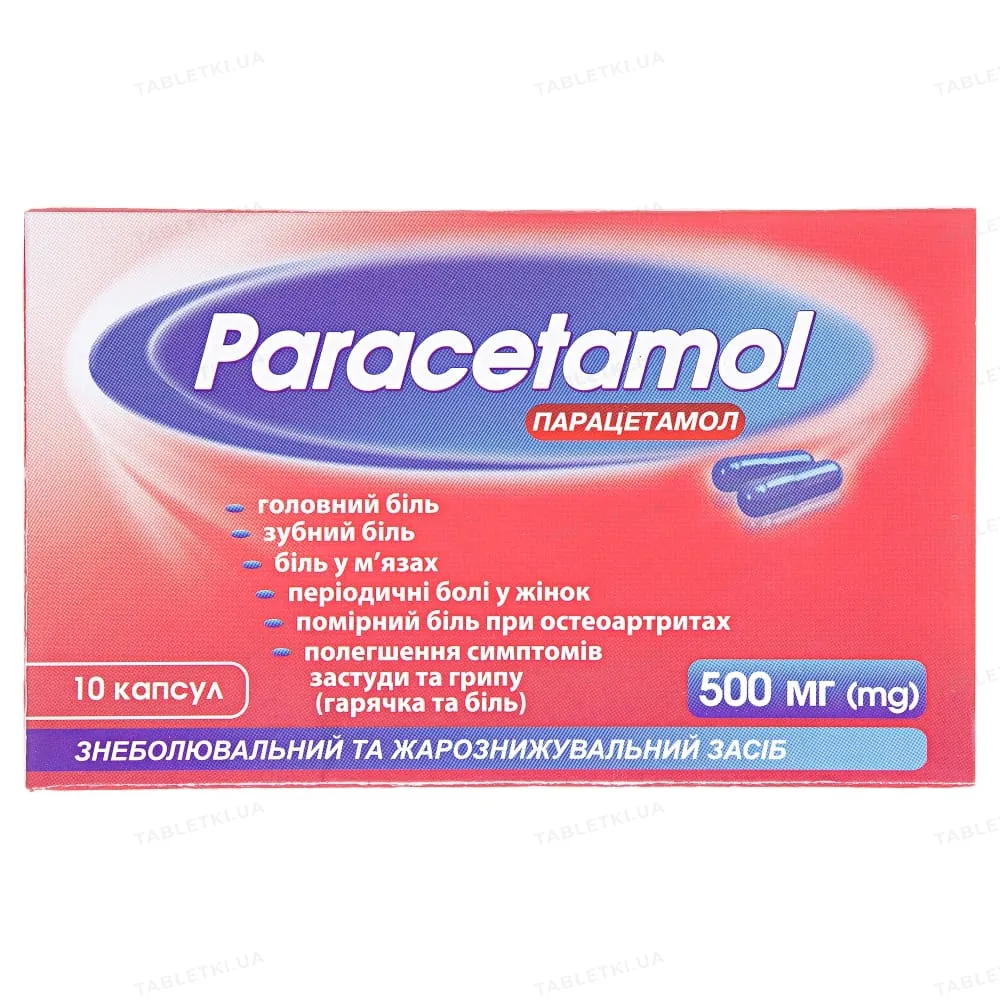
Table of Contents
INSTRUCTION FOR MEDICAL USE OF THE MEDICINAL PRODUCT PARACETAMOL (PARACETAMOL)
Composition:
Active ingredient: paracetamol;
1 capsule contains 500 mg of paracetamol;
Excipients: potato starch, povidone, magnesium stearate; the capsule shell contains indigocarmine (E 132), titanium dioxide (E 171), gelatin.
Pharmaceutical form. Capsules.
Main physicochemical characteristics: hard gelatin capsules ranging in color from blue to light blue. The capsule contents are a mixture of granules and powder ranging from white to almost white. The presence of particle agglomerates is acceptable.
Pharmacotherapeutic group. Analgesics and antipyretics. Paracetamol.
ATC code N02B E01.
Pharmacological properties.
Pharmacodynamics.
The drug contains paracetamol – an analgesic and antipyretic (pain-relieving and fever-reducing agent).
Pharmacokinetics.
Paracetamol is rapidly and almost completely absorbed in the gastrointestinal tract. Maximum plasma concentration is reached within 30–60 minutes. The elimination half-life is 1–4 hours. It is uniformly distributed throughout all body fluids. Plasma protein binding is variable. It is primarily excreted by the kidneys in the form of conjugated metabolites.
Clinical characteristics.
Indications.
Short-term treatment of headache, toothache, muscle pain, menstrual pain, moderate pain associated with osteoarthritis, and symptoms of fever and pain due to cold and flu.
Contraindications.
Hypersensitivity to the components of the drug, severe impairment of liver and/or kidney function, congenital hyperbilirubinemia, glucose-6-phosphate dehydrogenase deficiency, alcoholism, blood disorders, Gilbert's syndrome, severe anemia, leukopenia. Age under 6 years.
Interaction with other medicinal products and other forms of interaction.
The absorption rate of paracetamol may be increased when used concomitantly with metoclopramide and domperidone, and decreased with cholestyramine. The anticoagulant effect of warfarin and other coumarins may be enhanced with prolonged concurrent use of paracetamol, increasing the risk of bleeding. Occasional use does not have a significant effect.
Barbiturates reduce the antipyretic effect of paracetamol.
Anticonvulsant drugs (including phenytoin, barbiturates, carbamazepine), which stimulate hepatic microsomal enzyme activity, may enhance the hepatotoxic effect of paracetamol due to increased conversion of the drug into hepatotoxic metabolites. Concurrent use of paracetamol with hepatotoxic agents increases the risk of hepatotoxicity.
Concomitant use of high-dose paracetamol with isoniazid increases the risk of developing hepatotoxic syndrome. Paracetamol reduces the effectiveness of diuretics.
Caution is advised when paracetamol is used concomitantly with flucloxacillin, as this combination has been associated with metabolic acidosis with a high anion gap due to pyroglutamic acidosis, particularly in patients with risk factors (see section "Special precautions for use").
Do not use concurrently with alcohol.
Special precautions for use.
The medicinal product contains paracetamol; therefore, it should not be used concomitantly with other medicinal products containing paracetamol, such as those used for fever reduction, pain relief, flu and cold symptoms, or insomnia. Concurrent use with other paracetamol-containing products may lead to overdose. Paracetamol overdose can cause liver failure, which may necessitate liver transplantation or result in fatal outcome.
In patients with liver or kidney disease, consult a physician before using this medicinal product.
It should be noted that patients with liver disease have an increased risk of hepatotoxic effects of paracetamol.
Cases of impaired liver function/liver failure have been reported in patients with reduced glutathione levels, such as those with severe malnutrition, anorexia, low body mass index, chronic alcoholism, or sepsis.
Cases of high anion gap metabolic acidosis (HAGMA) due to 5-oxoprolinuria (pyroglutamic acidemia) have been reported in patients with severe underlying conditions, such as severe renal insufficiency and sepsis, or in those with malnutrition and other causes of glutathione deficiency (e.g., chronic alcoholism), who were treated with paracetamol at therapeutic doses over a prolonged period or in combination with flucloxacillin. If HAGMA due to pyroglutamic acidemia is suspected, immediate discontinuation of paracetamol is recommended, along with close monitoring of the patient. Measurement of 5-oxoproline levels in urine may be useful in identifying pyroglutamic acidemia as the underlying cause of HAGMA in patients with multiple risk factors. Symptoms of metabolic acidosis include deep, rapid, or labored breathing, nausea, vomiting, and loss of appetite. Immediate medical attention should be sought if these symptoms occur.
If symptoms persist, consult a physician. Prolonged use without medical supervision may be hazardous.
The medicinal product should be used only when clearly necessary.
Keep the medicinal product out of sight and reach of children.
Use during pregnancy or breastfeeding.
As with any medicinal product, consult a physician before using paracetamol during pregnancy.
Extensive data from pregnant women do not indicate any malformative or fetal/neonatal toxicity. Epidemiological studies on neurodevelopmental outcomes in children exposed to paracetamol in utero have yielded inconclusive results. Paracetamol may be used during pregnancy if clinically necessary, but it should be administered at the lowest effective dose, for the shortest duration, and with the lowest possible frequency.
Paracetamol passes into breast milk, but in clinically insignificant amounts when used at recommended doses. Available published data do not contain any contraindications regarding breastfeeding.
Ability to influence reaction speed when driving or operating machinery.
No effect.
Method of Administration and Dosage
The medication is intended for oral administration.
Do not exceed the recommended dose. The lowest effective dose required to achieve the treatment goal should be used.
Adults and children aged 12 years and older: 1–2 capsules up to 4 times daily (every 4–6 hours) as needed.
The interval between doses should be at least 4 hours.
Do not take more than 8 capsules (4000 mg) within 24 hours.
Children (6–11 years of age): 1 capsule up to 4 times daily (every 4–6 hours) as needed.
Maximum duration of use without medical consultation is 3 days.
Do not take more than 4 doses within 24 hours.
The interval between doses should be at least 4 hours.
Children. Not recommended for children under 6 years of age.
Overdose.
Paracetamol overdose may cause liver failure, which could necessitate liver transplantation or result in death. Clinical experience shows that signs of liver damage following paracetamol overdose typically appear within 24–48 hours after ingestion and peak at 4–6 days.
The risk of paracetamol poisoning is increased in elderly patients, children, patients with liver disease, chronic alcoholism, or chronic malnutrition.
Symptoms of overdose within the first 24 hours include pallor, nausea, vomiting, loss of appetite, and abdominal pain. However, overdose may also be asymptomatic.
Paracetamol overdose following a single ingestion by adults or children may lead to reversible or irreversible hepatocellular necrosis, resulting in impaired glucose metabolism, metabolic acidosis, hepatocellular failure, encephalopathy, hemorrhage, hypoglycemia, coma, and potentially death. Concurrently, elevated levels of liver transaminases (AST, ALT), lactate dehydrogenase, bilirubin, and prothrombin time may occur within 12–48 hours after ingestion.
Liver damage may occur in adults who have ingested more than the recommended amount of paracetamol. It is believed that an increased amount of a paracetamol metabolite (normally neutralized by glutathione when standard doses are used) irreversibly binds to liver tissue.
Acute renal failure with acute tubular necrosis may present as severe flank pain, hematuria, and proteinuria, and may develop even in the absence of severe liver damage. Cardiac arrhythmias and pancreatitis have also been reported, typically associated with impaired liver function and hepatotoxicity.
With prolonged use of the drug in high doses, hematological disorders such as aplastic anemia, pancytopenia, agranulocytosis, neutropenia, leukopenia, and thrombocytopenia may develop. High-dose intake may cause dizziness, psychomotor agitation, and disorientation due to central nervous system effects; urinary system effects may include nephrotoxicity (renal colic, interstitial nephritis, capillary necrosis).
Symptoms may be limited to nausea and vomiting, or may not reflect the severity of overdose or risk of organ damage.
Risk factors for paracetamol overdose include:
- prolonged use of carbamazepine, phenobarbital, phenytoin, primidone, rifampicin, St. John’s wort, or other drugs that induce liver enzymes;
- chronic alcohol abuse;
- reduced glutathione levels, for example, due to malnutrition, fasting, exhaustion, cystic fibrosis, or HIV infection.
In case of overdose, prompt medical intervention is required. Treatment for overdose, or even suspected overdose, must be initiated immediately by transporting the patient to a hospital, even if early symptoms are absent, as liver damage may not develop immediately. Plasma paracetamol concentration should be measured at least 4 hours after ingestion (earlier measurements are unreliable).
Consider treatment with activated charcoal if an excessive dose of more than 150 mg/kg has been ingested within 1 hour. Consider treatment with N-acetylcysteine or methionine. Symptomatic treatment should also be provided.
Side effects
Immune system disorders: (rare: < 1/10,000) — anaphylaxis, hypersensitivity reactions including skin rash, angioneurotic edema, Stevens-Johnson syndrome, and Lyell's syndrome.
Blood and lymphatic system disorders: (rare: < 1/10,000) — thrombocytopenia.
Respiratory, thoracic and mediastinal disorders: (rare: < 1/10,000) — bronchospasm in patients sensitive to acetylsalicylic acid and other nonsteroidal anti-inflammatory drugs.
Hepatobiliary disorders: (rare: < 1/10,000) — liver function abnormalities.
Metabolism and nutrition disorders: (unknown frequency: cannot be estimated from available data) — metabolic acidosis with high anion gap.
Cases of metabolic acidosis with high anion gap, resulting from pyroglutamic acidosis, have been observed in patients with risk factors during paracetamol use (see section "Special precautions"). Pyroglutamic acidosis may occur as a result of low glutathione levels in these patients.
Other adverse reactions observed after administration of paracetamol-containing medicinal products include: pruritus, erythema multiforme, nausea, epigastric pain, hypoglycemia up to hypoglycemic coma, agranulocytosis, anemia, sulfhemoglobinemia, and methemoglobinemia (cyanosis, dyspnea, chest pain), hemolytic anemia, bruising or bleeding, increased liver enzyme activity, usually without development of jaundice.
Shelf life. 5 years.
Storage conditions. Store in the original packaging at a temperature not exceeding 25 °C.
Keep out of reach of children.
Packaging. Capsules, 10, 10×2 in blisters per box.
Supply category. Over-the-counter.
Manufacturer.
LIMITED LIABILITY COMPANY "CORPORATION "ZDOROV'YA".
LIMITED LIABILITY COMPANY "FARMEKS GROUP".
Manufacturer's address and place of business.
Ukraine, 61013, Kharkiv region, Kharkiv, Shevchenka Street, 22.
(LIMITED LIABILITY COMPANY "CORPORATION "ZDOROV'YA")
Ukraine, 08301, Kyiv region, Boryspil, Shevchenka Street, 100.
(LIMITED LIABILITY COMPANY "FARMEKS GROUP")