Panangin forte
Ukraine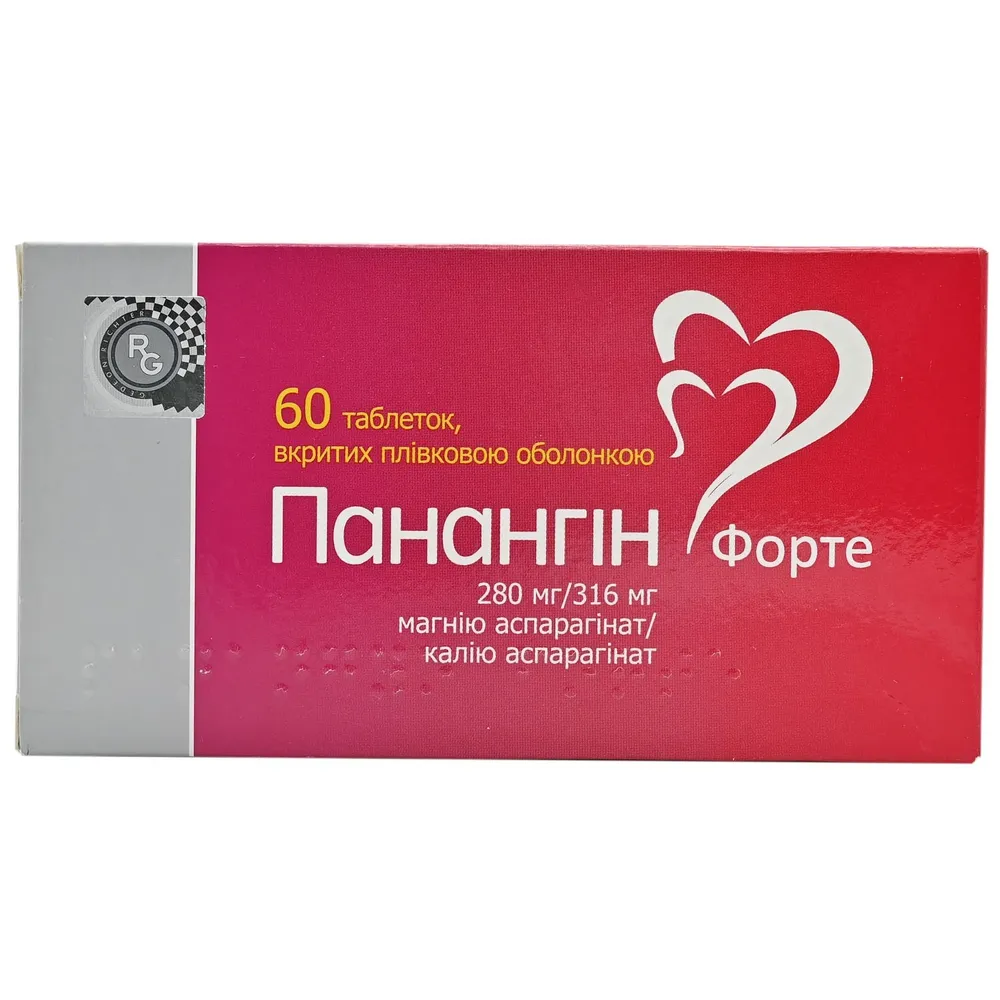
Table of Contents
INSTRUCTION FOR MEDICAL USE OF THE MEDICINAL PRODUCT PANAСHIN FORTE (PANANGIN FORTE)
Composition:
Active substances: magnesium aspartate, potassium aspartate;
One film-coated tablet contains:
280 mg magnesium aspartate (as 350 mg magnesium aspartate tetrahydrate);
316 mg potassium aspartate (as 332.6 mg potassium aspartate hemihydrate);
Excipients: colloidal anhydrous silicon dioxide; povidone K-30; potato starch; magnesium stearate; talc; corn starch;
Film coating: macrogol 6000; titanium dioxide (E 171); basic copolymer of butylated methacrylate (Eudragit E); talc.
Pharmaceutical form. Film-coated tablets.
Main physicochemical properties: oval, biconvex, film-coated tablets, almost white in color, with slightly shiny and slightly uneven surface, almost odorless, with imprint «A83» on one side.
Pharmacotherapeutic group. Mineral substances. Other mineral preparations. ATC code A12CX.
Pharmacological properties.
Pharmacodynamics. Potassium and magnesium ions are important intracellular cations that play a significant role in the function of various enzymes, in the binding of macromolecules to subcellular structures, and in the mechanism of muscle contraction at the molecular level. The ratio of intra- and extracellular concentrations of potassium, calcium, sodium, and magnesium ions affects the contractile ability of the myocardium. Aspartate, as an endogenous substance, is a suitable carrier of ions, has a pronounced affinity for cells, and its salts undergo dissociation only to a minor extent. As a result, ions penetrate into the intracellular space in the form of complex compounds. Magnesium aspartate and potassium aspartate improve myocardial metabolism. Insufficient levels of potassium and magnesium in the body increase the risk of developing arterial hypertension, atherosclerotic lesions of coronary vessels, cardiac arrhythmias, and myocardial pathology.
Pharmacokinetics.
Magnesium
The total body store of magnesium ions in a 70 kg human body averages 24 g (1000 mmol); more than 60% of magnesium is located in bone tissue and about 40% in skeletal muscles and other tissues. Approximately 1% of the total body magnesium is found in extracellular fluid, primarily in blood serum. In healthy adults, serum magnesium levels range from 0.7 to 1.10 mmol/L.
The recommended daily dietary intake of magnesium is 350 mg for men and 280 mg for women. Magnesium requirements increase during pregnancy and lactation.
Magnesium is absorbed from the gastrointestinal tract via active transport. The kidneys are the main regulators of magnesium balance in the body. 3–5% of ionized magnesium is excreted by the kidneys.
An increase in urine volume (e.g., during therapy with high-efficacy loop diuretics) leads to increased excretion of ionized magnesium. If magnesium absorption in the small intestine is reduced, subsequent hypomagnesemia leads to decreased magnesium excretion (< 0.5 mmol/day).
Potassium
The total body store of potassium ions in a 70 kg human body averages 140 g (3570 mmol). It is slightly lower in women than in men and decreases slightly with age. 2% of the total body potassium is located outside cells, while the remaining 98% is inside cells.
The optimal daily dietary intake of potassium is 3–4 g (75–100 mmol). The main route of potassium elimination is renal (approximately 90% of potassium is excreted daily by the kidneys). The remaining 10% is excreted via the gastrointestinal tract. Thus, the kidneys are responsible for long-term potassium homeostasis as well as for maintaining serum potassium levels. In the short term, blood potassium levels are also regulated by potassium exchange between intracellular and extracellular compartments.
Clinical characteristics.
Indications.
- Additional therapy in chronic heart diseases (in heart failure, post-infarction period) and cardiac arrhythmias (particularly ventricular arrhythmias), as recommended by a physician.
- Additional therapy during treatment with cardiac glycosides, as recommended by a physician.
- As a dietary supplement to increase magnesium and potassium levels in the body.
Contraindications.
- Hypersensitivity to the active substances or to any of the excipients of the medicinal product.
- Acute or chronic renal failure.
- Addison's disease.
- Third-degree atrioventricular block.
- Cardiogenic shock (arterial pressure < 90 mm Hg).
Interaction with other medicinal products and other forms of interaction.
Interaction studies of medicinal products containing potassium aspartate and magnesium aspartate have not been conducted. According to scientific literature, potassium and magnesium may interact with certain medicinal products. Concomitant use with potassium-sparing diuretics, angiotensin-converting enzyme inhibitors, beta-blockers, cyclosporine, heparin, and nonsteroidal anti-inflammatory drugs may lead to hyperkalemia.
Tetracyclines administered orally, iron salts, and sodium fluoride inhibit the absorption of potassium aspartate and magnesium aspartate from the gastrointestinal tract. An interval of at least 3 hours should be maintained between the administration of the above-mentioned medicinal products and Panangin Forte.
Special precautions for use.
Panangin Forte, being a preparation containing potassium and magnesium, should be administered with caution to patients with myasthenia gravis and in conditions that may lead to hyperkalemia, such as impaired renal function, acute dehydration, extensive tissue damage, particularly in severe burns. In these patient groups, regular monitoring of serum electrolyte concentrations is recommended.
Panangin Forte, film-coated tablets, should not be prescribed to patients with gastroduodenal ulcers or obstruction.
Use during pregnancy or breastfeeding.
To date, there are no data indicating any harmful effects associated with the use of Panangin Forte in these patient groups.
Ability to affect reaction speed when driving or operating machinery.
Panangin Forte does not affect the ability to drive or operate machinery.
Dosage and Administration
Dosage
Adults
The recommended daily dose is 1 tablet three times a day.
The maximum daily dose is 1 tablet three times a day.
The duration of treatment is determined by the physician.
Administration
For oral use.
Gastric juice may reduce the effectiveness of the drug; therefore, it is recommended to take Panangin Forte after meals.
Children
The safety and efficacy of Panangin Forte film-coated tablets in children and adolescents have not been established. Use in this patient group is not recommended.
Overdose.
There is no reported information on overdose with drugs containing potassium aspartate and magnesium aspartate, even with large doses.
Due to the kidneys' ability to excrete large amounts of potassium, increased dosage of the drug may lead to hyperkalemia only if associated with acute or marked impairment of potassium excretion.
The therapeutic index of magnesium is wide, and in the absence of renal insufficiency, severe adverse effects are extremely rare.
According to scientific data, oral administration of magnesium preparations may cause minor adverse effects such as diarrhea.
Large doses of Panangin Forte may increase the frequency of bowel movements due to its magnesium content.
Symptoms of hyperkalemia: general weakness, paresthesia, bradycardia, paralysis. Extremely high plasma potassium concentration may lead to death due to cardiac depression, arrhythmia, or cardiac arrest.
Symptoms of hypermagnesemia: nausea, vomiting, drowsiness, hypotension, bradycardia, weakness, slurred speech, double vision. With very high plasma magnesium concentrations, hyporeflexia, muscle paralysis, respiratory arrest, and cardiac arrest may develop.
Treatment.
In case of overdose, the drug should be discontinued and symptomatic treatment administered as needed (intravenous calcium chloride, dialysis if necessary).
Side effects.
Gastrointestinal tract: with the use of high doses of the drug, an increased frequency of bowel movements is possible.
According to some data, nausea, vomiting, and abdominal pain may occur.
Shelf life. 3 years.
Storage conditions.
Store at a temperature not exceeding 25 °C.
Keep out of reach of children.
Packaging.
15 tablets per blister pack.
2, 4 or 6 blisters per cardboard package.
Availability category.
Over-the-counter (without prescription).
Manufacturer.
JSC "Gedeon Richter".
LLC "Gedeon Richter Poland".
Manufacturer's address and place of business.
19–21 Demréi Street, Budapest, H-1103, Hungary.
5 J. Poniatowski Street, Grójec Mazowiecki, 05-825, Poland.
Marketing Authorization Holder.
JSC "Gedeon Richter".
Address of the Marketing Authorization Holder.
19–21 Demréi Street, Budapest, H-1103, Hungary.