Osteolon
Ukraine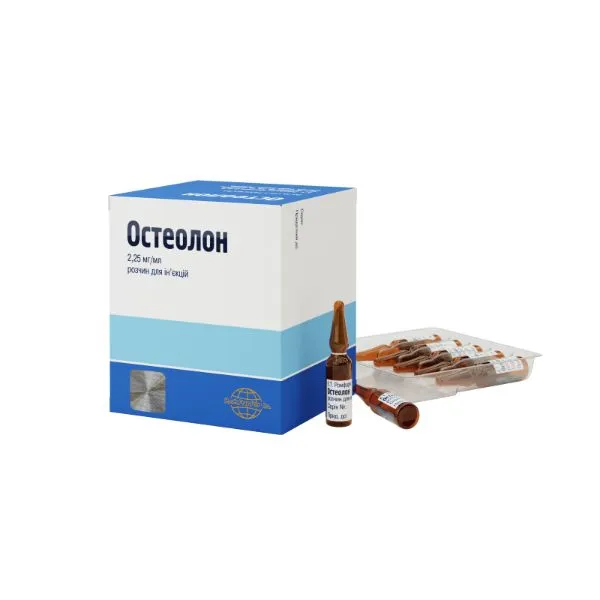
Table of Contents
INSTRUCTION FOR MEDICAL USE OF THE MEDICINAL PRODUCT OSTEOLON
Composition:
Active substance: extract from bone marrow and intercostal cartilage of young calves;
1 ml of solution contains: 1 ml of extract from bone marrow and intercostal cartilage of young calves, containing not less than 2.25 mg of glycosaminoglycan-peptide complex;
Excipients: metacresol, 0.1 M hydrochloric acid solution, water for injections.
Pharmaceutical form. Injection solution.
Main physicochemical properties: transparent yellowish-brown solution with the odor of metacresol, free from mechanical particles.
Pharmacotherapeutic group. Agents used in disorders of the musculoskeletal system. ATC code M09A X.
Pharmacological properties.
Pharmacodynamics.
Osteolon contains a glycosaminoglycan-peptide complex derived from cartilage and bone marrow of young calves (under 6 months of age). It affects impaired metabolism in hyaline cartilage tissue. The drug enhances biosynthesis of sulfated mucopolysaccharides, stimulates regeneration of articular cartilage, and inhibits catabolic processes in cartilage tissue.
Osteolon belongs to the group of chondroprotective agents—drugs that slow the progression of osteoarthritis and normalize metabolism in hyaline cartilage tissue. It stimulates synthesis of glycosaminoglycans and collagen in cartilage, reduces the activity of enzymes promoting degradation of articular cartilage, improves nutrition of joint cartilage, enhances cartilage regeneration and hyalinization, increases the amount of synovial fluid, and slows the progression of osteoarthritis.
Pharmacokinetics.
Studies have not been conducted.
Clinical characteristics.
Indications.
Osteolon is indicated in adults for the treatment of mild to moderate degenerative rheumatic diseases, such as coxarthrosis, gonarthrosis, spondylosis, and spondyloarthrosis.
Contraindications.
- Hypersensitivity to the components of the drug.
- Rheumatoid arthritis.
- Age under 18 years.
- Pregnancy, lactation.
- Use in women of reproductive age who are not using reliable contraceptive methods.
Interaction with other medicinal products and other forms of interaction.
Osteolon can be used concomitantly with nonsteroidal anti-inflammatory drugs and glucocorticoids.
Concomitant use with indirect anticoagulants, antiplatelet agents, and fibrinolytics may enhance their effects.
Special precautions for use.
Hypersensitivity reactions.
During clinical studies, hypersensitivity reactions have been reported during administration of this medicinal product. If signs or symptoms of a hypersensitivity reaction occur, such as rash, urticaria, erythema, pruritus, or angioedema, bronchospasm, hypotension, or life-threatening shock, the drug should be discontinued immediately and medical assistance should be sought.
The product contains metacresol, which may cause allergic reactions.
Prior to initiating treatment, the patient should consult a physician to rule out the presence of systemic autoimmune diseases (rheumatoid arthritis, ankylosing spondylitis, systemic lupus erythematosus, scleroderma); if such conditions are present, specific treatment should be prescribed.
Concomitant use of Osteolon with indirect anticoagulants, antiplatelet agents, and fibrinolytics may enhance their effects. Therefore, patients receiving Osteolon together with indirect anticoagulants, antiplatelet agents, or fibrinolytics should undergo frequent monitoring of blood coagulation.
Osteolon contains a glycosaminoglycan-peptide complex. Therefore, this medicinal product is not recommended for patients with phenylketonuria, rare inherited amino acid metabolism disorders, active gastric ulcer, peptic ulcer disease, or gastrointestinal bleeding.
Osteolon contains a glycosaminoglycan-peptide complex, which may provoke exacerbation of asthma symptoms. Thus, patients with asthma who initiate Osteolon therapy should be aware of the potential worsening of symptoms.
Osteolon should be used with caution in patients with impaired glucose tolerance. In diabetic patients, more careful monitoring of blood glucose levels may be required at the beginning of treatment and periodically throughout therapy, and insulin dosage may need adjustment if necessary.
Liver function impairment.
The use of Osteolon in patients with severe hepatic insufficiency has not been studied. Data are lacking.
Use during pregnancy or breastfeeding.
There are no data on the use of Osteolon in pregnant women. The use of this medicinal product during pregnancy or breastfeeding is contraindicated.
Ability to affect reaction rate when driving or operating machinery.
No data available.
Dosage and Administration.
The drug is administered deep intramuscularly: 0.3 mL on the first day, 0.5 mL on the second day, and thereafter 1 mL three times a week for 5–6 weeks.
Repeat treatment courses are administered according to the same regimen after an interval and upon physician consultation, taking into account the benefit in the context of the patient's clinical response.
Children.
Osteolon is contraindicated for use in children due to lack of data on safety and efficacy of treatment in this patient population.
Overdose.
Cases of overdose have not been observed.
Adverse reactions.
Brief overview of the safety profile of glycosaminoglycan-peptide complex
Adverse reactions reported during clinical trials with glycosaminoglycan-peptide complex are listed in the table below.
Tabulated list of adverse reactions
The following table presents MedDRA terms reported from 110 subjects who received glycosaminoglycan-peptide complex, along with the corresponding frequency:
Very common (≥1/10); Common (≥1/100 to <1/10); Uncommon (≥1/1000 to <1/100); Rare (≥1/10000 to <1/1000); Very rare (<1/10000), Frequency not known (cannot be estimated based on available data).
| System organ class |
Adverse reaction |
Frequency |
| Skin and subcutaneous tissue |
Pruritus |
uncommon |
| Urticaria |
uncommon |
|
| Erythema |
uncommon |
|
| Immune system |
Hypersensitivity* |
uncommon |
| Musculoskeletal and connective tissue |
Arthralgia** |
uncommon |
| General disorders and administration site conditions |
Local reaction |
uncommon |
Description of individual adverse reactions
*Hypersensitivity reactions may, for example, be accompanied by generalized skin reactions, angioneurotic edema, bronchospasm, hypotension, and shock, and may be life-threatening.
**Arthralgia: sometimes after 3–6 injections, joint pain may intensify; however, it resolves spontaneously without treatment and does not require discontinuation of the medicinal product.
If adverse effects not described in this instruction occur, the use of the medicinal product should be discontinued and the prescribing physician should be informed.
Reporting suspected adverse reactions
Reporting of adverse reactions after medicinal product registration is of great importance. It enables ongoing monitoring of the benefit-risk balance of the medicinal product. Medical and pharmaceutical personnel, as well as patients or their legal representatives, should report all suspected adverse reactions and lack of efficacy via the Automated Pharmacovigilance Information System at the following link: https://aisf.dec.gov.ua.
Shelf life. 5 years.
Storage conditions.
Store in the original packaging at a temperature not exceeding 25 °C.
Keep out of reach and sight of children.
Packaging.
1 ml or 2 ml in a vial, 5 vials in a blister, 1, 2 or 5 blisters in a cardboard box.
Prescription status.
Prescription only.
Manufacturer.
K.T. ROMPHARM COMPANY S.R.L.
Manufacturer's address and location of operations.
Strada Eroilor No. 1A, Otopeni, 075100, Ilfov County, Romania – Building Rompharm 1 and Rompharm 2.