Okomistin
Ukraine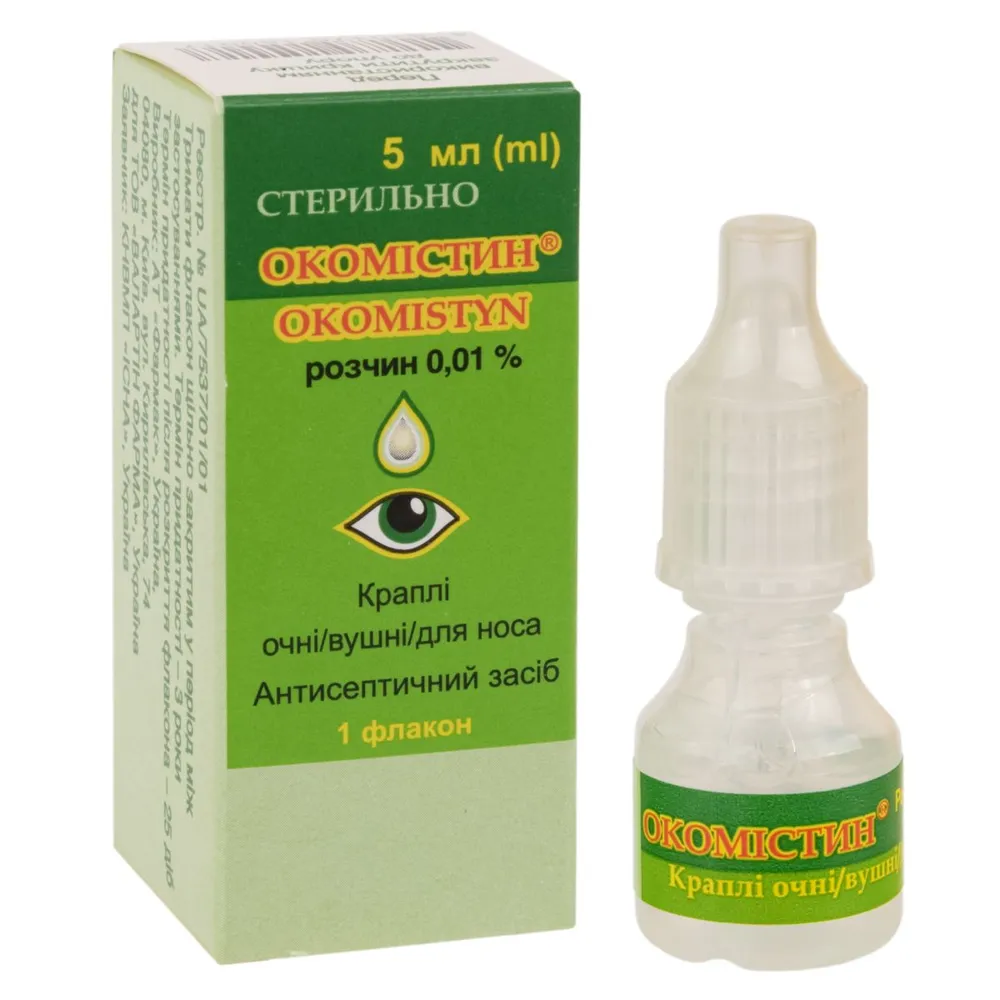
Table of Contents
INSTRUCTION FOR MEDICAL USE OF THE MEDICINAL PRODUCT OCOMISTINE® (OKOMISTYN)
Composition:
Active substance: benzyl dimethyl [3-(myristoylamino)propyl] ammonium chloride monohydrate;
1 ml of solution contains benzyl dimethyl [3-(myristoylamino)propyl] ammonium chloride monohydrate (calculated as anhydrous substance) 0.1 mg;
Excipients: sodium chloride, water for injections.
Pharmaceutical form. Eye/ear/nasal drops.
Main physicochemical properties: colorless clear liquid.
Pharmacotherapeutic group.
Agents used in ophthalmology and otology. ATC code S03D.
Anti-edematous and other agents for topical use in nasal cavity disorders. ATC code R01A.
Pharmacological Properties.
Pharmacodynamics.
Benzyl dimethyl [3-(myristoylamino) propyl] ammonium chloride monohydrate is a cationic surfactant with antimicrobial (antiseptic) activity.
The mechanism of action of Ocomistin® is based on the direct hydrophobic interaction of the molecule with microbial membrane lipids, leading to their fragmentation and destruction. In this process, part of the active substance molecule penetrates the hydrophobic region of the membrane, disrupts the supramembrane layer, loosens the membrane structure, increases its permeability for high-molecular-weight compounds, alters enzymatic activity of the microbial cell, and inhibits enzymatic systems, thereby suppressing microbial viability and causing cytolysis.
Unlike other antiseptics, Ocomistin® exhibits high selectivity towards microorganisms, as it has virtually no effect on human cell membranes. This effect is attributed to the different structure of human cell membranes (significantly longer lipid radicals that severely limit the possibility of hydrophobic interaction between the active substance and human cells).
Ocomistin® demonstrates pronounced antimicrobial activity against gram-positive and gram-negative, aerobic and anaerobic, spore-forming and non-spore-forming bacteria, both as monocultures and microbial associations, including hospital strains with multidrug resistance to antibiotics.
It exerts a detrimental effect on sexually transmitted disease pathogens—gonococci, Treponema pallidum, trichomonads, chlamydia—as well as on herpes and human immunodeficiency viruses. It also has antifungal activity against ascomycetes of the genera Aspergillus and Penicillium, yeasts (Rhodotorula rubra, Torulopsis gabrata), yeast-like fungi (Candida albicans, Candida krusei), dermatophytes (Trichophyton rubrum, Trichophyton mentagrophytes, Trichophyton verrucosum, T. schoenleinii, T. violaceum, Epidermophyton Kaufman-Wolf, E. floccosum, Microsporum gypseum, Microsporum canis), and other pathogenic fungi (e.g., Pityrosporum orbiculare (Malassezia furfur)) as monocultures and microbial associations, including fungal microflora resistant to chemotherapeutic agents. Under the influence of Ocomistin®, microbial resistance to antibiotics is reduced. Ocomistin® also has anti-inflammatory and immunoadjuvant effects, enhances local defense reactions and regenerative processes, and activates nonspecific defense mechanisms by modulating cellular and local humoral immune responses, thereby accelerating recovery.
Pharmacokinetics.
Ocomistin® exerts a local effect. Data on the potential penetration of the drug into the systemic circulation are not available.
Clinical characteristics.
Indications.
In the complex treatment of infectious processes of the anterior segment of the eye (blepharitis, conjunctivitis, keratitis, keratouveitis) caused by gram-positive and gram-negative bacteria, chlamydia, fungi, and viruses sensitive to Okomistin®, eye injuries, eye burns (thermal and chemical).
Prophylaxis of ophthalmia neonatorum, including gonococcal and chlamydial forms.
Prophylaxis and treatment of purulent-inflammatory eye disorders in the pre- and postoperative periods.
In the complex treatment of acute and chronic external otitis, chronic suppurative mesotympanitis, and otomycoses.
In the complex treatment of acute rhinitis.
Contraindications.
Individual hypersensitivity to components of the drug.
Interaction with other medicinal products and other types of interactions.
When used concomitantly, Okomistin® enhances the efficacy of locally acting antibiotics.
When any other medicinal products are used simultaneously, the physician should be informed.
Special precautions for use.
Use during pregnancy or breastfeeding.
The drug can be used during pregnancy. There are no data on the negative effect of the drug during breastfeeding.
Ability to influence reaction rate when driving or operating machinery.
The drug does not affect reaction speed when driving or operating machinery.
Administration and Dosage
Ophthalmology
For treatment of infectious processes in the anterior segment of the eye: in adults and children aged 12 years and older, instill 2–3 drops into the conjunctival sac 4–6 times daily; in children under 12 years of age – 1–2 drops 4–6 times daily. The duration of treatment usually does not exceed 2 weeks.
For prevention of complications in the pre- and postoperative period: 2–3 drops 3 times daily for 2–3 days before surgery. After surgery – 1–2 drops 3 times daily for 3–5 days.
In the treatment of eye burns: after rinsing the eye with large amounts of water, perform frequent instillations (every 5–10 minutes) for 1–2 hours. For further treatment, administer 2–3 drops 4–6 times daily in adults and children aged 12 years and older; in children under 12 years of age – 1–2 drops 4–6 times daily.
For prophylaxis of ophthalmia neonatorum: immediately after birth, instill 1 drop of the drug into each eye 3 times with an interval of 2–3 minutes.
Otolaryngology
For treatment of acute and chronic external otitis, otomycoses: in adults and children aged 12 years and older, instill 3–5 drops 4–6 times daily; in children under 12 years of age – 2–3 drops 4–6 times daily.
A gauze wick moistened with the drug may be inserted into the external auditory canal 4–6 times daily for 10–14 days as an alternative to instillation.
In chronic mesotympanitis: use as part of complex therapy via instrumental ultrasound irrigation or administration into the tympanic cavity in combination with antibiotics.
For treatment of acute rhinitis and nasal mucosa infections: instill 2–3 drops in adults and children aged 12 years and older, and 1–2 drops in children under 12 years of age, into each nostril 4–6 times daily. Treatment course: 7–14 days.
Dosage specifics. Precise dosing is achieved by pressing on the bottom of the vial – one press = 1 drop.
Children.
The drug may be used in pediatric practice.
Overdose.
Not observed.
Adverse Reactions.
Hypersensitivity reactions may occur during administration of the drug. In some cases, a transient burning sensation may develop, which resolves spontaneously within 5–20 seconds and does not require discontinuation of treatment.
If any adverse events occur, consult a physician immediately!
Shelf Life.
3 years.
After first opening of the bottle – 25 days.
The drug must not be used after the expiry date stated on the packaging.
Storage Conditions.
Store at a temperature not exceeding 35 °C in the original packaging, in a place inaccessible to children. Keep the bottle tightly closed between uses.
Packaging.
5 ml or 10 ml in a polymer bottle with dropper; 1 bottle per cardboard box.
Prescription Status.
Prescription only.
Manufacturers.
- LLC "VALARTIN PHARMA" (batch release).
- JSC "FARMAC" (manufacturing, packaging, quality control).
Addresses of manufacturers and locations of their business activities.
- 60 Hrushevskoho St., village Chayky, Kyiv-Sviatoshyn district, Kyiv region, Ukraine, 08135.
- 74 Kyrylivska St., Kyiv, Ukraine, 04080.
Marketing Authorization Holder.
State Enterprise "ISNA".
Address of the Marketing Authorization Holder.
8 Dubrovytska St., building 1, office 160, Kyiv, Ukraine, 04114.