Noophen® 100
Ukraine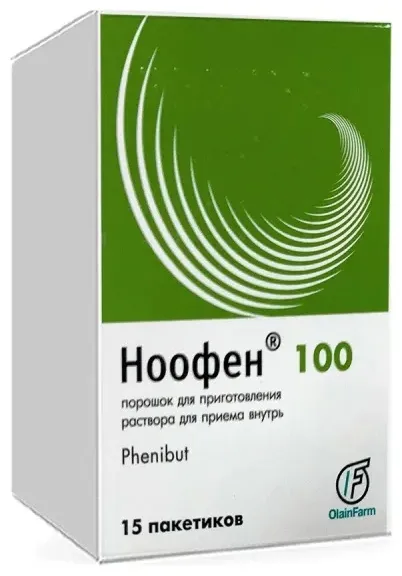
Table of Contents
INSTRUCTION FOR MEDICAL USE OF THE MEDICINAL PRODUCT NOOFEN® 100 (Noofen 100)
Composition:
Active substance: phenibut;
One sachet contains phenibut 100 mg;
Excipients: thaumatin (E957), mannite (E421), Durarom orange flavor [containing sucrose, mono- and diglycerides esters of citric and fatty acids (E472c)].
Medicinal form. Powder for oral solution.
Main physicochemical characteristics: white or almost white powder with a yellowish tint. Yellow specks may be present.
Pharmacotherapeutic group. Psychostimulants and nootropic agents. ATC code N06BX.
Pharmacological properties.
Pharmacodynamics.
Noofen® 100 is a derivative of γ-aminobutyric acid and phenylethylamine.
Its main action is anti-hypoxic and anti-amnesic. Noofen® 100 improves memory and attention, enhances learning processes, and increases physical and mental performance. Psychological parameters (speed and accuracy of sensorimotor reactions) improve under the influence of Noofen® 100. It has been established that Noofen® 100 enhances neuronal energy potential by improving mitochondrial function.
Noofen® 100 also possesses tranquilizing properties: it relieves psychoemotional tension, anxiety, fear, emotional lability, irritability, improves sleep, and prolongs and enhances the effects of sedatives, narcotics, neuroleptics, and anticonvulsants. Noofen® 100 binds exclusively to GABA-ß receptors in the brain, thus exerting a moderate calming effect without causing undesirable sedative effects such as drowsiness, dizziness, reduced attention, or impaired performance. The drug prolongs the latent period and reduces the duration and intensity of nystagmus, and has antiepileptic activity. It does not affect cholinergic or adrenergic receptors.
Noofen® 100 significantly reduces manifestations of asthenia and vasovegetative symptoms, including headache and a sensation of heaviness in the head. In patients with asthenia and emotionally labile individuals, Noofen® 100 improves well-being without causing excitation.
Pharmacokinetics.
The drug is rapidly absorbed after oral administration and penetrates into all body tissues, completely crossing the blood-brain barrier. Distribution in the liver and kidneys is close to uniform, while in the brain and blood it is lower than uniform. A significant amount of administered Noofen® 100 is detected in urine within 3 hours; however, the drug concentration in brain tissue does not decrease, and the compound remains detectable in the brain for up to 6 hours. The following day, Noofen® 100 can only be detected in urine; it remains detectable in urine for up to 2 days after intake, although the amount recovered accounts for only 5% of the administered dose. The highest binding of Noofen® 100 occurs in the liver (80%), and this binding is non-specific. No accumulation is observed upon repeated administration.
Clinical characteristics.
Indications.
Asthenic and anxiety-neurotic states (emotional instability, memory impairment, decreased concentration), restlessness, fear, anxiety, obsessive neurosis.
Stuttering, enuresis, tics.
Ménière’s disease in children, vertigo associated with vestibular apparatus dysfunction, prevention of motion sickness.
Prevention of stress states prior to surgeries or painful diagnostic procedures.
Contraindications. Hypersensitivity to the components of the drug. Acute renal failure.
Interaction with other medicinal products and other forms of interaction.
Noofen® 100 can be used with other medicinal products, including psychotropic agents – tranquilizers and neuroleptics (effects are mutually enhanced).
Special precautions for use.
When prescribing the drug to children with gastrointestinal disorders, caution should be exercised due to the irritant effect of Noofen® 100. Lower doses should be administered to such children.
With prolonged use, blood cell counts and liver function test parameters should be monitored.
Use during pregnancy or breastfeeding.
Noofen® 100 is not recommended during pregnancy or breastfeeding due to insufficient data on the use of the drug during these periods.
Ability to affect reaction rate while driving or operating machinery.
Patients who experience drowsiness, dizziness, or other central nervous system disturbances during treatment should refrain from driving or operating machinery.
Method of Administration and Dosage
The contents of the sachet should be dissolved in half a glass of boiled water and taken orally before meals. The treatment course lasts 2–6 weeks.
Children:
From 3–4 years of age: 100 mg (1 sachet) twice daily;
From 5–6 years: 100 mg three times daily;
From 7–10 years: 200 mg (2 sachets of 100 mg each) twice daily;
From 11–14 years: 200 mg (2 sachets of 100 mg each) three times daily.
Maximum single doses for children: up to 6 years – 100 mg; 7–10 years – 200 mg; 11–14 years – 300 mg.
For prevention of motion sickness, a single dose of Noofen® 100 should be taken one hour before traveling by sea, land, or air.
Noofen® 100 can be combined with other psychotropic agents; in such cases, the dosage of Noofen® 100 and of the concomitantly administered drugs may be reduced.
If one or several doses have been missed, continue treatment according to previously prescribed dosages.
Children.
Experience with use of the drug in children under 3 years of age has not been studied.
Overdose.
Noofen® 100 is a low-toxicity drug; however, at daily doses of 7–14 g during prolonged administration, it may become hepatotoxic.
These doses significantly exceed the recommended average therapeutic doses according to the child's age. Only at higher administered doses were eosinophilia and fatty degeneration of the liver observed. When lower doses were used, such changes were not noted.
Symptoms: drowsiness, nausea, vomiting, possible development of arterial hypotension, acute renal failure.
Treatment: gastric lavage. Symptomatic therapy.
In case of complications (arterial hypotension, renal failure), supportive and symptomatic measures should be applied.
Side effects.
Central nervous system: drowsiness (at the beginning of treatment), headache and dizziness (at doses exceeding 2 g per day; the intensity of this adverse effect decreases when the dose is reduced).
Gastrointestinal tract: nausea (at the beginning of treatment), vomiting, diarrhea, epigastric pain.
Hepatobiliary system: hepatotoxicity (with prolonged use of high doses).
Immune system: allergic reactions, including rash, itching, urticaria, skin redness.
Psychiatric disorders: emotional lability, sleep disturbances (these adverse reactions may occur in children when the medicinal product is used contrary to the instructions for use).
If any adverse reactions not listed in this instruction occur during treatment, or if any of the listed adverse reactions are particularly severe, please consult your doctor.
Shelf life. 2 years.
Storage conditions.
Store in the original packaging at a temperature not exceeding 25°C.
Keep out of reach of children.
Packaging.
1 g of the drug in a laminated sachet. 15 sachets in a cardboard box.
Prescription status.
Prescription only.
Manufacturer.
JSC "Olfa" / Olpha AS.
Manufacturer's address.
Rupnicu iela 5, Olaine, Olaines novads, LV-2114, Latvia / Rupnicu iela 5, Olaine, Olaines novads, LV-2114, Latvia.