Nizoral
Ukraine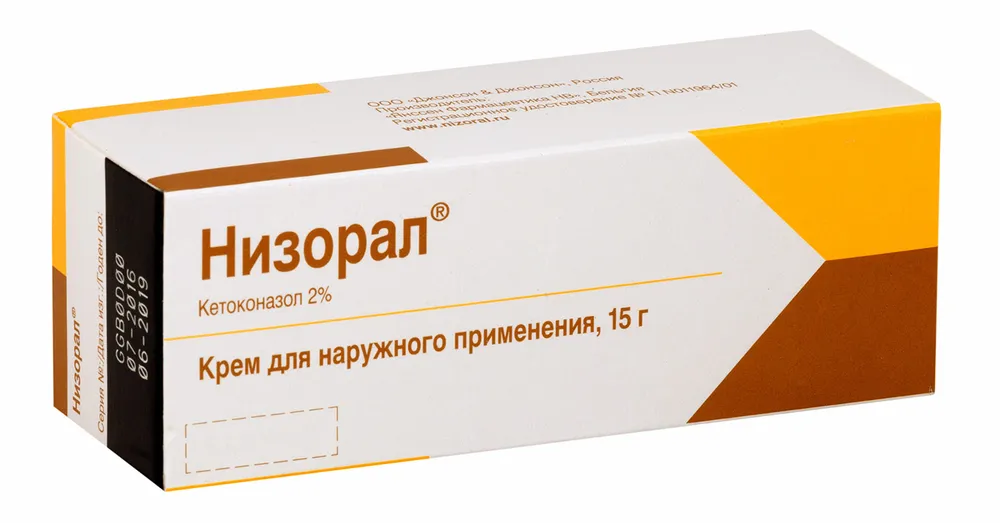
Table of Contents
INSTRUCTIONS for medical use of the medicinal product NIZORAL® (NIZORAL®)
Composition:
Active substance: ketoconazole;
1 g of cream contains 20 mg of ketoconazole;
Excipients: propylene glycol, stearyl alcohol, cetyl alcohol, sorbitan stearate, polysorbate 60, isopropyl myristate, sodium sulfite, polysorbate 80, purified water.
Pharmaceutical form. Cream.
Main physicochemical characteristics: white homogeneous cream.
Pharmacotherapeutic group. Topical antifungal agents. Imidazole and triazole derivatives. ATC code D01AC08.
Pharmacological properties.
Pharmacodynamics.
Ketoconazole is a synthetic imidazolodioxolane derivative that exhibits antifungal activity against dermatophytes such as Trichophyton spp., Epidermophyton floccosum, and Microsporum spp., as well as yeasts, including Malassezia spp. and Candida spp. The effect against Malassezia spp. is particularly pronounced.
Ketoconazole inhibits ergosterol biosynthesis in fungi and alters the composition of other lipid components in the fungal membrane.
Ketoconazole cream very rapidly relieves itching commonly associated with infections caused by dermatophytes and yeasts, as well as skin conditions induced by the presence of Malassezia spp. Symptomatic improvement occurs before the first signs of clinical recovery become evident.
Pharmacokinetics.
After topical application of Nizoral® cream, the concentration of ketoconazole in the plasma of adults is not detectable. In one study, approximately 40 g of Nizoral® 2% cream was applied daily to 40% of the body surface area in infants with seborrheic dermatitis (n = 19): ketoconazole was detected in the plasma of 5 infants, with concentrations ranging from 32 to 133 ng/mL.
Clinical characteristics.
Indications.
For topical use in the treatment of skin infections caused by dermatophytes: tinea corporis, tinea manuum, tinea pedis, tinea cruris, caused by Trichophyton rubrum, Trichophyton mentagrophytes, Microsporum canis, and Epidermophyton floccosum, as well as for the treatment of cutaneous candidiasis and pityriasis versicolor.
Nizoral® cream should also be prescribed for the treatment of seborrheic dermatitis—a skin condition associated with the presence of Malassezia furfur.
Contraindications.
Nizoral® cream is contraindicated in individuals with known hypersensitivity to ketoconazole or to any of the ingredients of the product.
Interaction with other medicinal products and other forms of interaction.
Interaction studies have not been conducted.
Special precautions.
Nizoral® cream should not be used in ophthalmology.
To prevent withdrawal syndrome after discontinuation of prolonged topical corticosteroid therapy, it is recommended to continue applying mild topical corticosteroids to the affected area in the morning and Nizoral® cream in the evening, then gradually discontinue corticosteroid therapy over 2–3 weeks.
The medicinal product contains propylene glycol, which may cause skin irritation, as well as stearyl alcohol and cetyl alcohol, which may cause local skin reactions (e.g. contact dermatitis).
Use during pregnancy or breastfeeding.
There are no adequate and well-controlled studies on the use of the drug in pregnant or breastfeeding women. Limited data on use in pregnant women indicate no adverse effects of ketokonazole on pregnancy or fetal/neonatal health. Animal studies have demonstrated reproductive toxicity at doses not achieved with topical application of ketokonazole.
After topical application of Nizoral® cream, ketokonazole is not detectable in plasma of non-pregnant women. Risks associated with use of the drug during pregnancy or breastfeeding are unknown.
Ability to influence reaction rate while driving or operating machinery.
Nizoral® cream does not affect the ability to drive or operate machinery.
Method of Administration and Dosage
Nizoral® cream is applied to the skin in adults.
Candidiasis of the skin, tinea corporis, tinea of hands and feet, tinea cruris, and pityriasis versicolor: Nizoral® cream is recommended to be applied once daily to affected skin areas and surrounding regions.
Treatment should continue for a sufficient duration, at least several days beyond the disappearance of all symptoms. If symptoms do not resolve after 4 weeks of treatment, the diagnosis should be re-evaluated. General hygiene measures should be followed to control sources of infection and reinfection.
The usual duration of treatment is: pityriasis versicolor – 2–3 weeks; fungal (yeast) infections – 2–3 weeks; tinea cruris – 2–4 weeks; tinea corporis – 3–4 weeks; tinea pedis – 4–6 weeks.
Seborrheic dermatitis: Nizoral® cream should be applied to affected skin areas once or twice daily. Treatment usually lasts from 2 to 4 weeks. For maintenance therapy in seborrheic dermatitis, apply the cream periodically (once weekly).
Seborrheic dermatitis is a chronic condition with a high risk of recurrence.
Children.
Experience with the use of Nizoral® cream in children is lacking.
Overdose.
Topical application.
Excessive topical application of the cream may lead to erythema, edema, and a burning sensation of the skin, which rapidly resolve upon discontinuation of therapy.
Accidental ingestion.
In case of accidental oral ingestion, supportive and symptomatic therapy should be administered.
Adverse Reactions
The safety of Nizoral® cream was evaluated in 30 clinical studies involving 1079 patients who received topical application of the drug on the skin.
Based on pooled safety data from clinical studies, the most frequently reported adverse reactions (≥ 1%) were: application site pruritus (2%), sensation of burning of the skin (1.9%), and application site erythema (1%).
Taking into account the aforementioned adverse reactions, the table below lists adverse reactions reported during clinical studies and post-marketing use. The frequency of adverse reactions is defined as follows: very common (≥ 1/10); common (≥ 1/100 and < 1/10); uncommon (≥ 1/1000 and < 1/100); rare (≥ 1/10,000 and < 1/1000); very rare (< 1/10,000); frequency not known (cannot be estimated based on available clinical study data).
| System organ class |
Adverse reactions |
||
| Frequency category |
|||
| Common (≥ 1/100 to < 1/10) |
Uncommon (≥ 1/1000 to < 1/100) |
Frequency not known |
|
| Immune system disorders |
Hypersensitivity reactions |
||
| Skin and subcutaneous tissue disorders |
Skin burning sensation |
Bullous eruptions, contact dermatitis, rash, skin peeling or stickiness |
Urticaria |
| General disorders and administration site conditions |
Erythema, pruritus |
Bleeding, discomfort, dryness, inflammation, irritation, paraesthesia, application site reactions |
|
Reporting of suspected adverse reactions
Reporting of suspected adverse reactions after authorization of the medicinal product is important. It allows continued monitoring of the benefit-risk balance of the medicinal product. Healthcare professionals are requested to report any suspected adverse reactions through the national reporting system.
Shelf life.
3 years.
Storage conditions.
No special storage conditions are required for this medicinal product.
Keep out of reach and sight of children.
Packaging. 15 g in a tube. 1 tube in a cardboard package.
Classification. Over-the-counter (without prescription).
Manufacturer.
Janssen Pharmaceutica NV.
STADA Arzneimittel AG.
Manufacturer's address and place of business.
Turnhoutseweg 30, Beerse, B-2340, Belgium.
Stadastrasse 2-18, 61118 Bad Vilbel, Germany.