Nitroxoline
Ukraine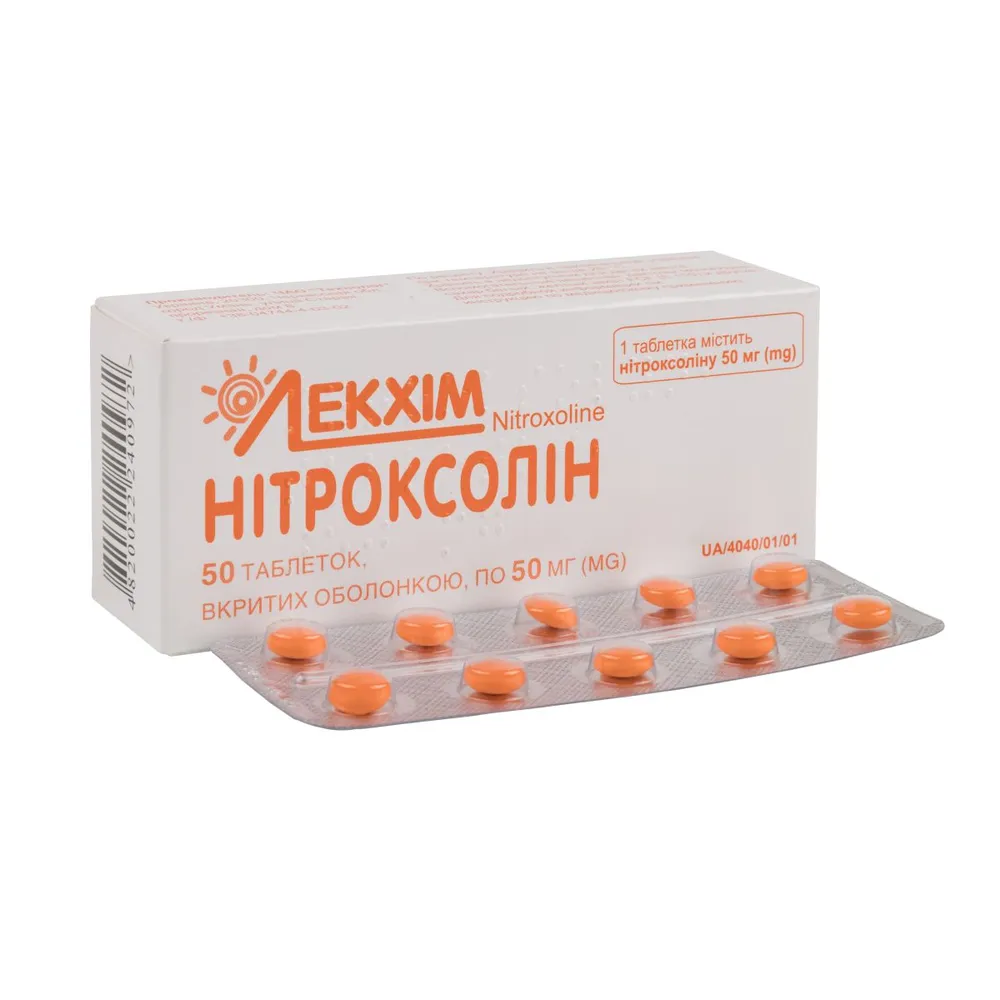
Table of Contents
INSTRUCTIONS FOR MEDICAL USE OF THE MEDICINAL PRODUCT NITROXOLINE (NITROXOLINE)
Composition:
Active ingredient: nitroxoline;
1 tablet contains nitroxoline (calculated as 100% dry substance) – 50 mg;
Excipients: potato starch, lactose monohydrate, calcium stearate, colloidal anhydrous silicon dioxide, talc;
film coating 85F35260 Opadry II Red: polyvinyl alcohol partially hydrolyzed, macrogol, talc, titanium dioxide (E 171), special red AG (E 129), yellow west FCF (E 110).
Pharmaceutical form. Film-coated tablets.
Main physicochemical characteristics: round-shaped tablets with a biconvex surface, coated with a red film coating.
Pharmacotherapeutic group. Antimicrobial agents for systemic use. Other antibacterial agents. ATC code J01XX07.
Pharmacological Properties.
Pharmacodynamics.
A broad-spectrum antimicrobial and antiprotozoal agent used for the treatment of urinary tract infections. Nitroxoline selectively inhibits bacterial DNA synthesis, forms complexes with metal-containing enzymes of microbial cells, and acts against both Gram-positive microorganisms Staphylococcus spp. (including S. aureus), Streptococcus spp. (including beta-hemolytic streptococci, Streptococcus pneumoniae, Enterococcus faecalis), Corynebacterium spp., Bacillus subtilis, and Gram-negative microorganisms N. gonorrhoeae, E. coli, Proteus spp., Klebsiella spp., Salmonella spp., Shigella spp., Enterobacter spp.
Nitroxoline is also active against Mycobacterium tuberculosis, Trichomonas vaginalis, and certain fungal species (Candida spp., dermatophytes, molds, and some agents of deep mycoses).
Pharmacokinetics.
After oral administration, it is well absorbed from the gastrointestinal tract. It is excreted predominantly unchanged by the kidneys. After a single 100 mg dose, the minimum bacteriostatic concentration in urine lasts up to 3 hours; after a 400 mg dose, it lasts up to 7 hours.
Clinical characteristics.
Indications.
- Acute, chronic, and recurrent urinary tract infections caused by gram-positive and gram-negative microorganisms and fungi sensitive to nitroxoline.
- Prophylaxis of recurrent urinary tract infections.
Before prescribing the medicinal product, a microbiological examination must be performed to identify the infectious agent and verify its sensitivity to nitroxoline. However, if there are grounds to believe that the infection is most likely caused by microorganisms sensitive to Nitroxoline, treatment may be initiated prior to obtaining test results.
Contraindications.
- Hypersensitivity to nitroxoline or to any other component of the medicinal product, as well as to other quinolines;
- severe hepatic and renal insufficiency (creatinine clearance less than 0.33 mL/s).
Interaction with other medicinal products and other types of interactions.
Tetracycline group drugs: summation of effects of each drug is observed; with nystatin and levorin – potentiation of action.
Antacids containing magnesium: absorption of nitroxoline is slowed.
Nitrofurans: concomitant use is not possible due to the occurrence of summation of negative neurotropic effects.
Nalidixic acid: reduced efficacy.
Hydroxyquinolines or their derivatives: should not be used simultaneously.
Special precautions for use.
Use with caution in patients with impaired renal function due to the potential for nitroxoline accumulation, and in patients with cataracts.
Cases of peripheral neuritis and optic neuritis have been reported with repeated and prolonged treatment using high doses of halogenated hydroxyquinolines. Nitroxoline is a nitro-derivative of quinoline, and such adverse effects have not been observed with nitroxoline; however, caution is recommended during nitroxoline therapy—such patients should be under close medical supervision.
Treatment should not exceed 4 weeks without additional medical evaluation.
The product contains the dye "Yellow West FCF" (E 110), which may cause allergic reactions, including bronchial asthma. The risk of allergy is higher in patients with hypersensitivity to acetylsalicylic acid.
The product contains lactose; therefore, it is contraindicated in patients with hereditary forms of galactose intolerance, glucose-galactose malabsorption syndrome, or lactase deficiency.
Since the drug is excreted by the kidneys, urine may turn saffron-yellow during nitroxoline therapy.
Use during pregnancy or breastfeeding.
The safety and efficacy of the drug during pregnancy or breastfeeding have not been established; therefore, nitroxoline should not be prescribed during these periods.
Ability to affect reaction speed when driving or operating machinery.
There is no evidence that the drug negatively affects reaction speed in drivers and individuals operating machinery.
Method of Administration and Dosage
Adults: the recommended average daily dose is 400 mg (2 tablets 4 times daily before meals). In severe diseases, the daily dose may be increased to 800 mg (4 tablets 4 times daily). The maximum daily dose for adults is 800 mg.
Children aged 3 to 5 years: the recommended daily dose is 200 mg (1 tablet 4 times daily).
Children aged 5 years and older: the recommended daily dose is 200–400 mg (1–2 tablets 4 times daily).
Duration of treatment course – 2–3 weeks.
Patients may take the drug continuously for 1 month. In chronic infections, the drug should be administered in repeated courses of 2 weeks duration with 2-week intervals (the treatment course may last several months).
Renal impairment. In patients with moderate renal impairment (creatinine clearance above 0.33 ml/s), the usual dose should be halved.
The drug is not recommended for patients with severe renal impairment (creatinine clearance below 0.33 ml/s).
Hepatic impairment. In case of impaired liver function, the usual dose should be halved.
Elderly patients. Dose adjustment is not required.
Children.
The drug in film-coated tablets should not be used in children under 3 years of age.
Overdose.
There have been no reports of overdose. In case of overdose, symptomatic therapy should be administered.
Adverse reactions.
Allergic reactions: skin rashes, itching, which quickly resolve after discontinuation of the drug; allergic reactions with development of thrombocytopenia.
Gastrointestinal system: possible dyspeptic symptoms (nausea, vomiting, loss of appetite), which can be prevented by taking the drug during meals.
Nervous system: headache, ataxia, paresthesia, polyneuropathy.
Hepatobiliary system: decreased transaminase activity, liver function abnormalities.
Urinary system: reduction of uric acid content in blood plasma.
Other: tachycardia, general weakness.
Adverse reactions usually resolve spontaneously after discontinuation of the drug.
Shelf life. 4 years.
Do not use the drug after the expiry date stated on the packaging!
Storage conditions.
In the original packaging at a temperature not exceeding 25 °C.
Keep out of reach of children.
Packaging.
10 tablets in a blister; 5 blisters in a pack.
Prescription status.
Prescription only.
Manufacturer.
Public Joint-Stock Company "Scientific and Production Center "Borshchagov Chemical and Pharmaceutical Plant".
Manufacturer's address and place of business.
17, Miru Street, Kyiv, 03134, Ukraine.