Movespasm
Ukraine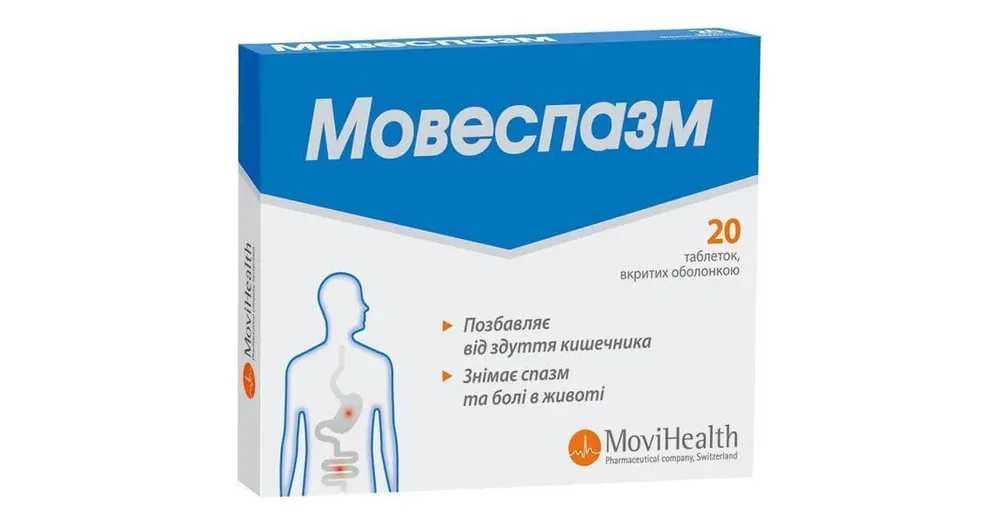
Table of Contents
- INSTRUCTIONS FOR MEDICAL USE OF THE MEDICINAL PRODUCT MOVESPAZM (MOVESPASM®)
- Composition:
- Pharmacological Properties
- Clinical Characteristics.
- Special precautions for use.
- Method of Administration and Dosage
- Adverse Reactions
- Composition:
- Pharmacological Properties
- Clinical characteristics.
- Special precautions for use.
- Method of Administration and Dosage
- Side effects
INSTRUCTIONS FOR MEDICAL USE OF THE MEDICINAL PRODUCT MOVESPAZM (MOVESPASM®)
Composition:
Active substances: simethicone, dicycloverine hydrochloride;
1 coated tablet contains simethicone 40 mg, dicycloverine hydrochloride 20 mg;
Excipients: microcrystalline cellulose, pregelatinized starch, povidone, magnesium stearate, sodium starch glycolate (type A), colloidal anhydrous silicon dioxide, lactose monohydrate, sodium croscarmellose, Wincoat WT-1001 (polyethylene glycol 400, titanium dioxide, hypromellose).
Pharmaceutical form. Coated tablets.
Main physico-chemical properties: white, round, biconvex coated tablets.
Pharmacotherapeutic group.
Spasmolytics and anticholinergics in combination with other agents. Spasmolytics in combination with other preparations.
ATC code: A03ED.
Pharmacological Properties
Pharmacodynamics
Hydrochloride dicyclomine exerts a spasmolytic effect (relieves smooth muscle spasm in the gastrointestinal tract, abdominal pain associated with this spasm or with stretching of the gastrointestinal wall) and antisecretory effects on exocrine glands. The action of dicyclomine is achieved through its specific anticholinergic (antimuscarinic) effect on acetylcholine receptors, as well as direct spasmolytic action on smooth muscles. Studies have shown that dicyclomine is equally effective against spasms induced by acetylcholine and barium chloride. In contrast, atropine's effect during barium chloride-induced spasm is 200 times weaker than its effect during acetylcholine-induced spasm. The mydriatic effect of dicyclomine and its effect on salivary gland secretion are negligible compared to those of atropine (1/500 and 1/300, respectively).
Simethicone is a surfactant and an antifoaming agent. Its mechanism of action is based on reducing the surface tension of gas bubbles, thereby promoting free elimination of gases from the gastrointestinal tract or their absorption through the intestinal wall. Simethicone improves the quality of X-ray and ultrasound images and ensures better distribution of contrast agents on the intestinal mucosa.
Pharmacokinetics
Dicyclomine hydrochloride is rapidly absorbed from the gastrointestinal tract following oral administration; maximum plasma concentration is reached within 60–90 minutes. It is primarily excreted in urine (79.5% of the administered dose), and partially in feces (8.4%). The mean elimination half-life is 1.8 hours. The mean volume of distribution is 3.65 L/kg.
Simethicone is physiologically and chemically inert; it is not absorbed and is excreted unchanged after passing through the gastrointestinal tract.
Clinical Characteristics.
Indications.
Treatment of conditions associated with smooth muscle spasm of the gastrointestinal tract and meteorism, as well as abdominal pain related to these conditions. Treatment of spastic conditions of the gastrointestinal tract, including colitis, intestinal colic, irritable bowel syndrome, and spastic constipation. As adjunctive therapy in organic gastrointestinal disorders such as colitis, diverticulitis, enteritis, gastritis, and peptic ulcers.
Contraindications.
Hypersensitivity to the components of the drug.
Paralytic ileus, obstructive gastrointestinal disorders, pyloric stenosis with obstruction, severe ulcerative colitis or toxic megacolon, reflux esophagitis, unstable cardiovascular status in acute bleeding. Renal insufficiency, obstructive kidney diseases. Prostatic adenoma with urinary retention, glaucoma, myasthenia gravis, thyrotoxicosis, cardiac failure.
Interaction with other medicinal products and other types of interactions.
Amantadine, class I antiarrhythmic agents (e.g., quinidine), antihistamines, antipsychotics (e.g., phenothiazines), benzodiazepines, MAO inhibitors, narcotic analgesics (e.g., meperidine), nitrates and nitrites, sympathomimetics, tricyclic antidepressants, corticosteroids, and other agents with anticholinergic activity may enhance the effects or adverse effects of dicycloverine.
Anticholinergic agents may neutralize the effects of anti-glaucoma medications; therefore, the drug should be used with caution in patients with elevated intraocular pressure and during concomitant use of corticosteroids.
Anticholinergic agents enhance the effects of digoxin, salicylic acid, pyrazolone, codeine, caffeine, and other cholinolytic agents (e.g., atropine sulfate); therefore, concomitant use with dicycloverine hydrochloride is not recommended.
Dicycloverine may neutralize the effects of drugs affecting gastrointestinal motility, such as metoclopramide. It potentiates the effects of spasmolytics.
Since antacid agents may reduce the absorption of anticholinergic drugs, their concomitant use should be avoided.
The inhibitory effect of anticholinergic agents on gastric hydrochloric acid secretion may neutralize the effects of drugs used in the treatment of achlorhydria and in studies of gastric secretion.
Intestinal absorption of levothyroxine may be impaired when administered concomitantly with simethicone.
Special precautions for use.
In conditions of high ambient temperature during treatment with the drug, overheating of the body (elevated body temperature and heat stroke due to reduced sweating) may occur. If such symptoms appear, the drug should be discontinued and medical advice should be sought.
Diarrhea may be an early sign of incomplete intestinal obstruction, particularly in patients with ileostomy or colostomy. In such cases, treatment with this drug should not be used.
In individuals with individual hypersensitivity to anticholinergic agents, the drug may cause central nervous system effects such as confusion, disorientation, ataxia, fatigue, or conversely – euphoria, excitement, insomnia, and affective disturbances. These symptoms usually resolve within 12–24 hours after discontinuation of the drug.
Moverpan should be used with caution in patients with autonomic neuropathy, liver or kidney disease, ulcerative colitis (administration of high doses may cause paralytic ileus and development or worsening of a serious complication such as toxic megacolon), arterial hypertension, ischemic heart disease, congestive heart failure, tachyarrhythmias, tachycardia, hiatal hernia, and prostatic hypertrophy.
The drug contains lactose. If the patient has known intolerance to certain sugars, medical advice should be sought before taking this medicinal product.
Use during pregnancy or breastfeeding.
The safety of treatment with dicycloverine and simethicone during pregnancy has not been established; therefore, the drug should not be used during pregnancy.
Since dicycloverine hydrochloride passes into breast milk, the drug should not be used during breastfeeding.
Ability to affect reaction speed when driving or operating machinery.
Dicycloverine hydrochloride may cause drowsiness and blurred vision; therefore, driving vehicles or operating complex machinery requiring high concentration and rapid psychomotor reactions is not recommended during treatment with this drug.
Method of Administration and Dosage
Adults and children over 12 years of age: 1 tablet up to 4 times daily.
The maximum daily dose is 4 tablets.
The drug should be taken either before or after meals. It is not recommended to take the drug for more than 5 days.
Children.
Do not use in children under 12 years of age.
Overdose.
Overdose is characterized by a biphasic pattern: initially, central nervous system stimulation occurs, manifested by restlessness, illusions, hallucinations, persistent mydriasis, tachycardia, and arterial hypertension. This is followed by central nervous system depression progressing to coma.
Symptoms: headache, nausea, vomiting, and abdominal pain, loss of appetite, pallor of the skin, increased intraocular pressure, dizziness, blurred vision, dilated pupils, hot and dry skin, dry mouth, difficulty swallowing, central nervous system stimulation, tachycardia, and changes in respiratory rate.
A curare-like effect may occur (neuromuscular blockade, muscle weakness, and paralysis).
Treatment: symptomatic therapy. Within the first hours, induce vomiting, perform gastric lavage, and administer adsorbents.
To relieve psychomotor agitation, diazepam (0.5% solution, 2 ml) is used.
Adverse Reactions
The adverse effects listed below pertain to the class of anticholinergic medicinal products; not all of these effects have been observed with dicycloverine hydrochloride.
Gastrointestinal system: dry mouth, taste disturbances, anorexia, nausea, vomiting, dyspepsia, bloating, abdominal pain, constipation.
Central nervous system: tinnitus, headache, drowsiness, weakness, nervousness, psychosis, numbness, dizziness, coma, loss of consciousness or confusion and/or excitement (especially in elderly patients), dyskinesia, insomnia, disorientation, transient memory loss, hallucinations, dysarthria, ataxia, euphoria, inappropriate emotional responses (symptoms usually subside within 12–24 hours after dose reduction).
Eyes: blurred vision, diplopia, mydriasis, cycloplegia, increased intraocular pressure (transient atropine-like effects that resolve after discontinuation of dicycloverine).
Skin and hypersensitivity reactions: hypersensitivity reactions including allergic dermatitis, pruritus, rash, urticaria, erythema, drug idiosyncrasy, angioneurotic edema, anaphylactic shock.
Urinary and reproductive system: difficulty in urination, urinary retention.
Cardiovascular system: tachycardia, palpitations.
Respiratory system: dyspnea, apnea, nasal congestion.
Other effects: decreased sweating, sneezing, swelling of the mucous membranes of the throat, suppression of lactation.
Reporting of suspected adverse reactions
Reporting suspected adverse reactions after medicinal product authorization is important. It allows continuous monitoring of the benefit-risk balance of the medicinal product. Healthcare and pharmaceutical professionals, as well as patients or their legal representatives, should report all suspected adverse reactions and lack of efficacy via the Automated Pharmacovigilance Information System at the following link: https://aisf.dec.gov.ua.
Shelf life
4 years.
Storage conditions
Store in the original packaging, out of reach of children, at a temperature not exceeding 25 °C.
Packaging
10 tablets per blister, 1 or 2 blisters per cardboard package.
20 tablets per blister, 1 blister per cardboard package.
Availability category
Over-the-counter (without prescription).
Manufacturer
MediTop Pharma Ltd.
Manufacturer’s address and location of operations
Edi Endre u. 1, Pilisborosjenő, 2097, Hungary.
Marketing Authorization Holder
TOV "Movi Health"
Address of the Marketing Authorization Holder
162 A Shevchenka St., Shevchenkove, Kyiv-Sviatoshyn District, Kyiv Oblast, 08140, Ukraine
INSTRUCTION
for medical use
MOVE SPAZM
(MOVESPASM®)
Composition:
Active substances: simethicone, dicycloverine hydrochloride;
1 coated tablet contains simethicone 40 mg, dicycloverine hydrochloride 20 mg;
Excipients: microcrystalline cellulose, pregelatinized starch, povidone, magnesium stearate, sodium starch glycolate (type A), colloidal anhydrous silicon dioxide, lactose monohydrate, sodium croscarmellose, Wincoat WT-1001 (polyethylene glycol 400, titanium dioxide, hypromellose).
Pharmaceutical form. Coated tablets.
Main physicochemical properties: white, round, biconvex, coated tablets.
Pharmacotherapeutic group.
Spasmolytics and anticholinergics in combination with other drugs. Spasmolytics in combination with other agents.
ATC code: A03ED.
Pharmacological Properties
Pharmacodynamics
Dicyclomine hydrochloride exerts a spasmolytic effect (relieves smooth muscle spasm in the gastrointestinal tract, abdominal pain associated with such spasm or with stretching of the gastrointestinal wall) and antisecretory effects on exocrine glands. The action of dicyclomine is achieved through its specific anticholinergic (antimuscarinic) effect on acetylcholine receptors, as well as through a direct spasmolytic effect on smooth muscles. Studies have shown that dicyclomine is equally effective against spasms induced by acetylcholine and barium chloride. In contrast, atropine's effect in barium chloride-induced spasm is 200 times weaker than its effect in acetylcholine-induced spasm. The mydriatic effect of dicyclomine and its effect on salivary gland secretion are negligible compared to those of atropine (1/500 and 1/300, respectively).
Simethicone is a surface-active agent and an antifoaming agent. Its mechanism of action is based on reducing the surface tension of gas bubbles, thereby promoting free elimination of gases from the gastrointestinal tract or their absorption through the intestinal wall. Simethicone improves the quality of X-ray and ultrasound images and ensures better distribution of contrast agents on the intestinal mucosa.
Pharmacokinetics
Dicyclomine hydrochloride is rapidly absorbed in the gastrointestinal tract following oral administration; maximum plasma concentration is reached within 60–90 minutes. It is excreted predominantly in the urine (79.5% of the administered dose) and partially in feces (8.4%). The mean elimination half-life is 1.8 hours. The mean volume of distribution is 3.65 L/kg.
Simethicone is physiologically and chemically inert; it is not absorbed and is excreted unchanged after passing through the gastrointestinal tract.
Clinical characteristics.
Indications.
Treatment of conditions associated with smooth muscle spasm of the gastrointestinal tract and meteorism, as well as abdominal pain related to these conditions. Treatment of spastic conditions of the gastrointestinal tract, including colitis, intestinal colic, irritable bowel syndrome, spastic constipation. As adjunctive therapy in organic diseases of the gastrointestinal tract such as colitis, diverticulitis, enteritis, gastritis, and peptic ulcers.
Contraindications.
Hypersensitivity to the components of the drug.
Paralytic ileus, obstructive gastrointestinal disorders, pyloric stenosis with obstruction, severe ulcerative colitis or toxic megacolon, reflux esophagitis, unstable cardiovascular status in acute bleeding. Renal insufficiency, obstructive kidney diseases. Prostatic adenoma with urinary retention, glaucoma, myasthenia gravis, thyrotoxicosis, cardiac failure.
Interaction with other medicinal products and other types of interactions.
Amantadine, class I antiarrhythmic drugs (e.g., quinidine), antihistamines, antipsychotics (e.g., phenothiazines), benzodiazepines, MAO inhibitors, narcotic analgesics (e.g., meperidine), nitrates and nitrites, sympathomimetics, tricyclic antidepressants, corticosteroids, and other agents with anticholinergic activity may enhance the effect or adverse effects of dicycloverine.
Anticholinergic agents may neutralize the effect of anti-glaucoma drugs; therefore, the drug should be administered with caution in patients with elevated intraocular pressure and during concomitant use of corticosteroids.
Anticholinergic agents enhance the effects of digoxin, salicylic acid, pyrazolone, codeine, caffeine, and other cholinolytic agents (e.g., atropine sulfate); therefore, simultaneous use with dicycloverine hydrochloride is not recommended.
Dicycloverine may neutralize the effect of drugs affecting gastrointestinal motility, such as metoclopramide. It potentiates the effect of spasmolytics.
Since antacid agents may reduce the absorption of anticholinergic drugs, their concomitant use should be avoided.
The inhibitory effect of anticholinergic agents on gastric hydrochloric acid secretion may neutralize the effect of drugs used in the treatment of achlorhydria and in studies of gastric secretion.
Intestinal absorption of levothyroxine may be impaired when administered concomitantly with simethicone.
Special precautions for use.
In conditions of high ambient temperature during treatment with the drug, overheating of the body (elevated body temperature and heat stroke due to reduced sweating) may occur. If such symptoms appear, the drug should be discontinued and medical advice should be sought.
Diarrhea may be an early sign of incomplete intestinal obstruction, particularly in patients with ileostomy or colostomy. In such cases, treatment with the drug should not be used.
In individuals with individual hypersensitivity to anticholinergic agents, the drug may cause central nervous system effects such as confusion, disorientation, ataxia, fatigue, or conversely—euphoria, excitement, insomnia, and affective disturbances. These symptoms usually resolve within 12–24 hours after discontinuation of the drug.
Moverelax should be used with caution in patients with autonomic neuropathy, liver or kidney disease, ulcerative colitis (administration of high doses may cause paralytic ileus and lead to or exacerbate a serious complication such as toxic megacolon), arterial hypertension, ischemic heart disease, congestive heart failure, tachyarrhythmias, tachycardia, hiatal hernia, and prostatic hyperplasia.
The drug contains lactose. If a patient has established intolerance to certain sugars, medical advice should be sought before taking this medicinal product.
Use during pregnancy or breastfeeding.
The safety of treatment with dicycloverine and simethicone during pregnancy has not been established; therefore, the drug should not be used during pregnancy.
Since dicycloverine hydrochloride passes into breast milk, the medicinal product should not be used during breastfeeding.
Ability to affect reaction speed when driving or operating machinery.
Dicycloverine hydrochloride may cause drowsiness and blurred vision; therefore, driving vehicles or operating complex machinery requiring increased attention and high psychomotor reaction speed is not recommended during treatment with this drug.
Method of Administration and Dosage
Adults and children over 12 years of age: 1 tablet up to 4 times daily.
The maximum daily dose is 4 tablets.
The drug should be taken either before or after meals. It is not recommended to use the drug for more than 5 days.
Children
Do not use in children under 12 years of age.
Overdose
Overdose is characterized by a biphasic course: initially, central nervous system stimulation occurs, manifested by restlessness, illusions, hallucinations, persistent mydriasis, tachycardia, and arterial hypertension. This is followed by central nervous system depression progressing to coma.
Symptoms: headache, nausea, vomiting, and abdominal pain, loss of appetite, pallor of the skin, increased intraocular pressure, dizziness, blurred vision, dilated pupils, hot and dry skin, dry mouth, difficulty swallowing, central nervous system stimulation, tachycardia, and changes in respiratory rate.
Curare-like effects may occur (neuromuscular blockade, sensation of muscle weakness, and paralysis).
Treatment: symptomatic therapy. Within the first hours, induce vomiting, perform gastric lavage, and administer adsorbents.
For relief of psychomotor agitation, diazepam (0.5% solution, 2 ml) is used.
Side effects
The adverse effects listed below are associated with the class of anticholinergic drugs; not all of them have been observed with the use of dicycloverine hydrochloride.
Gastrointestinal disorders: dry mouth, loss of taste, anorexia, nausea, vomiting, dyspepsia, bloating, abdominal pain, constipation.
Central nervous system disorders: tinnitus, headache, drowsiness, weakness, nervousness, psychosis, numbness, dizziness, coma, loss of consciousness or confusion and/or excitement (especially in elderly patients), dyskinesia, insomnia, disorientation, transient memory loss, hallucinations, dysarthria, ataxia, euphoria, inappropriate emotional responses (symptoms usually subside within 12–24 hours after dose reduction).
Eye disorders: blurred vision, diplopia, mydriasis, cycloplegia, increased intraocular pressure (transient atropine-like effects that resolve after discontinuation of dicycloverine).
Skin and hypersensitivity reactions: hypersensitivity reactions including allergic dermatitis, pruritus, rash, urticaria, erythema, drug-induced idiosyncrasy, angioneurotic edema, anaphylactic shock.
Urinary system disorders: dysuria, urinary retention.
Cardiovascular disorders: tachycardia, palpitations.
Respiratory system disorders: bronchospasm, apnea, nasal congestion.
Other effects: decreased sweating, sneezing, pharyngeal mucosal edema, lactation suppression.
Reporting suspected adverse reactions
Reporting of suspected adverse reactions after drug registration is of great importance. It enables continuous monitoring of the benefit-risk balance of the medicinal product. Healthcare professionals and patients or their legal representatives are encouraged to report any suspected adverse reactions and lack of efficacy via the Automated Pharmacovigilance Information System at the following link: https://aisf.dec.gov.ua.
Shelf life
4 years.
Storage conditions
Store in the original packaging, out of reach of children, at a temperature not exceeding 25 °C.
Packaging
10 tablets in a blister, 1 or 2 blisters per cardboard pack.
20 tablets in a blister, 1 blister per cardboard pack.
Availability classification
Over-the-counter (without prescription).
Manufacturer
Sava Helske Ltd.
Manufacturer’s address and place of business
GIDC Estate, 507-B-512, Vatva City - 363 035, Surendranagar, India.
Marketing Authorization Holder
LLC "Movi Health"
Address of the Marketing Authorization Holder
162 A, Shevchenka Street, Shevchenkove village, Kyiv-Sviatoshyn district, Kyiv region, 08140, Ukraine