Moleskin® c
Ukraine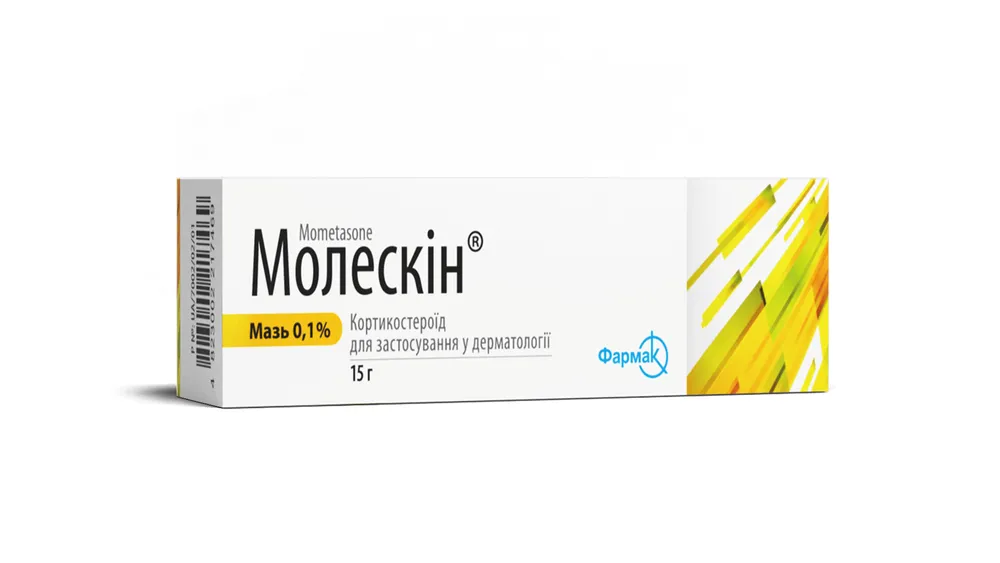
Table of Contents
INSTRUCTIONS FOR MEDICAL USE OF THE MEDICINAL PRODUCT MOLESKINC® (MOLESKINC)
Composition:
Active substances: mometasone furoate, salicylic acid;
1 g of ointment contains 1 mg of mometasone furoate and 50 mg of salicylic acid, calculated as 100 % substance;
Excipients: disodium edetate, hexylene glycol, purified water, propylene glycol monopalmitostearate, white wax, white soft paraffin.
Pharmaceutical form. Ointment.
Main physicochemical characteristics: homogeneous ointment of white or almost white color.
Pharmacotherapeutic group.
Corticosteroids for dermatological use. Potent corticosteroids in combination with other agents. ATC code D07XC03.
Pharmacological properties.
Pharmacodynamics.
Mometasone furoate is a potent glucocorticosteroid with anti-inflammatory, antipruritic, and vasoconstrictive properties. Mometasone furoate is a strong inhibitor in vitro of the production of three cytokines involved in the development and maintenance of the inflammatory process: interleukin-1 (IL-1), interleukin-6 (IL-6), and tumor necrosis factor-alpha (TNF-α).
Salicylic acid promotes desquamation of the stratum corneum and enhances penetration of mometasone furoate into the skin.
Pharmacokinetics.
After single topical application of Molestyline® Ointment for 12 hours without using an occlusive dressing, approximately 1.5% of the applied dose is absorbed systemically. The drug that enters systemic circulation is rapidly excreted in urine and feces.
Clinical characteristics.
Indications.
Treatment of moderate to severe plaque psoriasis.
Contraindications.
Hypersensitivity to mometasone furoate, salicylic acid, or to any other component of the drug.
Like other topical glucocorticoids, Molexicon® C is contraindicated in bacterial infections (including pyoderma, tuberculosis, syphilis), viral infections (herpes simplex, varicella, herpes zoster, warts, genital warts, molluscum contagiosum), or fungal infections (dermatophytes and yeasts), as well as in parasitic skin diseases, in the absence of concomitant adequate therapy.
Molexicon® C is also contraindicated in post-vaccination reactions, perioral dermatitis or rosacea, common acne, and skin atrophy.
Interaction with other medicinal products and other forms of interaction.
After topical application of Molexicon® C, a very small but measurable amount of salicylates was absorbed into blood plasma. A literature review on interactions of salicylates with other substances following oral administration or skin application revealed that possible alterations in the effects of such medicinal products as tolbutamide, methotrexate, heparin, pyrazinamide, uricosuric agents, and coumarin-type drugs may occur. Other glucocorticosteroids and ammonium sulfate may influence the levels of salicylic acid. This interaction should be taken into account when prescribing Molexicon® C concomitantly with the above-mentioned medicinal products.
Special precautions for use.
Moleskin® C is indicated for topical use only and is not intended for ophthalmic use.
As with other topical corticosteroids, appropriate precautions should be observed when applying the ointment to large skin areas (it should not be used in extensive plaque psoriasis) or when prolonged treatment is anticipated. This is particularly important in pediatric patients, as children may be more susceptible than adults to hypothalamic-pituitary-adrenal (HPA) axis suppression and Cushing's syndrome due to topical corticosteroids, owing to greater drug absorption resulting from a higher skin surface area to body mass ratio in children.
Moleskin® C ointment should not be used under occlusive dressings. It should not be applied to the face, axillae, groin areas, genital organs, or areas with intertrigo. Avoid contact of the ointment with mucous membranes and open wounds. Moleskin® C should not be used in ulcerative skin lesions, wounds, or striae. Moleskin® C is not recommended for use in pustular or guttate psoriasis.
If skin irritation develops, including excessive skin dryness, treatment with the ointment should be discontinued and appropriate therapy should be initiated.
With prolonged use, corticosteroids should be tapered gradually, as withdrawal symptoms (e.g., dermatitis, burning sensation) may occur.
Glucocorticosteroids may mask, stimulate, or exacerbate skin infections.
If a concomitant skin infection develops, appropriate antifungal or antimicrobial therapy should be administered. If no prompt response to treatment is observed, use of Moleskin® C ointment should be discontinued until the infection is adequately controlled.
Salicylic acid may have a photoprotective effect. Therefore, when combining Moleskin® C with UV therapy, it is recommended to remove residual ointment and cleanse the skin area prior to UV irradiation. The ointment may be reapplied after completion of the UV therapy session.
Any adverse effects associated with systemic corticosteroids, including adrenal cortex suppression, may also occur with topical application of glucocorticosteroids, especially in infants and children.
Moleskin® C contains propylene glycol monopalmitostearate, which may cause skin irritation.
Use during pregnancy or breastfeeding.
Controlled studies on the use of the drug during pregnancy have not been conducted. Moleskin® C should not be administered during the first and second trimesters of pregnancy. Moleskin® C is contraindicated during the third trimester of pregnancy.
It is unknown whether topical application of corticosteroids or salicylic acid, due to systemic absorption, may result in passage into breast milk; therefore, Moleskin® C is not recommended for use in nursing women.
Ability to affect reaction rate while driving or operating machinery.
The drug generally does not affect the ability to drive or operate machinery.
Method of Administration and Dosage
For adults and children aged 12 years and older, apply a thin layer of the ointment to the affected skin area once or twice daily (in the morning and/or evening). The maximum daily dose is 15 g, applied to no more than 30% of the body surface area. The duration of treatment is determined by the physician depending on the severity and course of the disease. Treatment duration longer than 3 weeks has not been evaluated in the main clinical trials. As with all potent glucocorticosteroids, a gradual reduction in dosage is recommended.
Children
The safety and efficacy of Molexcin® S in children under 12 years of age have not been established. In children, the minimal effective amount of glucocorticosteroid should be used to achieve the desired therapeutic effect. Prolonged therapy with glucocorticosteroids may adversely affect growth and development in children.
Overdose
Excessive or prolonged use of topical corticosteroids may lead to suppression of the hypothalamic-pituitary-adrenal (HPA) axis function, potentially resulting in secondary adrenal insufficiency and symptoms of hypercorticism, including Cushing's syndrome.
Treatment . If signs of hypothalamic-pituitary-adrenal (HPA) axis suppression occur, the frequency of application should be reduced or treatment discontinued. Appropriate symptomatic therapy should also be initiated.
In clinical studies, doses exceeding the recommended maximum daily dose of 15 g per day had a transient effect on hypothalamic-pituitary-adrenal (HPA) axis function.
When applied to large skin areas, systemic effects characteristic of salicylic acid may occur. In case of toxicity caused by salicylic acid, treatment with Molexcin® S should be discontinued. Fluids to promote diuresis should be administered. If necessary, sodium bicarbonate and potassium (orally or intravenously) should be given.
Side effects
The following adverse reactions have been reported during the use of topical corticosteroids: very common (≥ 1/10); common (≥ 1/100, < 1/10); uncommon (≥ 1/1000, < 1/100); rare (≥ 1/10,000, < 1/1000); very rare (< 1/10,000, including isolated reports).
Endocrine system disorders:
Rare – adrenal suppression.
Skin and subcutaneous tissue disorders:
Common – pruritus, local skin atrophy;
Uncommon – striae, rosacea-like dermatitis, ecchymosis, folliculitis, furunculosis;
Rare – hypertrichosis, hypopigmentation of the skin;
Not known – skin irritation, skin maceration, dry skin, acneiform dermatitis, dermatitis, contact dermatitis, skin desquamation, telangiectasia, miliaria.
General disorders and administration site conditions:
Common – burning sensation at the application site, prickling.
Infections and infestations:
Uncommon – infections.
Immune system disorders:
Rare – hypersensitivity.
In addition, perioral dermatitis has been reported uncommonly as an additional adverse effect associated with the use of topical corticosteroids.
Prolonged continuous use of topical corticosteroids may lead to the development of local skin atrophy, striae, and dilation of superficial blood vessels, particularly on the face.
Prolonged use of products containing salicylic acid may lead to the development of dermatitis.
Shelf life.
2 years.
Do not use the medicinal product after the expiry date stated on the package.
Storage conditions.
Store at a temperature not exceeding 25 °C. Do not freeze.
Keep out of the reach of children.
Packaging.
15 g in a tube. 1 tube in a carton.
Prescription status.
Prescription only.
Manufacturer.
JSC "Farmak".
Manufacturer's name and address of the place of business.
74, Kyrylivska Street, Kyiv, 04080, Ukraine.