Mirtazapine sandoz®
Ukraine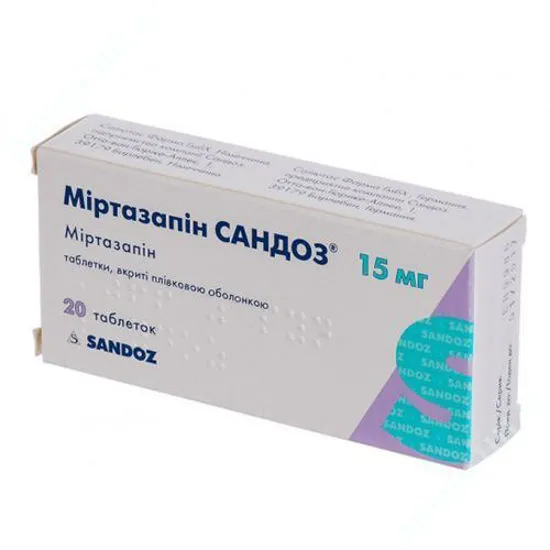
Table of Contents
INSTRUCTIONS FOR MEDICAL USE OF THE MEDICINAL PRODUCT MIRTAZAPINE SANDOZÒ (MIRTAZAPINE SANDOZÒ)
Composition:
Active ingredient: mirtazapine;
1 tablet contains 15 mg or 30 mg of mirtazapine;
Excipients: tablet core – lactose monohydrate, maize starch, hydroxypropylcellulose, colloidal anhydrous silicon dioxide, magnesium stearate;
15 mg tablets: coating (Opadry Yellow) – hydroxypropylmethylcellulose, titanium dioxide (E 171), polyethylene glycol 8000, iron oxide yellow (E 172), quinoline yellow (E 104), sunset yellow FCF (E 110);
30 mg tablets: coating (Opadry Beige) – hydroxypropylmethylcellulose, titanium dioxide (E 171), polyethylene glycol 8000, iron oxide red (E 172), iron oxide yellow (E 172), iron oxide black (E 172).
Pharmaceutical form. Film-coated tablets.
Main physicochemical properties:
15 mg tablets: yellow, round, biconvex, film-coated tablets with a score line on one side;
30 mg tablets: beige, round, biconvex, film-coated tablets with a score line on one side.
Pharmacotherapeutic group. Antidepressants. ATC code N06AX11.
Pharmacological properties.
Pharmacodynamics.
Mirtazapine is an antagonist of presynaptic α2-receptors, which enhances central noradrenergic and serotonergic neurotransmission. The enhancement of serotonergic neurotransmission occurs exclusively via 5-HT1-receptors, since mirtazapine blocks 5-HT2 and 5-HT3-receptors. Both enantiomers of mirtazapine possess antidepressant activity: the S(+) enantiomer blocks α2- and 5-HT2-receptors, while the R(–) enantiomer blocks 5-HT3-receptors. Mirtazapine blocks H1-receptors, which accounts for its sedative properties. At therapeutic doses, mirtazapine has virtually no anticholinergic activity and does not affect the cardiovascular system.
Pediatric population. In two randomized, double-blind, placebo-controlled trials involving children aged 7–18 years with major depressive disorder (n = 259), using a flexible dosing schedule during the first 4 weeks (15–45 mg of mirtazapine), followed by a fixed dose (15 mg, 30 mg, or 45 mg of mirtazapine) for an additional 4 weeks, no significant differences between mirtazapine and placebo were demonstrated on either primary or all secondary endpoints. A significant increase in body weight (≥7%) was observed in 48.8% of patients in the mirtazapine treatment group compared to 5.7% in the placebo group. Other adverse reactions included urticaria (11.8% vs. 6.8%) and hypertriglyceridemia (2.9% vs. 0%).
Pharmacokinetics.
After oral administration, mirtazapine is rapidly and well absorbed (bioavailability is approximately 50%), reaching peak plasma concentrations within about 2 hours. Approximately 85% of mirtazapine is bound to plasma proteins. The mean elimination half-life is 20–40 hours; cases with elimination half-life up to 65 hours have been reported; shorter half-life is typically observed in younger patients. The prolonged elimination half-life allows once-daily dosing. Steady-state concentrations are reached within 3–4 days, after which accumulation ceases. Within recommended doses, the pharmacokinetics of mirtazapine are linear. Food intake does not affect the pharmacokinetics of mirtazapine.
Mirtazapine is extensively metabolized and eliminated from the body via urine and feces over several days. The main biotransformation pathways are demethylation and oxidation followed by conjugation. In vitro data from liver microsomes indicate that CYP2D6 and CYP1A2 cytochrome P450 enzymes are involved in the formation of the 8-hydroxy metabolite of mirtazapine, while CYP3A4 is responsible for the formation of N-demethyl and N-oxide metabolites. The N-demethyl metabolite is pharmacologically active and likely exerts a pharmacological effect similar to that of the parent compound.
The clearance of mirtazapine may be reduced in patients with renal or hepatic impairment.
Clinical characteristics.
Indications.
Treatment of major depressive disorder.
Contraindications.
Hypersensitivity to mirtazapine or to any other component of the medicinal product.
Concomitant use of mirtazapine with monoamine oxidase inhibitors (MAOIs).
Interactions with other medicinal products and other forms of interactions.
Pharmacodynamic interactions.
Mirtazapine should not be used concurrently with MAO inhibitors or within 2 weeks after discontinuation of MAOI therapy. Approximately 2 weeks should elapse after stopping mirtazapine treatment before patients can start using MAO inhibitors.
In addition, concomitant use of mirtazapine with selective serotonin reuptake inhibitors and other serotonergic agents (L-tryptophan, triptans, tramadol, linezolid, venlafaxine, lithium, and products containing St. John’s wort (Hypericum perforatum)) may lead to serotonin-related effects. Caution and careful medical monitoring are recommended when these agents are used in combination with mirtazapine.
Mirtazapine may enhance the sedative effects of benzodiazepines and other sedative agents (particularly most antipsychotics, H1-receptor antagonists, and opioids). Caution should be exercised when prescribing these medicinal products concomitantly with mirtazapine.
Mirtazapine may potentiate the CNS-depressant effect of alcohol; therefore, patients should abstain from alcohol consumption during treatment with this medicinal product.
Mirtazapine at a dose of 30 mg once daily caused a small but statistically significant increase in INR (international normalized ratio) in patients treated with warfarin. Monitoring of INR is recommended during concomitant use of warfarin and mirtazapine due to the possibility of increased INR.
The risk of QT interval prolongation and/or ventricular arrhythmias (e.g., torsade de pointes) increases when mirtazapine is used concomitantly with other drugs that prolong the QT interval (e.g., certain antipsychotics and antibiotics).
Pharmacokinetic interactions.
Carbamazepine and phenytoin, CYP3A4 inducers, increase the clearance of mirtazapine by approximately two-fold, resulting in a 60% and 45% reduction in mean plasma mirtazapine concentrations, respectively. When carbamazepine or any other hepatic metabolism inducer (e.g., rifampicin) is added to mirtazapine therapy, the dose of mirtazapine should be increased. If treatment with such an inducer is discontinued, a reduction in the mirtazapine dose may become necessary.
Concomitant use of the potent CYP3A4 inhibitor ketoconazole increased peak plasma levels and AUC (area under the concentration-time curve) of mirtazapine by approximately 40% and 50%, respectively.
When cimetidine (a weak inhibitor of CYP1A2, CYP2D6, and CYP3A4) is coadministered with mirtazapine, mean plasma concentrations of mirtazapine may increase by more than 50%. Precautions should be taken and dose reduction considered when mirtazapine is used concomitantly with potent CYP3A4 inhibitors, HIV protease inhibitors, azole antifungals, erythromycin, cimetidine, or nefazodone.
No clinically significant pharmacokinetic interactions were observed with concomitant administration of mirtazapine and paroxetine, amitriptyline, risperidone, or lithium.
Special precautions for use.
Severe skin reactions. Severe skin reactions, including Stevens-Johnson syndrome, toxic epidermal necrolysis, drug reaction with eosinophilia and systemic symptoms (DRESS), bullous dermatitis, and erythema multiforme, which may be fatal, have been reported with mirtazapine treatment. If signs or symptoms suggestive of these reactions occur, mirtazapine should be discontinued immediately. If a patient has experienced one of these reactions while taking Mirtazapine Sandoz®, the drug must never be used again in this patient.
Suicide/suicidal thoughts or clinical worsening. Depression is associated with an increased risk of suicidal thoughts, self-harm, and suicide (suicide-related events). This risk persists until significant remission occurs. Since improvement may not occur during the first few weeks of treatment or longer, patients should be closely monitored until improvement occurs. According to general clinical experience, the risk of suicide may increase during the early stages of recovery.
Patients with a history of suicide attempts, or those exhibiting pronounced suicidal ideation prior to treatment initiation, are at higher risk of developing suicidal thoughts or suicide attempts and should be closely monitored throughout treatment. Analysis of clinical trials of antidepressants used in adults with psychiatric disorders has shown an increased risk of developing suicidal behavior in patients under 25 years of age treated with antidepressants compared to those receiving placebo.
Close monitoring is required during antidepressant therapy for patients at high risk of suicidal behavior, especially at the beginning of therapy and after dosage adjustments. Patients (and caregivers) should be advised to watch for any clinical worsening, suicidal behavior or thoughts, and unusual changes in behavior, and to seek immediate medical advice if such symptoms occur.
Due to the risk of suicide, particularly at the beginning of treatment, the patient should be prescribed the minimum necessary number of mirtazapine tablets.
Suppression of bone marrow function. Suppression of bone marrow function, typically manifesting as granulocytopenia or agranulocytosis, has been reported during mirtazapine treatment.
Isolated cases of agranulocytosis, usually reversible but sometimes fatal (predominantly in patients aged 65 years and older), have been reported. Physicians should be alert to symptoms such as fever, sore throat, stomatitis, or other signs of infection. If such symptoms occur, treatment should be discontinued and a blood count performed.
Jaundice. Treatment must be discontinued if jaundice occurs.
Conditions requiring medical supervision. Careful dosing and regular, close monitoring are necessary for patients with the following conditions:
- Epilepsy and organic brain disorders. Mirtazapine should be used with particular caution in patients with a history of epileptic seizures. Treatment should be discontinued in patients who develop seizures or experience an increase in seizure frequency;
- Hepatic impairment: Following oral administration of 15 mg mirtazapine, clearance was reduced by approximately 35% in patients with mild to moderate hepatic impairment compared to patients with normal liver function. The average plasma concentration of mirtazapine increased by approximately 55%. When prescribing 30 mg mirtazapine, the benefit/risk ratio for the patient should be considered;
- Renal impairment: After single oral administration of 15 mg mirtazapine in patients with moderate (10 mL/min ≤ creatinine clearance < 40 mL/min) or severe (creatinine clearance < 10 mL/min) renal impairment, mirtazapine clearance was reduced by approximately 30% and 50%, respectively, compared to healthy subjects. The average plasma concentration of mirtazapine increased by 55% and 115%, respectively. No significant differences were observed in patients with mild renal impairment (40 mL/min ≤ creatinine clearance < 80 mL/min) compared to the control group. When prescribing 30 mg mirtazapine, the benefit/potential risk ratio for the patient should be considered, and creatinine clearance should be monitored;
- Cardiac disorders, such as conduction disturbances, angina pectoris, and recent myocardial infarction. Such cases require standard precautions and concomitant therapy should be prescribed with caution;
- Arterial hypotension;
- Diabetes mellitus: In patients with diabetes mellitus, antidepressants may affect blood glucose levels. Adjustment of insulin and/or oral hypoglycemic agent dosage may be necessary, and careful monitoring is recommended.
The following precautions should be considered when using antidepressants:
- In patients with schizophrenia or other psychiatric disorders, psychotic symptoms may worsen during antidepressant treatment; paranoid thoughts may become more intense;
- In the treatment of the depressive phase of bipolar disorder, a switch to a manic phase may occur. Close monitoring is required for patients with a history of manic or hypomanic episodes. Mirtazapine treatment should be discontinued if the patient enters a manic phase;
- Although dependence on mirtazapine does not occur, post-marketing experience indicates that abrupt discontinuation after prolonged use may occasionally lead to withdrawal symptoms. Most withdrawal reactions are mild and resolve spontaneously. The most commonly reported withdrawal symptoms include dizziness, agitation, restlessness, headache, and nausea. Although reported as withdrawal symptoms, these may also be related to the course of the underlying illness. Gradual discontinuation of mirtazapine is recommended;
- Caution is required when treating patients with urinary retention, including that due to prostate hyperplasia, and patients with acute angle-closure glaucoma or elevated intraocular pressure (although the effect of mirtazapine is unlikely due to its very low anticholinergic activity);
- Akathisia/psychomotor agitation: Antidepressant use has been associated with akathisia, characterized by subjective feelings of unpleasant or anxious restlessness and an urge to move, with an inability to sit or stand still. These symptoms are most likely to occur during the first few weeks of treatment; therefore, increasing the dose may be harmful;
- Cases of QT interval prolongation, torsade de pointes, ventricular tachycardia, and sudden death have been reported. Most reports are associated with overdose or involve patients with other risk factors for QT prolongation, particularly those receiving concomitant medications that prolong the QT interval.
Mirtazapine should be used cautiously in patients with known cardiovascular disorders or a family history of QT interval prolongation, and when used concomitantly with other drugs that may prolong the QT interval.
Hypotension. Isolated cases of hyponatremia have been reported with mirtazapine use, associated with inappropriate antidiuretic hormone (ADH) secretion. Elderly patients or patients receiving concomitant therapy that may cause hyponatremia require precautionary measures.
Serotonin syndrome. Interaction with serotonergic agents: Serotonin syndrome may occur when selective serotonin reuptake inhibitors are used concomitantly with other serotonergic agents. Symptoms of serotonin syndrome may include hyperthermia, muscle rigidity, myoclonus, autonomic instability with possible rapid fluctuations in vital signs, and mental status changes such as confusion, agitation, and extreme excitement progressing to delirium and coma. Serotonin syndrome is very rare in patients treated solely with mirtazapine.
Elderly patients. When prescribing mirtazapine to elderly patients, the adverse effects associated with antidepressant use should be considered. The incidence of adverse reactions in elderly patients was not higher than in other age groups.
Lactose. The product contains lactose and therefore should not be administered to patients with rare hereditary forms of galactose intolerance, lactase deficiency, or glucose-galactose malabsorption syndrome.
The medicinal product Mirtazapine Sandoz® 15 mg film-coated tablets contains Yellow Sunset FCF (E 110), which may cause allergic reactions.
Use during pregnancy or breastfeeding.
Pregnancy. Limited data on the use of mirtazapine in pregnant women do not indicate an increased risk of congenital malformations. Animal studies did not show any teratogenic effects manifested clinically, but an adverse effect on intrauterine development was observed.
Epidemiological data indicate that the use of selective serotonin reuptake inhibitors (SSRIs) during pregnancy, particularly in late pregnancy, increases the risk of persistent pulmonary hypertension in the newborn (PPHN). Although no studies have specifically investigated the association between PPHN and mirtazapine treatment, this potential risk cannot be excluded due to the similar mechanism of action (increased serotonin concentrations).
The drug should be prescribed to pregnant women with particular caution, taking into account the benefit/risk ratio for the fetus. If mirtazapine is used until delivery or immediately before delivery, postnatal monitoring of the newborn is recommended to account for possible withdrawal effects.
Lactation. Animal studies and limited human data indicate that mirtazapine is excreted into breast milk in very small amounts. The decision to continue or discontinue breastfeeding or to continue or discontinue mirtazapine therapy should be made considering the benefits to the child and the benefits of mirtazapine treatment for the woman.
Fertility. Preclinical reproductive toxicity studies in animals indicate no effect on fertility with mirtazapine use.
Ability to influence reaction speed when driving or operating machinery.
Mirtazapine has a minor or moderate influence on the ability to drive and operate machinery. The drug may impair concentration and attention (especially during the initial treatment phase). Patients taking mirtazapine should avoid potentially hazardous activities requiring concentration and alertness.
Method of Administration and Dosage
Adults. The effective daily dose is usually from 15 to 45 mg; initial dose – 15 or 30 mg. Mirtazapine generally begins to show its effect after 1–2 weeks of treatment. Treatment with an adequate dose should lead to a positive response within 2–4 weeks. If the response is insufficient, the dose may be increased. If no effect is observed within the following 2–4 weeks, the drug should be discontinued.
Elderly patients. The recommended dose is the same as for adults. To achieve a satisfactory and safe outcome, dose escalation in elderly patients should be performed under strict medical supervision.
Dosing in renal impairment. Mirtazapine clearance may be reduced in patients with moderate or severe renal impairment (creatinine clearance < 40 mL/min). When prescribing the drug to this patient group, creatinine clearance should be monitored.
Dosing in hepatic impairment. Mirtazapine clearance may be reduced in patients with hepatic impairment. This should be taken into account when prescribing the drug to such patients, especially those with severe hepatic impairment. Treatment should be initiated at the lowest dose, with monitoring of mirtazapine clearance, particularly when increasing the dose.
The elimination half-life of mirtazapine is 20–40 hours; therefore, it can be administered once daily. It is preferable to take the drug once at night before bedtime. The daily dose may also be divided into two doses (in the morning and evening; the larger dose should be taken at night).
Tablets should be taken orally, swallowed whole, without chewing; if necessary, taken with water.
Patients with depression should be treated for a prolonged period, at least 6 months, until complete symptom remission.
It is recommended to discontinue mirtazapine treatment gradually to avoid withdrawal symptoms.
Children.
The drug should not be used for the treatment of children. Behaviour related to suicide (suicide attempts and suicidal thoughts) and hostility (mainly aggression, oppositional behaviour, and anger) have been most frequently observed among children and adolescents treated with antidepressants. If treatment is initiated based on clinical necessity, patients should be closely monitored for the emergence of suicidal symptoms. In addition, long-term safety data in children and adolescents regarding growth, maturation, cognitive and behavioural development are lacking.
Overdose.
Available experience indicates that symptoms of mirtazapine overdose are usually mild. Cases of central nervous system depression with confusion and prolonged sedation, accompanied by tachycardia and slight arterial hypo- or hypertension, have been reported. However, more severe outcomes (including fatal ones) are possible when doses significantly exceeding the therapeutic dose are taken, especially in cases of mixed overdoses.
In such cases, prolongation of the QT interval and ventricular tachycardia of the torsade de pointes type have also been reported.
In cases of overdose, patients should receive appropriate symptomatic therapy to support vital functions. ECG monitoring should be performed. Activated charcoal may be administered or gastric lavage may be performed.
Children. In cases of overdose, measures described for adults should be applied.
Adverse Reactions
Patients with depression have numerous symptoms that may be related to the disease itself. However, it is sometimes difficult to determine which symptoms are manifestations of the illness and which are due to treatment with mirtazapine.
The most commonly reported adverse reactions occurring in over 5% of patients treated with the drug are somnolence, sedation, dry mouth, weight gain, increased appetite, dizziness, and increased fatigue. Serious skin reactions have been reported, including Stevens-Johnson syndrome, toxic epidermal necrolysis, drug reaction with eosinophilia and systemic symptoms (DRESS), bullous dermatitis, and mirtazapine-associated erythema multiforme (see section "Special Warnings and Precautions").
Adverse effects are classified by frequency: very common (≥ 1/10), common (≥ 1/100, < 1/10), uncommon (≥ 1/1000, < 1/100), rare (≥ 1/10000, < 1/1000), very rare (< 1/10000), frequency not known (adverse reactions from spontaneous reports).
Blood and lymphatic system disorders: frequency not known – bone marrow suppression (granulocytopenia, agranulocytosis, aplastic anemia, thrombocytopenia), eosinophilia.
Endocrine disorders: frequency not known – antidiuretic hormone secretion disorders, hyperprolactinemia (including associated symptoms: galactorrhea and gynecomastia).
Metabolism and nutrition disorders: very common – weight gain, increased appetite; frequency not known – hyponatremia.
Psychiatric disorders: common – unusual dreams, confusion, restlessness, insomnia, amnesia*; uncommon – nightmares, mania, agitation, hallucinations, psychomotor hyperactivity (including akathisia, hyperkinesia); rare – aggression; frequency not known – suicidal ideation, suicidal behaviour.
Nervous system disorders: very common – somnolence, sedation, headache; common – lethargy, dizziness, tremor; uncommon – paraesthesia, restless legs syndrome, syncope; rare – myoclonus; frequency not known – seizures (haemorrhages), serotonin syndrome, oral paraesthesia, dysarthria.
Vascular disorders: common – orthostatic hypotension; uncommon – arterial hypotension.
Gastrointestinal disorders: very common – dry mouth; common – nausea, diarrhoea, vomiting, constipation; uncommon – hypoaesthesia of the oral cavity; rare – pancreatitis; frequency not known – swelling of the oral mucosa, increased salivation.
Hepatobiliary disorders: rare – increased serum transaminase activity.
Skin and subcutaneous tissue disorders: common – exanthema; frequency not known – Stevens-Johnson syndrome, bullous dermatitis, erythema multiforme, toxic epidermal necrolysis, drug reaction with eosinophilia and systemic symptoms (DRESS).
Musculoskeletal and connective tissue disorders: common – arthralgia, myalgia, back pain; frequency not known – rhabdomyolysis.
Renal and urinary disorders: frequency not known – urinary retention.
General disorders: common – peripheral oedema, increased fatigue; frequency not known – somnambulism, generalized oedema, localized oedema.
Investigations: frequency not known – increased creatine kinase levels.
* In most cases, patients recovered after discontinuation of the drug.
Reducing the dose usually does not reduce somnolence/sedation, but may reduce the antidepressant efficacy.
Agitation and insomnia, which may be symptoms of depression, may develop or worsen during treatment with antidepressants, including mirtazapine.
Cases of suicidal thoughts and suicidal behaviour have been reported during therapy with mirtazapine or immediately after discontinuation of treatment.
Laboratory evaluations in clinical trials indicated transient increases in transaminase and gamma-glutamyl transferase (GGT) levels; however, no adverse reactions associated with mirtazapine occurred more frequently during mirtazapine treatment than with placebo.
Pediatric population
In clinical trials in children, the following adverse events were observed: weight gain, urticaria, and hypertriglyceridemia (see section "Pharmacological Properties").
Shelf life. 3 years.
Storage conditions.
No special storage conditions required.
Keep out of the reach and sight of children.
Packaging.
10 tablets in a blister; 2 blisters (10 × 2) in a cardboard box.
Prescription category. Prescription only.
Manufacturer.
SALUTAS Pharma GmbH, Germany.
Manufacturer's address and place of business.
Otto-von-Guericke-Allee 1, 39179 Barleben, Germany.