Miramistin®
Ukraine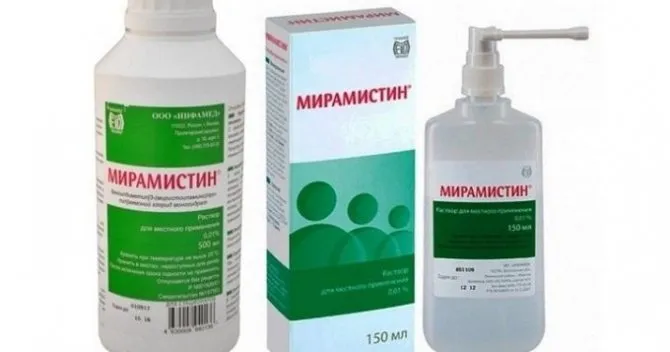
Table of Contents
INSTRUCTIONS FOR MEDICAL USE OF THE MEDICINAL PRODUCT MIRAMISTIN® (MYRAMISTIN)
Composition:
Active ingredient: myramistin;
1 ml of solution contains miramistin 0.1 mg;
Excipient: purified water.
Pharmaceutical form. Topical solution.
Main physicochemical properties: a colorless or slightly yellowish transparent liquid, which foams when shaken.
Pharmacotherapeutic group. Antiseptics and disinfectants. ATC code D08A J.
Pharmacological Properties
Pharmacodynamics
Miramistin exerts a pronounced bactericidal effect against gram-positive and gram-negative, aerobic and anaerobic bacteria, both as monocultures and microbial associations, including hospital strains resistant to antibiotics. The drug is effective against gram-positive bacteria (Staphylococcus spp., Streptococcus spp., Streptococcus pneumoniae, etc.) and gram-negative bacteria (Pseudomonas aeruginosa, Escherichia coli, Klebsiella spp., etc.), acts on sexually transmitted disease pathogens (Chlamydia spp., Treponema spp., Trichomonas vaginalis, Neisseria gonorrhoeae), as well as on herpes viruses, human immunodeficiency virus, and others. It exhibits antifungal activity against ascomycetes of the genus Aspergillus and Penicillium, yeast fungi (Rhodotorula rubra, Torulopsis gabrata, etc.), and yeast-like fungi (Candida albicans, Candida tropicalis, Candida krusei, etc.), dermatophytes (Trichophyton rubrum, Trichophyton mentagrophytes, Trichophyton verrucosum, Trichophyton schoenleini, Trichophyton violaceum, Epidermophyton Kaufmann-Wolf, Epidermophyton floccosum, Microsporum gypseum, Microsporum canis, etc.), as well as against other pathogenic fungi such as Pityrosporum orbiculare (Malassezia furfur), both as monocultures and microbial associations, including fungal microflora resistant to chemotherapeutic agents. It effectively prevents infection of wounds and burns and enhances regenerative processes. It stimulates protective responses at the site of application by activating the phagocytic and digestive functions of phagocytes and potentiates the activity of the mononuclear phagocyte system. It possesses pronounced hyperosmolar activity, thereby suppressing wound and perifocal inflammation and absorbing purulent exudate, promoting the formation of a dry scab. It does not damage granulation tissue or viable skin cells and does not inhibit marginal epithelialization.
It has no allergenic properties and does not produce local irritant effects.
Pharmacokinetics
When applied topically, it is not absorbed through the skin or mucous membranes.
Clinical Characteristics
Indications.
Otorhinolaryngology: complex treatment of acute and chronic external otitis, sinusitis, tonsillitis, pharyngitis, and laryngitis.
Stomatology: treatment and prevention of infectious-inflammatory diseases of the oral cavity: stomatitis, gingivitis, periodontitis. Hygienic cleaning of removable dentures.
Surgery, traumatology: prevention of suppuration and treatment of purulent wounds. Treatment of purulent-inflammatory processes of the musculoskeletal system.
Obstetrics and gynecology: prevention and treatment of postpartum wound infections, perineal and vaginal lacerations, postpartum infections, inflammatory diseases (vulvovaginitis).
Burn care (Combustiology): treatment of superficial and deep second-degree and third-degree burns (III A), preparation of burn wounds for skin grafting.
Dermatology: treatment and prevention of pyoderma and dermatomycoses, foot mycoses, cutaneous and mucocutaneous candidiasis.
Venereology: individual prevention of sexually transmitted diseases (syphilis, gonorrhea, chlamydia, trichomoniasis, genital herpes, and candidiasis).
Urology: complex treatment of acute and chronic urethritis and urethral-prostatitis of both specific etiology (chlamydia, trichomoniasis, gonorrhea) and nonspecific etiology.
Contraindications.
Individual hypersensitivity to miramistin.
Interaction with other medicinal products and other types of interactions.
When used concomitantly with antibiotics, an increase in their antibacterial and antifungal properties has been observed.
Special precautions for use
To minimize the risk of infection transmission, the medicinal product from one bottle should not be used for more than one person.
Use during pregnancy or breastfeeding.
According to available data, Miramistin® does not produce systemic effects when used at the doses specified in the instructions. Therefore, it may be used during pregnancy or breastfeeding; however, the decision on its appropriateness should be made by a physician.
Ability to influence reaction rate when driving vehicles or operating machinery.
Miramistin® does not affect the ability to drive vehicles or engage in other potentially hazardous activities requiring increased attention and psychomotor reaction speed.
Method of Administration and Dosage
The solution is ready for use.
If symptoms worsen or new symptoms occur after using the medicinal product, consult a physician.
Surgery, Traumatology, Burn Care
For adults and children aged 3 years and older
For prophylactic and therapeutic prevention of secondary infection, wound and burn surfaces should be irrigated with Miramistin®. Gauze swabs moistened with the solution should be applied to the wound surface. If necessary, wounds or fistulous tracts may be packed with the medicinal product during surgical procedures.
Active drainage of wounds and cavities is possible, with a daily dosage of up to 1 liter of the medicinal product.
Obstetrics and Gynecology
For adults
To treat and prevent postpartum infections and suppuration in postpartum perineal and vaginal wounds, Miramistin® should be used as vaginal irrigation before childbirth (5–7 days), during labor after each vaginal examination, and in the postpartum period as intravaginal tampons soaked with 50 ml of the medicinal product, with exposure time of 2 hours for 5 days.
In cesarean section deliveries, the vagina is treated immediately before surgery, the uterine cavity and uterine incision are treated during surgery, and in the postoperative period, tampons soaked with the medicinal product are inserted into the vagina with an exposure time of 2 hours for 7 days. Treatment of inflammatory diseases of female genital organs should be conducted over 2 weeks using intravaginal tampons soaked with the medicinal product, skin treatment of external genital organs, and/or electrophoresis.
In complex treatment of inflammatory diseases of external genital organs and vagina (vulvovaginitis), the medicinal product Miramistin® should be used as vaginal irrigation or intravaginal tampons soaked with the medicinal product, with exposure time of 2 hours for 7–14 days (frequency and duration of treatment are determined individually by the physician).
For children
The method of administration, duration of treatment, and frequency of use are determined by the physician.
Dermatology
For adults and children aged 3 years and older
Treatment and prevention of pyoderma, dermatomycoses, cutaneous and mucosal candidiasis, tinea pedis, and intertriginous mycoses should be performed by wiping with sterile gauze swabs thoroughly moistened with Miramistin®, 3 times daily.
Venereology
For adults
For individual prevention of sexually transmitted infections, Miramistin solution is effective if used no later than 2 hours after sexual intercourse. The contents of the bottle should be administered via a urethral nozzle into the urethra—2–3 ml (for men), 1–2 ml (for women), and into the vagina—5–10 ml for 2–3 minutes. After treatment with Miramistin® of the urethra, vagina, inner thigh surfaces, pubic area, and external genital organs, urination should be avoided for 2 hours.
Urology
For adults
Comprehensive treatment of urethritis and urethroprostatitis should be performed by instilling 2–3 ml of Miramistin® solution into the urethra 1–2 times daily. The treatment course lasts 10 days.
For children aged 3 years and older
The method of administration, duration of treatment, and frequency of use are determined by the physician.
Otorhinolaryngology
For adults and children aged 3 years and older
In cases of sinusitis, during maxillary sinus puncture, the sinus should be irrigated with a sufficient amount of Miramistin® solution.
In acute and chronic external otitis, 5 drops of the medicinal product should be administered into the external auditory canal 4 times daily using a dropper. As an alternative, a gauze swab moistened with Miramistin® may be inserted into the external auditory canal 4 times daily. The treatment course is 10 days.
For treatment of tonsillitis, laryngitis, and pharyngitis:
Children aged 3–6 years: Gargle with Miramistin® solution 3–4 times daily. The amount of medicinal product per gargle is 3–5 ml.
Children aged 7–14 years: Gargle with Miramistin® solution 3–4 times daily. The amount of medicinal product per gargle is 5–7 ml.
Adults and children aged 14 years and older: Gargle with 10–15 ml of the medicinal product 3–4 times daily.
The duration of therapy is 4–10 days, depending on clinical response and time to remission.
Dentistry
For adults and children aged 3 years and older
In cases of stomatitis, gingivitis, and periodontitis, rinsing of the oral cavity with 10–15 ml of the medicinal product 3–4 times daily is recommended. If rinsing is not possible, gauze or cotton swabs moistened with Miramistin® solution may be used.
For hygienic treatment of removable dentures, leave them overnight in Miramistin® solution. Before use, thoroughly rinse the dentures with running water.
Children
The medicinal product may be used in children aged 3 years and older according to the specified indications.
The method of administration, duration of treatment, and frequency are determined individually by the physician.
Overdose
No cases of overdose with the medicinal product have been reported following topical or external use.
Side effects.
All adverse reactions are listed by system organ class and frequency: very common (≥ 1/10), common (≥ 1/100 – < 1/10), uncommon (≥ 1/1,000 – < 1/100), rare (≥ 1/10,000 – < 1/1,000), very rare (< 1/10,000), frequency not known (cannot be estimated from available data).
Skin and subcutaneous tissue disorders: very rare – burning sensation, which resolves spontaneously within 15–20 seconds and does not require discontinuation of the medicinal product.
Immune system disorders: very rare – hypersensitivity reactions, including local skin irritation symptoms: itching, hyperemia, burning sensation, dry skin.
Reporting of suspected adverse reactions.
Reporting of suspected adverse reactions after medicinal product registration is important. It allows ongoing monitoring of the benefit-risk balance of the medicinal product. Medical and pharmaceutical professionals, as well as patients or their legal representatives, are encouraged to report any suspected adverse reactions and/or lack of efficacy via the Automated Information System for Pharmacovigilance at the following link: https://aisf.dec.gov.ua.
Shelf life. 3 years.
Storage conditions.
Store in the original packaging at a temperature not exceeding 30 °C.
Do not freeze. Keep out of reach and sight of children.
Packaging. 50 ml in a bottle, 1 bottle with a urethral applicator in a carton.
Supply classification. Over-the-counter.
Manufacturer. JSC "Pharmaceutical company "Darnytsia".
Manufacturer's address and location of business activity.
13, Borispilska Street, Kyiv, 02093, Ukraine.