Miramidez
Ukraine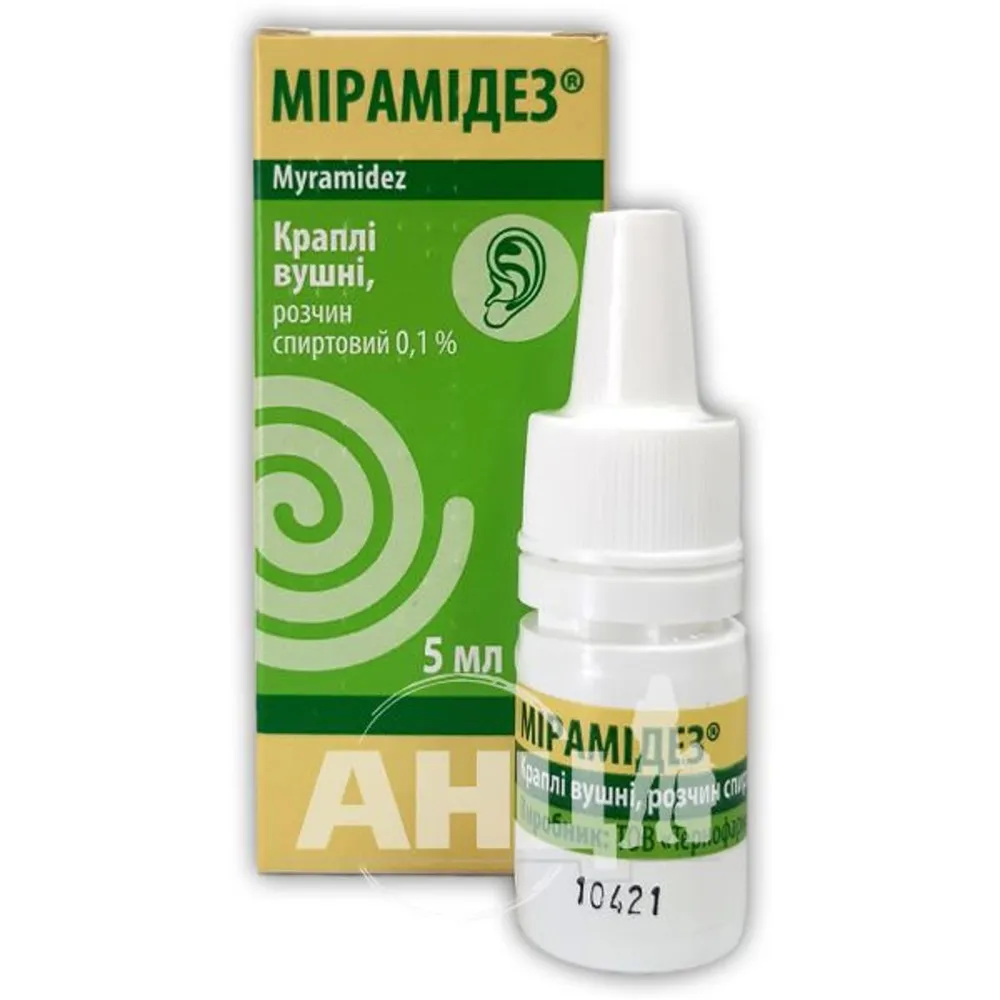
Table of Contents
INSTRUCTIONS FOR MEDICAL USE OF THE MEDICINAL PRODUCT MIRAMIDES®
Composition:
Active substance: benzyldimethyl[3-(myristoylamino)propyl]ammonium chloride monohydrate;
1 ml of solution contains benzyldimethyl[3-(myristoylamino)propyl]ammonium chloride monohydrate (calculated as anhydrous substance) 1 mg;
Excipients: ethanol 70%.
Pharmaceutical form. Topical solution, alcoholic.
Main physicochemical properties: colorless clear liquid with a characteristic odor of alcohol.
Pharmaco-therapeutic group.
Antiseptics and disinfectants. ATC code D08A J.
Pharmacological Properties.
Pharmacodynamics.
Benzyl dimethyl [3-(myristoylamino)propyl] ammonium chloride monohydrate is a cationic surfactant with antiseptic properties.
The mechanism of action of Miramidex® is based on the direct hydrophobic interaction of the molecule with microbial membrane lipids, leading to their fragmentation and destruction. In this process, part of the active molecule penetrates into the hydrophobic region of the membrane, disrupts the supramembrane layer, loosens the membrane structure, increases its permeability for high-molecular-weight substances, alters enzymatic activity of the microbial cell, and inhibits enzyme systems, resulting in suppression of microbial viability and subsequent cytolysis.
Unlike other antiseptics, Miramidex® demonstrates high selectivity towards microorganisms, as it has virtually no effect on human cell membranes. This effect is attributed to the different structure of human cell membranes (significantly longer lipid radicals that severely limit the possibility of hydrophobic interaction between the active substance and human cells).
Miramidex® exhibits pronounced antimicrobial activity against gram-positive and gram-negative, aerobic and anaerobic, spore-forming and non-spore-forming bacteria, both as monocultures and microbial associations, including hospital strains with multidrug resistance to antibiotics.
It exerts a detrimental effect on pathogens of sexually transmitted infections: gonococci, Treponema pallidum, trichomonads, chlamydia, as well as on herpes viruses and human immunodeficiency virus. It also demonstrates antifungal activity against ascomycetes of the genus Aspergillus and Penicillium, yeasts (Rhodotorula rubra, Torulopsis gabrata), yeast-like fungi (Candida albicans, Candida tropicalis, Candida krusei), dermatophytes (Trichophyton rubrum, Trichophyton mentagrophytes, Trichophyton verrucosum, Trichophyton schoenleini, Trichophyton violaceum, Epidermophyton Kaufman-Wolf, Epidermophyton floccosum, Microsporum gypseum, Microsporum canis), and other pathogenic fungi (e.g., Pityrosporum orbiculare (Malassezia furfur)) as monocultures and microbial associations, including fungal microflora resistant to chemotherapeutic agents. Under the influence of Miramidex®, microbial resistance to antibiotics decreases. Miramidex® possesses anti-inflammatory and immunoadjuvant properties, enhances local defense reactions and regenerative processes, and activates non-specific defense mechanisms through modulation of cellular and local humoral immune responses.
Pharmacokinetics.
Miramidex® exerts a local effect. There are no data available regarding the potential penetration of the drug into systemic circulation.
Clinical characteristics.
Indications.
In surgery for antisepsis: treatment of hands of personnel participating in surgery and treatment of the surgical field.
Local treatment of pressure ulcers, dermatitis, acne, bacterial and fungal skin infections, purulent-inflammatory lesions of soft tissues (abscess, furuncle, carbuncle, phlegmon, infected wounds).
In complex treatment of skin candidiasis, tinea pedis, and fungal infections of large skin folds.
Prevention of skin microtrauma infection.
Contraindications.
Individual hypersensitivity to the medicinal agent.
Interaction with other medicinal agents and other types of interactions.
When used concomitantly, Miramidex® enhances the efficacy of topical antibiotics.
Special precautions for use.
Use during pregnancy or breastfeeding.
Can be used during pregnancy. There are no data on the negative effect
of the medicinal product during breastfeeding.
Ability to influence the speed of reactions while driving or operating machinery.
Does not affect.
Administration and Dosage
For surgical antisepsis, wash hands with running water and soap (without a brush) for 1 minute, rinse off the soap with water, and dry with a sterile towel.
Then treat hands with a cotton swab thoroughly moistened with Miramidex®, for 2–3 minutes, twice, with a 1-minute interval. After drying, put on sterile gloves.
Wipe the surgical site twice with a 1-minute interval using a sterile cotton swab generously moistened with Miramidex®.
For local treatment of pressure sores, dermatitis, acne, bacterial and fungal skin infections, purulent-inflammatory soft tissue lesions (abscess, furuncle, carbuncle, phlegmon, infected wounds), in the complex treatment of cutaneous candidiasis, tinea pedis, and intertrigo, as well as for prevention of microtrauma skin infection, apply Miramidex® to affected skin areas 2–3 times daily using a cotton or gauze swab.
The duration of treatment is determined individually by a physician.
Children
There are insufficient observations regarding the use of the drug in children.
Overdose
Not observed.
Adverse reactions.
In individual cases, a transient burning sensation may occur, which resolves spontaneously within
15–20 seconds and does not require discontinuation of the medicinal product. Hypersensitivity reactions are possible during use of the drug.
Shelf life.
3 years.
Storage conditions.
No special storage conditions required. Keep away from heating devices and open flames. Store in a place inaccessible to children.
Packaging.
100 ml of the preparation in a bottle. One bottle per cardboard pack.
Classification by availability.
Over-the-counter (without prescription).
Manufacturers.
- VALARTIN PHARMA LLC (batch release).
- TERNOPHARM LLC (manufacturing, packaging, quality control).
Addresses of manufacturers and locations of their business activities.
- Ukraine, 08135, Kyiv region, Kyiv-Sviatoshyn district, village Chayky, Grushevskogo Street, 60.
- Ukraine, 46010, Ternopil region, Ternopil city, Fabrychna Street, 4