Miraxol
Ukraine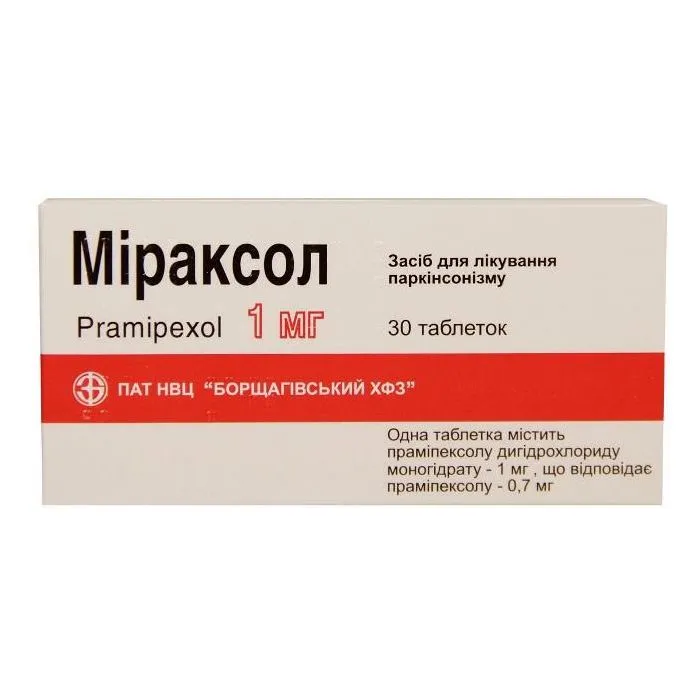
Table of Contents
INSTRUCTION FOR MEDICAL USE OF THE MEDICINAL PRODUCT MIRAXOL (MIRAXOL)
Composition:
Active substance: pramipexole;
1 tablet contains pramipexole dihydrochloride monohydrate 0.25 mg, corresponding to 0.18 mg pramipexole, or 0.5 mg, corresponding to 0.35 mg pramipexole, or 1.0 mg, corresponding to 0.7 mg pramipexole;
Excipients: pregelatinized starch, mannitol, povidone, colloidal anhydrous silicon dioxide, magnesium stearate.
Pharmaceutical form. Tablets.
Main physicochemical properties:
0.25 mg tablets – white or almost white, oval-shaped, flat-faced with bevelled edges and a score line on both sides;
0.5 mg tablets – white or almost white, round-shaped, flat-faced with bevelled edges and a score line;
1.0 mg tablets – white or almost white, round-shaped, flat-faced with bevelled edges and a score line.
Pharmacotherapeutic group.
Antiparkinson agents. Dopamine agonists.
ATC code N04BC05.
Pharmacological properties.
Pharmacodynamics.
Pramipexole is a dopamine agonist with high selectivity and specificity for dopamine receptors of the D2 subtype and has a preferential affinity for D3 receptors; it is characterized by full intrinsic activity.
Pramipexole alleviates Parkinsonian motor disturbances by stimulating dopamine receptors in the striatum. Animal studies have demonstrated that pramipexole inhibits the synthesis, release, and turnover of dopamine.
The exact mechanism of action of Miraxol in the treatment of restless legs syndrome is unknown. Although the pathophysiology of restless legs syndrome is generally not well understood, neuropharmacological data suggest the involvement of the central dopaminergic system.
Pharmacokinetics.
Pramipexole is rapidly and completely absorbed after oral administration. Absolute bioavailability exceeds 90%. Maximum plasma concentration is reached between 1 and 3 hours after drug intake. Concomitant administration with food does not reduce the extent of pramipexole absorption but decreases the rate of absorption. Pramipexole exhibits linear kinetics and, regardless of the dosage form, relatively minor fluctuations in plasma levels among different patients. In humans, protein binding of pramipexole is very low (< 20%), and the volume of distribution is large (400 L).
Pramipexole is metabolized in humans only to a negligible extent.
Renal excretion of unchanged pramipexole is the most important elimination pathway. Approximately 90% of a radiolabeled 14C dose is excreted via the kidneys, while less than 2% is found in feces. Total clearance of pramipexole is approximately 500 ml/min, and renal clearance is approximately 400 ml/min. Elimination half-life (t½) ranges from 8 hours in young individuals to 12 hours in elderly subjects.
Clinical characteristics.
Indications.
- The medicinal product Miraksol is indicated for the treatment of symptoms of idiopathic Parkinson's disease in adults, either as monotherapy (without levodopa) or in combination with levodopa throughout the course of the disease until late stages, when the effect of levodopa decreases or becomes unstable and fluctuations in therapeutic response occur (the "on-off" phenomenon).
- Indicated for symptomatic treatment of moderate to severe idiopathic restless legs syndrome in adults — at doses not exceeding 0.75 mg.
Contraindications.
Hypersensitivity to pramipexole or to any other component of the medicinal product.
Interaction with other medicinal products and other types of interactions.
Plasma protein binding
Pramipexole is bound to plasma proteins to a very low extent (< 20%) and has low biotransformation. Therefore, interaction with another drug affecting plasma protein binding or elimination via biotransformation is unlikely. Since anticholinergic agents are mainly eliminated via hepatic metabolism, potential interaction is unlikely. Interaction with anticholinergic agents has not been studied. There is no pharmacokinetic interaction between selegiline and levodopa.
Inhibitors/competitors of active renal elimination pathways
Cimetidine reduces the renal clearance of pramipexole by approximately 34%, likely by inhibiting the cationic renal tubular secretion transport system. Medicinal products that inhibit active renal tubular secretion or are themselves eliminated via this pathway—such as cimetidine, amantadine, mexiletine, zidovudine, cisplatin, quinine, and procainamide—may interact with pramipexole and cause reduced clearance of pramipexole. When these medicinal products are used concomitantly with Miraksol, consideration should be given to reducing the dose of pramipexole.
Combination with levodopa
During dose escalation of Miraksol in patients with Parkinson’s disease, reduction of the levodopa dose is recommended, while doses of other antiparkinsonian agents should remain unchanged.
Due to the potential for additive effects, caution should be exercised when patients are taking other sedative medicinal products in combination with pramipexole or consuming alcohol (see sections "Special precautions for use", "Ability to influence reaction rate when driving or operating machinery", and "Adverse reactions").
Antipsychotic medicinal products
Concomitant use of antipsychotic medicinal products with pramipexole should be avoided (see section "Special precautions for use") due to possible antagonistic effects.
Special precautions for use
The Miraxol medicinal product is recommended in reduced doses, as specified in the section "Dosage and administration", for patients with Parkinson's disease and impaired renal function.
Hallucinations. Hallucinations are known adverse reactions associated with dopamine agonists and levodopa therapy. Patients should be informed that hallucinations may occur (in most cases, visual).
Disorders of impulse control. Patients should be closely monitored for the development of impulse control disorders. Patients and caregivers should be aware that treatment with dopamine agonists, including Miraxol, may lead to symptoms of impulse control disorders, including pathological gambling, increased libido, hypersexuality, compulsive spending or shopping, binge eating, and compulsive eating.
If such symptoms develop, dose reduction or discontinuation of the medicinal product should be considered.
Mania and delirium. Patients should be closely monitored for the development of mania and delirium. Patients and caregivers should be aware that mania and delirium may occur in patients receiving pramipexole therapy. If such symptoms develop, dose reduction or discontinuation of the medicinal product should be considered.
Severe cardiovascular disorders. The medicinal product should be administered with particular caution in patients with severe cardiovascular disorders. Blood pressure monitoring is recommended, especially at the beginning of treatment, due to the general risk of postural hypotension associated with dopaminergic therapy.
Patients with psychiatric disorders. Patients with psychiatric disorders should be treated with dopamine agonists only when the potential benefit outweighs the risks. Concomitant use of antipsychotic medicinal products with pramipexole should be avoided (see section "Interaction with other medicinal products and other forms of interaction").
Neuroleptic malignant syndrome. Symptoms resembling neuroleptic malignant syndrome have been observed after abrupt withdrawal of dopaminergic therapy (see section "Dosage and administration").
Ophthalmological examination. Regular ophthalmological examination is recommended in case of visual disturbances.
Dopamine agonist withdrawal syndrome (DAWS). Dopamine agonist withdrawal syndrome has been observed with the use of dopamine agonists, including pramipexole (see section "Adverse reactions"). To discontinue treatment, the dose of pramipexole in patients with Parkinson's disease should be reduced gradually (see section "Dosage and administration"). Available data suggest that patients with impulse control disorders and those receiving high daily doses and/or high cumulative doses of dopamine agonists may be at higher risk of developing dopamine agonist withdrawal syndrome. Withdrawal syndrome may include apathy, anxiety, depression, fatigue, increased sweating, pain, and lack of response to levodopa. Before reducing the dose or discontinuing pramipexole, patients should be informed about possible withdrawal symptoms. Patients should be closely monitored during dose reduction and discontinuation of pramipexole. In cases of severe and/or persistent dopamine agonist withdrawal syndrome symptoms, temporary re-initiation of pramipexole at the lowest effective dose may be required.
Augmentation (worsening of symptoms) in restless legs syndrome. Treatment of restless legs syndrome with dopaminergic agents may lead to augmentation. Augmentation is characterized by earlier onset of symptoms in the evening (or even during the day), worsening of symptoms, and spread of symptoms to the upper limbs.
The risk of augmentation may increase with higher doses. Before initiating treatment, patients should be informed about the possibility of augmentation and advised to contact their physician if they experience worsening symptoms. If augmentation is suspected, consideration should be given to adjusting the dose to the lowest effective dose or discontinuing pramipexole (see sections "Dosage and administration" and "Adverse reactions").
Augmentation was specifically evaluated in a controlled clinical study over 26 weeks. Augmentation occurred in 11.8% of patients in both the pramipexole group (N = 152) and the placebo group (N = 149). Kaplan-Meier time-to-augmentation analysis did not demonstrate any significant difference between the pramipexole and placebo groups.
Renal impairment. Miraxol tablets should be used with caution in patients with renal impairment, as pramipexole is primarily excreted via the kidneys.
Rhabdomyolysis. A single case of rhabdomyolysis was reported in a 49-year-old man with advanced Parkinson's disease treated with pramipexole. The patient was hospitalized with elevated creatine kinase (CK) levels (10,631 IU/L). Symptoms resolved after discontinuation of treatment.
Use during pregnancy or breastfeeding.
The effects of Miraxol on pregnancy and lactation in humans have not been studied. The medicinal product Miraxol may be used during pregnancy only if the expected benefit to the mother outweighs the potential risk to the fetus.
Since treatment with Miraxol suppresses prolactin secretion, a reduction in lactation is possible. Excretion of Miraxol into human breast milk has not been studied. This medicinal product is not recommended for use in breastfeeding mothers. If pramipexole use cannot be avoided, breastfeeding should be discontinued.
Studies on the effect of pramipexole on human fertility have not been conducted.
Ability to affect reaction speed when driving or operating machinery.
The medicinal product Miraxol may substantially impair the ability to drive or operate machinery. Hallucinations or somnolence may occur.
During treatment with Miraxol, patients experiencing somnolence and/or sudden onset of sleep episodes should refrain from driving and engaging in potentially hazardous activities where reduced attention could increase the risk of serious injury or death.
Method of administration and dosage.
All dosage information refers to pramipexole as pramipexole dihydrochloride.
Parkinson's disease.
The daily dose should be administered in 3 divided doses of equal parts.
Initial treatment.
The dose of the medicinal product should be increased gradually, starting with 0.375 mg per day, every 5–7 days, as shown below. If patients do not experience intolerable adverse reactions, the dose should be titrated until the maximum therapeutic effect is achieved (see Table 1).
Table 1
| Dosage escalation scheme for the medicinal product Miraksol |
||
| Week |
Dose (mg) |
Total daily dose (mg) |
| 1st |
3 × 0,125 |
0.375 |
| 2nd |
3 × 0,25 |
0.75 |
| 3rd |
3 × 0,5 |
1.5 |
If further dose escalation is required, the daily dose should be increased by 0.75 mg weekly up to a maximum of 4.5 mg per day. However, it should be noted that the incidence of somnolence increases with doses above 1.5 mg per day.
Maintenance therapy.
The individual dose ranges from 0.375 mg to a maximum of 4.5 mg per day. During dose escalation in the main studies, a therapeutic effect was observed starting from a daily dose of 1.5 mg. Further dose adjustment should be based on clinical response and consideration of adverse reactions. In clinical trials, approximately 5% of patients received doses below 1.5 mg. In advanced Parkinson’s disease, doses above 1.5 mg per day may be beneficial for patients in whom reduction of levodopa dosage is planned during combination therapy with levodopa. Reduction of levodopa dosage is recommended when increasing the dose of Miraxol and during maintenance therapy, depending on the individual patient's response (see section "Interaction with other medicinal products and other forms of interaction").
Discontinuation of treatment.
Abrupt discontinuation of dopaminergic therapy may lead to the development of neuroleptic malignant syndrome or dopamine agonist withdrawal syndrome. The dose of pramipexole should be reduced by 0.75 mg per day until a daily dose of 0.75 mg is reached. After that, the dose should be further reduced to 0.375 mg per day (see section "Special precautions for use"). Dopamine agonist withdrawal syndrome may occur during gradual dose reduction. Therefore, temporary dose escalation may be necessary before resuming dose reduction (see section "Special precautions for use").
Dosing in patients with renal impairment.
Elimination of pramipexole depends on renal function. The following dosing regimen is recommended for initial therapy.
Patients with creatinine clearance above 50 mL/min do not require dose reduction or adjustment of dosing frequency.
For patients with creatinine clearance of 20–50 mL/min, the initial daily dose of Miraxol should be administered in two doses, starting with 0.125 mg twice daily (0.25 mg per day). The maximum daily dose of pramipexole should not exceed 2.25 mg.
For patients with creatinine clearance below 20 mL/min, the daily dose of Miraxol should be administered as a single dose, starting with 0.125 mg per day. The maximum daily dose of pramipexole should not exceed 1.5 mg.
In patients with renal impairment during maintenance therapy, the daily dose of Miraxol should be reduced by the same percentage by which creatinine clearance is reduced. For example, if creatinine clearance is reduced by 30%, the daily dose of Miraxol should be reduced by 30%. The daily dose may be administered in two divided doses if creatinine clearance is between 20–50 mL/min, or as a single dose if creatinine clearance is below 20 mL/min.
Dosing in patients with hepatic impairment.
Dose reduction is not considered necessary for patients with hepatic impairment, as nearly 90% of the absorbed drug is excreted by the kidneys. The potential impact of hepatic impairment on the pharmacokinetics of Miraxol has not been studied.
Restless legs syndrome
The recommended initial dose of Miraxol is 0.125 mg once daily, taken 2–3 hours before bedtime. For patients requiring additional symptom relief, the dose may be increased every 4–7 days up to a maximum dose of 0.75 mg per day (see Table 2). The lowest effective dose should be used (see section "Special precautions for use" – Augmentation in restless legs syndrome).
Table 2
| Dosing titration schedule for Miraksol |
|
| Titration step |
Single evening daily dose (mg) |
| 1 |
0.125 |
| 2* |
0.25 |
| 3* |
0.50 |
| 4* |
0.75 |
* If necessary.
The patient's response to treatment should be evaluated after 3 months, and the need for continuing therapy should be reviewed. If treatment is interrupted for more than a few days, dose titration should be restarted as described above.
Discontinuation of treatment.
Since the daily dose for restless legs syndrome treatment does not exceed 0.75 mg, the drug Miraxol can be discontinued without gradual dose reduction. During a 26-week placebo-controlled clinical study, symptom rebound of restless legs syndrome (worsening of symptoms compared to baseline levels) was observed in 10% of patients (14 out of 135 patients) after abrupt discontinuation of pramipexole. This effect was observed across all doses.
Dosing in patients with renal impairment.
Elimination of Miraxol depends on renal function. If creatinine clearance is above 20 mL/min, there is no need to reduce the daily dose.
The use of Miraxol has not been studied in patients undergoing hemodialysis or in patients with severe renal impairment.
Dosing in patients with hepatic impairment.
Dose reduction is not considered necessary in patients with hepatic impairment, as nearly 90% of the absorbed drug is excreted via the kidneys.
Method of administration.
Tablets should be taken orally, independent of food intake, with water.
Children.
Parkinson’s disease. The safety and efficacy of Miraxol in children (under 18 years of age) have not been established. There is no rationale for the use of Miraxol in children with Parkinson’s disease.
Restless legs syndrome. The use of Miraxol is not recommended in children (under 18 years of age) due to insufficient data on safety and efficacy.
Tourette syndrome. Miraxol should not be used in children (under 18 years of age) with Tourette syndrome due to an unfavorable benefit-risk ratio in this condition.
Overdose.
Clinical experience with significant overdose is lacking. Expected adverse reactions related to the pharmacodynamic profile of a dopamine agonist include nausea, vomiting, hyperkinesia, hallucinations, agitation, and arterial hypotension. There is no established antidote for dopamine agonist overdose. In case of signs of central nervous system agitation, neuroleptics may be administered. General supportive measures may be required for the treatment of overdose, including gastric lavage, intravenous fluid administration, activated charcoal, and electrocardiogram monitoring.
Adverse reactions
Most adverse reactions usually occur at the beginning of therapy, and a significant proportion of them resolve even if therapy is continued.
Adverse reactions are listed by organ systems and frequency of occurrence: very common (≥ 1/10), common (≥ 1/100 – < 1/10), uncommon (≥ 1/1000 – < 1/100), rare (≥ 1/10,000 – < 1/1000), very rare (< 1/10,000), frequency not known (cannot be estimated from available data).
Parkinson’s disease
In patients with Parkinson’s disease, the most common adverse reactions (≥ 5%) observed during treatment with pramipexole compared to placebo were nausea, dyskinesia, hypotension, dizziness, somnolence, insomnia, constipation, hallucinations, headache, and fatigue. The incidence of somnolence increased with doses higher than 1.5 mg daily (see section "Dosage and administration"). Dyskinesia was the most common adverse reaction when pramipexole was taken in combination with levodopa. Hypotension may occur at the beginning of treatment, especially if the dose of pramipexole is titrated too rapidly.
| System organ classes |
Very common |
Common |
Uncommon |
Rare |
Frequency not known |
| Infections and infestations |
pneumonia |
||||
| Endocrine system disorders |
disorders of antidiuretic hormone secretion1 |
||||
| Psychiatric disorders |
insomnia, hallucinations, sleep disorders, confusion, symptoms of impulse control disorder and compulsive behavior |
pathological gambling, pathological shopping, anxiety, hypersexuality, delusions, libido disorders, paranoia, delirium, binge eating1, hyperphagia1 |
mania |
||
| Nervous system disorders |
sleepiness, dizziness dyskinesia |
headache |
sudden sleep attacks, amnesia, hyperkinesia, syncope |
||
| Eye disorders |
visual disturbances, including diplopia, blurred vision and reduced visual acuity |
||||
| Cardiac and vascular disorders |
arterial hypotension |
heart failure1 |
|||
| Respiratory, thoracic and mediastinal disorders |
dyspnea, hiccups |
||||
| Gastrointestinal disorders |
nausea |
constipation, vomiting |
|||
| Skin and subcutaneous tissue disorders |
hypersensitivity, pruritus, rash |
||||
| General disorders |
increased fatigue, peripheral edema |
dopamine agonist withdrawal syndrome (including apathy, anxiety, depression, fatigue, increased sweating and pain) |
|||
| Investigations |
weight decreased, including decreased appetite |
weight increased |
1 This adverse reaction was observed in the post-marketing period. In 95 %, the frequency is not higher than "uncommon", but may be lower. Establishing the exact frequency is not possible, since the adverse reaction was not observed during clinical studies in 2,762 Parkinson's disease patients treated with pramipexole.
Restless legs syndrome.
In patients with restless legs syndrome treated with pramipexole, the most frequently reported adverse reactions (≥ 5 %) were nausea, headache, dizziness, and increased fatigue. Nausea and increased fatigue were observed more frequently in women (20.8 % and 10.5 %, respectively) compared to men (6.7 % and 7.3 %, respectively) during treatment with Miraxol medicinal product.
| Organ systems |
Very common |
Common |
Uncommon |
Frequency not known |
| Infections and infestations |
pneumonia2 |
|||
| Endocrine system disorders |
disorders of antidiuretic hormone secretion2 |
|||
| Psychiatric disorders |
insomnia, sleep disturbances |
anxiety, confusion, hallucinations, libido disorders, delirium2, hyperphagia2, paranoia2, mania2, delirium2, impulse control disorder symptoms and compulsive behaviors2 (such as pathological shopping, pathological gambling, hypersexuality, binge eating) |
||
| Nervous system disorders |
augmentation of restless legs syndrome |
headache, dizziness, somnolence |
sudden sleep attacks, syncope, dyskinesia, amnesia2, hyperkinesia2 |
|
| Eye disorders |
visual disturbances, including reduced visual acuity, diplopia, and blurred vision |
|||
| Cardiac disorders |
heart failure2, arterial hypotension |
|||
| Respiratory, thoracic and mediastinal disorders |
dyspnea, hiccough |
|||
| Gastrointestinal disorders |
nausea |
constipation, vomiting |
||
| Skin and subcutaneous tissue disorders |
hypersensitivity, pruritus, rash |
|||
| General disorders |
increased fatigue |
peripheral edema |
dopamine agonist withdrawal syndrome (including apathy, anxiety, depression, fatigue, increased sweating, pain) |
|
| Investigations |
weight decrease, including decreased appetite, weight increase |
2 This adverse reaction was observed during the post-marketing period. In 95 %, the frequency is not higher than "uncommon", but may be lower. The exact frequency cannot be established, as the adverse reaction was not observed during clinical trials in 1395 patients with restless legs syndrome treated with pramipexole.
Description of selected adverse reactions
Somnolence. Pramipexole use is often associated with somnolence and uncommonly with excessive daytime sleepiness and episodes of sudden sleep attacks (see section "Special warnings and precautions for use").
Libido disorders. Pramipexole use may uncommonly be associated with libido disorders (increased or decreased libido).
Impulse control disorders. Treatment with dopamine agonists, including the medicinal product Miraksol, may lead to symptoms of impulse control disorders, including pathological gambling, increased libido, hypersexuality, compulsive spending or shopping, binge eating, and compulsive eating (see section "Special warnings and precautions for use").
Dopamine agonist withdrawal syndrome. When reducing the dose or discontinuing dopamine agonists (including pramipexole), non-motor adverse reactions may occur. Symptoms include apathy, anxiety, depression, fatigue, increased sweating, and pain (see section "Special warnings and precautions for use").
Heart failure. Cases of heart failure have been reported in patients treated with pramipexole during clinical trials and post-marketing surveillance. In a pharmacoepidemiological study, pramipexole use was associated with an increased risk of heart failure compared to non-use (risk ratio 1.86; 95 % CI [confidence interval], 1.21–2.85).
Reporting suspected adverse reactions
Reporting suspected adverse reactions after medicinal product authorization is important. It allows continued monitoring of the benefit-risk balance of the medicinal product. Medical and pharmaceutical professionals, as well as patients or their legal representatives, should report all suspected adverse reactions and lack of efficacy through the Automated Pharmacovigilance Information System at the following link: https://aisf.dec.gov.ua/.
Shelf life. 2 years.
Storage conditions. Store at temperatures not exceeding 25 °C. Keep out of reach and sight of children.
Packaging. 10 tablets per blister; 3 blisters per carton.
Prescription status. Prescription only.
Manufacturer. Public Joint-Stock Company "Scientific and Production Center "Borshchahivskiy Chemical and Pharmaceutical Plant".
Manufacturer's address and location of its business activities.
17 Myru Street, Kyiv, 03134, Ukraine.