Miconazole-darnitsa
Ukraine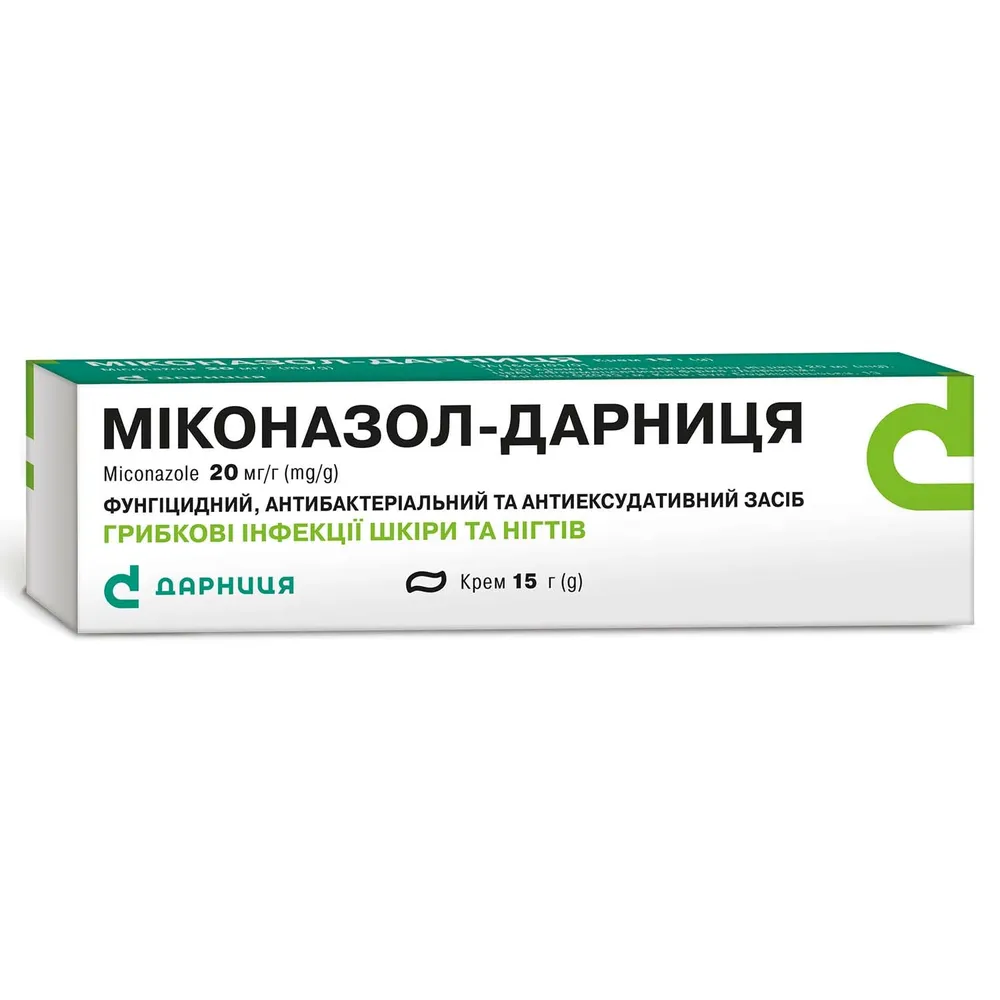
Table of Contents
INSTRUCTION FOR MEDICAL USE OF THE MEDICINAL PRODUCT MICONAZOLE-DARNITSA (Miconazole-Darnitsa)
Composition:
Active substance: miconazole;
1 g of cream contains miconazole nitrate 20 mg;
Excipients: propylene glycol, macrogol 400, poloxamer, macrogol cetostearyl ether, cetostearyl alcohol.
Pharmaceutical form. Cream.
Main physico-chemical properties: homogeneous white cream.
Pharmacotherapeutic group. Antifungal agents for topical use. Imidazole and triazole derivatives. ATC code D01AC02.
Pharmacological Properties
Pharmacodynamics
The active ingredient of the medicinal product, miconazole, belongs to the group of antifungal agents derived from imidazole. Miconazole nitrate inhibits ergosterol biosynthesis and alters the lipid composition of the fungal cell membrane, leading to fungal cell death. It exerts a fungicidal effect against dermatophytes (Trichophyton rubrum, Trichophyton mentagrophytes, Epidermophyton floccosum, Microsporum canis), yeasts and yeast-like fungi (Candida albicans), as well as other pathogenic fungi (Malassezia furfur, Aspergillus niger, Penicillium crustaceum). The medicinal product also exhibits antibacterial activity, which is more pronounced against Gram-positive bacteria (staphylococci, streptococci) and less pronounced against Gram-negative bacteria (Escherichia coli, Pseudomonas aeruginosa, Proteus spp.).
The medicinal product has moderate hyperosmolar activity, resulting in an anti-exudative effect.
Pharmacokinetics
When applied topically, miconazole is hardly absorbed into the systemic circulation. The small amount that is absorbed is bound to plasma proteins (88.2%) and erythrocytes (10.6%). It is excreted from the body unchanged in the feces and as metabolites.
Clinical characteristics.
Indications.
- Fungal infections of the skin and nails caused by dermatophytes or Candida species sensitive to miconazole.
- Superinfections caused by Gram-positive bacteria.
Contraindications.
Hypersensitivity to the active substance or to any of the excipients.
Skin diseases caused by herpes viruses.
Interaction with other medicinal products and other forms of interaction.
When administered systemically, miconazole inhibits cytochrome P450 CYP3A4/2C9 and suppresses the metabolism of medicinal products metabolized by these enzymes. Due to limited systemic availability, clinically significant interactions are rare. However, the medicinal product should be used with caution when administered concomitantly with oral anticoagulants (e.g., warfarin), and anticoagulant effect should be monitored.
Concomitant use of miconazole with hypoglycemic agents—such as sulfonylureas—or phenytoin may potentiate the effects of these agents.
Concomitant use of the medicinal product with other topical medicinal products is not recommended.
Special precautions for use
Avoid contact of the medicinal product with eyes and open wounds.
If local reactions occur or there is no clinical evidence of therapeutic efficacy within 4 weeks of using the medicinal product, treatment should be discontinued and additional examination is required.
Use the medicinal product with caution in patients with diabetes mellitus complicated by microcirculation disorders.
In case of nail involvement, it is recommended to cut nails as short as possible.
In case of foot involvement, special attention should be paid to the interdigital spaces. Wearing loose, well-ventilated footwear is recommended, and socks should be changed at least once daily.
Propylene glycol may cause skin irritation.
Cetostearyl alcohol may cause local skin reactions (e.g., contact dermatitis).
Use during pregnancy or breastfeeding
The medicinal product may be cautiously used during pregnancy after consultation with a physician.
It is unknown whether miconazole passes into breast milk. If use of the medicinal product is necessary, breastfeeding should be discontinued.
During breastfeeding, the medicinal product should not be applied to the mammary glands.
Ability to affect reaction rate while driving or operating machinery
The medicinal product does not affect the ability to drive or operate machinery.
Method of Administration and Dosage.
Apply the medicinal product topically.
Fungal skin infections: apply the medicinal product to affected skin areas twice daily (in the morning and evening) and rub in until completely absorbed, covering a small area around the lesion. Moist areas and skin folds (interdigital spaces, inguinal folds) should be washed and dried with a gauze pad before applying the medicinal product.
The duration of treatment depends on treatment efficacy and mycological test results and ranges from 1 to 6 weeks. The average duration for cutaneous candidiasis is 1–3 weeks, infections caused by dermatophytes 3–4 weeks, and more prolonged infections 5–6 weeks.
Treatment with the medicinal product should be continued for at least 1 week after the disappearance of clinical symptoms.
Fungal nail infections: after preliminary debridement of the affected nail plate, apply the medicinal product in a thin layer to the nail bed 1–2 times daily, followed by application of an occlusive dressing. Treatment should continue for a minimum of 3 months until complete formation of a new nail.
Depending on the type and severity of the disease, the physician may prescribe an individual dosage regimen and method of administration.
Children.
The medicinal product is permitted for use in pediatric practice only after consultation with a physician.
Overdose.
Skin irritation is possible, which usually resolves after discontinuation of the medicinal product. In case of accidental ingestion of a large amount of the medicinal product, gastric lavage is recommended.
The medicinal product is intended for external use only.
Side effects.
The following adverse reactions are possible:
Immune system disorders: hypersensitivity reactions, including anaphylactic reactions, angioneurotic edema;
Skin and subcutaneous tissue disorders: rash, pruritus, erythema, dry skin, urticaria, contact dermatitis, application site reactions including skin irritation, hyperemia, burning, stinging.
Shelf life. 2 years.
Storage conditions.
Store in the original packaging at a temperature between 8 °C and 15 °C.
Keep out of reach of children.
Packaging. 15 g or 30 g in a tube; 1 tube in a carton.
Pharmaceutical category. Over-the-counter (no prescription required).
Manufacturer: JSC "Pharmaceutical company "Darnytsia".
Manufacturer's address and place of business.
13 Borispilska Street, Kyiv, 02093, Ukraine.