Miaren
Ukraine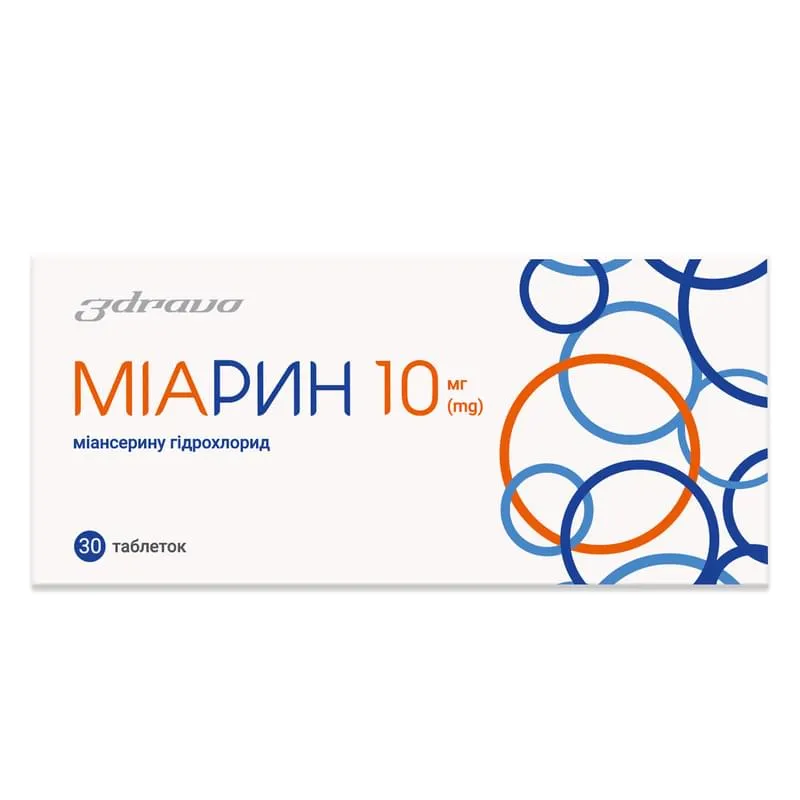
Table of Contents
INSTRUCTIONS FOR MEDICAL USE OF THE MEDICINAL PRODUCT MIRAN (MIARIN)
Composition:
Active substance: mianserin;
One tablet contains mianserin hydrochloride — 10 mg or 30 mg;
Excipients: microcrystalline cellulose; sodium croscarmellose; povidone; citric acid monohydrate; magnesium stearate;
coating: polyethylene glycol 8000, hypromellose (E5), hypromellose (E15), hydroxypropylcellulose, titanium dioxide (E 171).
Pharmaceutical form. Coated tablets.
Main physico-chemical properties:
10 mg tablets: white or almost white, round, smooth, biconvex tablets with the imprint «10»;
30 mg tablets: white or almost white, round, smooth, biconvex tablets with the imprint «30».
Pharmacotherapeutic group. Antidepressants. ATC code N06AX03.
Pharmacological properties.
Pharmacodynamics.
Mianserin, the active substance of the medicinal product Miarin, belongs to the group of piperazino-azepine compounds. The chemical structure of mianserin lacks the side chain characteristic of tricyclic antidepressants, which is responsible for their anticholinergic activity. Mianserin enhances central noradrenergic neurotransmission through α₂-autoreceptor blockade and inhibition of neuronal norepinephrine reuptake. The drug binds to serotonin receptors of the central nervous system (CNS). Pharmacological and electroencephalographic studies in humans have confirmed the antidepressant effect of mianserin. The antidepressant efficacy of mianserin has been demonstrated in placebo-controlled trials. It has been shown to be comparable in efficacy to other currently used antidepressants. In addition, mianserin exhibits anxiolytic properties and improves sleep by deepening and prolonging it, which is particularly important in the treatment of patients with anxiety or sleep disorders occurring in depressive disorders. The sedative properties of mianserin are believed to be related to its effects on α₁-adrenoceptors and histamine H₁-receptors.
Mianserin is also well tolerated in elderly patients and patients with cardiovascular diseases. At therapeutic doses, mianserin exhibits virtually no anticholinergic activity and has minimal effects on the cardiovascular system. In cases of overdose, it causes significantly fewer cardiotoxic effects compared to tricyclic antidepressants. The drug does not interact with sympathomimetic agents or antihypertensive drugs whose action is mediated via beta-adrenoceptors (bethanidine) or alpha-adrenoceptors (clonidine, methyldopa).
Pharmacokinetics.
After oral administration, mianserin is rapidly absorbed. Maximum plasma concentration of the active substance is reached within 3 hours after administration. Bioavailability is approximately 20%. Mianserin is about 95% bound to plasma proteins. The elimination half-life of mianserin ranges from 20 to 60 hours; therefore, once-daily dosing is sufficient. A steady-state plasma concentration of mianserin is achieved within 6 days of treatment. Mianserin is metabolized and excreted in urine and feces over a period of 7–9 days. The main biotransformation pathways of mianserin are demethylation and oxidation, followed by conjugation of metabolites.
Clinical characteristics.
Indications.
Depressive states of various origins.
Contraindications.
- Hypersensitivity to mianserin or to any component of the medicinal product.
- Manic state.
- Severe hepatic impairment.
- Concomitant use of mianserin with monoamine oxidase inhibitors (MAOIs).
Interaction with other medicinal products and other forms of interaction.
Mianserin may potentiate the depressant effect of alcohol on the central nervous system; therefore, patients are advised not to consume alcohol during treatment with this medicinal product.
Mianserin must not be administered concomitantly with MAO inhibitors (such as moclobemide, tranylcypromine, linezolid, etc.) or within two weeks following discontinuation of MAOI therapy. Likewise, approximately two weeks should elapse after stopping mianserin treatment before initiating therapy with MAO inhibitors.
Mianserin does not affect the action of drugs such as betanidine, clonidine, methyldopa, guanethidine, or propranolol (alone or in combination with hydralazine). Despite this, blood pressure should be monitored in patients receiving antihypertensive agents concomitantly with Mianserin.
Concomitant treatment with antiepileptic drugs that are CYP3A4 inducers (such as phenytoin and carbamazepine) may lead to reduced plasma levels of mianserin. Dose adjustment should be considered when starting or discontinuing concomitant treatment with these agents.
Like other antidepressants, Mianserin may affect the metabolism of coumarin derivatives such as warfarin. Therefore, patients taking such medicinal products require close monitoring.
The risk of QT interval prolongation and/or ventricular arrhythmias (including torsade de pointes-type ventricular tachycardia) increases when mianserin is administered concomitantly with other drugs that prolong the QT interval (e.g., certain antipsychotics and antibiotics). Always consult the prescribing information of any concomitantly administered medicinal product to determine whether it affects the QT interval.
Special precautions for use.
Use in children and adolescents (under 18 years of age)
Miarin should not be used for the treatment of children and adolescents (under 18 years of age). In clinical trials, suicidal-related phenomena (suicide attempts and suicidal thoughts) and hostility (particularly aggression, oppositional behavior, and anger) were observed more frequently in children and adolescents receiving antidepressants compared to those in the placebo group. If, based on clinical need, a decision to treat is made, patients should be closely monitored for the emergence of suicidal symptoms. Furthermore, there are no long-term safety data in children and adolescents regarding growth, maturation, and cognitive and behavioral development.
Suicide / suicidal thoughts or worsening of condition
Depression is associated with an increased risk of suicidal thoughts, self-harm, and suicide. This risk persists until full remission is achieved. Since improvement may not occur during the first few weeks of treatment, patients should be closely monitored until such improvement occurs. Clinical experience generally indicates that the risk of suicide may increase during the early stages of recovery.
Patients with a history of suicidal behavior or those who exhibit significant suicidal ideation prior to starting treatment are at higher risk of developing suicidal thoughts or suicide attempts during treatment and therefore require careful monitoring. A meta-analysis of placebo-controlled clinical trials of antidepressants in adult patients with psychiatric disorders showed an increased risk of suicidal behavior with antidepressant use compared to placebo in patients under 25 years of age. During treatment, particularly at the beginning of therapy and during dose adjustments, patients—especially those at higher risk—should be closely observed. Patients (and caregivers) should be alerted to the need to monitor for any clinical worsening of depression, suicidal behavior or thoughts, and unusual changes in behavior, and to seek immediate medical help if such symptoms occur.
Due to the risk of suicide, particularly at the beginning of treatment, patients should be given only a limited quantity of Miarin tablets.
Warnings
- During treatment with Miarin, bone marrow suppression has been reported, typically manifesting as granulocytopenia or agranulocytosis. Symptoms most commonly occur within 4–6 weeks of treatment and usually resolve after discontinuation of the drug. These symptoms have been observed in all age groups, but occur more frequently in elderly patients. If patients experience symptoms such as fever, sore throat, stomatitis, or other signs of infection, treatment should be discontinued and a complete blood count should be performed.
- Miarin, like other antidepressants, may induce or exacerbate hypomanic episodes in predisposed individuals with bipolar depressive disorder. In such cases, Miarin should be discontinued.
- General precautions should be taken when treating patients with diabetes mellitus or with cardiac, hepatic, or renal insufficiency, and doses of concomitant medications should be monitored regularly.
- During post-marketing use of mianserin, cases of QT interval prolongation and ventricular arrhythmia (including cases of torsades de pointes) have been reported. Mianserin should be used with caution in patients with risk factors for QT interval prolongation/torsades de pointes, including patients with congenital long QT syndrome, patients aged 65 years and older, women, patients with structural cardiovascular disease/left ventricular (LV) dysfunction, renal or hepatic impairment, patients taking drugs that inhibit mianserin metabolism, and patients receiving concomitant medications known to prolong the QT interval. Hypokalemia and hypomagnesemia should be corrected prior to initiating treatment. If the QT interval reaches >500 ms or increases by >60 ms, discontinuation of mianserin or dose reduction should be considered. Patients with closed-angle glaucoma or suspected benign prostatic hyperplasia should also be monitored, although anticholinergic side effects are not typically associated with Miarin use.
- Treatment should be discontinued if jaundice occurs.
- Treatment should be discontinued if seizures occur.
Epilepsy
Like tricyclic antidepressants, mianserin lowers the seizure threshold and should therefore be used with particular caution or avoided in patients with epilepsy and other risk factors such as brain lesions of various etiologies, concomitant use of neuroleptics, withdrawal from alcohol or drugs with anticonvulsant properties (e.g., benzodiazepines).
Use during pregnancy or breastfeeding
Animal studies and limited human safety data suggest that mianserin is not harmful to the fetus or newborn. Mianserin is excreted in breast milk only in minimal amounts. However, when using Miarin during pregnancy or breastfeeding, the benefit to the mother must be weighed against the potential risk to the fetus/newborn.
Ability to affect reaction speed when driving or operating machinery
During the first few days of treatment with Miarin, psychomotor reactions may be altered. Patients with depression being treated with antidepressants should avoid driving or operating machinery.
Dosage and Administration
The tablets should be taken orally, swallowed whole with a small amount of liquid, without chewing.
The dosage of the medicinal product is determined individually by a physician for each patient.
For adults, the recommended initial dose of Myarin is 30 mg per day. The dose may be gradually increased every few days to achieve the optimal clinical effect. The usual effective daily dose is 60 mg, with a maximum of 90 mg.
Treatment of elderly patients should be initiated at a dose of 30 mg per day. The dose should be individually adjusted for each patient. A lower than normal maintenance dose may be sufficient to achieve a satisfactory clinical response.
- The daily dose may be divided into several administrations or taken once at night (considering the favorable effect on sleep).
- Treatment with an appropriate dose usually leads to a positive clinical response within 2–4 weeks. If the response is inadequate, the dose may be increased. If there is no response within the following 2–4 weeks, treatment should be discontinued.
- After achieving clinical improvement, treatment should be continued for an additional 4–6 months.
- Discontinuation of Myarin treatment may, in individual cases, cause withdrawal syndrome.
Children.
Myarin should not be used for the treatment of children and adolescents (under 18 years of age).
Overdose.
Symptoms of significant overdose of Myarin generally include prolonged sedative effects. Cardiac arrhythmias, seizures, marked arterial hypotension, and respiratory depression are rare. Cases of QT interval prolongation on ECG and torsades de pointes ventricular tachycardia have also been reported. ECG monitoring is required.
Treatment. There is no specific antidote. Gastric lavage is recommended, followed by symptomatic therapy and supportive measures to maintain vital functions.
Adverse reactions.
In patients with depression, symptoms associated with the disease itself may occur (dry mouth, constipation, accommodation disturbances). Therefore, it is sometimes difficult to determine which symptoms are related to the disease and which arise during treatment with Myarin.
| Body systems |
Adverse reactions (frequency unknown) |
| Blood system disorders |
Pathological blood changes that may manifest as granulocytopenia or agranulocytosis (see section "Dosage and administration") |
| Metabolism and nutrition disorders |
Weight gain Hyponatremia |
| Psychiatric disorders |
Hypomania, suicidal thoughts, suicidal behaviour Psychotic symptoms, including mania and paranoid delusions, which may be exacerbated during antidepressant therapy Effects on sexual function in adults, withdrawal symptoms in adults, withdrawal symptoms (e.g., neuromuscular irritability) in newborns of mothers who received tricyclic or second-generation tricyclic antidepressants during pregnancy |
| Nervous system disorders |
Sedative effect occurring at the beginning of treatment and decreasing with continued therapy (Caution! Dose reduction usually does not reduce the sedative effect but may reduce the antidepressant efficacy) Seizures Hyperkinesia Neuroleptic malignant syndrome |
| Cardiovascular system disorders |
Bradycardia after initial dose administration Prolonged QT interval on ECG Arterial hypotension |
| Hepatobiliary disorders |
Elevated liver enzymes Jaundice Hepatitis Liver function test abnormalities |
| Skin and subcutaneous tissue disorders |
Exanthema, sweating |
| Musculoskeletal system disorders |
Joint pain, polyarthropathy, arthritis |
| General disorders |
Edema |
Suicidal thoughts and suicidal behavior have been reported during mianserin therapy or immediately after discontinuation of treatment.
Reporting of suspected adverse reactions
Reporting of suspected adverse reactions after authorization of the medicinal product is important. It allows continued monitoring of the benefit-risk balance of the use of this medicinal product. Medical and pharmaceutical professionals, as well as patients or their legal representatives, should report all cases of suspected adverse reactions and lack of efficacy of the medicinal product via the Automated Information System for Pharmacovigilance at the following link: https://aisf.dec.gov.ua.
Shelf life.
3 years.
Storage conditions.
Store in the original packaging at a temperature not exceeding 25 °C.
Packaging.
30 tablets in a blister, 1 blister per cardboard pack — for the 10 mg dosage; 10 tablets in a blister, 3 blisters per cardboard pack — for the 30 mg dosage.
Prescription status.
Prescription only.
Manufacturer.
Adamed Pharma S.A.
Manufacturer's address and location of its business operations.
5 Józefa Piłsudskiego Marshal Street, Pabianice, 95-200, Poland
Marketing Authorization Holder.
LLC "ZDRAVO"
Address of the Marketing Authorization Holder.
54/19 Avtozavodska Street, Lit. A, office, Kyiv, 04114, Ukraine