Metovitan
Ukraine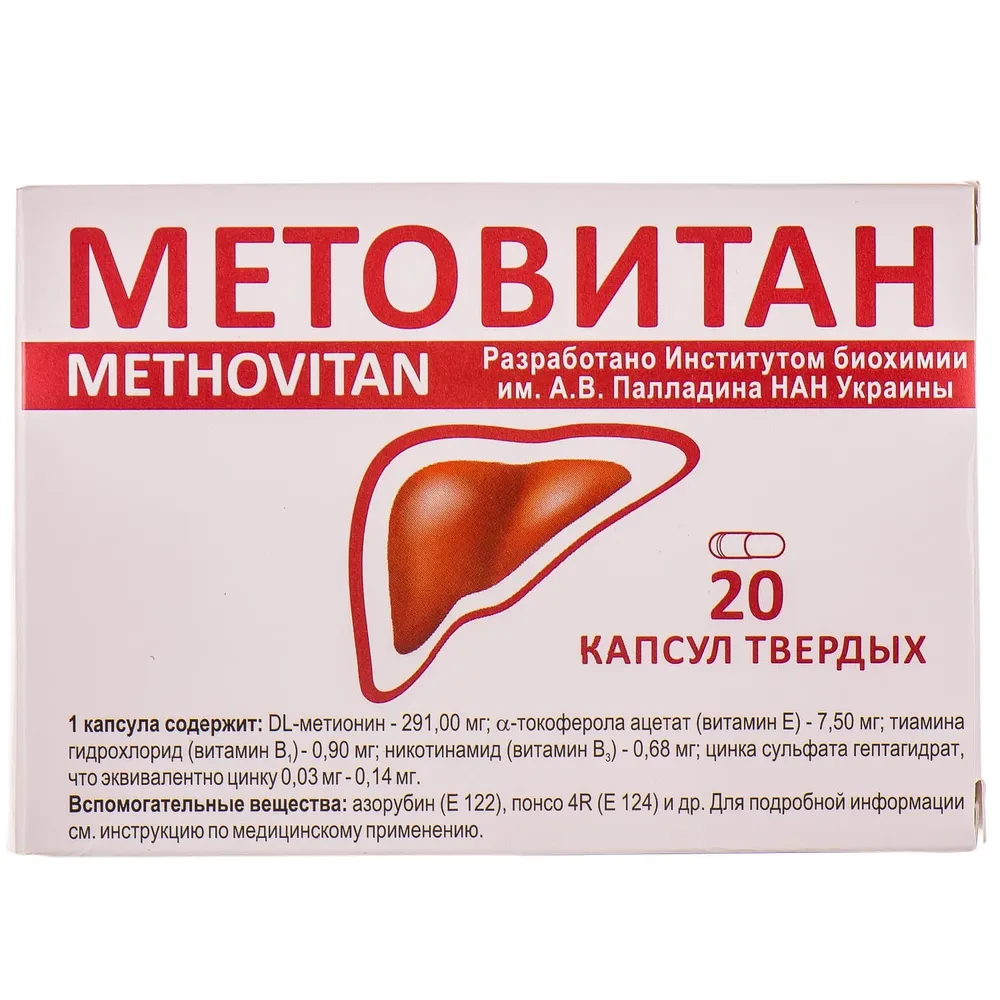
Table of Contents
INSTRUCTIONS FOR MEDICAL USE OF THE MEDICINAL PRODUCT MЕТОVІTAN (METHOVITAN)
Composition:
Active substances: 1 capsule contains: DL-methionine – 291 mg; α-tocopheryl acetate (vitamin E) – 7.5 mg; thiamine hydrochloride (vitamin B1) – 0.9 mg; nicotinamide (vitamin B3) – 0.68 mg; zinc sulfate heptahydrate, equivalent to zinc 0.03 mg – 0.14 mg;
Excipients: microcrystalline cellulose, hypromellose, talc, banana flavor;
capsule shell composition: gelatin, quinoline yellow (E 104), azorubine (E 122), Ponceau 4R (E 124), titanium dioxide (E 171).
Pharmaceutical form. Hard capsules.
Main physicochemical properties: hard gelatin capsules of cylindrical shape with an opaque white body and an opaque red cap, filled with microgranules ranging from white to light yellow in color, with a characteristic odor.
Pharmacotherapeutic group. Vitamins. Multivitamins, other combinations.
ATC code A11A B.
Pharmacological properties.
Pharmacodynamics.
A complex preparation with targeted metabolic effects. The rationally selected composition promotes a more pronounced targeted biological effect of the drug on increasing human body resilience under adverse conditions due to synergistic regulatory effects of its components on specific links of cellular metabolism, primarily on bioenergetic exchange reactions, transmethylation, and transsulfuration.
The drug promotes assimilation and conversion in tissues into biologically active forms of both vitamins contained in its composition and those entering the body with food.
Metovitan is an effective hepatoprotector, promotes normalization of intracellular metabolism in all organs, facilitates detoxification of lipid and hydroperoxides, reduces cholesterol concentration in blood, increases phospholipid content, thereby enhancing immunity, mental and physical performance, overall leading to increased resilience and endurance of the organism against adverse environmental factors. The drug also improves appetite and normalizes digestion.
Methionine is an essential amino acid that is part of proteins, plays an important role in the synthesis of several biologically important compounds, activates the action of hormones, vitamins, and enzymes, and neutralizes toxic metabolites.
Vitamin E has antioxidant properties, participates in the biosynthesis of heme and proteins, cell proliferation, and other vital tissue metabolic processes, and prevents hemolysis of erythrocytes. It is required for the development and functioning of connective tissue and strengthening of blood vessel walls. It inhibits free radical-induced lipid peroxidation. Vitamin E enhances phagocytosis and is used to maintain proper erythrocyte resistance.
Vitamin B1 normalizes functional activity of the nervous, cardiovascular, and digestive systems.
Vitamin B3 participates in redox reactions and regulates biochemical processes in the body by contributing to the synthesis of nicotinamide adenine dinucleotide (NAD) and nicotinamide adenine dinucleotide phosphate (NADP).
Zinc is one of the essential trace elements that is part of many enzyme systems regulating fundamental metabolic processes, particularly involved in protein synthesis and carbohydrate metabolism.
Pharmacokinetics.
Components of the Metovitan preparation are readily absorbed in the intestine and, being natural constituents of living cells, are rapidly metabolized. The drug activates protein synthesis and various metabolic reactions: transmethylation, transsulfuration, deamination, and decarboxylation. It is excreted in small amounts in urine. The activating effect induced by the drug administration is prolonged; therefore, Metovitan is recommended to be taken with intervals, for example: daily intake for one week, followed by a one-week break, and so on.
Clinical characteristics.
Indications.
For the prevention and as part of complex therapy of liver diseases: non-alcoholic and alcoholic steatohepatitis, liver damage caused by toxic chemicals (arsenic, chloroform, benzene) and medicinal substances (including antibiotics).
In the postoperative period and during convalescence after various illnesses, including intoxications of different origins.
In combined therapy for chronic alcoholism.
In cases of increased mental and physical strain, especially under adverse environmental conditions.
To enhance the body's resistance to infectious diseases, including colds.
Contraindications.
Hypersensitivity to any component of the drug.
Hepatic encephalopathy, severe hepatic insufficiency, acute viral hepatitis.
Congenital disease homocystinuria, in which impaired remethylation of homocysteine to methionine occurs.
Interaction with other medicinal products and other types of interactions.
Vitamin E should not be used together with iron preparations, silver, alkaline agents (sodium bicarbonate, trisamin), or indirect-acting anticoagulants (dicoumarol, neodicoumarol). Vitamin E enhances the effect of steroid and non-steroidal anti-inflammatory agents (sodium diclofenac, ibuprofen, prednisolone), reduces the toxic effect of cardiac glycosides (digoxin, digitoxin), and vitamins A and D. Medicinal products containing iron suppress the action of vitamin E.
Vitamin B1, by influencing polarization processes at neuromuscular synapses, may weaken the curare-like effect of muscle relaxants.
The drug reduces the negative impact on the body of toxic medicinal agents, including paracetamol.
Do not use with other multivitamins, as there is a risk of their overdose.
Special precautions.
A specific odor of urine may occur, which is not a harmful effect. This is due to increased concentration in urine of sulfur-containing compounds—metabolites of methionine.
During prolonged use of the drug, periodic monitoring of homocysteine levels in blood is advisable.
Use during pregnancy or breastfeeding.
During pregnancy or breastfeeding, the drug should be used only upon physician's recommendation.
Ability to affect reaction rate when driving or operating machinery.
There have been no reports indicating that the drug affects the ability to drive a vehicle or operate machinery.
Dosage and Administration.
The drug is prescribed for therapeutic purposes to adults at a dose of 1 capsule three times a day.
For prophylaxis in autumn and spring, during epidemics, it is recommended to take 2 capsules once daily.
Capsules should be taken orally, 0.5 hours after meals, in courses of 5–10 days with equal intervals between courses.
The duration of treatment is determined individually by a physician and may range from 2 weeks to 2 months.
Children.
This medication in the given pharmaceutical form is not intended for use in children.
Overdose.
Symptoms: possible arterial hypotension, tachycardia, disorientation.
Treatment: gastric lavage, administration of activated charcoal, symptomatic therapy.
Side effects.
Adverse reactions may occasionally occur, mainly when used in high doses.
Immune system side effects: allergic reactions are possible in individuals with increased sensitivity, including anaphylactic shock, angioneurotic edema, hyperthermia, itching, skin rashes; rarely – bronchospasm in individuals hypersensitive to B vitamins.
Skin and subcutaneous tissue side effects: rash, urticaria, itching, skin redness.
Gastrointestinal side effects: dyspeptic disorders, nausea, vomiting, diarrhea; rarely – possible increase in gastric juice secretion.
Nervous system side effects: headache, dizziness, increased excitability, drowsiness.
If any adverse reaction occurs, it is essential to consult a physician regarding further use of the drug. After reducing the dose or temporarily discontinuing the drug, adverse reactions disappear within 2–3 days.
Shelf life. 3 years.
Storage conditions.
Store in the original packaging at a temperature not exceeding 25°C. Keep out of reach of children.
Packaging.
10 capsules per blister. 2 blisters per cardboard box.
Prescription status.
Over-the-counter.
Manufacturer.
JSC "Tekhnolog".
Manufacturer's address and location of business activity.
8 Stara Prorizna Street, Uman, Cherkasy region, 20300, Ukraine.