Metacartin
Ukraine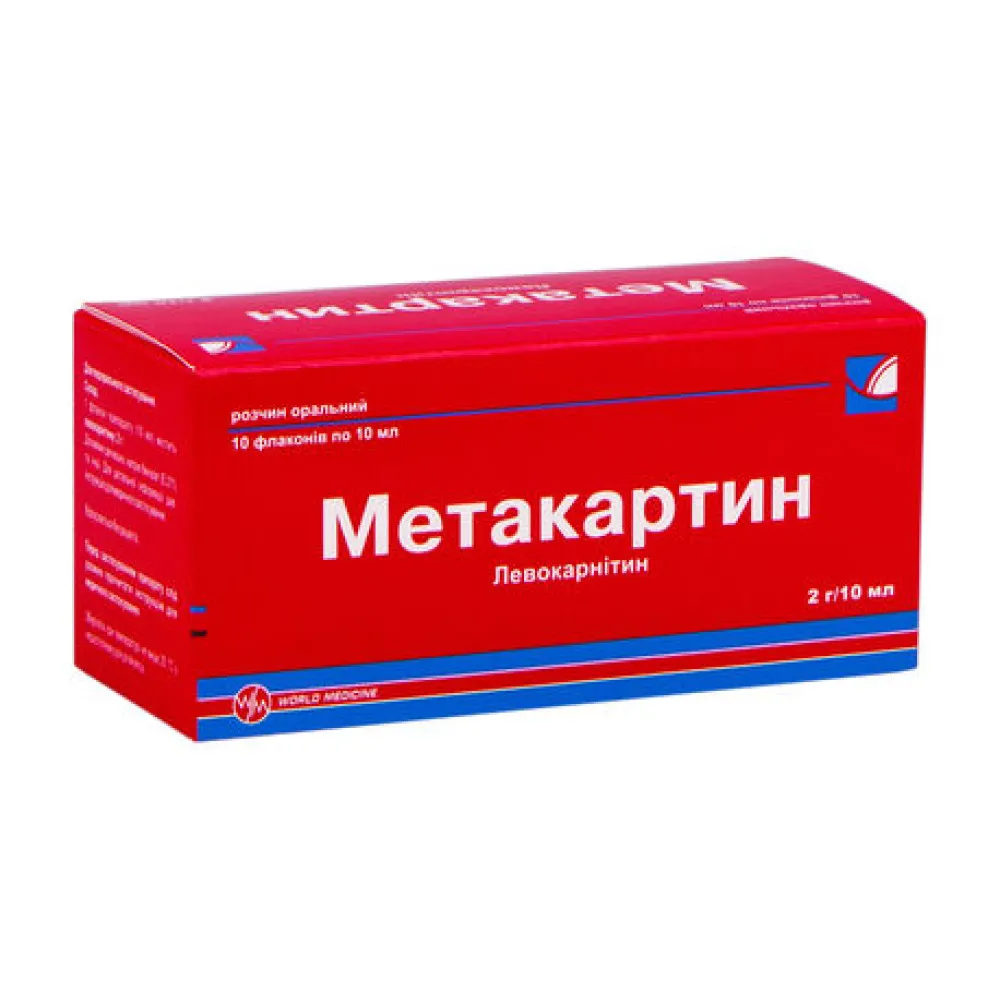
Table of Contents
INSTRUCTIONS FOR MEDICAL USE OF THE MEDICINAL PRODUCT METACARTIN (METACARTIN)
Composition:
Active substance: levocarnitine;
1 vial (10 ml) of the medicinal product contains 2 g of levocarnitine;
Excipients: malic acid, sodium benzoate (E 211), sodium saccharin, orange flavoring, purified water.
Pharmaceutical form. Oral solution.
Main physicochemical properties: clear, colorless or slightly yellow solution.
Pharmacotherapeutic group.
Amino acids and their derivatives. Levocarnitine. ATC code A16A A01.
Pharmacological properties.
Pharmacodynamics.
Carnitine is a natural component of cells, where it plays a fundamental role in energy synthesis and transport processes. It is essentially the only indispensable factor for the penetration of long-chain fatty acids into mitochondria and their participation in β-oxidation. In addition, carnitine regulates the transport of energy produced by mitochondria into the cytoplasm by modulating the enzyme adenine nucleotide translocase.
The highest concentrations of carnitine are observed in skeletal muscles and myocardium. Despite its ability to use various substrates for energy production, the myocardium typically utilizes fatty acids. Therefore, carnitine plays an important role in cardiac metabolism, as fatty acid oxidation strictly depends on the availability of sufficient amounts of this substance. Experimental studies have shown that reduced levels of carnitine in myocardial tissue may occur under various stress conditions, acute ischemia, and diphtheritic myocarditis. Studies using various animal models have confirmed the beneficial effects of carnitine on different types of artificially induced cardiac dysfunction: acute and chronic ischemia, heart failure, heart failure associated with diphtheritic myocarditis, and drug-induced cardiotoxicity (e.g., propranolol, adriamycin).
Levocarnitine has demonstrated therapeutic efficacy in the following conditions:
- Primary carnitine deficiency, characterized by phenotypes such as lipid storage myopathy, hepatic encephalopathy resembling Reye’s syndrome, and/or progressive dilated cardiomyopathy;
- Secondary carnitine deficiency in patients with organic acidurias of genetic origin (propionic acidemia, methylmalonic aciduria, isovaleric acidemia) and in patients with genetic defects in β-oxidation. In these situations, secondary deficiency manifests as accumulation of fatty acid esters. Endogenous levocarnitine effectively acts as a buffer for various fatty acids that cannot be metabolized;
- Secondary carnitine deficiency in patients undergoing intermittent hemodialysis. The reduction in muscle levocarnitine levels positively correlates with its loss into dialysate fluid.
Muscle symptoms commonly observed in these patients after hemodialysis sessions improve with levocarnitine therapy.
Pharmacokinetics.
Following oral administration, levocarnitine undergoes degradation by intestinal bacteria, leading to the formation of trimethylamine (TMA) and γ-butyrobetaine. Since only about 10–20% of the administered dose reaches systemic circulation unchanged, intestinal metabolism is considered responsible for the elimination of approximately 80–90% of the oral dose.
Following absorption, γ-butyrobetaine is excreted unchanged in urine, whereas TMA is metabolized to trimethylamine-N-oxide (TMAO), which is found in urine along with a small amount of unchanged TMA.
Prolonged oral administration of levocarnitine in patients with severe renal insufficiency or in those undergoing hemodialysis may lead to accumulation of TMA and TMAO in plasma, resulting in trimethylaminuria—a pathological condition characterized by a strong fish-like odor of urine, exhaled breath, and sweat.
Clinical characteristics.
Indications.
Primary and secondary carnitine deficiency.
Contraindications.
Hypersensitivity to the active substance or to any of the excipients of the medicinal product.
Interaction with other medicinal products and other forms of interaction.
Interactions between levocarnitine and coumarin derivatives cannot be excluded. In very rare cases, an increased international normalized ratio (INR) has been reported when levocarnitine is used concomitantly with coumarin derivatives (see sections "Special precautions for use", "Adverse reactions"). When these agents are used concomitantly, monitoring of INR or other coagulation tests should be performed weekly until stabilization, and monthly thereafter (see section "Special precautions for use").
Concomitant use of levocarnitine with agents that induce hypocarnitinemia by enhancing renal excretion of carnitine (e.g., valproic acid, pivamide-containing prodrugs, cephalosporins, cisplatin, carboplatin, ifosfamide) may reduce its levels.
Special precautions for use
The use of levocarnitine in patients with diabetes mellitus who are receiving insulin or oral hypoglycemic agents that enhance glucose utilization may cause hypoglycemia. In such patients, plasma glucose levels should be monitored continuously to allow timely adjustment of hypoglycemic therapy.
Administration of levocarnitine to patients with a history of seizure activity may increase the frequency and/or severity of seizures. In patients with predisposing factors, levocarnitine may also trigger seizures.
The safety and efficacy of oral levocarnitine in patients with renal insufficiency have not been studied. Long-term oral administration of high doses of levocarnitine in patients with severe renal insufficiency or end-stage renal disease on hemodialysis may lead to accumulation in blood of potentially toxic metabolites, trimethylamine (TMA) and trimethylamine-N-oxide (TMAO), as these metabolites are normally excreted by the kidneys. This situation is not observed after intravenous administration of levocarnitine.
Levocarnitine is a physiological substance; therefore, there is no risk of habituation or dependence.
Very rarely, increased INR has been reported during concomitant use of levocarnitine with coumarin derivatives (see sections "Interaction with other medicinal products and other forms of interaction", "Side effects"). When these agents are used concomitantly, INR should be monitored or other coagulation tests performed weekly until stabilized, and monthly thereafter.
Use during pregnancy or breastfeeding.
Pregnancy
No teratogenic effects were observed in preclinical studies with levocarnitine. At the highest studied dose of 600 mg/kg body weight in animals, a statistically non-significant increase in the frequency of post-implantation fetal loss in early pregnancy was noted. The clinical relevance of these findings to humans is unknown.
Adequate clinical studies in pregnant women have not been conducted. During pregnancy, the medicinal product should be used only if the expected benefit to the woman outweighs the potential risk to the fetus.
Breastfeeding period
Levocarnitine is a normal component of human milk. The use of levocarnitine in breastfeeding mothers has not been studied. During breastfeeding, the medicinal product should be used only if the benefit to the woman outweighs the potential risk to the infant due to excessive carnitine exposure.
Fertility
No negative effects on fertility were observed in clinical studies.
Ability to influence reaction rate when driving or operating machinery.
Levocarnitine does not affect the ability to drive or operate machinery.
Method of Administration and Dosage
Method of Administration
The medicinal product is intended for oral administration. Before use, the solution should be diluted in a glass of water and taken 30 minutes before meals. For dosing, use the provided dosing syringe or measuring cup.
During treatment with this medicinal product, it is advisable to monitor free carnitine and acyl-carnitine levels both in blood plasma and urine.
Dosage
The dosage and duration of levocarnitine treatment are determined individually by the physician based on the patient's age, body weight, and the specific nosological form of the disease.
Adults
Primary and Secondary Carnitine Deficiency
Dosage depends on the specific inherited metabolic disorder and the severity of the patient's condition at the time of treatment.
Generally, the recommended oral dosage ranges from 100 to 200 mg/kg per day, divided into 2–4 doses. In less severe cases, a lower dosage (50–100 mg/kg per day) may be sufficient.
If clinical and biochemical parameters do not improve, the dose may be temporarily increased.
In acute metabolic disturbances, higher doses (up to 400 mg/kg/day) or intravenous administration of levocarnitine at a daily dose of 100 mg/kg may be required.
Secondary Carnitine Deficiency in Patients Undergoing Hemodialysis
If significant clinical improvement has been achieved after the initial course of intravenous administration, maintenance therapy may be continued orally at a dose of 1 g per day. On dialysis days, the oral dose should be taken after the dialysis procedure.
The maximum daily dose for adults is 6 g (30 ml).
The average treatment course for adults and children lasts 1–3 months. If necessary, the treatment course may be repeated. In cases of primary and secondary carnitine deficiency, the medicinal product should be administered continuously or until the underlying cause is resolved.
Children
The medicinal product may be administered to children from the first day of life, including preterm infants. The solution should be started at a dose of 50 mg/kg per day. The usual pediatric dosage is 50–100 mg/kg per day (see table).
| Age |
Single dose |
Number of doses per day |
| Newborns |
100 mg (0.5 ml) |
2–3 |
| Children under 1 year |
100–200 mg (0.5–1 ml) |
2–3 |
| Children aged 1–3 years |
200–400 mg (1–2 ml) |
3 |
| Children aged 4–6 years |
400–600 mg (2–3 ml) |
3 |
| Children aged 7–11 years |
500–800 mg (2.5–4 ml) |
3 |
| Children aged 12 years and older |
800–1000 mg (4–5 ml) |
3 |
The maximum daily dose for children is 3 g (15 ml).
Special patient categories
Patients with renal impairment
The medicinal product should not be used for prolonged periods at high doses in patients with severe renal function impairment due to accumulation of potentially toxic metabolites TMA and TMAO (see section "Special precautions for use").
Elderly patients
There is no need for dose adjustment or other precautions in elderly patients. In clinical studies, the safety profile was similar in younger and elderly patients.
Patients with diabetes mellitus
Administration of levocarnitine to patients with diabetes mellitus who are receiving insulin or oral hypoglycemic agents that enhance glucose utilization may cause hypoglycemia. In such patients, plasma glucose levels should be monitored closely to allow timely adjustment of hypoglycemic therapy (see section "Special precautions for use").
Children
The medicinal product can be administered to children from the first day of life.
Overdose
Overdose or prolonged administration of levocarnitine may lead to diarrhea. Levocarnitine is readily removed from blood plasma by dialysis.
Adverse Reactions
Adverse reactions (based on clinical trials, literature, and post-marketing experience) are listed by organ system classes according to the Medical Dictionary for Regulatory Activities (MedDRA) and classified by the following frequency: very common (≥1/10), common (≥1/100, <1/10), uncommon (≥1/1,000, <1/100), rare (≥1/10,000, <1/1,000), very rare (<1/10,000), frequency not known (cannot be estimated from available data). Within each frequency group, adverse reactions are listed in order of decreasing severity.
Central and peripheral nervous system:
Uncommon – headache; frequency not known – seizures1, dizziness.
Cardiac disorders:
Frequency not known – palpitations.
Vascular disorders:
Uncommon – arterial hypotension, arterial hypertension.
Respiratory, thoracic and mediastinal disorders:
Frequency not known – dyspnea.
Gastrointestinal disorders:
Common – nausea, vomiting, diarrhea, abdominal pain; uncommon – dysgeusia, dyspepsia, dry mouth.
Skin and subcutaneous tissue disorders:
Uncommon – abnormal body odor2; frequency not known – pruritus, rash.
Musculoskeletal and connective tissue disorders:
Uncommon – muscle spasms; frequency not known – myasthenia3, muscle tension.
General disorders and administration site conditions:
Uncommon – chest pain, abnormal sensations, pyrexia.
Investigations:
Uncommon – increased blood pressure; very rare – prolonged aPTT4.
1 Seizures have been reported in patients with or without a history of seizure activity who received levocarnitine orally or intravenously. Levocarnitine administration may increase the frequency and/or severity of seizures. In patients with predisposing factors, levocarnitine may also trigger seizures.
2 Long-term oral administration of levocarnitine to patients with severe renal insufficiency or patients undergoing hemodialysis may lead to accumulation of TMA and TMAO in blood plasma, resulting in trimethylaminuria—a pathological condition characterized by a strong fish-like odor of urine, exhaled breath, and sweat (see section "Pharmacological properties. Pharmacodynamics").
3 Mild symptoms of myasthenia have been reported in patients with uremia.
4 Very rare cases of prolonged aPTT have been reported in patients receiving concomitant therapy with coumarin derivatives (see sections "Interaction with other medicinal products and other forms of interaction" and "Special precautions for use").
Reporting suspected adverse reactions.
Reporting of suspected adverse reactions after marketing authorization is important. It allows continued monitoring of the benefit-risk balance of the medicinal product. Healthcare professionals and patients, as well as their legal representatives, are encouraged to report any suspected adverse reactions and lack of efficacy via the Automated Pharmacovigilance Information System at: https://aisf.dec.gov.ua.
Shelf life.
4 years.
Storage conditions.
Store at temperatures not exceeding 25 °C, in a place inaccessible to children.
Packaging.
10 ml in vials; 10 vials per cardboard box.
Prescription status.
Over-the-counter (without prescription).
Manufacturer.
WORLD MEDICINE ILAC SAN. VE TIC. A.S. /
WORLD MEDICINE ILAC SAN. VE TIC. A.S.
Manufacturer's address and location of operations.
Lot No. 30, 6th Street, G.O. Pasha District, Cerkezkoy/Tekirdag, Turkey /
COSB G.O. Pasa Mah. 6. Cad. No:30, Cerkezkoy/Tekirdag, Turkey.
Marketing Authorization Holder.
LLC "WORLD MEDICINE", Ukraine /
WORLD MEDICINE, LLC, Ukraine.