Lizak
Ukraine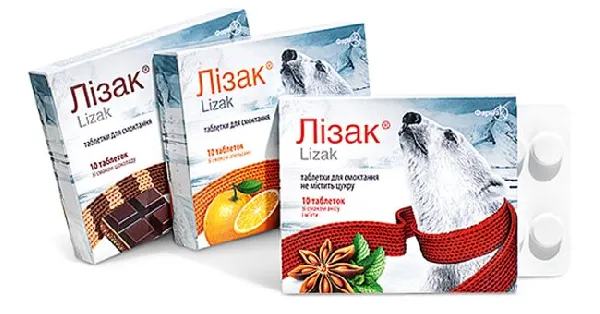
Table of Contents
INSTRUCTIONS FOR MEDICAL USE OF THE MEDICINAL PRODUCT LIZAK® (LIZAK)
Composition:
Active substances: lysozyme hydrochloride, dequalinium chloride;
One tablet contains lysozyme hydrochloride 10 mg calculated as dry substance, dequalinium chloride 0.25 mg calculated as 100 % dry substance;
Excipients:
for anise and mint flavored tablets: lactose monohydrate; mannitol (E 421); povidone; magnesium stearate; flavorings: anise and mint;
for chocolate flavored tablets: dextrose monohydrate ST; povidone; magnesium stearate; flavorings: cocoa powder, chocolate;
for orange flavored tablets: dextrose monohydrate ST; povidone; magnesium stearate; flavoring: orange; colorants: yellow iron oxide (E 172), red iron oxide (E 172);
for raspberry flavored tablets: dextrose monohydrate ST; povidone; magnesium stearate; flavorings: raspberry flavor, natural raspberry flavor; colorant: red iron oxide (E 172).
Pharmaceutical form. Effervescent tablets for oral sucking.
Main physicochemical properties: white or almost white tablets, with flat surface, score line and chamfer, flavored with anise and mint.
Tablets from grey to brown in color, with speckles, flat surface, score line and chamfer, cocoa flavored. Marbled appearance on the tablet surface is permissible.
Pink-orange colored tablets, with speckles, flat surface, score line and chamfer, orange flavored. Marbled appearance on the tablet surface is permissible.
Pink-colored tablets with reddish tint, with speckles, flat surface, score line and chamfer, raspberry flavored.
Pharmacological Properties
Pharmacodynamics
Lizak® is a combination medication with pronounced local antiseptic, antibacterial, and antifungal effects. The therapeutic action of the drug is due to its constituent components.
Diquafosel chloride is a local antiseptic belonging to the quinoline group. It exerts primarily local antiseptic action, antibacterial activity—mainly against Gram-positive and Gram-negative microorganisms—and antifungal activity—primarily against Candida albicans, some species of Trichophyton, and epidermophytes.
Its antibacterial effect is due to denaturation of microbial proteins and enzymes through solubilization and depolymerization, as well as glycolysis and inactivation of dehydrogenases; inhibition of protein synthesis at the ribosomal level; and cytolysis of the cell membrane. The surface-active cationic action forms the basis of its bacteriostatic activity, which is stronger against Gram-positive than against Gram-negative microorganisms.
Lysozyme is a mucopolysaccharide effective against Gram-positive bacteria due to its ability to convert insoluble polysaccharides of the bacterial cell wall into soluble mucopetides. It is also effective against Gram-negative bacteria, viruses, and fungi.
Lysozyme exerts a local anti-inflammatory effect and enhances the body's non-specific resistance.
Pharmacokinetics
Diquafosel chloride is absorbed in negligible amounts.
Lysozyme is well absorbed from the gastrointestinal tract. Peak blood concentration of lysozyme is reached within 1–1.5 hours. Lysozyme is widely distributed in body tissues, particularly accumulating in mucous membranes. It is hydrolyzed by intestinal enzymes and excreted in urine in the form of metabolites.
Clinical characteristics.
Indications.
- Local antiseptic treatment of inflammatory conditions of the oral cavity and throat caused by microorganisms sensitive to the drug (catarrhal, ulcerative, fibrous gingivitis; aphthous stomatitis; oral and pharyngeal candidiasis; pharyngitis; tonsillitis; laryngitis and glossitis).
- Prevention of infections before and after surgical procedures in the oral cavity and throat.
Contraindications.
Hypersensitivity to the active substances or to any of the excipients of the drug.
Allergy to quaternary ammonium compounds (e.g., benzalkonium chloride).
Interaction with other medicinal products and other forms of interaction.
When used concomitantly with kayexalate (a treatment for hyperkalemia), there is a risk of developing severe necrotic lesions of the skin and mucous membranes, particularly of the gastrointestinal tract.
The antibacterial activity of dequalinium chloride is reduced when used simultaneously with anionic detergents, such as toothpaste.
The use of the drug should not be combined with the intake of cholinesterase inhibitors.
Lysozyme enhances the effectiveness of antibacterial agents such as penicillin and chloramphenicol.
Special precautions.
Anise- and mint-flavored tablets are sugar-free and therefore can be used by patients with diabetes mellitus.
1 effervescent tablet with chocolate, orange or raspberry flavor contains 0.05 carbohydrate exchange units (CHU), which should be taken into account by patients with diabetes mellitus.
In the presence of main clinical signs of infection generalization, systemic antibacterial therapy should be prescribed. If any adverse reactions occur during the use of Lizak**®**, treatment should be discontinued and another medicinal product should be prescribed.
Concomitant use with other locally acting medicinal products should be performed with caution.
Anise- and mint-flavored tablets contain lactose and therefore should not be used in patients with rare hereditary forms of galactose intolerance, lactase deficiency, or glucose-galactose malabsorption syndrome.
Use during pregnancy or breastfeeding.
Controlled studies have not been conducted; therefore, the drug should be used during pregnancy or breastfeeding only after consultation with a physician, if the therapeutic benefit outweighs the potential risk to the fetus/child.
Ability to affect reaction rate when driving or operating machinery.
Lizak® does not affect the performance of tasks requiring increased attention (such as driving vehicles or operating moving machinery).
Method of administration and dosage.
Recommended doses for adults and children aged 12 years and older.
Take 1 effervescent tablet every 2–3 hours (no more than 10 tablets per day). After symptoms of inflammation subside, take 1 tablet every 4 hours.
Recommended doses for children aged 4 to 12 years.
Take 1 effervescent tablet every 3 hours (no more than 5 tablets per day). After symptoms of inflammation subside, take 1 tablet every 4 hours.
The tablet should be sucked slowly, without chewing.
After using the medication, it is recommended not to eat or drink for 30 minutes.
Treatment should be continued for another 1–2 days after the symptoms of the disease have disappeared. It is recommended to continue using Lizak**®** until symptoms of the illness have completely resolved. If symptoms persist after 5–7 days of treatment, consult a physician to determine further treatment strategy.
Children.
The medication in this pharmaceutical form should not be used for the treatment of children under 4 years of age due to the risk of aspiration.
Overdose.
There is no data available on overdose.
Side effects.
Possible adverse reactions:
Gastrointestinal tract: nausea, dryness in the mouth, oral dysbacteriosis (with prolonged use at high doses);
Skin and subcutaneous tissue: possible allergic reactions, including urticaria, rash, itching;
Local reactions, including burning sensation and irritation in the throat and oral mucosa. In rare cases, particularly with abuse, ulceration and necrosis may occur. If any adverse reactions occur, discontinue use of the drug and consult a physician for further therapy.
Shelf life. 2 years.
Do not use the medication after the expiry date stated on the packaging.
Storage conditions.
Store at a temperature not exceeding 25°C.
Keep out of reach of children.
Packaging.
6 tablets per blister, 2 blisters per carton (for anise-mint flavored tablets, chocolate flavored tablets, orange flavored tablets).
10 tablets per blister, 1, 2 or 4 blisters per carton.
Availability. Over-the-counter.
Manufacturer.
JSC "Farmak".
Manufacturer's address and place of business.
74, Kyrylivska Street, Kyiv, 04080, Ukraine.