Lipoyka
Ukraine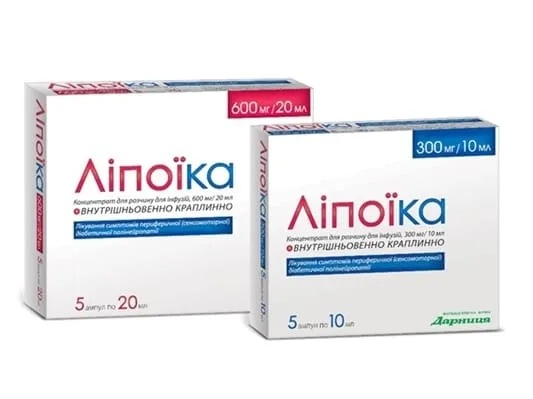
Table of Contents
INSTRUCTIONS FOR MEDICAL USE OF THE MEDICINAL PRODUCT Lipoica (Lipoica)
Composition:
Active substance: thioctic acid (α-lipoic acid);
One 10 ml ampoule of solution contains 300 mg of thioctic (α-lipoic) acid;
One 20 ml ampoule of solution contains 600 mg of thioctic (α-lipoic) acid;
Excipients: trometamol, water for injections.
Pharmaceutical form. Concentrate for solution for infusion.
Main physicochemical properties: clear yellowish solution.
Pharmacotherapeutic group.
Agents affecting the digestive system and metabolic processes. Thioctic acid.
ATC code A16AX01.
Pharmacological properties.
Pharmacodynamics.
Thioctic (α-lipoic) acid is an endogenous vitamin-like substance that functions as a coenzyme in the oxidative decarboxylation of α-keto acids.
Hyperglycemia caused by diabetes mellitus leads to the accumulation of so-called "advanced glycation end-products." This process results in reduced endoneurial blood flow and endoneurial hypoxia and ischemia, accompanied by increased production of reactive oxygen species, which in turn damage peripheral nerves. Additionally, a decreased level of antioxidants (such as glutathione) is observed in peripheral nerves.
The intervention of thioctic (α-lipoic) acid in these processes results in reduced formation of "advanced glycation end-products," improved endoneurial blood flow, and restoration of physiological levels of antioxidants such as glutathione, which acts as a scavenger of reactive oxygen species in nerve fibers in diabetes mellitus.
These effects, observed in experimental studies, support the theory that peripheral nerve function can be improved by thioctic (α-lipoic) acid. This applies particularly to sensory disturbances in diabetic polyneuropathy, manifested by dysesthesia and paresthesia, such as burning sensations, pain, numbness, and "pins and needles."
Pharmacokinetics.
Primary metabolism of α-lipoic acid occurs in the liver. There are no significant differences in the systemic bioavailability of thioctic (α-lipoic) acid among different patients.
Thioctic (α-lipoic) acid undergoes biotransformation via oxidation of side chains and conjugation, and is primarily excreted by the kidneys.
The elimination half-life of thioctic (α-lipoic) acid in human plasma is approximately 25 minutes, and total plasma clearance ranges from 10 to 15 ml/min/kg. At the end of a 12-minute infusion of thioctic (α-lipoic) acid at a dose of 600 mg, the plasma concentration reaches approximately 47 μg/ml. Animal studies (rats, dogs) using radiolabeled tracers have shown that excretion is predominantly renal, with 80–90% of the administered dose recovered as metabolites in urine. Similarly, in humans, only a small fraction is excreted unchanged in urine. Biotransformation occurs mainly through side-chain oxidation (β-oxidation) and/or S-methylation of the corresponding thiol groups.
Clinical characteristics.
Indications.
Treatment of symptoms of peripheral (sensorimotor) diabetic polyneuropathy.
Contraindications.
Hypersensitivity to thioctic acid and to other components of the medicinal product.
Cardiac and respiratory failure.
Acute phase of myocardial infarction.
Acute cerebrovascular accident.
Chronic alcoholism and other conditions that may lead to lactic acidosis.
Interaction with other medicinal products and other forms of interaction.
Thioctic acid interacts in vitro with ionic metal complexes (e.g., cisplatin); therefore, when using the medicinal product Lipoya together with cisplatin, the efficacy of the latter is reduced.
Thioctic acid is a metal chelator; hence, it should not be administered concomitantly with metals (iron, magnesium preparations).
Thioctic acid forms poorly soluble complex compounds with sugar molecules (levulose solution, fructose).
When used concomitantly, the medicinal product Lipoya may enhance the blood glucose-lowering effect of insulin and/or other antidiabetic agents. Therefore, regular monitoring of blood glucose levels is recommended, especially at the beginning of treatment with thioctic (α-lipoic) acid.
In order to prevent symptoms of hypoglycemia, in some cases it may be necessary to reduce the dose of insulin and/or oral antidiabetic agent.
Caution
Regular alcohol consumption is a significant risk factor for the development and progression of the clinical picture of neuropathy and may negatively affect therapy with the medicinal product Lipoya. Therefore, patients with diabetic polyneuropathy are generally advised, if possible, to abstain from alcohol consumption. This restriction also applies to the intervals between treatment courses.
Special precautions for use
When thioctic acid is administered parenterally, hypersensitivity reactions of varying severity, up to anaphylactic shock, have been observed (see section "Adverse reactions"). Patients must be under close medical supervision during administration of the medicinal product. If early signs (such as itching, nausea, weakness) occur, treatment must be discontinued immediately and appropriate supportive measures should be initiated if necessary.
In patients with diabetes mellitus, especially at the beginning of treatment, frequent monitoring of blood glucose levels is required, as hypoglycemia may occur due to improved glucose utilization. In some cases, it may be necessary to adjust the dosage of antidiabetic agents to prevent hypoglycemia.
Alcohol consumption may reduce the effectiveness of the medicinal product. Therefore, it is recommended to avoid alcohol intake during therapy with Lipoya. During treatment of polyneuropathy, transient increased sensitivity may occur due to regenerative processes, accompanied by paresthesia with a sensation of "crawling ants".
Cases of autoimmune insulin syndrome (AIS) have been reported during treatment with thioctic (α-lipoic) acid. Patients with certain human leukocyte antigen (HLA) genotypes, such as HLA-DRB1*04:06 and HLA-DRB1*04:03, are more susceptible to developing autoimmune insulin syndrome (a hormonal disorder affecting blood glucose regulation, with marked reduction in blood sugar levels) during treatment with thioctic (α-lipoic) acid. The HLA-DRB1 * 04:03 allele (predisposition to AIS, odds ratio: 1.6) is more common in individuals of Caucasian descent (more prevalent in Southern Europe than in Northern Europe); the HLA-DRB1 * 04:06 allele (predisposition to AIS, odds ratio: 56.6) is predominantly found in patients from Japan and Korea.
When diagnosing spontaneous hypoglycemia in patients receiving thioctic (α-lipoic) acid, autoimmune insulin syndrome should be considered as a possible cause.
After administration of the medicinal product Lipoya, an unusual odor of urine may occur.
The medicinal product is light-sensitive; therefore, vials should be removed from the packaging only immediately before use.
Advanced patient age (over 75 years) is a relative contraindication for intravenous administration of thioctic acid preparations.
Use during pregnancy or breastfeeding
Thioctic acid should not be used during pregnancy due to lack of adequate clinical data.
There are no data on the passage of thioctic acid into breast milk; therefore, its use during breastfeeding is not recommended.
Ability to affect reaction rate when driving or operating machinery
Patients should refrain from driving vehicles or operating potentially hazardous machinery while receiving this medicinal product.
Method of Administration and Dosage
The cornerstone of treatment for diabetic polyneuropathy is optimal glycemic control.
Dosing
Dosage and duration of treatment are determined individually.
For symptomatic peripheral (sensorimotor) diabetic polyneuropathy, the recommended daily dose for adults is 600 mg of thioctic acid administered intravenously. The infusion should be given slowly, with an infusion duration of at least 30 minutes.
During the initial treatment phase, the prepared solution should be administered intravenously over 2–4 weeks.
Method of Administration
The solution should be administered as an intravenous infusion over 30 minutes in adults. Prior to administration, the ampoule should be diluted in 250 mL of 0.9% sodium chloride solution.
For preparation of the infusion solution, only 0.9% sodium chloride solution should be used.
Infusion Guidelines
Since the active substance is light-sensitive, the solution for short-term infusion should be prepared immediately before use.
The infusion solution should be protected from light (e.g., by wrapping the container in aluminum foil). When protected from light, the infusion solution remains stable for approximately 6 hours.
Continuation of therapy with oral formulations of thioctic (α-lipoic) acid at a daily dose of 600 mg is recommended.
Children
Not recommended for use in children.
Overdose
Symptoms: headache, nausea, vomiting. In cases of overdose or suspicion of adverse reactions, administration of the drug should be stopped immediately. Without removing the injection needle, 0.9% sodium chloride solution should be slowly infused through the same needle.
There have been reports of severe, including fatal, intoxication following accidental or intentional administration of thioctic acid in doses of 10–40 g, particularly in association with alcohol intoxication. Clinical manifestations included psychomotor disturbances or dizziness, followed by generalized seizures and development of lactic acidosis. Consequences of thioctic acid intoxication may include hypoglycemia, shock, rhabdomyolysis, hemolysis, disseminated intravascular coagulation (DIC), bone marrow suppression, and multiorgan failure.
Treatment
In cases of acute thioctic acid poisoning (e.g., > 80 mg/kg body weight in adults or > 50 mg/kg body weight in children), immediate hospitalization is indicated, along with general therapeutic measures for detoxification (mechanical ventilation, induction of emesis, gastric lavage, activated charcoal administration). Management of generalized seizures, lactic acidosis, and other complications should follow principles of intensive care and symptomatic treatment to accelerate elimination of thioctic acid. There is no specific antidote. To date, there is no evidence supporting the efficacy of hemodialysis, hemoperfusion, or hemofiltration in enhancing the elimination of thioctic acid.
Adverse reactions.
Classification according to the frequency of adverse effects that may occur during administration of this medicinal product: very common (≥ 1/10), common (≥ 1/100 – < 1/10), uncommon (≥ 1/1000 – < 1/100), rare (≥ 1/10,000 – < 1/1000), very rare (< 1/10,000), frequency not known (cannot be estimated from available data).
Eye disorders: very rare – diplopia, visual disturbances.
Gastrointestinal disorders: in individual cases nausea and vomiting, diarrhea, abdominal pain, which resolve spontaneously.
Hepatobiliary disorders: frequency not known – cholestatic hepatitis.
Metabolism and nutrition disorders: hypoglycemia* possible.
Nervous system disorders: uncommon – dysgeusia; rare – stroke, headache*, dizziness*, sweating*.
Very rare cases of intravenous administration of α-lipoic acid have been associated with sensations of heaviness in the head, headache, hot flushes, increased sweating, dyspnea, increased intracranial pressure, dizziness, seizures, visual disturbances, and diplopia. In most cases, all these manifestations resolve spontaneously.
Frequency not known – loss of consciousness, seizures.
Cardiac disorders: chest pain, tachycardia.
Blood and lymphatic system disorders: very rare – after intravenous administration purpura has developed, petechial hemorrhages in mucous membranes and skin have been observed, platelet function disorders, hypocoagulation, thrombophlebitis, thrombocytopenia, thrombopathy.
Immune system disorders: frequency not known – skin rashes, urticaria, pruritus, eczema, as well as systemic reactions, including anaphylactic shock, autoimmune insulin syndrome.
Skin and subcutaneous tissue disorders: rare – purpura.
General disorders: after rapid intravenous injection, a sensation of pressure in the head and dyspnea may occur, which resolve spontaneously.
Due to improved glucose uptake, blood glucose levels may decrease in some cases. Consequently, symptoms of hypoglycemia such as dizziness, increased sweating, headache, and blurred vision have been reported.
Administration site reactions: rare – burning pain at the injection site.
* As a result of improved glucose utilization, a decrease in blood glucose levels may very rarely be observed. Consequently, symptoms of hypoglycemia such as dizziness, increased sweating, headache, and blurred vision have been reported.
Reporting of suspected adverse reactions.
Reporting of suspected adverse reactions after authorization of the medicinal product is important. It allows continued monitoring of the benefit-risk balance of the medicinal product. Healthcare professionals and patients, or their legal representatives, should report any suspected adverse reactions and/or lack of efficacy of the medicinal product via the Automated Pharmacovigilance Information System at the following link: https://aisf.dec.gov.ua.
Shelf life. 2 years.
Storage conditions.
Store in the original packaging in a light-protected place at a temperature not exceeding 25 °C. Do not freeze. Keep out of reach of children.
Incompatibilities.
Thioctic acid reacts in vitro with metal ion complexes (e.g., with cisplatin). Thioctic acid forms complexes with sugar molecules (e.g., levulose solution). Lipoica is incompatible with glucose solution, Ringer's solution, and also with solutions that react with SH groups or disulfide bonds. For infusion, only 0.9% sodium chloride solution should be used as the solvent for Lipoica.
Packaging.
10 ml in an ampoule or 20 ml in an ampoule; 5 ampoules in a blister pack; 1 blister pack in a carton.
Prescription status.
Prescription only.
Manufacturer.
JSC "Pharmaceutical Company "Darnytsia".
Manufacturer's address and place of business.
13 Boryspylska Street, Kyiv, 02093, Ukraine.