Legkolaks
Ukraine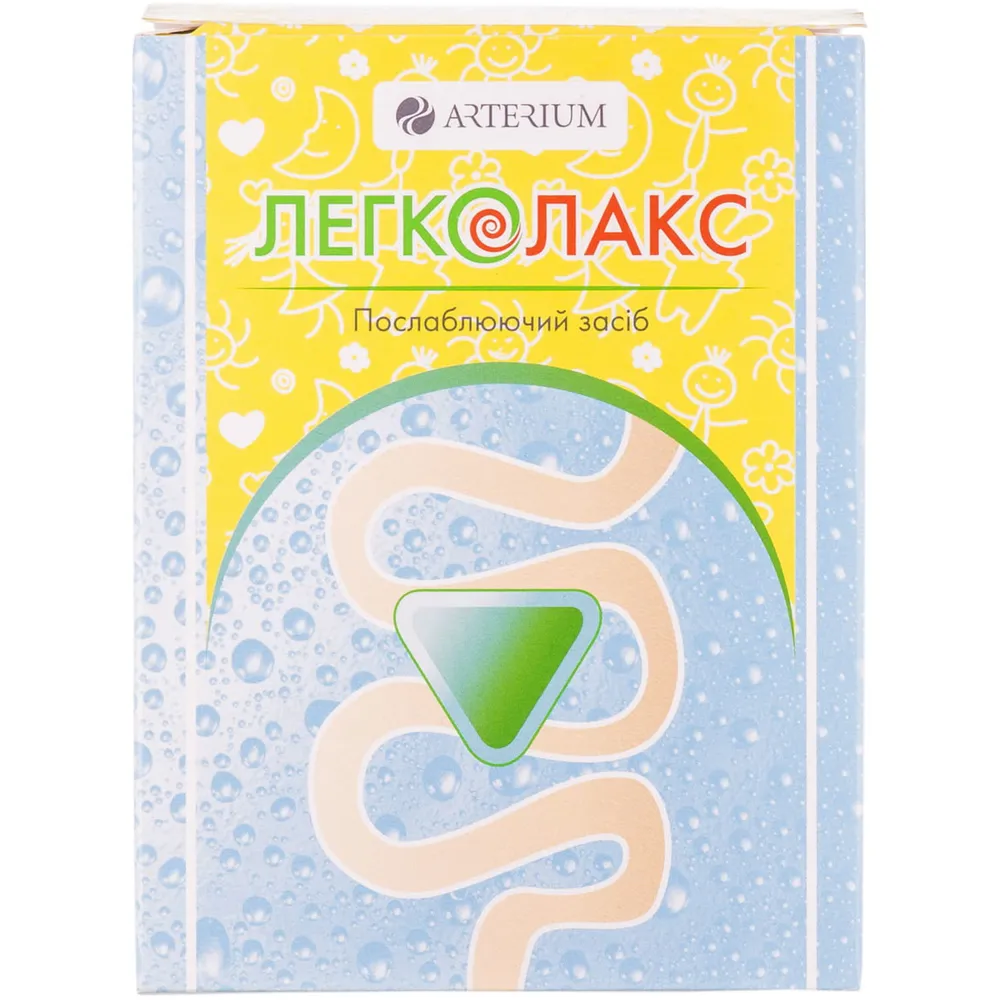
Table of Contents
INSTRUCTIONS FOR MEDICAL USE OF THE MEDICINAL PRODUCT LEGKOLAX (LEGKOLAX)
Composition:
Active substance: macrogol;
1 sachet contains polyethylene glycol (macrogol) 4000, calculated as 100% substance: 4 g or 10 g.
1 bottle contains polyethylene glycol (macrogol) 4000, calculated as 100% substance: 150 g or 300 g.
Pharmaceutical form. Powder for oral solution.
Main physicochemical properties: white or almost white powder.
Pharmacotherapeutic group. Laxatives. Osmotic laxatives. Macrogol. ATC code A06AD15.
Pharmacological properties.
Pharmacodynamics. By forming hydrogen bonds with water molecules, the drug retains water in the intestine. Thus, the fluid content in the intestinal lumen increases, improving the defecation process.
Pharmacokinetics. The laxative effect of the drug occurs 24–48 hours after administration.
The drug is not absorbed and not metabolized. It is excreted from the body in unchanged form.
Clinical characteristics.
Indications.
Symptomatic treatment of constipation.
Contraindications.
Hypersensitivity to macrogol.
Inflammatory bowel diseases (ulcerative colitis, Crohn's disease, toxic megacolon).
Intestinal obstruction or suspicion of intestinal obstruction.
Gastrointestinal perforation or risk of gastrointestinal perforation.
Abdominal pain of unknown origin.
Interaction with other medicinal products and other forms of interaction.
Concomitant administration of Legolax with other medicinal products may delay their absorption. Therefore, it is recommended to take Legolax separately from other agents, with an interval of at least 2 hours.
Special precautions.
Before initiating treatment, organic causes of constipation should be ruled out. Treatment of constipation with any medicinal product is only an auxiliary therapy provided that a healthy lifestyle and dietary habits are maintained, including adequate fluid and dietary fiber intake, appropriate physical activity, and restoration of normal bowel function.
Maximum duration of use in children should not exceed 3 months.
If symptoms persist despite using the medication and adhering to an appropriate diet, this may indicate other underlying pathologies requiring diagnosis and treatment.
Cases of aspiration have been reported following administration of large volumes of polyethylene glycol with electrolytes via nasogastric tube. The risk of aspiration is particularly increased in children with neurological swallowing disorders.
Use with caution in patients predisposed to disturbances in water-electrolyte balance, such as elderly patients, patients with impaired liver or kidney function, and patients taking diuretics, due to the potential risk of developing diarrhea. Monitoring of electrolyte balance is also recommended.
The medicinal product is sugar-free and therefore can be administered to patients with diabetes mellitus and to individuals on a galactose-free diet.
Since the product contains macrogol, symptoms of hypersensitivity to the active substance may occur (see section "Adverse reactions").
Use during pregnancy or breastfeeding.
The medicinal product can be used during pregnancy or breastfeeding.
Ability to influence the speed of reactions while driving or operating machinery.
Not established.
Method of Administration and Dosage
The medicinal product is intended for oral administration.
Treatment normalizes colonic motility provided that appropriate dietary habits (diet) are maintained.
For adults and children aged 8 years and older, the usual dose is 10–20 g per day.
The daily dose for children aged 6 months to 1 year is 4 g, from 1 to 4 years – 8 g, from 4 to 8 years – 16 g.
The contents of the sachet or the required amount of powder, measured with a dosing spoon marked with 4 g and 10 g graduations (when using the medicinal product in jars), should be dissolved beforehand in a glass of water, clear juice (e.g., apple juice), or cold tea; for children under 1 year of age, dissolve in 50 ml of water.
It is recommended to take Lekolaks in the morning during a meal, as a single dose.
The first effect of the drug occurs within 24–48 hours after administration.
The daily dose is determined according to the clinical response and may range from 4 g every other day (for children) up to 20 g per day.
The duration of treatment is determined by the physician depending on the nature and course of the disease and the treatment efficacy. The treatment duration for children should not exceed 3 months, as there are no clinical data on the use of the drug beyond this period.
Children.
The medicinal product can be used in children aged 6 months and older.
Overdose.
Due to the absence of systemic absorption, overdose is unlikely.
Overdose may lead to diarrhea, which resolves upon temporary discontinuation of the drug or dose reduction.
Excessive fluid loss due to diarrhea or vomiting may require correction of disturbed water-electrolyte balance.
Side effects.
In individual cases, abdominal distension and/or abdominal pain, nausea, vomiting, acute urges for defecation, and involuntary bowel evacuation may occur.
When a very large dose is taken, diarrhea may develop, which ceases within 1–2 days after discontinuation of the drug; after that, the drug can be taken again at lower doses. In children, diarrhea may cause painful sensations in the perianal area.
Disturbances in water-electrolyte balance (hyponatremia, hypokalemia) and/or dehydration are possible, especially in elderly patients.
Very rarely, hypersensitivity reactions may occur, including skin itching, urticaria, rash, facial swelling, angioedema (Quincke's edema), anaphylactic shock, and bronchospasm.
Shelf life. 3 years.
After first opening the bottle – 1 year.
Storage conditions.
Store in the original packaging at a temperature not exceeding 25 °C. Keep out of reach of children.
For bottle packaging: after first opening, store in a tightly closed bottle.
Packaging. 4 g or 10 g in sachets, 4, 10, or 20 sachets per carton.
150 g or 300 g in a bottle, 1 bottle with a measuring spoon in a carton.
Supply category. Over-the-counter.
Manufacturer. JSC "Kyivmedpreparat".
Manufacturer's address and location of business activity.
139 Saksahanskoho Street, Kyiv, 01032, Ukraine.