Xylat
Ukraine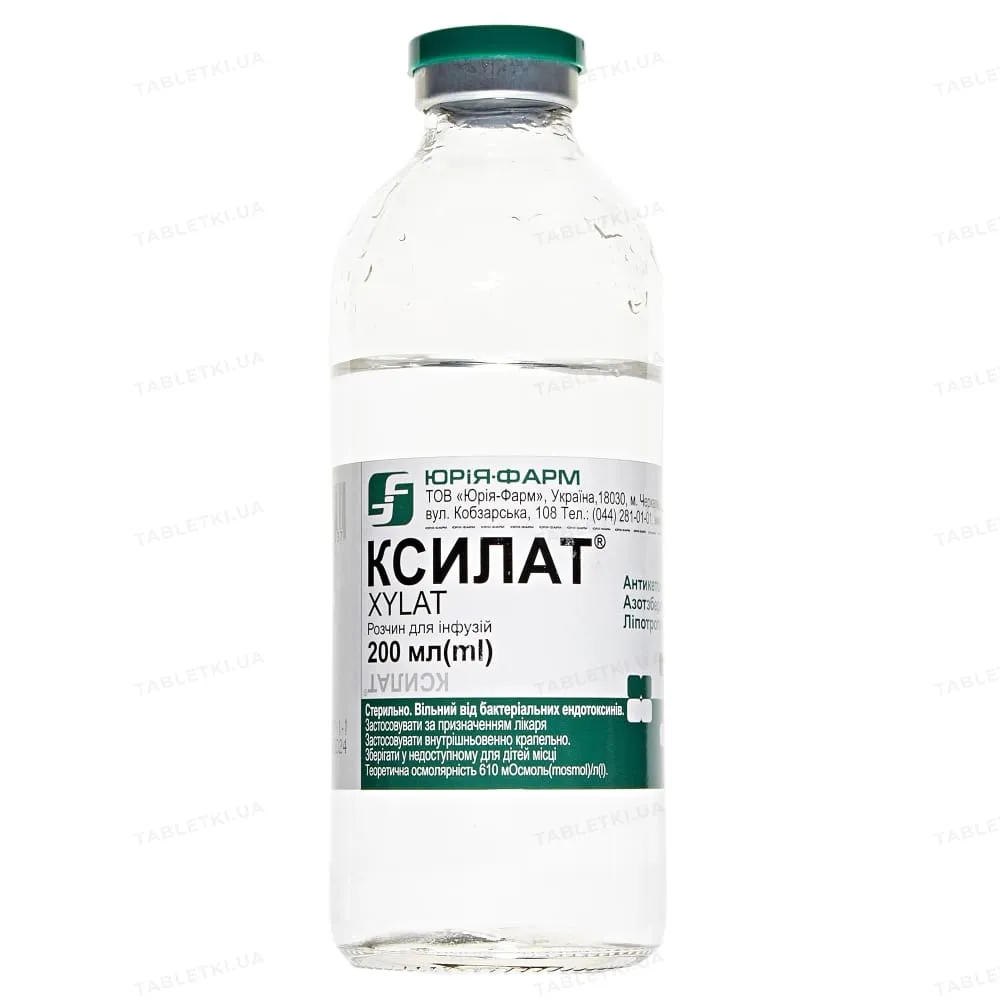
Table of Contents
INSTRUCTION FOR MEDICAL USE OF THE MEDICINAL PRODUCT XYLAT® (XYLAT)
Composition:
Active substances:
1 ml of solution contains xylitol 50 mg, sodium acetate trihydrate (calculated as sodium acetate) 2.6 mg, sodium chloride 6 mg, calcium chloride dihydrate (calculated as calcium chloride) 0.1 mg, potassium chloride 0.3 mg, magnesium chloride hexahydrate (calculated as magnesium chloride) 0.1 mg;
Excipient: hydrochloric acid concentrated, water for injections.
Pharmaceutical form. Infusion solution.
Main physico-chemical properties: clear, colorless liquid. Ionic composition of the preparation:
Na⁺ − 134.4 mmol/l, K⁺ − 4 mmol/l, Ca²⁺ − 0.9 mmol/l, Mg²⁺ − 1.1 mmol/l,
Cl⁻ − 110.6 mmol/l, CH₃COO⁻ − 31.7 mmol/l. Energy value – 200 kcal/l. Theoretical osmolarity 611 mosmol/l, pH 6.0–7.6.
Pharmacotherapeutic group.
Plasma substitutes and perfusion solutions. Electrolyte solutions. Electrolytes in combination with other agents. ATC code B05XA31.
Pharmacological properties.
Pharmacodynamics.
The active ingredients of the medicinal product are xylitol and sodium acetate.
Xylitol is a five-carbon sugar alcohol which, when administered intravenously, rapidly enters general metabolism, with 80% being metabolized in the liver and stored as glycogen.
It exerts a pronounced anti-ketogenic effect and serves as an energy source with insulin-independent metabolism.
Xylitol is a natural intermediate product of carbohydrate metabolism in humans and therefore has low toxicity and good tolerability. Unlike fructose, xylitol does not cause depletion of hepatic nucleotides (adenosine triphosphate, adenosine diphosphate, adenosine monophosphate) and is safe for administration to patients with deficiency of the enzyme fructose-1,6-diphosphatase or those with fructose intolerance.
Sodium acetate belongs to slow-acting alkalizing agents. It promotes accumulation of base equivalents due to metabolism of the buffered preparation and is indicated in types of metabolic acidosis where excess H+ accumulates slowly (e.g., in renal and deficit-type non-respiratory acidosis). Compared to sodium hydrogencarbonate solution, correction of metabolic acidosis with sodium acetate occurs more gradually, thus avoiding sharp fluctuations in pH.
Pharmacokinetics.
Sodium acetate is completely metabolized within 1.5–2 hours into an equivalent amount of sodium hydrogencarbonate. It does not cause intracellular or interstitial cerebral edema and does not increase platelet or erythrocyte aggregation. Importantly, oxygen consumption during acetate metabolism is significantly lower than during lactate metabolism, which is highly relevant in the treatment of severe shock of various etiologies.
KsylatÒ belongs to the group of multi-component, polyfunctional hyperosmolar solutions and exerts anti-ketogenic, hemodynamic, detoxifying, rheological, energetic, alkalizing, and osmotic diuretic effects.
Clinical characteristics.
Indications.
For reduction of intoxication, improvement of microcirculation, and partial coverage of carbohydrate requirements arising in diabetes mellitus and other disorders of glucose utilization; in traumatic, surgical, hemolytic, and burn shock (considering blood and urine osmolarity); in preoperative preparation and postoperative period; in acute blood loss; as well as in burn disease, prolonged purulent processes, various infectious diseases, and chronic toxic hepatitis.
Contraindications.
Hyperosmolar coma, anuria. Xylat® must not be administered when fluid infusion is contraindicated (edema, cerebral hemorrhage, thromboembolism, cardiac and vascular decompensation, stage III arterial hypertension). The medicinal product is not recommended for use in cases of general dehydration and disturbances in water-electrolyte balance.
Interaction with other medicinal products and other forms of interaction.
The preparation must not be mixed with phosphate- or carbonate-containing solutions. Xylat® cannot serve as a carrier solution for other drugs. Addition of other drugs may lead to physicochemical changes.
Instructions for Use
To achieve the hemodynamic effect, administer Ksylat® intravenously by drip infusion to adults at a rate of 40–60 drops/min.
If necessary, bolus (intravenous push) administration of the drug is permitted after performing a test dose by drip infusion at a rate of 30 drops/min. Initially, administer 15 drops of the drug, and after 3 minutes, in the absence of any adverse reaction, proceed with bolus administration.
The anti-ketogenic properties of the drug are manifested when the infusion rate equals the utilization rate of xylitol.
In liver diseases, the drug should be administered under monitoring of liver function parameters. The drug should be used with caution in chronic renal insufficiency; during administration, kidney function should be monitored.
Since Ksylat® has choleretic properties, its administration in biliary calculous disease should be performed under strict medical supervision. Administration of Ksylat® to patients with diabetes mellitus should be carried out with monitoring of blood glucose levels.
The drug is not recommended for use in cases of severe dehydration or disturbances in water-electrolyte balance.
Use during Pregnancy or Breastfeeding
Clinical studies on the use of Ksylat® in pregnant women or women who are breastfeeding have not been conducted.
Ability to Influence Reaction Rate while Operating Vehicles or Machinery
The drug must be used exclusively in a hospital setting.
Method of Administration and Dosage
For adults, administer intravenously by drip infusion at a rate of 50–70 drops per minute, i.e., 2.1–3 mL/kg/hour or 150–210 mL/hour.
Maximum dose for adults – 2100 mL per day or 1.5 g of xylitol/kg body weight/day. Maximum infusion rate – 210 mL/hour (70 drops per minute) = 0.15 g xylitol/kg body weight/hour.
In chronic and toxic hepatitis – for adults, administer 400 mL (5–6 mL/kg) daily by drip infusion (liver function parameters must be monitored), either once daily or twice daily (daily dose may be divided into two administrations).
For parenteral nutrition of patients, including patients with diabetes mellitus – for adults, administer 600–1000 mL (10–15 mL per 1 kg of patient's body weight) daily, either once or twice daily (daily dose may be divided into two administrations).
In traumatic, burn, postoperative, and hemolytic shock – for adults, administer 600–1000 mL (10–15 mL per 1 kg of patient's body weight) daily, either once or twice daily (daily dose may be divided into two administrations).
In the preoperative period and after various surgical procedures, administer to adults by drip infusion at a dose of 400–600 mL (6–10 mL/kg) daily, once or twice daily (daily dose may be divided into two administrations), daily for 3–5 days.
In acute blood loss – for adults, administer 1000–1400 mL (up to 20 mL/kg). In such cases, infusion of Xylat® is also recommended at the pre-hospital stage using a specialized emergency ambulance vehicle.
Children.
Studies on the possibility of use in children have not been conducted.
Overdose.
In case of overdose, nausea, intestinal distension, diarrhea, abdominal pain, and disturbances in water-electrolyte balance (manifested as hypertonic reaction) may occur; in such cases, hypotensive agents should be administered with careful monitoring of arterial pressure.
Adverse reactions.
Allergic reactions, including rash, pruritus, urticaria, rarely – tachycardia, increased body temperature, irritation of peripheral veins at the site of infusion. Hypertensive reaction may occur (in such case antihypertensive agents should be administered with control of arterial pressure); nausea, chills.
Electrolyte imbalance, lactic acidosis, hyperhydration, edema, hyperoxaluria, hyperuricemia, changes in liver function tests, acidosis (including lactic acidosis).
Shelf life.
2 years.
Storage conditions.
Store at a temperature not exceeding 25 °C. Do not freeze. Keep out of reach of children.
Incompatibility.
The drug must not be mixed with phosphate- or carbonate-containing solutions. Addition of drugs may lead to physicochemical changes. If addition is necessary, sterility, thorough mixing, and drug compatibility must be controlled.
Packaging.
200 or 400 ml in glass bottles. 200 ml or 400 ml in polymer bottles.
Prescription category. By prescription only.
Manufacturer.
LLC "Yuria-Pharm".
Manufacturer's address and location of business activities.
108, Kobzarska St., Cherkasy, Cherkasy region, Ukraine, 18030. Tel.: (044) 281-01-01.