Xofluza
Ukraine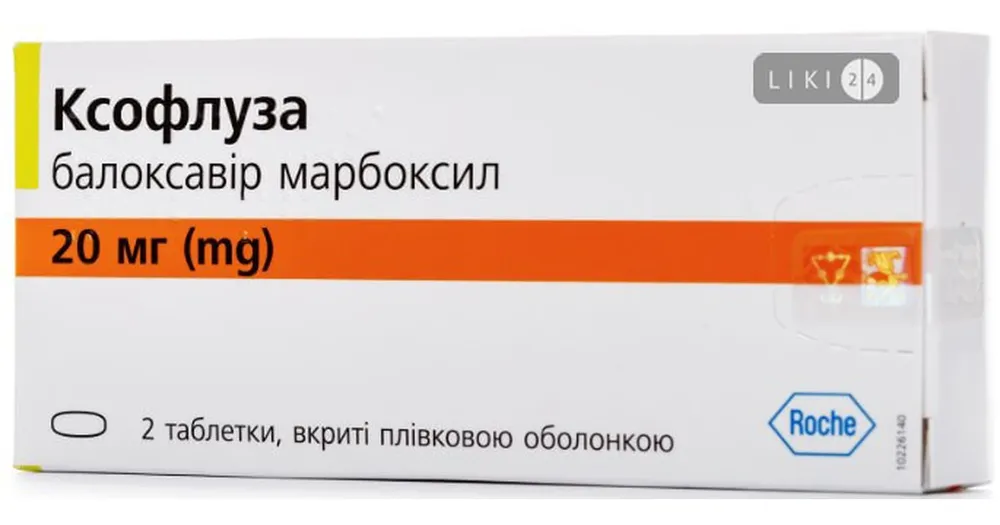
Table of Contents
INSTRUCTIONS FOR MEDICAL USE OF THE MEDICINAL PRODUCT KSOFLUZA® (XOFLUZA®)
Composition:
Active substance: baloxavir marboxil;
1 tablet contains baloxavir marboxil 20 or 40 mg;
Excipients: sodium croscarmellose; lactose monohydrate; microcrystalline cellulose; povidone (K value: 25); sodium stearyl fumarate;
Tablet coating: OPADRY WHITE 03A48081 (hypromellose, talc, titanium dioxide (E 171)), talc.
Pharmaceutical form. Film-coated tablets.
Main physicochemical properties:
20 mg tablets – film-coated tablets, white to light yellow in color,
oblong-shaped, with the trademark imprint and "772" on one side and "20" on the other;
40 mg tablets – film-coated tablets, white to light yellow in color,
oblong-shaped, with the imprint "BXM40" on one side.
Pharmacotherapeutic group.
Antiviral agents for systemic use. Other antiviral agents.
ATC code: J05AX25.
Pharmacological Properties
Pharmacodynamics
Mechanism of Action
Baloxavir marboxil is a prodrug that is converted by hydrolysis to baloxavir, the active form, which has antiviral activity against influenza virus. Baloxavir acts on the cap-dependent endonuclease, a polymerase acidic (PA) subunit of the viral RNA polymerase complex specific to influenza virus, thereby inhibiting transcription of the influenza virus genome, leading to suppression of influenza virus replication.
In vitro Activity
In enzyme inhibition assays, the 50% inhibitory concentration (IC50) of baloxavir ranged from 1.4 to 3.1 nmol/L for influenza A virus and from 4.5 to 8.9 nmol/L for influenza B virus.
In MDCK cell culture assays, median 50% effective concentration (EC50) values of baloxavir were 0.73 nmol/L (n = 31; range: 0.20–1.85 nmol/L) for A/H1N1 subtype strains, 0.83 nmol/L (n = 33; range: 0.35–2.63 nmol/L) for A/H3N2 subtype strains, and 5.97 nmol/L (n = 30; range: 2.67–14.23 nmol/L) for type B strains.
In MDCK cell-based virus titer reduction assays, 90% effective concentration (EC90) values of baloxavir ranged from 0.46 to 0.98 nmol/L for A/H1N1 and A/H3N2 subtypes, from 0.80 to 3.16 nmol/L for avian subtypes A/H5N1 and A/H7N9, and from 2.21 to 6.48 nmol/L for type B viruses.
Resistance
Viruses carrying the PA/I38T/F/M/N mutation, selected in vitro or in clinical studies, demonstrated reduced susceptibility to baloxavir, with EC50 values shifted 11–57-fold for influenza A virus and 2–8-fold for influenza B virus.
In two phase 3 treatment trials of uncomplicated influenza (see below), no baseline isolates resistant to baloxavir were detected. PA/I38T/M/N mutations emerging during treatment were detected in 36/370 (9.7%) and 15/290 (5.2%) patients receiving baloxavir marboxil, but were not detected in any patients receiving placebo.
In a phase 3 post-exposure prophylaxis trial (see below), PA/I38T/M mutations emerging during treatment were detected in 10 out of 374 (2.7%) patients who received baloxavir marboxil. PA/I38 substitutions were not detected in patients receiving placebo, except for two subjects who received baloxavir marboxil as emergency therapy.
Baloxavir is active in vitro against influenza viruses considered resistant to neuraminidase inhibitors, including strains with the following mutations: H274Y in A/H1N1, E119V and R292K in A/H3N2, R152K and D198E in type B virus, H274Y in A/H5N1, R292K in A/H7N9.
Clinical Studies
Treatment of Uncomplicated Influenza
Capstone 1 (1601T0831) – a randomized, double-blind, multicenter phase 3 trial conducted in Japan and the United States to evaluate the efficacy and safety of a single oral dose of baloxavir marboxil compared with placebo and oseltamivir in otherwise healthy adults and adolescents (aged ≥12 to ≤64 years) with uncomplicated influenza. Patients were randomized to receive baloxavir marboxil (40 mg for patients with body weight 40 to <80 kg; 80 mg for patients with body weight ≥80 kg), oseltamivir 75 mg twice daily for 5 days (patients aged ≥20 years only), or placebo. Study drug was administered within 48 hours of the onset of symptoms.
A total of 1,436 patients (including 118 patients aged ≥12 to ≤17 years) were enrolled during the 2016–2017 influenza season in the Northern Hemisphere. The predominant influenza virus strain in this study was A/H3 subtype (84.8–88.1%), followed by type B (8.3–9.0%) and A/H1N1pdm subtype (0.5–3.0%). The primary efficacy endpoint was time to alleviation of symptoms (TTAS), defined as cough, sore throat, headache, nasal congestion, fever or chills, muscle or joint pain, and fatigue. Baloxavir marboxil resulted in a statistically significant reduction in TTAS compared with placebo (Table 1).
Table 1
Capstone 1: Time to Alleviation of Symptoms (Baloxavir Marboxil vs. Placebo)
| Time to symptom alleviation (median [hours]) |
|||
| Baloxavir marboxil 40/80 mg (95 % CI) N = 455 |
Placebo (95 % CI) N = 230 |
Difference between baloxavir marboxil and placebo (95 % CI for difference) |
p-value |
| 53.7 (49.5, 58.5) |
80.2 (72.6, 87.1) |
-26.5 (−35.8, −17.8) |
< 0.0001 |
CI – confidence interval.
When comparing the baloxavir marboxil group with the oseltamivir group, no statistically significant difference in TTAS values was observed (53.5 hours compared to 53.8 hours, respectively).
The median (95% CI) TTAS was 49.3 (44.0, 53.1) and 82.1 (69.5, 92.9) hours in patients whose symptoms had been present for > 0 to ≤ 24 hours, and 66.2 (54.4, 74.7) and 79.4 (69.0, 91.1) hours in patients whose symptoms had been present for > 24 to ≤ 48 hours, in the baloxavir marboxil and placebo groups, respectively.
The median time to resolution of fever was 24.5 hours (95% CI: 22.6, 26.6) in patients receiving baloxavir marboxil compared to 42 hours (95% CI: 37.4, 44.6) in those receiving placebo. No difference in fever duration was observed between the baloxavir marboxil group and the oseltamivir group.
Capstone 2 (1602T0832) – a randomized, double-blind, multicenter, phase 3 study evaluating the efficacy and safety of a single oral dose of baloxavir marboxil compared to placebo and to oseltamivir in adolescents and adults (aged ≥ 12 years) with uncomplicated influenza who had at least one factor predisposing them to influenza-related complications. Patients were randomized to receive a single oral dose of baloxavir marboxil (dosed according to body weight, as in the Capstone 1 study), oseltamivir 75 mg twice daily for 5 days, or placebo. Study treatment was initiated within 48 hours of symptom onset.
Of the total 2184 patients, 59 were aged ≥ 12 to ≤ 17 years, 446 were aged ≥ 65 to ≤ 74 years, 142 were aged ≥ 75 to ≤ 84 years, and 14 were aged ≥ 85 years. The predominant circulating influenza virus strains in this study were influenza A/H3 (46.9% to 48.8%) and influenza B (38.3% to 43.5%). The primary endpoint was time to improvement in influenza symptoms (cough, sore throat, headache, nasal congestion, fever or chills, muscle or joint pain, and fatigue) (TTIS). Baloxavir marboxil resulted in a statistically significant reduction in TTIS compared to placebo (Table 2).
Table 2
Capstone 2: Time to improvement in influenza symptoms (baloxavir marboxil compared to placebo)
| Time to symptom improvement (median [hours]) |
|||
| Baloxavir marboxil 40/80 mg (95 % CI) N = 385 |
Placebo (95 % CI) N = 385 |
Difference between baloxavir marboxil and placebo (95 % CI for difference) |
p-value |
| 73.2 (67.5, 85.1) |
102.3 (92.7, 113.1) |
-29.1 (−42.8, −14.6) |
< 0.0001 |
When comparing the baloxavir marboxil group with the oseltamivir group, there was no statistically significant difference in TTIS values (73.2 hours compared to 81.0 hours, respectively).
The median (95% CI) TTIS was 68.6 (62.4, 78.8) and 99.1 (79.1, 112.6) hours in patients with symptoms present for > 0 to ≤ 24 hours, and 79.4 (67.9, 96.3) and 106.7 (92.7, 125.4) hours in patients with symptoms present for > 24 to ≤ 48 hours, in the baloxavir marboxil and placebo groups, respectively.
In patients infected with influenza A/H3 virus, the median TTIS was shorter in the baloxavir marboxil group compared to the placebo group, but not compared to the oseltamivir group (see Table 5). In the subgroup of patients infected with influenza type B virus, the median TTIS was shorter in the baloxavir marboxil group compared to both the placebo and oseltamivir groups (see Table 3).
Table 3
Time to symptom improvement by influenza virus subtype
| Time to symptom improvement (hours) Median [95% CI] |
|||
| Virus |
Baloxavir marboxil |
Placebo |
Oseltamivir |
| A/H3 |
75.4 [62.4, 91.6] N = 180 |
100.4 [88.4, 113.4] N = 185 |
68.2 [53.9, 81.0] N = 190 |
| B |
74.6 [67.4, 90.2] N = 166 |
100.6 [82.8, 115.8] N = 167 |
101.6 [90.5, 114.9] N = 148 |
The median time to alleviation of fever was 30.8 hours (95% CI: 28.2, 35.4) in the baloxavir marboxil group compared to 50.7 hours (95% CI: 44.6, 58.8) in the placebo group. No clear difference was observed between the baloxavir marboxil group and the oseltamivir group.
The overall incidence of influenza-related complications (death, hospitalization, sinusitis, otitis media, bronchitis, and/or pneumonia) was 2.8% (11/388 patients) in the baloxavir marboxil group compared to 10.4% (40/386 patients) in the placebo group. The lower overall incidence of influenza-related complications in the baloxavir marboxil group compared to placebo was primarily driven by a lower incidence of bronchitis (1.8% vs. 6%, respectively) and sinusitis (0.3% vs. 2.1%, respectively).
Flagstone (CP40617) – a randomized, double-blind, Phase 3 study evaluating baloxavir marboxil versus placebo, in combination with standard-of-care neuraminidase inhibitor therapy, in hospitalized patients with severe influenza aged ≥12 years. No statistically significant difference was observed in the primary endpoint of time to clinical improvement compared to standard-of-care neuraminidase inhibitor monotherapy (N = 322 patients were evaluable for the primary endpoint analysis, of whom 7 patients were aged ≥12 to ≤17 years). Baloxavir marboxil was well tolerated (N = 363, safety population, of whom 11 patients were aged ≥12 to ≤17 years), and no new adverse reactions were identified.
Post-exposure influenza prophylaxis
Study 1719T0834 – a randomized, double-blind, multicenter, Phase 3 study conducted in Japan involving 749 individuals to evaluate the efficacy and safety of a single oral dose of baloxavir marboxil compared to placebo for post-exposure prophylaxis of influenza. Study subjects were household contacts of index patients.
Overall, 607 subjects aged ≥12 years received either baloxavir marboxil at a body weight-based dose as used in treatment studies or placebo. The majority (74%) of subjects were enrolled within 24 hours of symptom onset in index patients. Predominant influenza virus strains in index patients were subtype A/H3 (49.1%) and A/H1N1pdm (46.2%), followed by influenza B (0.9%).
The primary efficacy endpoint was the proportion of household members who became infected with influenza virus and developed fever and at least one respiratory symptom between days 1 and 10.
A statistically significant reduction in the proportion of subjects with laboratory-confirmed clinical influenza was observed, decreasing from 13.6% in the placebo group to 1.9% in the baloxavir marboxil group (see Table 4).
Table 4
Proportion of subjects with influenza virus, fever, and at least one respiratory symptom (baloxavir vs. placebo)
| Percentage of subjects with influenza virus, fever, and at least one respiratory symptom (%) in the modified population of all randomized patients according to assigned treatment (mITT) |
|||
| Baloxavir marboxil (95 % CI) |
Placebo (95 % CI) |
Risk ratio (95 % CI for risk ratio) |
p-value |
| N = 374 1.9 (0.8, 3.8) |
N = 375 13.6 (10.3, 17.5) |
0.14 (0.06, 0.30) |
< 0.0001 |
| Percentage of subjects aged ≥ 12 years with influenza virus, fever, and at least one respiratory symptom (%) |
|||
| N = 303 1.3 (0.4, 3.3) |
N = 304 13.2 (9.6, 17.5) |
0.10 (0.04, 0.28) |
< 0.0001 |
Pharmacokinetics.
Absorption
After oral administration, baloxavir marboxil is almost completely converted to the active metabolite baloxavir. The concentration of baloxavir marboxil is very low or below the lower limit of quantification (< 0.100 ng/mL).
After a single 80 mg oral dose of baloxavir marboxil administered under fasting conditions, the time to reach maximum plasma concentration (Tmax) is approximately 4 hours. The absolute bioavailability of baloxavir after oral administration of baloxavir marboxil has not been established.
Effect of food
A food-effect study in healthy volunteers receiving baloxavir marboxil under fasting conditions and with food (approximately 400 to 500 kcal, including 150 kcal from fat) showed that Cmax and AUC of baloxavir decreased by 48% and 36%, respectively, when administered with food. The Tmax parameter remained unchanged when administered with food. In clinical studies, no clinically meaningful differences in efficacy of baloxavir were observed between administration with or without food.
Distribution
In an in vitro study, binding of baloxavir to human plasma proteins, primarily albumin, ranges from 92.9% to 93.9%. The apparent volume of distribution during the terminal elimination phase (Vz/F) after a single oral dose of baloxavir marboxil is approximately 1180 liters in Caucasian subjects and 647 liters in Japanese subjects.
Biotransformation
Baloxavir is primarily metabolized by UGT1A3 to form a glucuronide, with minor involvement of CYP3A4 forming a sulfoxide.
Drug interaction studies
Based on in vitro and in vivo drug interaction studies, baloxavir marboxil and baloxavir are not expected to inhibit CYP or UGT isoenzymes or cause significant induction of CYP enzymes.
Based on in vitro transporter studies and in vivo drug interaction studies, no clinically significant pharmacokinetic interactions are expected between baloxavir marboxil or baloxavir and medicinal products that are substrates of the following transporters: OATP1B1, OATP1B3, OCT1, OCT2, OAT1, OAT3, MATE1, or MATE2K.
Excretion
After a single 40 mg oral dose of [14C]-labeled baloxavir marboxil, 80.1% of the total radioactivity was excreted in feces and 14.7% in urine (3.3% and 48.7% of the administered dose were excreted as baloxavir in urine and feces, respectively).
Elimination
The apparent terminal half-life (t1/2,z) of baloxavir after a single oral dose of baloxavir marboxil is 79.1 hours in Caucasian subjects.
Linearity/Non-linearity
After a single oral dose of baloxavir marboxil, baloxavir exhibits linear pharmacokinetics in the dose range of 6 to 80 mg.
Special patient populations
Body weight
Population pharmacokinetic analysis indicates that patient body weight is a significant covariate for baloxavir pharmacokinetics. Dosing recommendations for baloxavir marboxil are based on patient body weight (see section "Dosage and administration").
Sex
Population pharmacokinetic analysis did not reveal a clinically significant effect of patient sex on baloxavir pharmacokinetics. Dose adjustment based on patient sex is not required.
Race
Population pharmacokinetic analysis shows that, similar to body weight, patient race is a covariate for oral clearance (CL/F) of baloxavir; however, dose adjustment of baloxavir marboxil based on patient race is not required.
Age
Population pharmacokinetic analysis using plasma concentration data from subjects aged 12 to 64 years who participated in clinical studies did not identify age as a significant covariate for baloxavir pharmacokinetics.
Pediatric population
Limited pharmacokinetic data are available for children under 12 years of age.
Elderly patients
Pharmacokinetic data from 181 patients aged ≥ 65 years demonstrated that baloxavir plasma exposure was similar to that in patients aged ≥ 12 to 64 years.
Renal impairment
The effect of renal impairment on the pharmacokinetics of baloxavir marboxil or baloxavir has not been studied. Renal impairment is not expected to affect the elimination of baloxavir marboxil or baloxavir.
Hepatic impairment
No clinically significant differences in baloxavir pharmacokinetics were observed in patients with mild or moderate hepatic impairment (Child-Pugh class A or B) compared to healthy control subjects with normal hepatic function.
The pharmacokinetics of baloxavir in patients with severe hepatic impairment have not been evaluated (see section "Dosage and administration").
Clinical characteristics.
Indications.
Treatment of uncomplicated influenza in patients aged 12 years and older.
Post-exposure prophylaxis of influenza in individuals aged 12 years and older.
Xofluza® should be used in accordance with official recommendations.
Contraindications.
Hypersensitivity to baloxavir marboxil or to any excipient of the medicinal product.
Interaction with other medicinal products and other forms of interaction.
Effect of other medicinal products on baloxavir marboxil or its active metabolite baloxavir
Medicinal products containing polyvalent cations may reduce plasma concentrations of baloxavir. Xofluza® should not be taken with products containing polyvalent cations, such as laxatives, antacids, or oral supplements containing iron, zinc, selenium, calcium, or magnesium.
Immune response to influenza virus
Studies on interactions between influenza vaccines and baloxavir marboxil have not been conducted. In studies of natural and experimental influenza, treatment with Xofluza® did not impair humoral response to influenza infection.
Children
Interaction studies with other medicinal products have been conducted only in adults.
Usage Notes.
Lactose intolerance
Xofluza® contains lactose. This medicinal product is contraindicated in patients with rare hereditary conditions of galactose intolerance, total lactase deficiency, or glucose-galactose malabsorption.
Sodium
This medicinal product contains less than 1 mmol of sodium (23 mg) per tablet and is therefore considered essentially "sodium-free".
Use during pregnancy or breastfeeding.
Pregnancy
There are no data or limited data available on the use of baloxavir marboxil in pregnant women. Animal studies do not indicate any direct or indirect harmful effects on reproductive function.
As a precautionary measure, it is advisable to avoid using Xofluza® during pregnancy.
Breastfeeding
It is unknown whether baloxavir marboxil or baloxavir is excreted in human breast milk. Baloxavir marboxil and its metabolites are excreted in the milk of lactating rats.
A risk to newborns/infants cannot be excluded.
The decision on whether to discontinue breastfeeding or to abstain from treatment with baloxavir marboxil should be made by considering the benefits of breastfeeding for the child and the benefits of treatment for the woman.
Fertility
No effects on fertility were observed in male and female animals in studies with baloxavir marboxil.
Ability to influence reaction speed when driving or operating machinery.
Xofluza® has no effect or has a negligible effect on the ability to drive vehicles or operate other machinery.
Method of administration and dosage.
Dosage
Influenza treatment
A single dose of baloxavir marboxil should be taken as soon as possible within 48 hours of symptom onset.
Post-exposure influenza prophylaxis
A single dose of baloxavir marboxil should be taken as soon as possible within 48 hours after close contact with a person who has influenza or is suspected of having influenza (see section "Pharmacological properties").
Adults and adolescents (aged ≥ 12 years)
The recommended oral dosage of baloxavir marboxil based on body weight is shown in Table 5.
Table 5
Baloxavir marboxil dosage according to patient body weight
| Patient body weight |
Recommended oral dose |
| From 40 to < 80 kg |
Single dose of 40 mg, taken as 2 tablets of 20 mg |
| ≥ 80 kg |
Single dose of 80 mg, taken as 2 tablets of 40 mg |
There are no clinical data on the use of repeated doses of baloxavir marboxil for the treatment of uncomplicated influenza or for post-exposure prophylaxis within any single influenza season.
Method of administration
For oral use. Tablets should be taken with water.
Xofluza® can be administered with or without food (see section "Pharmacokinetics").
Xofluza® should not be taken with medicinal products/food products containing polyvalent cations, such as laxatives, antacids, or oral supplements containing iron, zinc, selenium, calcium, or magnesium (see section "Interaction with other medicinal products and other forms of interaction").
Special patient groups
Elderly patients (aged ≥ 65 years)
Dose adjustment is not required (see section "Pharmacokinetics").
Renal impairment
Dose adjustment is not required in patients with renal impairment (see section "Pharmacokinetics").
Hepatic impairment
Dose adjustment is not required in patients with mild or moderate hepatic impairment (Child–Pugh class A or B). The safety and efficacy of baloxavir marboxil in patients with severe hepatic impairment (Child–Pugh class C) have not been established.
Any unused medicinal product or waste material should be disposed of in accordance with local regulatory requirements.
Children
The safety and efficacy of baloxavir marboxil in children under 12 years of age have not been established.
Overdose
Cases of baloxavir marboxil overdose have been reported during clinical studies and in the post-marketing period. In most cases, no adverse reactions were reported following overdose. Insufficient data are available to determine which symptoms might be expected in case of overdose.
Treatment
There is no specific antidote for overdose with Xofluza®. In case of overdose, standard supportive treatment should be initiated based on the signs and symptoms present in the patient.
Baloxavir is unlikely to be significantly removed by dialysis due to its high plasma protein binding.
Adverse reactions.
Summary of safety profile
Hypersensitivity reactions have been observed during the post-marketing period, including reports of anaphylaxis/anaphylactic reactions and less severe forms of hypersensitivity reactions, such as urticaria and angioedema. Among these adverse reactions, only urticaria was observed in clinical trials with an incidence rated as "uncommon".
The adverse reactions listed below were identified during the post-marketing use of baloxavir marboxil based on spontaneous reports and cases from non-interventional study programs. Adverse reactions are listed by MedDRA system organ classes and frequency of occurrence: very common (≥ 1/10), common (≥ 1/100 to < 1/10), uncommon (≥ 1/1,000 to < 1/100), rare (≥ 1/10,000 to < 1/1,000), very rare (< 1/10,000), and not known (cannot be estimated from the available data).
Immune system disorders: not known – anaphylaxis, anaphylactic reactions, hypersensitivity.
Skin and subcutaneous tissue disorders: common – rash, uncommon – urticaria; not known – angioedema.
Gastrointestinal disorders: common – vomiting, diarrhea.
Children
The safety profile in 109 adolescents (aged ≥ 12 to < 18 years) was similar to that in adult patients.
Anaphylactic reactions, anaphylaxis, urticaria, and angioedema (facial swelling, eyelid and lip swelling) have been reported in the post-marketing period in the pediatric population.
Reporting of adverse reactions after drug authorization is important. It allows ongoing monitoring of the benefit-risk balance of the medicinal product. Healthcare and pharmaceutical professionals, as well as patients or their legal representatives, should report all suspected adverse reactions and lack of efficacy through the automated pharmacovigilance information system at the following link: https://aisf.dec.gov.ua.
Shelf life.
5 years.
Storage conditions.
Store in the original packaging to protect from moisture at a temperature not exceeding 30 °C. Keep out of the reach and sight of children.
Packaging.
For 20 mg tablets: 2 or 4 tablets in a blister, 1 blister per cardboard pack.
For 40 mg tablets: 1 or 2 tablets in a blister, 1 blister per cardboard pack.
Prescription status.
Prescription only.
Manufacturer.
F. Hoffmann-La Roche Ltd
Manufacturer's location and address of place of business.
For 20 mg film-coated tablets:
Grenzacherstrasse 124, 4058 Basel, Switzerland
For 40 mg film-coated tablets:
Grenzacherstrasse 124, 4058 Basel, Switzerland
Wurmisweg, 4303 Kaiseraugst, Switzerland