Contriven
Ukraine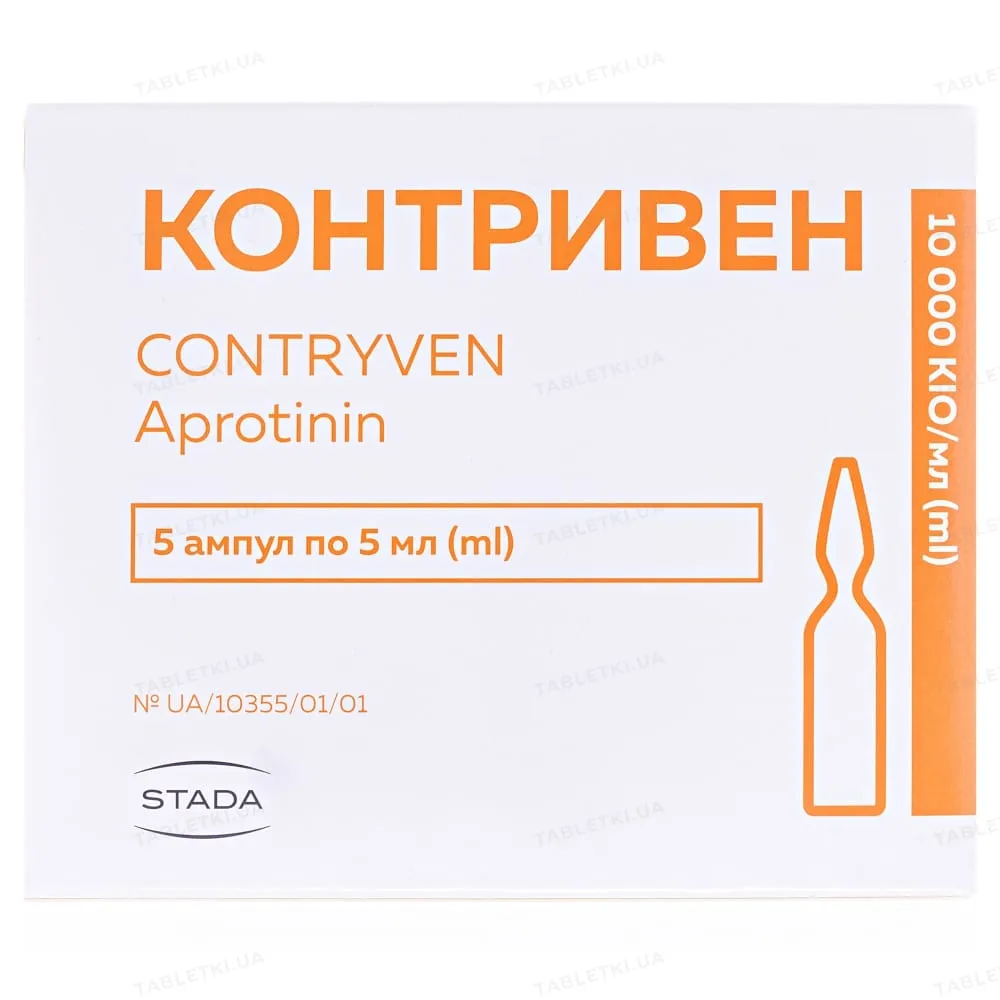
Table of Contents
I N S T R U C T I O N for medical use of the medicinal product CONTRYVEN (CONTRYVEN)
Composition:
Active substance: aprotinin;
1 ml of solution contains: 10 000 KIU aprotinin;
Excipients: sodium chloride, water for injections.
Pharmaceutical form. Solution for injection.
Main physico-chemical properties: clear, colourless or slightly yellowish liquid.
Pharmacotherapeutic group. Protease inhibitors. Aprotinin. ATC code B02AB01.
Pharmacological properties.
Pharmacodynamics.
Aprotinin is a broad-spectrum protease inhibitor molecule with antifibrinolytic activity. By forming a reversible stoichiometric enzyme–inhibitor complex, aprotinin inhibits trypsin, plasmin, and plasma and tissue kallikrein in humans, leading to inhibition of fibrinolysis.
In addition, it inhibits the contact phase of blood coagulation activation, which is a trigger factor for the coagulation process and stimulation of fibrinolysis.
Aprotinin is used during surgery under cardiopulmonary bypass conditions because it attenuates inflammatory responses, resulting in reduced need for allogeneic blood transfusion and reduced blood loss, as well as decreased necessity for re-exploration of the mediastinum due to bleeding.
In patients undergoing coronary artery bypass graft (CABG) surgery, the incidence of an increase in serum creatinine level by 0.5 mg/dL compared to baseline was significantly higher in patients who received a full dose of aprotinin compared to the placebo group. In most cases, postoperative renal dysfunction was reversible and not severe; the incidence of an increase in serum creatine level by 2.0 mg/dL or more relative to baseline was similar in the group receiving a full dose of aprotinin and in the placebo group.
The objective of the Nordic Aprotinin Patient Registry (NAPaR), a multicenter, non-interventional post-marketing surveillance study with active monitoring, was, among other outcomes, to determine the frequency of safety-related events. Aprotinin was used in a subgroup of 1384 patients who underwent isolated coronary artery bypass grafting (iCABG). In-hospital mortality was 1.3% (95% CI: 0.73%; 1.96%). The incidence of myocardial infarction and thromboembolic complications (TECs) was 0.9% (95% CI: 0.39%, 1.39%) and 2.5% (95% CI: 1.63%, 3.28%), respectively. Renal dysfunction (postoperative increase in creatinine > 0.5 mg/dL) and renal failure (postoperative increase in serum creatinine > 2.0 mg/dL) were observed with an incidence of 2.7% (95% CI: 1.82%, 3.55%) and 0.15% (95% CI: 0.02%, 0.54%), respectively. Within 24 hours after the procedure, 1.3% (95% CI: 0.73%, 1.96%) of patients underwent re-exploration for bleeding. Compared to published results from historical control groups, the NAPaR study results were largely consistent with the known safety profile of aprotinin when used according to approved indications.
Pharmacokinetics.
After intravenous administration, aprotinin rapidly distributes throughout the extracellular space, resulting in a rapid decline in plasma aprotinin concentration, with an elimination half-life of 0.3 to 0.7 hours. Later, particularly after 5 hours, a terminal elimination phase occurs, during which the half-life ranges from 5 to 10 hours.
The placenta is likely not completely impermeable to aprotinin, but penetration appears to occur extremely slowly.
During surgery, mean steady-state plasma concentrations of the drug in patients receiving aprotinin during cardiac surgery ranged from 175 to 281 KIEU/mL using the following regimen:
2,000,000 KIEU as an initial intravenous dose; 2,000,000 KIEU in the pump prime solution; and 500,000 KIEU/hour as a continuous intravenous infusion throughout surgery. The mean steady-state plasma concentration during surgery after administration of half this dose ranged from 110 to 164 KIEU/mL.
Pharmacokinetic data from studies of aprotinin in healthy volunteers, cardiac patients undergoing surgery under cardiopulmonary bypass, and women undergoing hysterectomy indicate that pharmacokinetic parameters are linear over the dose range of 50,000 to 2,000,000 KIEU.
Plasma protein binding was studied ex vivo. Approximately 20% of antifibrinolytic activity was attributed to the unbound form in the protein-free fraction, while 80% of the drug was bound to serum proteins.
At steady state, the volume of distribution was approximately 20 liters, and total systemic clearance in humans was about 40 mL/min.
Aprotinin accumulates in the kidneys and, to a lesser extent, in cartilage tissue.
Accumulation in the kidneys results from binding of aprotinin to the brush border of epithelial cells in the proximal tubules, as well as accumulation in phagolysosomes of these cells. Accumulation in cartilage is due to the affinity of aprotinin for acidic proteoglycans.
In other organs, drug concentrations were generally similar to those in blood serum. The lowest drug concentration was observed in the brain; aprotinin barely penetrated into cerebrospinal fluid.
Only a small amount of aprotinin crosses the placental barrier. The placenta cannot be considered completely impermeable to aprotinin, but the rate of penetration is extremely low.
Excretion of aprotinin into breast milk has not been studied.
Metabolism, elimination, and excretion.
The aprotinin molecule is degraded in the kidneys by lysosomal enzymes into shorter peptides or amino acids. In humans, less than 5% of the administered dose of aprotinin is excreted unchanged in urine. After intravenous administration of 131I-labeled aprotinin to healthy volunteers, 25% to 40% of the labeled compound was excreted in urine as metabolites within 48 hours. These metabolites had no inhibitory activity against enzymes.
Data on the use of the drug in patients with end-stage renal impairment are not yet available. However, in patients with impaired renal function, no clinically significant pharmacokinetic changes or obvious adverse effects have been observed. Therefore, no specific dose adjustment is required in such cases.
Clinical characteristics.
Indications.
Aprotinin is indicated for prophylactic use to reduce postoperative blood loss and the need for blood transfusion in adult patients at high risk of major blood loss undergoing isolated cardiopulmonary bypass surgery (i.e., coronary artery bypass grafting not combined with other cardiovascular procedures).
Contraindications.
Hypersensitivity to the active substance (bovine protein) or to any of the excipients; disseminated intravascular coagulation (DIC syndrome). In patients with specific IgG antibodies to aprotinin, treatment with aprotinin is associated with an increased risk of anaphylaxis. Therefore, aprotinin therapy is contraindicated in such patients.
If testing for specific IgG antibodies to aprotinin prior to initiating treatment is not feasible, but the patient has received aprotinin treatment within the previous 12 months, administration of aprotinin is contraindicated.
Interaction with other medicinal products and other forms of interaction.
The drug should not be mixed with other medicinal products, including beta-lactam antibiotics (incompatible). Administration of the drug is prohibited together with solutions containing dextran, corticosteroids, or parenteral nutrition solutions containing amino acids and lipids.
Depending on the dose, Contreven reduces the activity of streptokinase and urokinase. It may inhibit the activity of serum nonspecific cholinesterase. In patients with reduced nonspecific cholinesterase activity, concomitant use of aprotinin and succinylcholine may result in apnea due to prolonged muscle relaxation.
Aprotinin inhibits the action of thrombolytic agents, including streptokinase, urokinase, and alteplase (r-TPA = recombinant tissue-type plasminogen activator), with the inhibitory effect being dose-dependent. Particular attention should be paid to coagulation in patients receiving active thrombolytic agents that are targets of aprotinin.
Aprotinin use may lead to impaired renal function, especially in patients with pre-existing renal impairment. Concomitant use of agents with strong nephrotoxic potential (e.g., aminoglycosides and renin-angiotensin-aldosterone system inhibitors) further increases the risk of renal dysfunction. Special attention should be given to renal protection when using aprotinin as well as other drugs that may impair renal function.
Special precautions for use.
Aprotinin should not be used during coronary artery bypass grafting (CABG) in combination with other cardiovascular surgeries, as the benefit-risk ratio of aprotinin use in other cardiovascular procedures has not been established.
Renal function impairment
Results from previous observational studies indicate that treatment with aprotinin may lead to renal function impairment, particularly in patients who already have pre-existing kidney dysfunction. Analysis of all combined placebo-controlled trials involving patients undergoing coronary artery bypass grafting (CABG) showed an increase in serum creatinine levels by more than 0.5 mg/dL from baseline in the aprotinin-treated group (see section "Pharmacodynamics").
An increased incidence of renal failure and death has been reported compared to age-matched historical control groups in patients who received aprotinin during thoracic aortic surgery performed under cardiopulmonary bypass with deep hypothermic cardiac arrest.
Therefore, careful assessment of the benefit-risk ratio is required before prescribing aprotinin to patients with impaired renal function or those at risk of kidney injury (e.g., patients receiving concomitant aminoglycoside therapy).
Aprotinin should be used with caution in patients with atopic dermatitis, as pseudoallergic reactions may occur.
Careful evaluation of the benefit-risk ratio is necessary when using aprotinin, especially in patients who have previously received aprotinin (including fibrin sealant materials containing aprotinin), as they may develop an allergic reaction (see section "Adverse reactions"). Although most cases of anaphylaxis occur within 12 months after administration of the approved dose, there have been isolated reports of anaphylactic reactions occurring after re-exposure beyond 12 months. Appropriate emergency equipment and medications for the treatment of allergic and anaphylactic reactions must be readily available when administering aprotinin.
All patients receiving aprotinin therapy must first be given a test dose to assess susceptibility to allergic reactions (see section "Dosage and administration"). The test dose should be administered to the patient in the operating room.
H1 and H2 antagonists may be administered 15 minutes prior to the aprotinin test.
The test dose of aprotinin for all patients is 1 millilitre (10,000 KIU). After administration, the patient must be observed for at least 10 minutes before administering the loading dose (see section "Dosage and administration").
However, even in the absence of complications following the initial 1 mL dose, the therapeutic dose of aprotinin may still cause an anaphylactic reaction. If an anaphylactic reaction occurs, aprotinin infusion must be stopped immediately and appropriate emergency measures initiated.
Due to the potential for hypersensitivity reactions (see section "Adverse reactions"), a careful benefit-risk assessment must be performed for each patient previously treated with aprotinin before re-administration (see section "Adverse reactions").
If it is known or suspected that the patient has previously received or may have received aprotinin treatment, precautionary measures are recommended. As stated in the section "Dosage and administration", all patients should receive a test dose of aprotinin of 1 mL (10,000 KIU) at least 10 minutes prior to the initial dose. Additionally, an H1 antagonist (e.g., clemastine) and an H2 antagonist (e.g., cimetidine) may be administered 15 minutes before the test dose. Standard emergency procedures should be available for the treatment of allergic (anaphylactic) reactions if needed.
It should be noted that a therapeutic dose may still cause an allergic reaction even if the patient tolerated the initial 1 mL test dose without any adverse symptoms. In such cases, aprotinin infusion must be stopped immediately and standard emergency procedures for the treatment of anaphylactic reactions initiated.
An increased frequency of renal function impairment and mortality has been observed in patients receiving aprotinin compared to age-matched control groups with similar medical histories undergoing thoracic aortic surgery under cardiopulmonary bypass with circulatory arrest under deep hypothermia. In such cases, aprotinin should be used only with extreme caution. Adequate anticoagulation with heparin must be maintained.
Monitoring of laboratory coagulation parameters during coronary artery bypass grafting under cardiopulmonary bypass
Aprotinin does not reduce the amount of heparin required; therefore, it is essential to maintain adequate anticoagulant activity provided by heparin during aprotinin therapy.
Activated partial thromboplastin time (aPTT) and partial thromboplastin time (PTT) are similar parameters, but their measurement becomes unreliable when high-dose heparin is used. Therefore, aPTT and PTT should not be used to monitor heparin anticoagulation in patients undergoing coronary artery bypass grafting under cardiopulmonary bypass.
For patients undergoing coronary artery bypass grafting under cardiopulmonary bypass while receiving aprotinin therapy, one of the following methods is recommended to maintain adequate anticoagulation:
- To reduce postoperative coagulation disorders and bleeding complications during cardiac surgery under cardiopulmonary bypass, individualized dosing of heparin and protamine should be considered. Individualized heparin dosing or titration is based on computerized heparin dosing systems, measurement of anti-Xa activity or heparin levels in blood, in addition to activated clotting time (ACT) monitoring. Aprotinin does not interfere with anti-Xa or heparin blood level measurements; therefore, these assays should be performed according to the test manufacturer's instructions.
In the absence of individualized heparin dosing systems, regular ACT testing at defined intervals according to institutional protocols is recommended, with heparin dosing adjusted accordingly. The target ACT level depends on the type of activator and equipment used. Prolonged celite-ACT or kaolin-ACT is expected in patients receiving aprotinin during and for several hours after surgery. For maintaining anticoagulation in patients under cardiopulmonary bypass during aprotinin therapy, minimum celite-ACT values of 750 seconds or kaolin-ACT values of 480 seconds are recommended, regardless of hemodilution or hypothermia effects. ACT tests using mixed activators should be performed according to test manufacturer instructions.
- 2. Continuous heparin infusion: a standard loading dose of heparin administered prior to cardiac catheterization, as well as the amount added to the initial priming solution of the cardiopulmonary bypass circuit, should be at least 350 IU/kg. Additional heparin dosing should be based on patient body weight and duration of cardiopulmonary bypass.
- Heparin/protamine titration: this method is not affected by aprotinin and is therefore acceptable for measuring heparin levels. The relationship between heparin dose and response should be assessed by protamine titration prior to aprotinin administration (to determine the loading dose of heparin).
Additional heparin may be administered based on heparin concentration measured by protamine titration. Heparin concentration during cardiopulmonary bypass should not fall below 2.7 IU/mL (2 mg/kg) or below the level determined by dose-response testing performed prior to aprotinin administration.
After completion of cardiopulmonary bypass in patients who have received aprotinin injections, heparin should be neutralized with protamine.
Use of protamine
Aprotinin does not interfere with the protamine test. Therefore, in patients who have received aprotinin injections, heparin should be neutralized with protamine after termination of extracorporeal circulation, according to the test manufacturer's instructions.
Important: aprotinin use does not reduce the need for heparin; aprotinin cannot be used as a heparin-sparing agent.
This medicinal product contains less than 1 mmol (8.5 mg)/1 mL sodium and (42.5 mg)/5 mL sodium, i.e., essentially "sodium-free".
Use during pregnancy or breastfeeding.
Adequate and well-controlled studies in pregnant women have not been conducted. Animal studies do not indicate teratogenic or embryotoxic effects of aprotinin. Aprotinin is contraindicated in the first trimester of pregnancy and should not be used during the second and third trimesters unless the potential benefit outweighs the potential risk. In cases of serious adverse reactions (such as anaphylactic reactions, cardiac arrest, etc.) and during their treatment, the potential risk to the fetus should be considered when evaluating benefit and risk (see section "Special precautions for use").
It is unknown whether aprotinin is excreted in breast milk. Information on the use of Contraven during breastfeeding is lacking. However, since aprotinin is not bioavailable orally, any amount excreted into breast milk is unlikely to affect the infant.
Ability to influence reaction speed when driving or operating machinery.
The drug may only be administered in a hospital setting.
Method of Administration and Dosage
If possible, before initiating treatment, all patients should be tested for specific IgG antibodies to aprotinin (see section "Contraindications"). The following dosages are recommended for adult patients:
Test dose
Due to the risk of developing an allergic (anaphylactic) reaction, all patients should receive an intravenous test dose of 10,000 KIU (kallikrein inhibitory units) of aprotinin (1 mL) at least 10 minutes prior to administration of the initial therapeutic dose. If the initial 1 mL dose does not provoke an allergic reaction, the therapeutic dose may be administered.
H1 and H2 antagonists may be administered 15 minutes prior to the aprotinin test dose. Equipment for standard emergency treatment of anaphylactic and allergic reactions must be readily available.
During open-heart surgery (with cardiopulmonary bypass) to reduce blood loss and the need for blood transfusions:
After induction of anesthesia (but prior to sternotomy), a loading dose of 1,000,000 to 2,000,000 KIU should be administered by slow intravenous injection or infusion over 20–30 minutes. An additional 1,000,000–2,000,000 KIU should be administered after initiation of cardiopulmonary bypass. To avoid physical incompatibility between aprotinin and heparin added to the pump prime solution, each agent should be added during recirculation to ensure adequate dilution of both drugs before they mix. Following the initial high-dose bolus infusion, a continuous infusion of 250,000 to 500,000 KIU per hour should be maintained until the end of surgery.
Overall, the total amount of aprotinin administered during the treatment cycle should not exceed 6,000,000 KIU.
Aprotinin for intravenous administration should be given through a central venous catheter, which should not be used for administration of any other medicinal product.
The drug should only be administered to patients in a lying position; administration should be performed slowly (maximum rate of 5 to 10 mL per minute) by intravenous injection or short-term infusion.
Patients with renal impairment: based on current clinical experience, dosage adjustment is not required.
Use in elderly patients: according to currently available clinical experience, no dosage adjustment is necessary for elderly patients.
The drug must not be used if turbidity is observed in the ampoule. After opening, the solution should be used immediately.
Children. The efficacy and safety of the medicinal product in children have not been established.
Overdose. Symptoms of overdose or intoxication have not been described. There is no specific antidote. Symptomatic treatment is recommended.
Adverse reactions
Summary of safety profile
The safety of aprotinin was evaluated in over forty-five Phase II–III studies involving more than 3800 patients who received aprotinin. Overall, adverse reactions occurred in 11% of patients receiving aprotinin. The most serious adverse reaction was myocardial infarction. The safety of aprotinin use was monitored in the Nordic Aprotinin Register study (NAPaR) from February 2016 to November 2020. Among 6682 enrolled patients, the frequency of adverse reactions was 1.1%. Adverse reactions should be evaluated in the context of surgical procedures.
In patients receiving aprotinin for the first time, the development of allergic or anaphylactic reactions is unlikely. Upon re-exposure, the frequency of allergic (anaphylactic) reactions may reach up to 5%. Retrospective analysis of allergic (anaphylactic) reactions showed that the frequency increases if re-administration occurs within 6 months after initial treatment (frequency is 5% when re-administered within 6 months and 0.9% when re-administered after more than 6 months). Furthermore, retrospective analysis demonstrated that the frequency of severe anaphylactic reactions is further increased in patients who received aprotinin more than twice within 6 months. Even if a patient tolerated re-treatment with aprotinin well, subsequent administration may provoke a severe allergic reaction or, in extremely rare cases, anaphylactic shock leading to death.
Symptoms of allergic or anaphylactic reactions:
Cardiovascular system: arterial hypotension, tachycardia, cardiac arrhythmia, cyanosis of lips;
Gastrointestinal system: nausea;
Respiratory system: bronchial asthma (bronchospasm);
Skin and appendages: pruritus, urticaria, skin rashes, pallor;
Psychiatric disorders: psychoses, hallucinations, confusion;
Other: dyspnea, profuse sweating.
If an allergic reaction develops during injection or infusion, administration of the medicinal product must be stopped immediately. Standard emergency measures should be applied, including administration of adrenaline, corticosteroids, and infusion therapy.
Cardiovascular system
In patients undergoing coronary artery bypass graft (CABG) surgery, no significant differences were observed in the number of myocardial infarction cases compared to the placebo group. In some studies, a trend toward increased frequency of myocardial infarction was observed during aprotinin administration, whereas in other studies, a decrease in the number of myocardial infarction cases was noted.
Since the primary objective of the aforementioned studies was not to detect differences in the frequency of myocardial infarction, a statistically significant increase in the likelihood of clinically significant adverse effects cannot be ruled out.
In a study where patients underwent first-time CABG surgery, the risk of graft occlusion was higher in patients receiving aprotinin compared to the placebo group. Upon re-analysis, it was revealed that in one of these centers, inadequate heparinization was performed, and in another, an unapproved method of graft preservation was used. In addition to the concerns regarding heparinization (see section "Special precautions"), it is absolutely unacceptable to draw blood samples for testing from the primary intravenous system used for aprotinin administration. Taking these factors into account, no differences were observed between treatment groups in terms of frequency of myocardial infarction or mortality rate.
Within groups, adverse reactions are listed in order of decreasing severity.
Summary table of adverse reactions
Adverse reactions recorded in all placebo-controlled clinical trials using aprotinin and categorized by frequency according to CIOMS III guidelines (CIOMS – Council for International Organizations of Medical Sciences) (aprotinin, n = 3817; placebo, n = 2682; as of April 2005), and those recorded in the NAPaR study, are presented in the table below.
Frequency unknown (cannot be estimated based on available data)
System organ class according to the Medical Dictionary for Regulatory Activities (MedDRA) |
Common ≥ 1/100 to < 1/10 |
Uncommon ≥ 1/1,000 to < 1/100 |
Rare ≥ 1/10,000 to < 1/1,000 |
Very rare < 1/10,000 |
| Immune system disorders |
Allergic reactions. Anaphylactic/anaphylactoid reactions. |
Anaphylactic shock (potentially life-threatening). |
||
| Blood and lymphatic system disorders |
Disseminated intravascular coagulation (DIC). Coagulopathy. |
|||
| Cardiac disorders |
Myocardial ischemia |
|||
| Vascular disorders |
Thrombosis. Embolic stroke. |
Arterial thrombosis (and its forms affecting vital organs, e.g., kidneys, lungs, brain). Pulmonary artery thromboembolism. |
||
| Renal and urinary disorders |
Oliguria. Acute kidney injury. |
|||
| General disorders and administration site conditions |
Reactions at injection or infusion site. (Thrombo)phlebitis at infusion site. |
|||
| Investigations |
Increased blood creatinine |
Additional adverse reactions identified during the post-marketing period with the use of aprotinin: skin hyperemia, sensation of heat, tachycardia, weakness, chills, hyperthermia, dizziness, vomiting, itching, angioneurotic edema.
Shelf life. 2 years.
Storage conditions. In the original packaging, protected from light, at a temperature not exceeding 25°C. Keep out of reach of children.
Incompatibility.
Aprotinin should be considered practically incompatible with other medicinal products. The drug must not be administered in mixed infusions. Due to chemical incompatibility, it must not be used simultaneously with corticosteroids or with nutrient solutions containing amino acids and fats.
Packaging. 1 ml in vials, pack of 10 (5×2) in blisters in a cardboard box; 5 ml in vials, pack of 5 (5×1) in blisters in a cardboard box.
Prescription status. Prescription only.
Manufacturer. LLC "FZ "STADA", Ukraine.
Manufacturer's address and place of business.
37 Kyivska Street, Bila Tserkva, Kyiv region, 09100, Ukraine.