Colistin-vista
Ukraine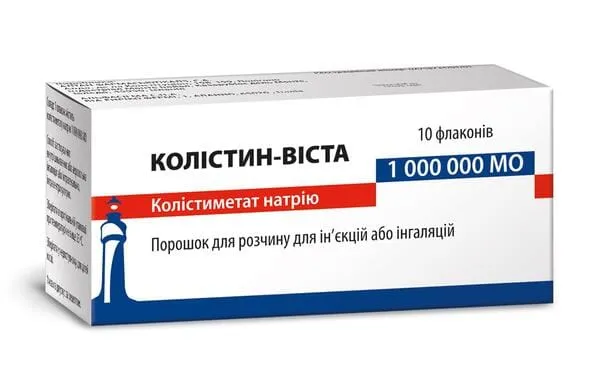
Table of Contents
INSTRUCTIONS FOR MEDICAL USE OF THE MEDICINAL PRODUCT KOLISTIN-VISTA (COLISTIN-VISTA)
Composition:
Active substance: sodium colistimethate;
1 vial contains sodium colistimethate 1,000,000 IU or 2,000,000 IU
Pharmaceutical form. Powder for solution for injection or inhalation.
Main physicochemical properties: white lyophilized powder.
Pharmacotherapeutic group.
Antibacterial agents for systemic use. ATC code J01X B01.
Pharmacological properties.
Pharmacodynamics.
Mechanism of action. Colistin is a cyclic polypeptide antibacterial agent belonging to the polymyxin group. Polymyxins damage bacterial cell membranes, resulting in physiological effects that are lethal to bacteria. Polymyxins selectively act against aerobic Gram-negative bacteria, which possess a hydrophobic outer membrane.
Resistance. Resistant bacteria are characterized by modifications of the phosphate groups of lipopolysaccharides, which are substituted with ethanolamine or aminoarabinose. Naturally resistant Gram-negative bacteria, such as Proteus mirabilis and Burkholderia cepacia, exhibit complete substitution of their lipid phosphate with ethanolamine or aminoarabinose. Cross-resistance. Cross-resistance between sodium colistimethate and polymyxin B is possible. Since the mechanism of action of polymyxins differs from that of other antibiotics, resistance to colistin and polymyxin via the aforementioned mechanism does not imply resistance to other classes of antimicrobial agents. Pharmacokinetic/pharmacodynamic relationship. The bactericidal activity of polymyxins against susceptible bacteria has been reported to be concentration-dependent. The fAUC (free fraction area under the concentration-time curve)/MIC (minimum inhibitory concentration) ratio is considered to correlate with clinical efficacy.
Table 1
EUCAST* susceptibility breakpoints
| Susceptible (S) |
Resistant (R)** |
|
| Acinetobacter |
S ≤ 2 |
R > 2 mg/L |
| Enterobacteriaceae |
S ≤ 2 |
R > 2 mg/L |
| Pseudomonas spp. |
S ≤ 4 |
R > 4 mg/L |
* EUCAST (European Committee on Antimicrobial Susceptibility Testing).
** Breakpoint concentrations refer to a dose of 2–3 million IU×3. A loading dose (9 million IU) may be required.
Susceptibility.
The prevalence of acquired resistance may vary according to geographical location and time for selected bacterial species; therefore, obtaining local resistance data is advisable, especially when treating severe infections. The local resistance rates of microorganisms to sodium colistimethate should be taken into account when prescribing the medicinal product. If necessary, when local resistance prevalence renders the benefit of the medicinal product questionable for certain types of infections, professional consultation should be sought.
Generally susceptible species:
Acinetobacter baumannii;
Haemophilus influenzae;
Klebsiella spp.;
Pseudomonas aeruginosa.
Species for which acquired resistance may be problematic:
Stenotrophomonas maltophilia;
Achromobacter xylosoxidans (previously known as Alcaligenes xylosoxidans);
Naturally resistant organisms:
Burkholderia cepacia and related species;
Proteus species;
Providencia species;
Serratia species.
Pharmacokinetics.
Absorption. Data on the pharmacokinetics of sodium colistimethate and colistin are limited. Evidence suggests that pharmacokinetics in critically ill patients differ from those in patients with less severe physiological disturbances and in healthy volunteers. After infusion of sodium colistimethate, inactive prodrugs are converted into active colistin. Peak plasma concentrations of colistin are delayed, reaching maximum levels up to 7 hours after administration of sodium colistimethate in critically ill patients. Gastrointestinal absorption in healthy volunteers is negligible.
When the medicinal product was administered via nebulization, variable absorption was reported, depending on aerosol particle size, nebulizer system, and lung condition. In studies involving healthy volunteers and patients with various infections, plasma concentrations of the medicinal product ranged from zero to potentially therapeutic levels of 4 mg/L and higher. Therefore, the possibility of systemic absorption should always be considered when administering via inhalation.
Distribution. The volume of distribution of colistin in healthy volunteers is low and approximately corresponds to extracellular fluid. The volume of distribution is relatively increased in critically ill patients. Plasma protein binding is moderate and decreases at higher concentrations. Penetration into cerebrospinal fluid is minimal in the absence of meningeal inflammation but increases when meningeal inflammation is present. Both sodium colistimethate and colistin exhibit linear pharmacokinetics within the clinically relevant dosage range.
Elimination. Approximately 30% of sodium colistimethate is converted into colistin in healthy volunteers. Its clearance depends on creatinine clearance, and with decreasing renal function, a greater proportion of sodium colistimethate is converted into colistin. In patients with significantly impaired renal function (creatinine clearance <30 mL/min), the conversion rate may reach 60–70%. Sodium colistimethate is eliminated by the kidneys via glomerular filtration. In healthy volunteers, 60% to 70% of sodium colistimethate is excreted unchanged in urine within 24 hours.
Elimination of active colistin has not been sufficiently studied. Colistin undergoes significant renal tubular reabsorption and may be eliminated via non-renal pathways or undergo renal metabolism, potentially leading to renal accumulation. Colistin clearance decreases in renal impairment, likely due to increased conversion of sodium colistimethate.
The elimination half-life of colistin in healthy volunteers and patients with cystic fibrosis was approximately 3 and 4 hours, respectively, with a total clearance of approximately 3 L/hour. In critically ill patients, the elimination half-life was prolonged to approximately 9–18 hours.
Clinical characteristics.
Indications.
Intravenous administration of the medicinal product is indicated for adults and children, including newborns, for the treatment of severe infections caused by specific aerobic Gram-negative pathogens in patients with limited treatment options. The medicinal product Colistin-Vista as an inhaled formulation is also indicated for adults and children with cystic fibrosis for the treatment of chronic pulmonary infections caused by Pseudomonas aeruginosa.
Official recommendations regarding appropriate use of antibacterial agents should be followed.
Contraindications.
Hypersensitivity to sodium colistimethate (colistin) or polymyxin B.
Safety precautions.
Inhalation of antibiotics as a procedure may provoke bronchospasm. Bronchospasm can be prevented or terminated with appropriate β2-agonists. If this is ineffective, treatment should be discontinued.
Interaction with other medicinal products and other forms of interaction.
Concomitant use of sodium colistimethate with other medicinal products exhibiting neurotoxic and/or nephrotoxic effects requires great caution. Simultaneous administration of different formulations of sodium colistimethate should be done cautiously due to lack of experience and the potential for cumulative toxicity.
In vivo interaction studies have not been conducted. The mechanism of conversion of sodium colistimethate into the active substance, colistin, has not been studied. The clearance mechanism of colistin, particularly renal elimination, has also not been described. Sodium colistimethate or colistin did not induce the activity of any of the tested P450 (CYP) enzymes (CYP1A2, 2B6, 2C8, 2C9, 2C19, and 3A4/5) in in vitro studies using human hepatocytes.
The potential for drug interactions should be considered when Colistin-Vista is administered with medicinal products that inhibit or induce drug-metabolizing enzymes, or with medicinal products that are substrates for renal transport mechanisms.
Due to the effect of colistin on acetylcholine release, non-depolarizing muscle relaxants should be used with caution in patients receiving sodium colistimethate, as their effects may be prolonged.
Concomitant use of sodium colistimethate with macrolide antibiotics such as azithromycin and clarithromycin, or with fluoroquinolones such as norfloxacin and ciprofloxacin, should be used cautiously in patients with myasthenia gravis.
Concomitant administration of sodium colistimethate with other medicinal products having neurotoxic and/or nephrotoxic potential should be avoided. These include aminoglycoside antibiotics such as gentamicin, amikacin, netilmicin, and tobramycin. Concomitant use with cephalosporin antibiotics may increase the risk of nephrotoxicity.
Special precautions for use.
Concomitant use of intravenous colistimethate sodium with another antibacterial agent should be considered whenever possible, taking into account the susceptibility of the causative pathogen(s) to treatment. Since development of resistance to intravenous colistin, particularly when used as monotherapy, has been reported, combination therapy with another antibacterial agent should be considered to prevent emergence of resistance.
Clinical data on the efficacy and safety of intravenous colistimethate sodium are limited. Recommended doses in all subpopulations are based on limited data (clinical and pharmacokinetic/pharmacodynamic data). In particular, there are limited data on the safety of high-dose regimens (>6000000 IU/day) and on the use of loading doses, as well as in specific patient groups (adults with impaired renal function and children). Colistimethate sodium should be used only when other, more commonly used antibiotics are ineffective or unsuitable.
Nephrotoxicity.
Renal function should be assessed in all patients prior to initiation of treatment and monitored throughout therapy. The dose of colistimethate sodium should be adjusted according to creatinine clearance. Colistimethate sodium is eliminated by the kidneys and may be nephrotoxic if high serum concentrations are achieved. Patients with hypovolemia or those receiving other potentially nephrotoxic medicinal products have an increased risk of nephrotoxic effects of colistin. Renal impairment (usually after administration of doses exceeding recommended levels) has been reported following intravenous or intramuscular administration in patients with normal renal function, or in the absence of dose reduction in patients with impaired renal function, or with concomitant use of other nephrotoxic antibiotics. In some studies, nephrotoxicity has been associated with cumulative dose and duration of treatment. The benefit of prolonged treatment should be weighed against the potential increased risk of nephrotoxicity.
Neurotoxicity.
High serum concentrations of colistimethate sodium, which may result from overdose or lack of dose adjustment in patients with impaired renal function, have been shown to cause neurotoxic effects such as facial paraesthesia, muscle weakness, vertigo, slurred speech, vasomotor instability, visual disturbances, confusion, psychosis, and apnoea. Dose reduction of colistimethate may alleviate symptoms. Monitoring for perioral and extremity paraesthesia, which are signs of overdose, is required. Neurotoxic reactions are unlikely during inhalation therapy; however, patients (particularly those with impaired renal function) should be observed for such reactions, and renal function should also be monitored.
Caution is required when using colistimethate sodium in infants (under 1 year of age), as renal function in this age group is not yet fully mature. Furthermore, the impact of immature renal and metabolic function on the conversion of colistimethate sodium to colistin is unknown.
If an allergic reaction occurs, treatment with colistimethate sodium should be discontinued and appropriate measures taken.
Myasthenia gravis.
Colistimethate sodium is known to reduce presynaptic release of acetylcholine at the neuromuscular junction; therefore, it should be used with extreme caution in patients with myasthenia gravis (due to the risk of neuromuscular blockade) and only if clearly necessary.
Intramuscular administration.
Respiratory arrest has been reported after intramuscular administration of colistimethate sodium. Impaired renal function increases the likelihood of apnoea and neuromuscular blockade following administration of colistimethate sodium.
Porphyria.
Particular caution should be exercised when administering the medicinal product to patients with porphyria.
Antibiotic-associated colitis and pseudomembranous colitis.
Antibiotic-associated colitis and pseudomembranous colitis have been reported with nearly all antibacterial agents, including colistimethate sodium. The severity may range from mild to life-threatening. This diagnosis should be considered in patients who develop diarrhoea during or after treatment with colistimethate sodium. Discontinuation of therapy and initiation of specific treatment for Clostridium difficile may be required. Medicinal products that suppress peristalsis should not be used.
Intrathecal or intraventricular administration.
Following intravenous administration, colistimethate sodium does not cross the blood-brain barrier in clinically significant amounts. Intrathecal or intraventricular administration of colistimethate sodium for the treatment of meningitis has not been systematically studied in clinical trials; only case reports support its use. Data on dosing are very limited. Aseptic meningitis has been the most frequently reported adverse effect with this route of administration.
Bronchospasm.
Inhalation of colistimethate sodium may cause cough or bronchospasm. The first dose should be administered under medical supervision. It is recommended to use the recommended dose of a bronchodilator (e.g., a β2-agonist), especially if this is part of the patient’s current therapeutic regimen. Bronchial hyperreactivity despite bronchodilator use may indicate an allergic reaction, and administration of colistimethate sodium should be discontinued. Bronchospasm, if it occurs, requires treatment. Instructions for use must not be disregarded, as this may harm health.
Resistance to colistimethate sodium.
During clinical use, resistance of colistimethate sodium to mucoid Pseudomonas aeruginosa has been reported. Susceptibility testing should be performed in patients receiving prolonged treatment with colistimethate sodium, in those with frequent infections, and during exacerbations. If physiotherapy or inhalation therapy is used, this medicinal product should be administered after these procedures.
Important information on excipients
This medicinal product contains less than 1 mmol (23 mg)/dose of sodium, i.e., essentially "sodium-free".
Use during pregnancy or breastfeeding.
Pregnancy. There are insufficient data on the use of colistimethate sodium in pregnant women. Studies of single doses in pregnant women have shown that colistimethate sodium crosses the placental barrier; therefore, there may be a risk of fetotoxicity if the drug is administered during pregnancy.
Data on the potential genotoxicity of the medicinal product are limited, and data on carcinogenicity of colistimethate sodium are lacking. In vitro, colistimethate sodium has been shown to cause chromosomal aberrations in human lymphocytes. This effect may be related to a decreased mitotic index, which was also observed.
Colistimethate sodium may be used during pregnancy only if the benefit outweighs the potential risk.
Breastfeeding. Colistimethate sodium passes into breast milk. Colistimethate sodium may be used during breastfeeding only if clearly necessary.
Ability to influence the ability to drive and use machines.
Neurotoxicity, including dizziness, confusion, and visual disturbances, may occur during parenteral treatment with colistimethate sodium. Patients should be advised to avoid driving or operating machinery if such events occur.
Dosage and method of administration.
The dose of the medicinal product and the duration of treatment depend on the severity of the infection and the patient's clinical response. Therapeutic recommendations should be followed. Intravenous administration.
The dose of the medicinal product is expressed in international units (IU) of sodium colistimethate. The conversion table of IU of sodium colistimethate to milligrams (mg) of sodium colistimethate, as well as to milligrams of colistin base activity (CBA), is provided below.
Dosage conversion. In the EU, the dose of sodium colistimethate is prescribed and administered exclusively in IU. The product labeling states the number of IU per vial. Confusion and medication errors have occurred due to different expressions of the dose related to the active substance content. In the USA and other regions of the world, the dose is expressed in milligrams of colistin base activity (mg CBA). The conversion table below is provided for informational purposes only, and the values should be considered nominal and approximate.
Table 2
Conversion of dosage units for sodium colistimethate
| Active ingredient content |
≈ colistimethate sodium mass (mg)* |
|
| MO |
≈ mg BAU |
|
| 12500 |
0.4 |
1 |
| 150000 |
5 |
12 |
| 1000000 |
34 |
80 |
| 4500000 |
150 |
360 |
| 9000000 |
300 |
720 |
* Nominal content of the active substance in the medicinal product – 12,500 IU/mg.
Dose.
The dosage recommendations below are based on limited population pharmacokinetic data obtained in critically ill patients.
Adults and adolescents.
Maintenance dose – 9 million IU per day, divided into 2–3 doses. Critically ill patients should receive a loading dose of 9 million IU. The optimal time interval to the first maintenance dose has not been established. Modelling suggests that patients with normal renal function may require loading and maintenance doses of up to 12 million IU in some cases. However, clinical experience with such doses is extremely limited, and their safety has not been established.
The loading dose should be administered to patients with normal and impaired renal function, including those undergoing hemodialysis.
Renal impairment
Dosage adjustment is required in renal impairment; however, available pharmacokinetic data in patients with reduced renal function are very limited.
For patients with creatinine clearance <50 mL/min, the following dosage adjustment is recommended.
Table 3
Dosage adjustment according to creatinine clearance
| Creatinine clearance |
Daily dose |
| <50–30 |
5.5–7.5 million IU |
| <30–10 |
4.5–5.5 million IU |
| <10 |
3.5 million IU |
For patients with creatinine clearance <50 mL/min, it is recommended to administer the medicinal product twice daily.
Hemodialysis and continuous hemodiafiltration.
Colistin is likely eliminated by dialysis via conventional hemodialysis and continuous venovenous hemodiafiltration. There are very limited data from population pharmacokinetic studies involving a small number of patients undergoing hemodialysis. It is not possible to provide clear dosing recommendations. The following regimens may be used.
Hemodialysis. On non-hemodialysis days: 2.25 million IU daily (2.2–2.3 million IU daily). On hemodialysis days: 3 million IU daily on hemodialysis days, administered after the hemodialysis session. It is recommended to administer twice daily.
Continuous venovenous hemodiafiltration. As in patients with normal renal function. It is recommended to administer three times daily.
Hepatic impairment.
There are no data in patients with hepatic impairment. Colistimethate sodium should be used with caution in these patients.
Elderly patients.
Dose adjustment is not required in elderly patients with normal renal function.
Children.
Data on pediatric dosing are very limited. Renal maturity should be considered when determining the dose. The dose should be based on lean body weight.
Children ≤40 kg: 75,000–150,000 IU/kg/day, divided into three doses.
For children with body weight above 40 kg, adult dosing recommendations should be followed.
Doses >150,000 IU/kg/day have been reported in children with cystic fibrosis. There are no data on administration or size of loading dose in critically ill children. There are no dosing recommendations for children with impaired renal function.
Method of administration.
The medicinal product Colistin-Vista is administered intravenously as a slow infusion over 30–60 minutes. Patients with a totally implanted venous access device (TIVAD) may tolerate a bolus injection of up to 2 million IU in 10 mL, administered over at least 5 minutes.
Colistimethate sodium undergoes hydrolysis to the active substance colistin in aqueous solution. When preparing the dose, especially when combining several vials, reconstitution must be performed with strict adherence to aseptic technique.
AEROSOL INHALATION.
Inhaled colistimethate sodium is recommended to be administered under the supervision of a physician experienced in its use.
Dose.
The dose may be adjusted depending on the severity of the condition and clinical response.
The following doses are recommended.
Inhalation administration.
Adults, adolescents, and children aged ≥2 years:
1–2 million IU 2–3 times daily (maximum dose – 6 million IU/day).
Children aged <2 years:
0.5–1 million IU twice daily (maximum dose – 2 million IU/day).
Appropriate clinical guidelines regarding treatment regimen, including duration of treatment, frequency, and concomitant use of other antibacterial agents, should be followed.
Elderly patients.
Dose adjustment is not required.
Renal impairment.
Dose adjustment is not required; however, caution is necessary when administering to patients with renal impairment.
Hepatic impairment.
Dose adjustment is not required.
Method of administration.
Administered by inhalation. Colistimethate sodium undergoes hydrolysis to the active substance colistin in aqueous solution. If other treatments are used, they should be administered as per physician's recommendation (see dose conversion table above).
Preparation of solution.
For bolus injection.
Reconstitute the vial contents with no more than 10 mL of water for injections or 0.9% sodium chloride solution.
For infusion.
The reconstituted vial contents may be further diluted, usually with 50 mL of 0.9% sodium chloride solution.
For nebulizer inhalation.
Reconstitute the vial contents with water for injections to obtain a hypotonic solution, or with a 50:50 mixture of water for injections and 0.9% sodium chloride solution to obtain an isotonic solution, or with 0.9% sodium chloride solution to obtain a hypertonic solution. The reconstitution volume should comply with the nebulizer device instructions, usually not exceeding 4 mL.
The solution may be nebulized into open air or through a filter. The nebulizer should be used in a well-ventilated room. Careful swirling is recommended during reconstitution to avoid foaming.
The solution is intended for single use only; any unused portion must be discarded.
Reconstituted solutions.
Hydrolysis of colistimethate is significantly increased upon reconstitution and dilution below the critical micelle concentration of approximately 80,000 IU/mL. Solutions with lower concentrations should be used immediately.
Chemical and physical stability of the reconstituted solution in the original vial at concentrations ≥80,000 IU/mL has been demonstrated for 24 hours at 2–8°C for solutions intended for bolus injection or inhalation.
From a microbiological standpoint, the solution should be used immediately unless the method of opening/reconstitution/dilution excludes the risk of microbial contamination.
If the solution is not used immediately, responsibility for the storage duration and conditions of the ready-to-use solution lies with the user.
Infusion solutions that have been diluted beyond the original vial volume and/or to a concentration <80,000 IU/mL must be used immediately.
Children.
May be administered from birth.
Overdose.
Symptoms. Overdose of the medicinal product may cause neuromuscular blockade, which in turn may lead to muscle weakness, apnea, and respiratory arrest. Overdose may cause acute renal failure, characterized by decreased urine output and increased plasma concentrations of BUN (blood urea nitrogen) and creatinine.
Treatment. There is no specific antidote. Supportive therapy is recommended. Measures that may be taken to enhance colistin elimination include forced diuresis using mannitol, prolonged hemodialysis, or peritoneal dialysis; however, their efficacy is unknown.
Adverse Reactions.
The likelihood of developing adverse events may be related to age, renal function, and the patient's condition.
Neurological reactions have been observed in 27% of patients with cystic fibrosis. These reactions were usually mild and resolved spontaneously during or after discontinuation of treatment.
Neurotoxicity may be associated with overdose, insufficient dose reduction in patients with renal impairment, or concomitant use of neuromuscular blockers or other drugs with similar neurological effects. Dose reduction may alleviate these symptoms. Adverse effects may include apnea, transient sensory disturbances (such as facial paresthesia and dizziness), pruritus, urticaria, ataxia, hypotension, and rarely vasomotor instability, slurred speech, visual disturbances, confusion, or psychosis.
Renal adverse effects (including impaired kidney function) usually occurred after administration of doses exceeding recommended levels in patients with normal renal function, or due to inadequate dose adjustment in patients with renal impairment, or as a result of concomitant use of other nephrotoxic agents. These reactions are usually reversible upon discontinuation of therapy.
In patients with cystic fibrosis receiving recommended doses of the drug, nephrotoxic reactions occurred rarely (less than 1% of patients). In severely ill hospitalized patients without cystic fibrosis, signs of nephrotoxicity were reported in approximately 20% of cases.
Hypersensitivity reactions, including skin rash and drug fever, have been reported. If such symptoms occur, treatment with the drug should be discontinued. Local irritation may occur at the injection site.
Inhalation use.
Inhalation may cause cough or bronchospasm. Reports of sore throat and oral cavity pain have occurred, which may be due to Candida albicans infection or hypersensitivity. Skin rashes may also indicate hypersensitivity. If such symptoms occur, treatment should be discontinued.
Reporting of suspected adverse reactions
Reporting suspected adverse reactions after drug authorization is an important procedure. It allows continuous monitoring of the benefit-risk ratio of the medicinal product. Healthcare professionals should report any suspected adverse reactions through the national reporting system.
Shelf life.
3 years.
The solution remains physically and chemically stable for 24 hours at a temperature between 2 and 8 °C.
From a microbiological standpoint, the solution should be used immediately. If not used immediately, the user is responsible for the duration and conditions of storage.
Storage conditions.
Store in the original packaging at a temperature not exceeding 25 °C. Keep out of the reach of children.
Incompatibilities.
Mixed infusions, injections, and inhalations containing colistimethate sodium should be avoided.
Packaging.
10 vials per cardboard box.
Prescription category. Prescription only.
Manufacturers:
Altaf Pharmaceuticals, S.A.
Manufacturer's location and address of place of business.
Avda. de la Constitucion, 198-199, Poligono Industrial Monte Boyal, Casarubejos del Monte, Toledo, 45950, Spain
Alfasigma S.P.A.
Manufacturer's location and address of place of business.
Via Enrico Fermi, 1, Alanno, 65020, Italy