Ketorol gel
Ukraine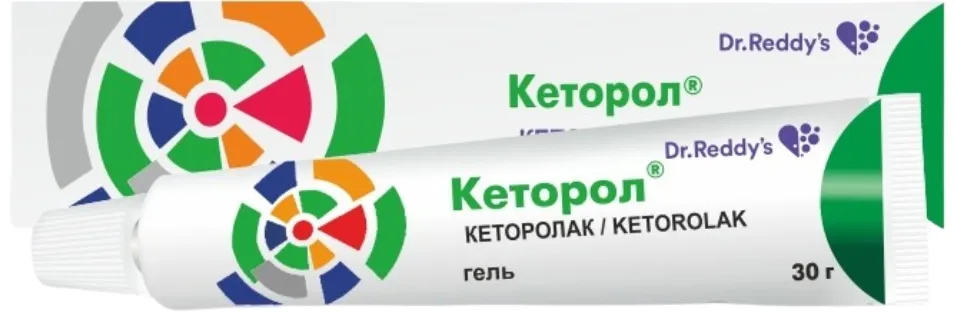
Table of Contents
INSTRUCTIONS FOR MEDICAL USE OF THE MEDICINAL PRODUCT KETOROL GEL (KETOROL GEL)
Composition:
Active substance: ketorolac;
1 g of gel contains ketorolac tromethamine 20 mg;
Excipients: propylene glycol, dimethyl sulfoxide, carbomer, sodium methylparaben (E 219), sodium propylparaben (E 217), tromethamine, purified water, Dreamon Inde flavoring (triethyl citrate, castor oil, isopropyl myristate, diethyl phthalate), anhydrous ethanol, glycerin.
Pharmaceutical form. 2% gel.
Main physicochemical properties: homogeneous gel, from almost clear to clear, with a characteristic odor.
Pharmacotherapeutic group.
Non-steroidal anti-inflammatory drugs for topical use, for joint and muscular pain. ATC code M02A A.
Pharmacological properties.
Pharmacodynamics.
Ketorolac is a nonsteroidal anti-inflammatory agent with pronounced analgesic, antipyretic, and anti-inflammatory effects. The mechanism of pharmacological action is associated with inhibition of the enzyme cyclooxygenase in peripheral tissues, resulting in suppression of prostaglandin biosynthesis—mediators of pain sensitivity, thermoregulation, and inflammation. Thus, the therapeutic effect develops directly at the site of injury.
The formulation includes dimethyl sulfoxide, whose transporting capacity enhances the penetration of ketorolac tromethamine through the skin directly into the affected tissues.
Pharmacokinetics.
Following application of Ketorol gel, maximum plasma concentration (Cmax) ranges from 0.18 to 0.82 μg/mL. The total area under the concentration-time curve ranges from 6.6 to 9.7 hours. Nonsteroidal anti-inflammatory drugs penetrate directly through the skin to a depth of 3–4 mm and are then transported via the circulatory system to subcutaneous tissues.
Clinical characteristics.
Indications.
Post-traumatic inflammation and pain in muscles, ligaments, joints, soft tissue injuries, sprains, dislocations, bursitis, tendinitis, epicondylitis; inflammation of the synovial membrane; osteoarthritis of superficial joints.
Contraindications.
- Hypersensitivity to ketorolac, acetylsalicylic acid or other nonsteroidal anti-inflammatory drugs and/or any component of the drug;
- Exacerbation of gastric or duodenal ulcer, gastrointestinal bleeding, perforations;
- Nasal polyp syndrome, bronchospasm, and Quincke's edema due to the use of acetylsalicylic acid.
Interaction with other medicinal products and other types of interactions.
No clinically significant interactions with other medicinal products have been reported with topical application of Ketorol gel; however, it should be considered that systemic absorption may lead to interactions observed with oral administration of ketorolac tromethamine. A slight reduction in warfarin plasma protein binding has been reported. In vitro studies have demonstrated that at therapeutic salicylate concentrations, plasma protein binding of ketorolac decreases from 99.2% to 97.5%, which may lead to an increase in free ketorolac levels. Ketorolac reduces the diuretic effect of furosemide by approximately 20%. When probenecid and ketorolac are used concomitantly, an increase in ketorolac plasma concentration and prolongation of its elimination half-life occur. When used simultaneously with lithium-containing preparations, renal clearance of lithium may be inhibited, thus increasing lithium plasma levels. Ketorolac may interact with nondepolarizing muscle relaxants, potentially leading to respiratory depression. Concurrent use of ketorolac with angiotensin-converting enzyme inhibitors increases the risk of renal function impairment, especially in patients with hypovolemia (reduced extracellular fluid volume). Concurrent use of ketorolac with anticoagulants may increase the risk of bleeding. Do not use with other NSAIDs due to increased risk of adverse effects.
Special precautions for use.
Do not apply the gel to areas around the eyes, mucous membranes, or open wounds. Wash hands before and after application. Do not exceed the recommended dosage.
As with any other non-steroidal anti-inflammatory drugs (NSAIDs), there is a risk of bleeding and bruising. If these occur, further use of the product should be avoided.
Ketorol gel should be used with caution in patients prone to allergic reactions. If irritation occurs, treatment must be discontinued.
Elderly patients (aged 65 years and older) are more sensitive to the effects of pharmaceuticals. Therefore, Ketorol gel should be used with caution in this age group.
Ketorol gel should also be used with caution in patients with impaired kidney and/or liver function, cardiovascular disorders, arterial hypertension, and in cases where previous use of ketorolac was associated with fluid retention and edema. Monitoring of liver function tests is recommended before starting and during treatment with Ketorol gel. If liver enzymes increase compared to baseline values, treatment should be discontinued.
Use during pregnancy or breastfeeding.
The drug is not recommended for use in pregnant women and women who are breastfeeding.
Ability to influence reaction rate when driving or operating machinery.
Possible occurrence of drowsiness, dizziness, depression, and insomnia should be taken into account, as these may reduce attention concentration and thus impair the ability to react quickly when driving or operating machinery.
Dosage and Administration.
Apply topically 3-4 times a day. Before applying Ketorol gel, wash the affected area and dry it thoroughly. Squeeze the gel from the tube onto the fingertip and gently massage it into the skin, covering the affected area and surrounding regions. It is advisable not to cover the treated area with clothing.
The duration of therapy depends on the indications and treatment efficacy.
Children.
The drug is not intended for use in children under 18 years of age.
Overdose.
There have been no reported cases of ketorolac tromethamine overdose in gel form when applied topically to small skin areas.
Systemic adverse reactions may occur with prolonged use, high doses, or application over large skin areas. There is no specific antidote. Treatment is symptomatic.
Side effects.
Skin reactions (irritation, erythema, dermatitis) may occasionally occur at the application site.
Shelf life. 2 years.
Storage conditions.
Keep out of reach of children, at a temperature not exceeding 25 ºC.
Packaging.
30 g of gel in a tube with a tamper-evident seal. 1 tube per carton.
Prescription status.
Over-the-counter (without prescription).
Manufacturer: Dr. Reddy’s Laboratories Limited
Manufacturer’s address and place of business.
Production unit - VI, Village Khol, Nalagarh Road, Baddi, District Solan, Himachal Pradesh, 173205, India
Report any adverse reactions or lack of efficacy observed during use of the medicinal product to the following e-mail address: [email protected]