Carsil
Ukraine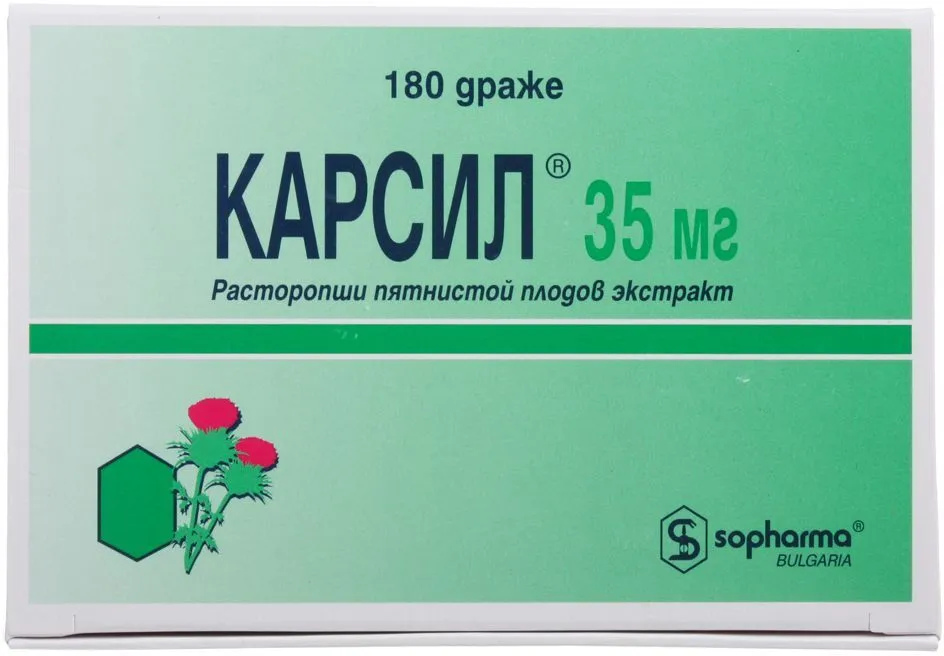
Table of Contents
INSTRUCTIONS FOR MEDICAL USE OF THE MEDICINAL PRODUCT KARSILO® (CARSIL®)
Composition:
Active substance: dry extract of milk thistle fruits;
One coated tablet contains dry extract of milk thistle fruits (Silybi mariani fructus extractum siccum) (35-50:1) (extraction solvent: methanol ≥ 99.0%) – 40.9-56.3 mg, equivalent to 22.5 mg of silymarin;
Excipients: lactose monohydrate, wheat starch, povidone K25, microcrystalline cellulose, magnesium stearate, talc, mannite (E 421), crospovidone, polysorbate 80, sodium bicarbonate;
Coating: cellulose acetate phthalate, diethyl phthalate, sucrose, acacia, gelatin, talc, titanium dioxide (E 171), macrogol 6000, Opalux AS 26586 brown [sucrose, iron oxide red (E 172), iron oxide black (E 172), methylparahydroxybenzoate (E 218), propylparahydroxybenzoate (E 216)], glycerin.
Pharmaceutical form. Coated tablets.
Main physicochemical properties: coated tablets, of regular round shape, brown in color, odorless.
Pharmacotherapeutic group.
Agents used in liver disorders, lipotropic substances.
Hepatoprotective agents.
ATC code A05B A03.
Pharmacological Properties.
Pharmacodynamics.
Silymarin is a plant-derived active component of the medicinal product Karsil®, obtained from the extract of fruits of milk thistle (Silybum marianum). The drug exerts hepatoprotective and antioxidant effects. Karsil® inhibits penetration of toxins into liver cells (demonstrated in poisoning with death cap mushroom), and also causes physicochemical stabilization of hepatocyte cell membranes, thereby limiting or preventing loss of soluble cellular components (including transaminases) from liver cells.
The antioxidant effect of Karsil® is due to interaction of silybinin with free radicals in the liver, converting them into less toxic compounds. Thus, the process of lipid peroxidation is interrupted, and further destruction of cellular structures does not occur; toxins are neutralized via physiological pathways.
Silymarin stimulates synthesis of proteins (structural and functional) and phospholipids in damaged liver cells (normalizing lipid metabolism), stabilizes their cell membranes, binds free radicals (antioxidant effect), thereby protecting liver cells from harmful influences and promoting their regeneration. Clinical effects of Karsil® are manifested in improvement of general condition in patients with liver diseases and reduction of subjective complaints (such as weakness, feeling of heaviness in the right hypochondrium, loss of appetite, skin itching, vomiting). Laboratory parameters improve: decreased activity of transaminases, gamma-glutamyl transferase, alkaline phosphatase, and reduced plasma bilirubin levels. Long-term use of Karsil® significantly increases survival rate in patients suffering from liver cirrhosis.
Pharmacokinetics.
After oral administration, silymarin is slowly and partially absorbed from the gastrointestinal tract. It undergoes enterohepatic circulation. It does not accumulate in the body.
The elimination half-life of silymarin is 6.3 hours. It is excreted predominantly with bile as glucuronides and sulfates.
Clinical characteristics.
Indications.
Liver toxicity: for supportive treatment in patients with chronic inflammatory liver diseases or liver cirrhosis.
Contraindications.
Hypersensitivity to the active substance or to any of the excipients. Acute poisonings of any etiology.
Interaction with other medicinal products and other forms of interaction.
When silimarins are used concomitantly with oral contraceptives and drugs used in estrogen replacement therapy, as well as tamoxifen treatment, a reduction in the effectiveness of these agents is possible.
Due to inhibition of the cytochrome P450 system, silimarins enhance the effects of antiallergic drugs (fexofenadine), anticoagulants (clopidogrel, warfarin).
Silimarins may potentiate the effects of such drugs as diazepam, alprazolam, ketoconazole, lovastatin, atorvastatin, and vinblastine, due to their inhibitory effect on the cytochrome P450 system.
Herbal products containing silimarins are widely used as hepatoprotective agents in oncology practice, administered concomitantly with cytostatic drugs. Clinical studies indicate a low risk of potential pharmacokinetic interactions between silimarin, as an inhibitor of the CYP3A4 and UGT1A1 isoenzymes, and cytostatic agents that are substrates of these enzymes.
Special precautions for use.
Treatment with Karsil® for liver disorders will be effective only if accompanied by dietary restrictions, such as abstaining from alcohol.
If jaundice develops, a physician should be consulted to adjust the therapy.
Due to the possible estrogen-like effect of silymarin, it should be used with caution in patients with hormonal disorders (endometriosis, uterine fibroids, carcinoma of the breast, ovaries or uterus, prostate cancer). In such cases, consultation with a physician is required.
The preparation contains wheat starch as an excipient. Wheat starch may contain gluten, but only in trace amounts, and is therefore considered safe for patients with celiac disease (gluten-sensitive enteropathy).
The formulation contains lactose monohydrate as an excipient. The drug should not be administered to patients with rare hereditary disorders of galactose intolerance, Lapp lactase deficiency, or glucose-galactose malabsorption.
The medicinal product contains sucrose in the coating. Patients with rare hereditary fructose intolerance, glucose-galactose malabsorption syndrome, or sucrase-isomaltase deficiency should not take this drug.
The tablet coating contains methylparahydroxybenzoate (E 218) and propylparahydroxybenzoate (E 216), which may cause allergic reactions (possibly delayed-type reactions).
Use during pregnancy or breastfeeding.
There are no data available on the safety and efficacy of using the drug during pregnancy or breastfeeding; therefore, it should not be administered during these periods.
Ability to affect reaction speed when driving or operating machinery.
Karsil® does not affect the ability to drive vehicles or operate machinery.
Patients with vestibular disorders should use the medicinal product with caution when driving vehicles or operating machinery.
Method of administration and dosage.
Take tablets orally whole, without chewing, with sufficient amount of liquid.
Adults and children aged 12 years and older:
Karsil**®** should be administered orally. In mild and moderate cases – 1-2 tablets 3 times daily. In severe cases, the dose may be doubled to 2-4 tablets 3 times daily.
The duration of treatment is determined individually depending on the nature and course of the disease. The average treatment duration is 3 months.
Children.
The use of the drug is not recommended in children under 12 years of age.
Overdose.
There are no reports of overdose. In case of accidental ingestion of a high dose, induce vomiting, perform gastric lavage, administer activated charcoal, and if necessary, apply symptomatic treatment prescribed by a physician.
Adverse Reactions.
The medicinal product is well tolerated. Rarely, in individual cases and in the presence of individual hypersensitivity, the following adverse effects may occur.
Gastrointestinal system: diarrhea due to enhanced liver and gallbladder function, nausea, dyspepsia, vomiting, decreased appetite, flatulence, heartburn.
Immune system: allergic reactions (possibly of delayed type); hypersensitivity reactions, including skin rashes, pruritus, anaphylactic shock.
Ear and labyrinth: worsening of pre-existing vestibular disorders.
Respiratory system: dyspnea.
Urinary system: increased diuresis.
Skin and its appendages: exacerbation of alopecia.
Adverse effects are transient and disappear after discontinuation of the drug without requiring special interventions.
Shelf life. 3 years.
Storage conditions.
Keep out of reach of children. Store in the original packaging at a temperature not exceeding 25 °C.
Packaging.
10 tablets in a blister pack made of PVC film/aluminum foil; 8 blisters in a cardboard box.
Supply category. Over-the-counter.
Manufacturer.
JSC "Sofarma".
Manufacturer's name and address of the place of business.
16 Iliensko Shose Str., Sofia, 1220, Bulgaria.