Canepron® n
Ukraine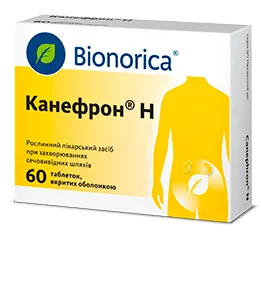
Instructions for Use
INSTRUCTIONS FOR MEDICAL USE OF THE MEDICINAL PRODUCT CANEPRON® N (CANEPHRON® N)
Composition:
Active ingredients: 1 tablet contains dried medicinal plants in the form of powder:
Centaurium herb (Herba Centaurii) 18 mg,
Lovage root (Radix Levistici) 18 mg,
Rosemary leaves (Folia Rosmarini) 18 mg;
Excipients: corn starch, colloidal anhydrous silicon dioxide, lactose monohydrate, povidone, magnesium stearate, iron oxide red (E 172), riboflavin (E 101), calcium carbonate, dextrin, glucose syrup, glycol montan wax, castor oil, sucrose, shellac, talc, titanium dioxide (E 171).
Pharmaceutical form. Coated tablets.
Main physicochemical properties: round, biconvex, coated tablets of orange color with a smooth surface.
Pharmacotherapeutic group. Agents used in urology. ATC code G04BX.
Pharmacological properties.
Pharmacodynamics. The components contained in the herbal medicinal product exhibit complex activity, manifested as anti-inflammatory, antioxidant, spasmolytic, and analgesic effects. In addition, Canephron® N has antibacterial and diuretic effects, which are due to substances present in the herbal components of the drug.
Clinical characteristics.
Indications. Herbal medicinal product for the comprehensive treatment of inflammatory diseases of the urinary tract. Prevention of urinary stone formation, including after their removal.
Contraindications. Hypersensitivity to any component of the medicine, or to other plants of the Apiaceae family (e.g., anise, fennel), or to anethole (i.e., a component of essential oils found, for example, in anise and fennel).
Peptic ulcer.
Edema due to heart failure or impaired kidney function and/or physician's recommendation to restrict fluid intake.
Interaction with other medicinal products and other forms of interactions. Unknown.
If concomitant use with any other medicinal products is necessary, consult a physician.
Special precautions for use
In case of prolonged fever, spasms, presence of blood in urine, urinary disorders, or acute urinary retention, consult a physician immediately.
Patients with known intolerance to certain sugars should consult a physician before starting treatment with Canephron® N tablets.
The preparation should not be used in patients with rare hereditary forms of fructose intolerance, galactose intolerance, lactase deficiency, glucose-galactose malabsorption syndrome, or sucrase-isomaltase deficiency.
Note for patients with diabetes mellitus. 1 tablet contains on average 0.02 bread units (BU).
Use during pregnancy or breastfeeding
Pregnancy
Clinical experience in pregnant women (300–1000 newborns) indicates no risk of fetal malformations or fetal/neonatal toxicity associated with Canephron® N tablets.
Animal studies have shown no evidence of reproductive toxicity. Canephron® N tablets may be used during pregnancy only after consultation with a physician.
Breastfeeding
Due to lack of data on the passage of Canephron® N or its metabolites into breast milk, a risk to the infant cannot be excluded. Therefore, the use of this preparation is not recommended during breastfeeding.
Fertility
There are no data available on the effect of Canephron® N on human fertility. Animal studies have shown no adverse effects on fertility in males or females.
Ability to influence reaction speed when driving or operating machinery
This medicinal product does not affect the ability to drive or operate machinery.
Dosage and Administration
If otherwise not prescribed by the physician, the medication should be taken by adults and children aged 12 years and older at a dose of 2 tablets three times daily (total daily dose: 6 tablets).
Take one dose each morning, at noon, and in the evening. The tablets should be swallowed whole, without chewing, with sufficient fluid (e.g., a glass of water).
Adequate fluid intake must be maintained during treatment with this medication.
The duration of treatment is determined individually by the physician. If the medication is well tolerated, it may be prescribed for a prolonged period. Follow the recommendations provided in the section "Special Instructions" of the leaflet.
Children. The medication is not recommended for children under 12 years of age.
Overdose. Cases of poisoning due to overdose have not been reported.
Treatment: symptomatic.
Adverse reactions
Adverse reactions are listed according to the following frequency categories:
Very common (≥ 1/10), common (≥ 1/100 to <1/10), uncommon (≥ 1/1000 to <1/100), rare (≥ 1/10000 to <1/1000), very rare (<1/10000), not known (cannot be estimated from available data).
Gastrointestinal disorders
Common: gastrointestinal disturbances (e.g., nausea, vomiting, diarrhea).
Immune system disorders
Not known: allergic reactions in case of hypersensitivity to components of the medicinal product, including urticaria, pruritus, skin hyperemia.
If any adverse reactions occur, discontinue use of the medicinal product and consult a physician.
Shelf life. 3 years.
Do not use after the expiry date stated on the packaging. The shelf life indicates that the product may be used up to the last day of the month stated.
Storage conditions. Store at a temperature not exceeding 30 °C.
Keep out of reach and sight of children.
Packaging. 20 tablets in a blister; 3 blisters № 60 (20x3) in a cardboard box.
Classification. Over-the-counter (without prescription).
Manufacturer/Applicant.
Bionorica SE / Bionorica SE.
Address of manufacturer and place of business / Address of applicant and/or applicant's representative.
Kerschensteinerstrasse, 11-15, 92318 Neumarkt, Germany.
Contact details of the manufacturer's representative in Ukraine, LLC "Bionorica":
Phone: 044 521 86 00; Fax: 044 521 86 01, [email protected]
Frequently Asked Questions
What is Canepron® n prescribed for?
The drug is used for the complex treatment of inflammatory diseases of the urinary tract, as well as for the prevention of kidney stone formation, particularly after their removal.
How should Canepron® n be taken correctly?
Adults and children aged 12 years and older should take 2 tablets 3 times a day (morning, afternoon, and evening). Tablets should be swallowed whole, without chewing, and taken with a sufficient amount of liquid. It is important to drink plenty of water during treatment.
What are the possible side effects of Canepron® n?
Gastrointestinal disorders, such as nausea, vomiting, or diarrhea, may occur frequently. Allergic reactions (itching, urticaria, skin redness) are also possible in case of hypersensitivity to the components.
Who should not take this drug?
Use is contraindicated in case of hypersensitivity to the components of the drug or to other plants of the Apiaceae family (e.g., anise or fennel), in case of peptic ulcer, as well as in case of edema due to heart failure, renal impairment, or if the doctor has advised limiting fluid intake.
Can the drug be taken during pregnancy and breastfeeding?
For pregnant women, use is possible after consultation with a physician. During breastfeeding, the drug should not be used, as data regarding its effect on the infant through breast milk are unavailable.
Can the drug be given to children?
The drug is not recommended for use in children under 12 years of age.
When should you seek medical attention immediately?
You must seek medical attention urgently if fever or spasms persist for a long time, blood appears in the urine, or if urinary disorders or acute urinary retention occur.
Similar Medications
-
Aquallibra
Form: tablets, film-coated
Active substance Dosage dry extract mixture of the root of valerian, leaves of orthosiphon and herb of goldenrod 80 mg + 90 mg + 180 mg -
Nephrodol®
Form: tablets, film-coated
Active substance Dosage mixture of dried medicinal plant powders: centaury herb, lovage root and rosemary leaves 54 mg -
Tribestan
Form: tablets, film-coated
Active substance Dosage dry extract of the herb of sweet flag 250 mg Manufacturer: JSC "Sofarma" (manufacturing unpackaged products, primary packaging or full-cycle production)
This page has been machine-translated and may contain inaccuracies. The original data is available in the manufacturing country's language.
Last data check: July 21, 2026 · Data source: Державний реєстр лікарських засобів України