Calcium-d3 nicomed with mint flavor
Ukraine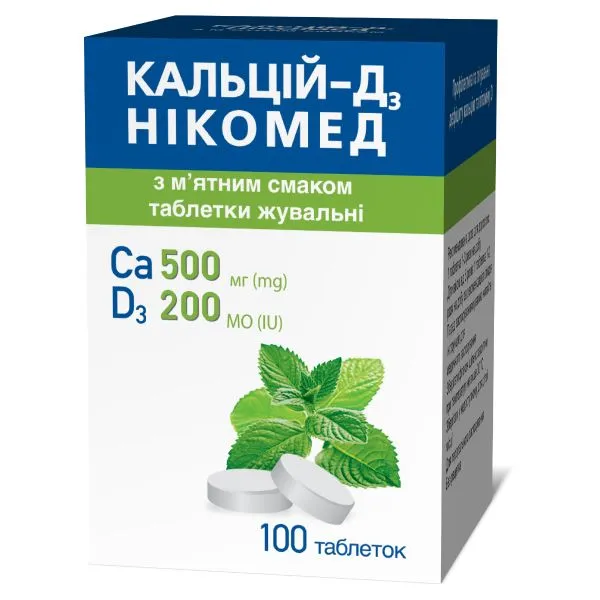
Table of Contents
INSTRUCTIONS FOR MEDICAL USE OF THE MEDICINAL PRODUCT CALCIUM-D3 NYCOMED WITH MINT FLAVOUR (CALCIUM-D3 NYCOMED with mint flavour)
Composition:
Active ingredients: 1 tablet contains calcium carbonate 1250 mg, equivalent to 500 mg of calcium, cholecalciferol (vitamin D3) – 5 µg (200 IU), corresponding to cholecalciferol concentrate* 2 mg;
Excipients: xylitol (E 967), mint flavouring granulate (isomalt (E 953), mint flavouring, mono- and diglycerides of fatty acids), povidone, magnesium stearate, sucralose (E 955).
*Composition of cholecalciferol concentrate: cholecalciferol, DL-α-tocopherol, medium-chain triglycerides, modified maize starch, sucrose, sodium ascorbate, silicon dioxide, anhydrous colloidal.
Pharmaceutical form. Chewable tablets.
Main physicochemical properties: white, round, biconvex, uncoated tablets with a mint flavour. The presence of specks and minor edge irregularities is acceptable. A small amount of powder at the bottom of the bottle is possible.
Pharmacotherapeutic group.
Mineral supplements. Calcium, combinations with vitamin D and/or other agents.
ATC code A12AX.
Pharmacological Properties.
Pharmacodynamics.
Vitamin D3 increases calcium absorption in the intestine.
Administration of calcium and vitamin D3 prevents the increase in parathyroid hormone (PTH) levels caused by calcium deficiency, which leads to enhanced bone resorption (leaching of calcium from bones).
A clinical study in hospitalized patients with vitamin D deficiency showed that daily intake of 2 calcium tablets of 500 mg and vitamin D at a dose of 400 IU for 6 months normalized the level of 25-hydroxylated metabolite of vitamin D3 and reduced manifestations of secondary hyperparathyroidism and alkaline phosphatase levels.
Pharmacokinetics.
Calcium.
Absorption. Approximately 30% of the administered calcium dose is absorbed through the gastrointestinal tract.
Distribution and biotransformation. 99% of calcium is concentrated in hard tissues of the body (bones, teeth); 1% of calcium is present in intracellular and extracellular environments. Approximately 50% of calcium in blood is in the physiologically active ionized form, nearly 10% is complexed with citrates, phosphates, and other anions, and the remaining 40% is bound to proteins, mainly albumins.
Excretion. Calcium is excreted in feces, urine, and sweat. Renal excretion depends on glomerular filtration and tubular reabsorption of calcium.
Cholecalciferol.
Absorption. Vitamin D3 is readily absorbed in the small intestine.
Distribution and biotransformation. Cholecalciferol and its metabolites circulate in the blood bound to a specific globulin. In the liver, cholecalciferol is converted via hydroxylation into 25-hydroxycholecalciferol. It is further transformed into the active form, 1,25-dihydroxycholecalciferol, in the kidneys. 1,25-dihydroxycholecalciferol is the metabolite responsible for enhanced calcium absorption. Vitamin D3 that has not undergone metabolism is stored in adipose and muscle tissues.
Excretion. Vitamin D3 is excreted in feces and urine.
Clinical characteristics.
Indications.
Prevention and treatment of calcium and vitamin D deficiency.
Additional use of vitamin D and calcium as a supplement to specific osteoporosis therapy in patients at risk of developing calcium and vitamin D deficiency.
Contraindications.
- Hypersensitivity to the active substance or to any of the excipients;
- severe renal impairment (glomerular filtration rate < 30 ml/min/1.73 m²);
- diseases and/or conditions associated with hypercalcemia and/or hypercalciuria;
- urolithiasis (nephrolithiasis);
- hypervitaminosis D;
- active tuberculosis.
Interaction with other medicinal products and other forms of interactions.
The activity of vitamin D3 may be reduced when used concomitantly with rifampicin.
Thiazide diuretics reduce calcium excretion in urine. During concomitant therapy, serum calcium levels should be monitored regularly, as the risk of hypercalcemia increases.
Calcium carbonate may interfere with the absorption of tetracycline antibiotics. Tetracycline antibiotics should be taken at least 2 hours before or 4–6 hours after taking Calcium-D3 Nycomed.
Hypercalcemia may potentiate the toxicity of cardiac glycosides (possible development of arrhythmias, etc.) when using calcium and vitamin D preparations. Concomitant use in patients receiving cardiac glycosides and high doses of calcium is not recommended. If concomitant therapy with cardiac glycosides is necessary, low doses of the preparation should be used. Monitoring of cardiac function by ECG and serum calcium levels in patients is required.
To prevent reduced absorption of bisphosphonates, it is recommended to take Calcium-D3 Nycomed no earlier than 1 hour after their administration.
When used concomitantly, calcium may reduce the effectiveness of levothyroxine due to decreased absorption. Levothyroxine should be taken at least 4 hours after taking Calcium-D3 Nycomed.
Concomitant use of calcium may impair the absorption of quinolone antibiotics. Quinolone antibiotics should be taken 2 hours before or 6 hours after taking Calcium-D3 Nycomed.
Calcium salts may reduce the absorption of iron, zinc, and strontium ranelate. Therefore, iron, zinc, and strontium ranelate preparations should be taken at least 2 hours before or after taking Calcium-D3 Nycomed.
Treatment with orlistat may potentially impair the absorption of fat-soluble vitamins (e.g., vitamin D3).
Special precautions for use
During prolonged treatment with this medicinal product, serum calcium and creatinine levels and renal function should be monitored, especially in elderly patients receiving concomitant therapy with cardiac glycosides or diuretics (see section "Interaction with other medicinal products and other forms of interaction") and in patients with a high predisposition to dental calculus formation. If signs of hypercalcaemia or impaired renal function occur, the dose should be reduced or treatment discontinued.
This medicinal product should be used with caution in patients with hypercalcaemia or signs of impaired renal function, and serum levels of calcium and phosphates should be monitored. The risk of soft tissue calcification should be taken into account. In patients with severe renal insufficiency, vitamin D3 in the form of cholecalciferol may not be properly metabolized; therefore, other forms of vitamin D should be used (see section "Contraindications").
Concomitant intake of vitamin D from other sources, including medicinal products or foods containing calcium (e.g. milk), may lead to hypercalcaemia and milk-alkali syndrome, resulting in impaired renal function. Additional doses of calcium or vitamin D should be taken under medical supervision. Such patients require regular monitoring of serum calcium levels and renal function.
Calcium-D3 Nycomed is contraindicated in patients with sarcoidosis and hypoparathyroidism due to the risk of increased metabolism of vitamin D3 into its active form.
Serum and urinary calcium levels should be monitored in such patients.
Calcium-D3 Nycomed should be used with caution in immobilized patients with osteoporosis due to the risk of developing hypercalcaemia.
Calcium-D3 Nycomed contains sucrose, which may be harmful to teeth. The product also contains isomalt (E 953). Therefore, patients with rare hereditary fructose intolerance, sucrase-isomaltase deficiency, or glucose-galactose malabsorption should not use this medicinal product.
Calcium-D3 Nycomed contains less than 23 mg of sodium per tablet, i.e. it is essentially sodium-free.
Use during pregnancy or breastfeeding.
Pregnancy. Calcium-D3 Nycomed may be used during pregnancy in cases of calcium and vitamin D deficiency. The daily dose should not exceed 2500 mg of calcium and 4000 IU of vitamin D. Animal studies have shown that high doses of vitamin D have reproductive toxicity. Pregnant women should avoid overdosing on Calcium-D3 Nycomed, as prolonged hypercalcaemia may have adverse effects on the fetus. There is no evidence that vitamin D at recommended doses causes teratogenic effects in humans.
Breastfeeding. Calcium-D3 Nycomed may be used during breastfeeding. Calcium, vitamin D3, and its metabolites may pass into breast milk; therefore, intake of calcium and vitamin D from other sources into the infant's body should be taken into account.
Ability to affect the reaction rate when driving or operating machinery.
There are no known data regarding the effect of Calcium-D3 Nycomed on the ability to drive or operate machinery.
Dosage and Administration.
The medication is intended for oral use. The tablet should be chewed or sucked.
Calcium and vitamin D deficiency.
Adults: 1 tablet 1–3 times daily.
Children aged 5 years and older: 1 tablet 1–2 times daily as recommended by a physician.
Adjunctive treatment of osteoporosis.
Adults: 1 tablet 2–3 times daily.
Patients with hepatic insufficiency do not require dose adjustment.
Patients with severe renal insufficiency should not use the medication (see section "Contraindications").
Elderly patients. The recommended dosage is the same as for adults.
Children. The medication may be used for the treatment of calcium and vitamin D deficiency in children aged 5 years and older as recommended by a physician.
Overdose.
Symptoms. Overdose may lead to hypercalcemia and hypervitaminosis D. Symptoms of hypercalcemia include: anorexia, thirst, nausea, vomiting, constipation, abdominal pain, muscle weakness, increased fatigue, mental disorders, polydipsia, polyuria, bone pain, nephrocalcinosis, nephrolithiasis, and cardiac arrhythmias in severe cases. Severe hypercalcemia may lead to coma and fatal outcome. Persistent high calcium levels in the body may result in irreversible kidney damage and soft tissue calcification.
In patients taking large amounts of calcium and absorbable alkalis, milk-alkali syndrome may develop; such patients require hospitalization.
Treatment. Symptomatic and supportive therapy. The use of the medication should be discontinued. Therapy with thiazide diuretics and cardiac glycosides should also be discontinued (see section "Interaction with other medicinal products and other forms of interaction"). Gastric lavage should be performed in patients with impaired consciousness, and large amounts of fluid should be administered. Depending on the severity of overdose, treatment with loop diuretics, bisphosphonates, calcitonin, corticosteroids, either alone or in combination, may be required. Serum electrolyte levels, renal function, and diuresis should be monitored. In severe cases, electrocardiogram (ECG) and central venous pressure (CVP) monitoring should be performed.
Adverse Reactions
Undesirable effects are classified by frequency of occurrence as follows:
Uncommon (≥ 1/1000, < 1/100), rare (≥ 1/10000, < 1/1000), very rare (< 1/10000), not known (frequency cannot be determined from available data).
Immune system disorders.
Not known: hypersensitivity reactions, including angioneurotic edema, laryngeal edema.
Metabolism and nutrition disorders.
Uncommon: hypercalcemia, hypercalciuria.
Very rare: milk-alkali syndrome (frequent urge to urinate, persistent headache, persistent loss of appetite, nausea or vomiting, unusual tiredness or weakness, hypercalcemia, alkalosis, renal failure) observed only in cases of overdose (see section "Overdose").
Gastrointestinal disorders.
Rare: constipation, dyspepsia, flatulence, nausea, abdominal pain, diarrhea.
Skin and subcutaneous tissue disorders.
Very rare: pruritus, rash, urticaria.
Special patient groups.
Patients with renal impairment: risk of developing hyperphosphatemia, nephrolithiasis, and nephrocalcinosis (see section "Special Warnings and Precautions for Use").
Shelf life. 30 months.
Storage conditions. Store the bottle tightly closed at a temperature not exceeding 30 °C. Keep out of reach of children!
Packaging. 30 or 100 tablets in a bottle; 1 bottle in a cardboard box.
Pharmaceutical classification. Over-the-counter.
Manufacturer. Asker Contract Manufacturing AS, Norway.
Manufacturer's address. Drammensveien 852, NO-1383 Asker, Norway.