Glutargin alkoclin
Ukraine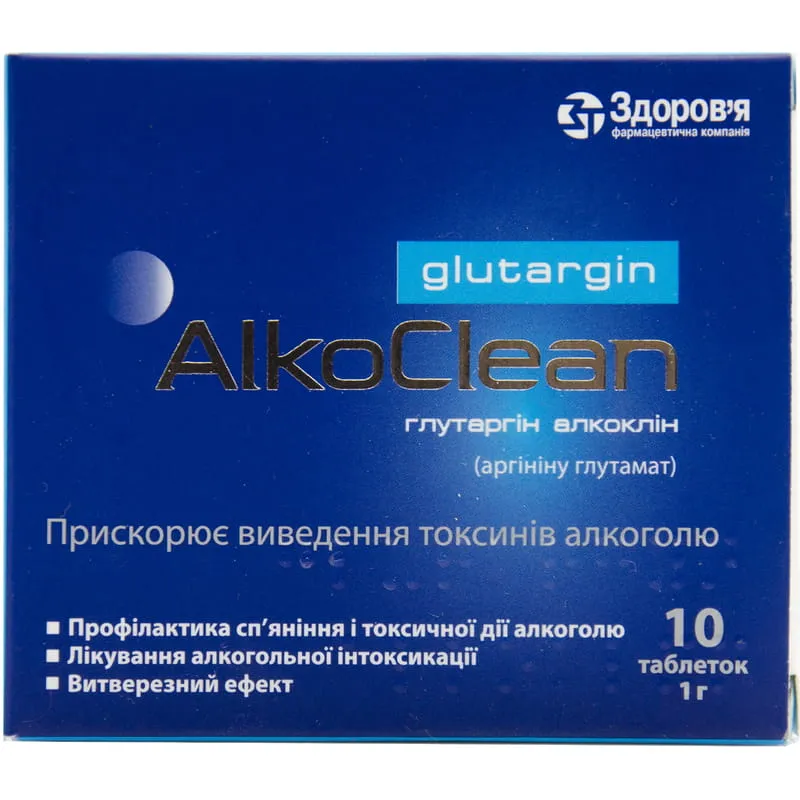
Table of Contents
INSTRUCTIONS FOR MEDICAL USE OF THE MEDICINAL PRODUCT GLUTARGINALKOCLEAN (GLUTARGINALKOCLEAN)
Composition:
Active substance: arginine glutamate;
1 tablet contains 1 g of arginine glutamate;
Excipients: microcrystalline cellulose, crospovidone, calcium stearate.
Pharmaceutical form. Tablets.
Main physicochemical properties: white, elongated, double-convex tablets with a groove.
Pharmacotherapeutic group. Drugs used in liver diseases, lipotropic agents. Hepatotropic agents. Arginine glutamate. ATC code A05BA01.
Pharmacological properties.
Pharmacodynamics.
Glutarzin Alkoclin is a salt of arginine and glutamic acid.
In alcohol intoxication, the medicinal product stimulates alcohol utilization in the hepatic monooxygenase system and prevents inhibition of alcohol dehydrogenase, the key enzyme in ethanol metabolism. It accelerates inactivation and elimination of toxic ethanol metabolites by enhancing the formation and oxidation of succinic acid. It reduces the depressant effect of alcohol on the central nervous system (CNS) due to the excitatory neurotransmitter properties of glutamic acid. Because of these properties, the drug exerts antidotal and sobering effects.
The drug also possesses hepatoprotective and hypoammonemic properties. Hepatoprotection is due to its antioxidant, anti-hypoxic, and membrane-stabilizing effects, as well as its positive influence on energy metabolism in hepatocytes. The hypoammonemic effects are achieved through activation of ammonia detoxification in the ornithine cycle of urea synthesis, binding of ammonia into non-toxic glutamine, and enhanced removal of ammonia from the CNS and its excretion from the body. These actions reduce the general toxic, including neurotoxic, effects of ammonia.
In experimental animal studies, the drug showed no embryotoxic, gonadotoxic, mutagenic, or teratogenic effects and did not cause allergic or immunotoxic reactions.
Pharmacokinetics.
Not studied.
Clinical characteristics.
Indications.
Prevention of alcohol intoxication and hepatotoxic effects of alcohol. Treatment of mild to moderate acute alcohol intoxication, as well as in complex therapy of post-intoxication disorders following severe acute alcohol poisoning.
Contraindications.
Hypersensitivity to the components of the drug. Collapse state, increased excitability, severe impairment of renal filtration (nitrogen-excreting) function.
Interaction with other medicinal products and other types of interactions.
The drug's effect on insulin secretion is enhanced when used concomitantly with aminophylline. The drug may potentiate the effect of antiplatelet agents (dipyridamole). Prevents and reduces neurotoxic symptoms that may occur during isoniazid administration. Reduces the effect of vinblastine.
Special precautions for use.
When administered on a long-term basis to patients with endocrine gland function disorders, it should be taken into account that the drug stimulates insulin and growth hormone secretion. The drug enhances ammonia binding into urea, which may be accompanied by a transient increase in urea blood levels.
Use during pregnancy or breastfeeding.
Experience with use during pregnancy or breastfeeding is insufficient; therefore, the drug should not be used during pregnancy. If use of the drug is necessary, breastfeeding should be discontinued.
Ability to influence reaction speed when driving or operating machinery.
No effect.
Method of Administration and Dosage.
The drug should be taken orally by adults.
For prevention of alcohol intoxication and hepatotoxic effects of alcohol, take 2 g (2 tablets) 1–2 hours before alcohol consumption, or 1 g (1 tablet) 1 hour before alcohol consumption and 1 g (1 tablet) within 0.5 hours after alcohol consumption.
For treatment of acute alcohol intoxication of mild to moderate severity, take 1 g (1 tablet) 4 times daily at 1–2.5-hour intervals; during the following 2–3 days, reduce to 1 g (1 tablet) twice daily. In cases of severe alcohol intoxication, take 1 g (1 tablet) twice daily for 20 days as part of complex therapy, following a course of treatment with Glutargin injection preparations.
Children.
The efficacy and safety of the drug in children have not been studied; therefore, the drug should not be used in this age group.
Overdose.
Symptoms: nausea, vomiting, abdominal pain, diarrhea, chills, transient hyperthermia and/or hypotension, central nervous system excitation, insomnia, chest pain, atrioventricular block. Exacerbation of adverse reactions.
Treatment. Symptomatic therapy. Depending on the severity of clinical symptoms, administer activated charcoal; if necessary, antihistamine therapy and intravenous corticosteroids.
Side effects.
Rarely possible:
Gastrointestinal disorders: epigastric pain, mild gastrointestinal discomfort, and nausea immediately after administration of the drug, which resolve spontaneously.
Immune system disorders: hypersensitivity reactions, including skin rashes, pruritus, hyperemia, urticaria, and angioneurotic edema.
Shelf life. 5 years.
Storage conditions.
Store in the original packaging at a temperature not exceeding 25 °C.
Keep out of reach of children.
Packaging. Tablets, 1×2, №10 in a blister pack in a box.
Availability. Over-the-counter (without prescription).
Manufacturer. LIMITED LIABILITY COMPANY "CORPORATION "ZDOROV'YA".
Limited Liability Company "FARMEKS GROUP".
Manufacturer's address and place of business. Ukraine, 61013, Kharkiv region, Kharkiv, Shevchenka Street, 22.
(LIMITED LIABILITY COMPANY "CORPORATION "ZDOROV'YA")
Ukraine, 08301, Kyiv region, Boryspil, Shevchenka Street, 100.
(Limited Liability Company "FARMEKS GROUP")